Best execution monitoring is the continuing check that a firm's orders are executed in line with its best execution policy: every order measured against a benchmark, those beyond the policy's thresholds flagged, each explained, and brokers and venues compared, with the results taken to a committee. Software for it ranges from transaction cost analysis dashboards to surveillance tools that raise alerts and workflow systems that build the committee's papers. The way to choose between them is to ask what each would show an examiner, because that is what the regulators' findings are about: the SEC staff's most common deficiencies, drawn from over 1,500 adviser examinations, are reviews firms "could not demonstrate", comparisons not sought, and policies not followed (OCIE, July 2018). Botminds' Best Execution Review sits at the evidence end: agents that select outliers by your policy, find and check each reason, compare brokers and tie every figure. The twelve questions below apply to it as much as to anyone.
Twelve questions for best execution monitoring software, and why each matters
- Does it reconcile the population before it measures anything?
Every order in the order system, matched to the cost analysis file, late bookings included. An outlier list built on a short file is wrong in a way no chart shows.
- Are thresholds yours, by asset class, versioned and approved?
The EU will require "thresholds pre-determined by the investment firm" from 2028; the FCA found one bank whose thresholds had not changed in years.
- Is every exclusion coded and reversible?
Market-on-close, client-directed, program trades: set aside with a reason, never silently.
- Does each outlier get a reason with its source?
The trader's note, the PM's instruction, the market event, linked to the system it came from.
- Who tests the reason, and against what?
Spread, depth, volume, pauses and peer costs at the time, checked by someone other than the trader.
- How does it get input from traders and portfolio managers?
The SEC staff cited reviews that did not ask; a structured request with a deadline is evidence that they did.
- Does it compare brokers and venues you do not use?
FINRA says a review limited to current routes "would not satisfy the duty of best execution".
- Does it cover bonds, FX and derivatives with the right benchmarks?
Composite mid, best quote received, mid at fill, ticks: one arrival-price model does not fit every market.
- Can it use Rule 605 and Rule 606(b)(3) data?
Amended 605 reports apply to execution data from August 1, 2026; 606(b)(3) reports are yours on request.
- Does every figure in the committee papers tie to a source row?
Including provider re-statements, with both values kept when one changes.
- What can nobody change quietly?
Thresholds, decisions, figures and the audit trail: who changed what, when and why.
- Can you test it on a quarter you already reviewed?
Replaying a signed quarter is the only test where every answer can be checked.
What is best execution monitoring software?
It is software that turns a firm's orders, cost analysis and policy into evidence that execution was reviewed and acted on. Most products are one of three kinds, often combined: analytics that measure cost against benchmarks and peers; surveillance that raises alerts in real time or after the trade; and review workflow that collects reasons, decisions and sign-offs for the committee. Each is useful. Only the last produces what examiners ask for when they say "documentation or otherwise".
The distinction matters at selection time because a demonstration naturally shows analytics. Charts of cost by broker look the same in every product. What differs is what happens to the trade in the bottom-right corner of the chart: whether the software finds its reason, tests it, records who accepted it and keeps all of that for the five years Rule 204-2 requires.
What should best execution monitoring cover for advisers and for broker-dealers?
An adviser monitors the brokers it chooses; a broker-dealer monitors the venues and routing it chooses. The questions overlap but the evidence differs, and software built for one often fits the other badly. The table sets out the scope each needs.
Best execution monitoring for an adviser and for a broker-dealer: what each must cover
| Investment adviser | Broker-dealer | |
|---|---|---|
| What is monitored | Brokers, dealers and banks used for client orders, and the desk's own handling | Venues, routing logic and internalisation, by order type |
| Cadence | Periodic and systematic; in practice quarterly with an annual policy review | Order by order, or a regular and rigorous review at least quarterly |
| Comparison | Against brokers not used, peers and expected cost | Against "competing markets", including venues the firm is not connected to |
| Qualitative factors | Execution capability, financial responsibility, responsiveness, research | Speed, likelihood of execution, price improvement and disimprovement |
| Typical gap examiners find | No trader input; no comparisons; policy not followed | No review by order type; routing logic not based on execution quality |
| Public data it can use | Rule 606(b)(3) reports on request; brokers' Rule 605 reports | Its own and competitors' Rule 605 reports; Rule 606(a) quarterly reports |
FINRA's effective practices give a broker-dealer's software requirements in its own words: "Using exception reports and surveillance reports to support the firm's efforts to meet their best execution obligations"; monitoring "marketable orders of all types fully and promptly"; and "Being prepared to explain and evidence the firm's best execution analysis, including internalized orders" (FINRA, December 2025). An adviser's version is shorter and harder: show the evaluation happened, show it compared, show the traders were asked.
Does best execution monitoring cover bonds, FX and derivatives?
It should, with benchmarks that fit each market. FINRA's guidance covers best execution "in Equity, Options and Fixed Income Markets", and its 2026 report still finds firms without written procedures for "Securities with Limited Quotations or Pricing Information", including "documenting compliance with those policies and procedures" (FINRA, December 2025). The same guidance accepts that bond reviews may be "less frequent than that of equity securities or options" (Regulatory Notice 15-46). Less frequent still means reviewed.
Ask a vendor to show, for each asset class, the benchmark, the threshold and an outlier with its reason. A credible answer for investment-grade credit is cost against composite mid, or a trade not done at the best quote received; for FX, cost against mid at the time of the fill, with last-look rejects counted; for listed futures, ticks against arrival. A product that applies one arrival-price model to everything will flag the wrong bond trades and miss the right ones.
Can best execution monitoring use Rule 605 and 606 data?
Yes, and from this year the data is better. The SEC's 2024 amendments extend Rule 605 execution quality reports to larger broker-dealers, require time stamps "in increments of a millisecond or finer", realized spread "at multiple time intervals", and "a summary report" from every reporting entity (89 FR 26428). After an extension, "beginning on August 1, 2026" firms "must begin to collect the information needed to prepare the execution quality reports" (90 FR 47552).
Public execution data a monitoring tool can draw on
~85broker-dealers
with over 100,000 customer accounts, brought into Rule 605 reporting
98%+
of customer accounts handled by those broker-dealers
Aug 12026
first month of execution data under the amended Rule 605
7business days
for a broker to deliver a Rule 606(b)(3) report on a customer's not-held orders
Rule 605 describes how a market center or broker executes orders in aggregate; it does not describe yours. Rule 606(b)(3) does: a broker must, "on request of a customer that places, directly or indirectly, one or more orders in NMS stocks that are submitted on a not held basis", deliver a report on its handling of that customer's orders (17 CFR 242.606). Monitoring software that can ingest those reports and set them beside your cost analysis gives the committee a comparison the SEC staff found missing. Reading the reports themselves in depth is covered in the Rule 606(b)(3) routing report guide, and choosing who measures the cost in the first place in TCA vendors compared on one order.
How does best execution software document outliers?
Good software documents each outlier with the threshold it broke, the reason, the source of the reason, the test applied to it and the decision taken, with who took it. Weak software stores a comment field. The FCA's 2025 review of eight banks found practice still uneven at the most basic level, how many outliers were reviewed at all: "Two banks checked all their outlier trades, one bank checked all trades beyond a certain limit of their tolerance threshold and the others took a sample-based approach" (FCA, December 2025).
Ask the vendor to open one outlier and follow it: where the reason came from, who checked it, whether the checker could see the first answer, who accepted it and when. The outlier reasons a committee can defend sets out what a good answer looks like, including a reason the second check rejected.
Can it produce the best execution committee papers?
It should produce the committee's papers with every figure tied to its source, not a set of charts someone pastes into slides. The FCA's description of the strongest committee information is a useful specification: an overview of market conditions, "outlier trend analysis, including themes and rationales", venue and algorithm performance, client complaints and feedback, use of third-party brokers, and "open and closed actions with action owners and time to complete" (FCA, December 2025).
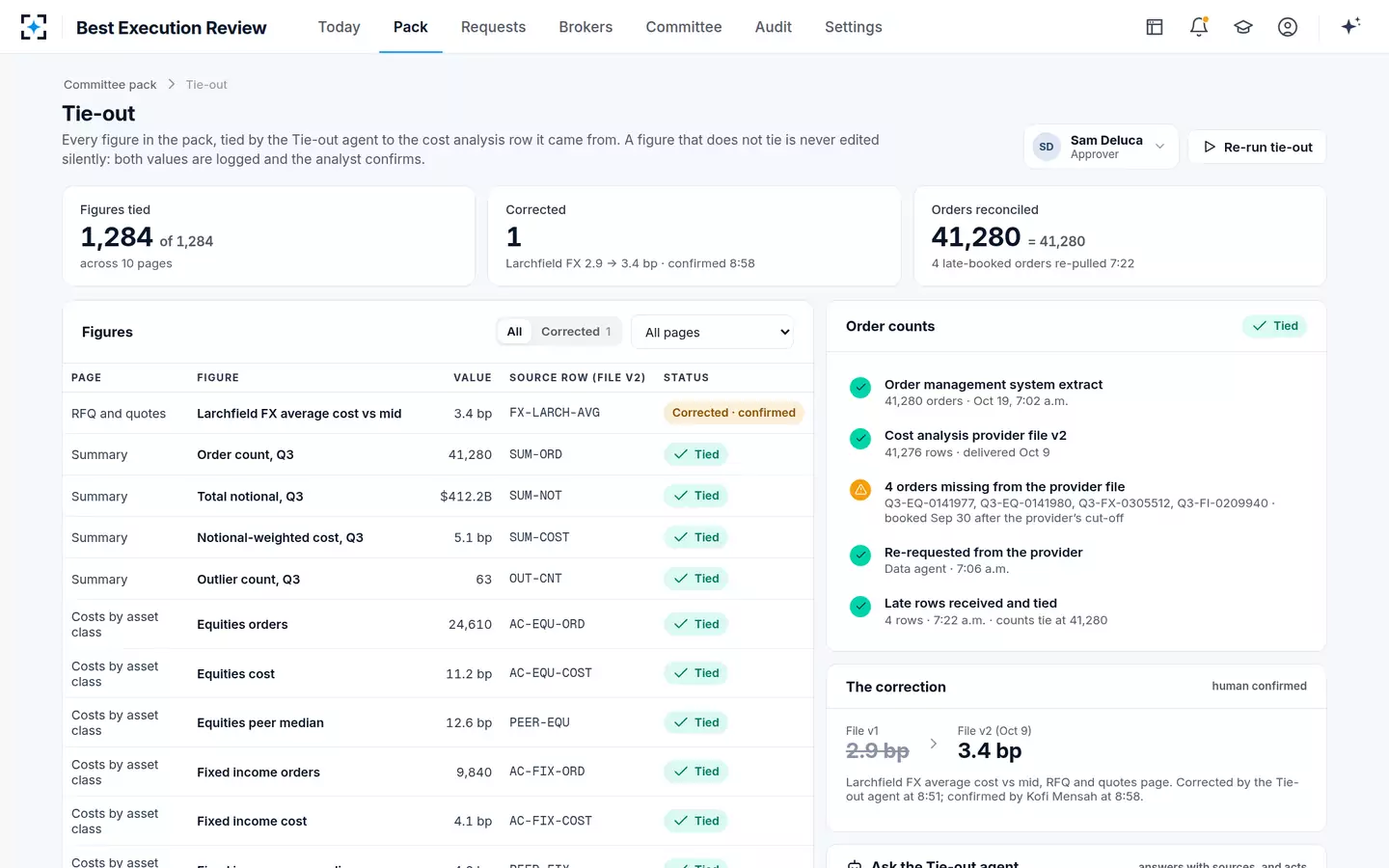
The test that separates products is the tie-out. Cost analysis providers re-state files; late-booked orders arrive after a cut-off; a figure copied on Tuesday is wrong by Thursday. Ask how the software knows a figure in the papers still matches its source, and what it does when it does not.
Every figure in the committee papers tied to its cost analysis row, and one re-statement caught
How is best execution monitoring software validated?
Validate it on three levels: its data, its rules and its judgement. Data: does the population reconcile and does each figure tie? Rules: do the thresholds and exclusions do what the policy says, on orders where the answer is known? Judgement, where the tool uses models: on a fixed set of past outliers with agreed answers, does it find the same reasons, and does a change to the model change the answers?
For broker-dealers FINRA's guidance on relying on another firm's review sets the standard for relying on any external analysis: "periodically reviewing both the methodology and the results of the review". On vendor-produced routing reports it suggests "comparing order samples against third-party vendor-provided information" (FINRA, December 2025). The same discipline applies to a monitoring tool: sample its output against the source, every quarter, and keep the result.
Periodically reviewing both the methodology and the results of the review.
FINRA, 2026 Annual Regulatory Oversight Report, effective practices
What does best execution monitoring software cost?
Vendors don't publish prices, and no regulator or independent study publishes what firms pay, so the honest answer is a method. The cost to run monitoring is the licence, plus the data it needs, plus the work to connect it, plus the people's time it still takes; set against it, the hours of assembly it removes. The formula below is a way to put a vendor's quote in context.
What best execution monitoring costs to run for a year
Licence
vendor quote per year
Ask what is included: asset classes, users, entities, history.
Vendor
Data
cost analysis + market data + archive access
Often already paid for; check whether the tool needs more.
Head of trading
Connection
integration hours × internal rate
Order and execution systems, provider files, message archive, read-only.
Technology
Review time
hours per quarter × 4 × rate
Analyst, traders, head of trading, compliance, committee.
Trading and compliance
The term that varies most between products is the last one. Software that measures but does not document leaves the hours of chasing traders and assembling papers where they were. Measure it on your own last quarter: how long the review took by hand, and how long it takes with the tool, with the same people signing.
Where Best Execution Review fits, and where it does not
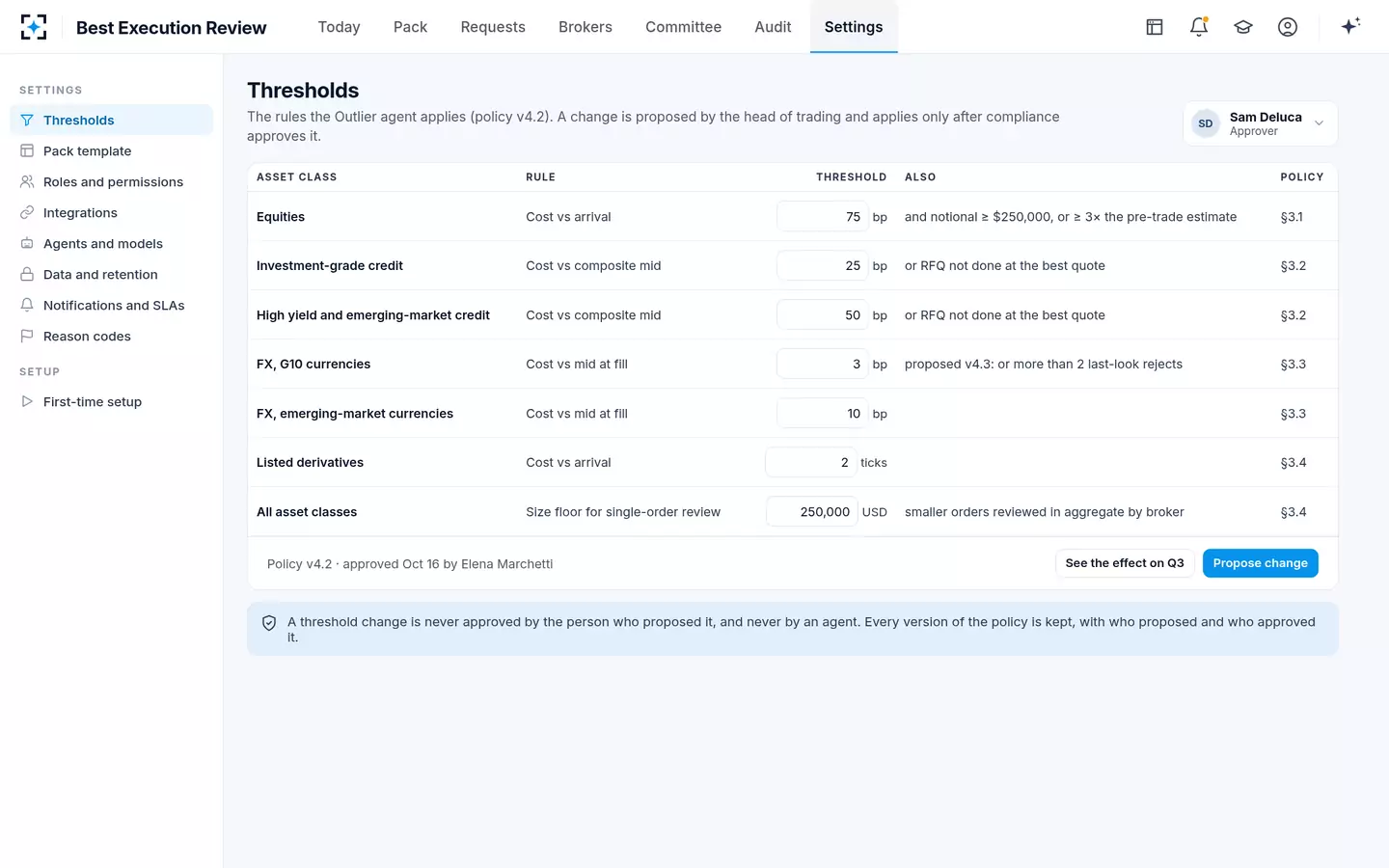
Botminds' Best Execution Review fits a buy-side firm whose committee reviews execution quarterly and whose weak point is the evidence: reasons gathered late, figures retyped, decisions minuted loosely. Seven agents select the outliers by your policy and code every exclusion, find the documented reason for each and test it against market data, rank brokers against expected cost and a trader survey, tie every figure to its cost analysis row, and assemble the papers and draft minutes. The head of trading accepts, compliance countersigns, the committee votes. Thresholds are yours and change only with compliance's approval.
Thresholds from the firm's own best execution policy, by asset class
It is not a cost analysis engine: it reads your provider's results, pre-trade estimates and peer data, every file version, rather than replacing them. It is not a real-time pre-trade or order-routing tool, and it never changes routing or algorithm wheel weights. A firm without a cost analysis provider, or whose need is real-time surveillance of its own routing as a broker-dealer, needs something else first. A two-week pilot on last quarter's orders is how to find out whether it fits yours, and what AI should never decide in a best execution review covers the agents' limits. To start, see Best Execution Review.
Questions people ask
What are the best execution monitoring requirements?
For advisers, periodic and systematic evaluation of execution, with evidence; for broker-dealers, order-by-order review or a regular and rigorous review at least quarterly by security and order type; for EU and UK firms, regular monitoring and at least an annual review of the execution policy. From February 12, 2028 EU firms must monitor against thresholds they set in advance for each class of instrument.
Is TCA the same as best execution monitoring?
No. Transaction cost analysis measures cost against benchmarks; monitoring uses that measurement to find outliers, explain them, compare brokers and record decisions. A firm can have excellent cost analysis and still fail an examination because it cannot show what it did with it.
Do small advisers need best execution monitoring software?
They need the evidence, not necessarily the software. A small adviser trading through one or two brokers can document a quarterly review by hand, but must still compare its brokers with others; the SEC staff cited advisers that used a single broker "without seeking comparisons from competing broker-dealers initially and/or on an ongoing basis".
Can best execution monitoring software be outsourced to a vendor?
The tool can be bought; the duty cannot be handed over. FINRA says "a firm cannot transfer its duty of best execution to another person", and expects firms using vendors to supervise them. The firm decides the thresholds, accepts the reasons and signs the review.
How long does it take to implement best execution monitoring?
It depends mostly on access: read-only connections to the order and execution systems, the cost analysis provider's files and the message archive. A pilot on one past quarter can show within weeks whether the tool reproduces your last review and what it adds.