The SEC best execution risk alert is a four-page staff document, "Compliance Issues Related to Best Execution by Investment Advisers", published by the Office of Compliance Inspections and Examinations on July 11, 2018. It lists the deficiencies the staff cited most often in adviser best execution programmes, drawn from deficiency letters in "over 1,500 adviser examinations" (OCIE Risk Alert). Its sidebar names six; the body sets out eight, from not performing reviews at all to not following the firm's own policy. Read closely, almost every finding describes something an adviser could not show rather than something it did not believe in. That is why the alert still shapes exams eight years on, and why Botminds' Best Execution Review is built around evidence: a written, sourced reason for every outlier, and a trail an examiner can follow.
The table below takes the alert's eight findings in its own order, with what the staff observed and the document that would have answered the examiner.
Eight findings in the SEC best execution risk alert, and the document that closes each
| Finding | What the staff observed | The evidence that answers it |
|---|---|---|
| Not performing best execution reviews | Advisers that "could not demonstrate" periodic and systematic evaluation, or did not evaluate a broker when selecting it | Dated quarterly reviews and a selection memo for each new broker |
| Not considering materially relevant factors | No qualitative factors such as execution capability, financial responsibility and responsiveness; no input from traders and portfolio managers | A broker scorecard with qualitative scores, and traders' reasons attached to outliers |
| Not seeking comparisons from other broker-dealers | One broker for all clients, chosen on a cursory review or on the broker's own summary | Costs compared with brokers and venues not used, initially and each quarter |
| Not fully disclosing best execution practices | Undisclosed trade rotation between account types; brochures promising price reviews that did not happen | Form ADV language matched to what the review actually does |
| Not disclosing soft dollar arrangements | Inadequate disclosure of soft dollar use, of which clients bear the cost, and of non-eligible products | Item 12 disclosure tied to the research and brokerage actually received |
| Not properly administering mixed use allocations | No reasonable allocation, or no support "through documentation or otherwise" for the rationale | An allocation study per mixed-use product, kept with the books |
| Inadequate policies and procedures | No best execution policy; no monitoring of broker performance; policies that ignored the securities actually traded | A policy that names asset classes, thresholds, benchmarks and owners |
| Not following best execution policies | Comparisons, soft dollar allocations and ongoing monitoring that the policy required but the firm did not do | Minutes and work papers that show each step of the policy was run |
What did the SEC best execution risk alert find?
It found that many advisers could not prove they had done what the best execution duty requires: evaluate brokers periodically and systematically, weigh more than commission, compare alternatives, disclose their practices and follow their own policies. The alert grouped the problems into six headings in its sidebar (not performing reviews, not considering relevant factors, not seeking comparisons, disclosure issues, soft dollar issues, and weak policies and procedures) and spread them over eight findings in the text.
The staff's framing of the duty is worth quoting because examiners still use it. An adviser "must execute securities transactions for clients in such a manner that the client's total costs or proceeds in each transaction are the most favorable under the circumstances", should consider "the full range and quality of a broker-dealer's services", and "should therefore periodically and systematically evaluate the execution quality of broker-dealers executing their clients' transactions". Every finding is a way of failing one of those three sentences.
The SEC best execution risk alert in four numbers
1,500+
adviser examinations whose deficiency letters the alert draws on
8
findings set out in the body, each with examples of what the staff observed
6
headings in the alert's sidebar of the most frequent issues
2018
July 11: still the staff's most detailed public list for advisers
Finding 1: not performing the review, or not being able to prove it
The first finding is the one the others rest on. The staff "observed advisers that could not demonstrate that they periodically and systematically evaluated the execution performance of broker-dealers", including advisers that "did not conduct an evaluation of best execution when selecting a broker-dealer" or "were unable to demonstrate, through documentation or otherwise, that they performed such an evaluation".
Unable to demonstrate, through documentation or otherwise, that they performed such an evaluation.
SEC staff, OCIE Risk Alert, July 11, 2018
"Documentation or otherwise" leaves room for proof in other forms, but in practice an examiner arriving two years after a quarter has only what was written down. A committee that met, discussed, and minuted "execution quality reviewed; no concerns" has evidence that a meeting happened. It does not have evidence that anyone evaluated a broker. The fix is a review file that shows the population, the thresholds, the outliers, a reason for each and the decisions taken, with dates.
Findings 2 and 3: more than price, and more than one broker
The second finding is about what the review weighs. The staff cited advisers that "did not evaluate any qualitative factors relating to a broker-dealer including, among other things, the broker-dealer's execution capability, financial responsibility, and responsiveness to the adviser", and advisers that "did not solicit and review input from the adviser's traders and portfolio managers". A review that ranks brokers on commission rates alone fails on its face; so does one that never asks the desk what happened on its worst trades.
The third finding is about comparison. The staff cited advisers that "utilized a single broker-dealer for all clients without seeking comparisons from competing broker-dealers initially and/or on an ongoing basis", that relied on "cursory reviews of the broker-dealer's policies and prices", and that chose a broker "based solely on that broker-dealer's brief summary of its services". A manager with an approved list of twenty brokers is not immune: if the review only ranks the brokers already used, it has not looked at the market.
For broker-dealers' equity routing there is a public data source the comparison can start from. Rule 606(b)(3) entitles a customer that places not-held orders in NMS stocks to a report on how the broker handled them, delivered within seven business days of the request and covering the previous six months, month by month (17 CFR 242.606; the Rule 606(b)(3) report, section by section). A committee that has never asked any of its brokers for one has left a free comparison on the table.
What is a mixed use allocation, and why is it in a best execution alert?
A mixed use item is a product or service paid for with client commissions that serves both investment decisions and something else, such as a data terminal also used by marketing. The alert repeats the SEC's rule that an adviser "should make a reasonable allocation of the costs of the product or service according to its use and keep adequate books and records concerning such allocation", and cites advisers that could not show, on paper or otherwise, why their mixed use splits were what they were. How to split a mixed-use license and prove the split sets out the study that answers that finding.
It sits in a best execution alert because paying for research with commissions is the one place the law lets an adviser pay more than the lowest commission, and the SEC's 2006 guidance on Section 28(e) is explicit that the safe harbor left the duty to seek best execution unchanged (SEC Release 34-54165). The two disclosure findings follow from the same arrangements: Form ADV Item 12 requires an adviser that receives soft dollar benefits to describe its practice and the conflicts it creates (Form ADV Part 2; Form ADV Item 12, clause by clause). The allocation studies and commission arrangements themselves are the work of Commission Management; the best execution review needs only to show that the cost of research did not quietly become the cost of execution.
Findings 7 and 8: policies that do not fit, and policies not followed
The last two findings are about the policy itself. The staff cited advisers "that did not have any policies relating to best execution", advisers with "insufficient internal controls because the advisers failed to monitor broker-dealer execution performance", and policies "that did not take into account the current business of the adviser, including the type of securities traded". A best execution policy written for listed equities, at a manager that now trades credit and FX, is the textbook case of the third.
Not following the policy is the more damaging finding, because the firm wrote the standard it failed. The staff observed advisers that skipped the comparisons their own policies required, did not allocate soft dollar expenses as their policies said, and "did not follow their internal policies regarding the ongoing monitoring of execution price, research, and responsiveness of their broker-dealers". The defence is unglamorous: a policy whose every requirement maps to a step in the quarterly review, and a review whose every step leaves a dated trace.
Which SEC enforcement actions involve best execution?
The cases show the same pattern as the alert: a duty everyone acknowledged, and no evidence it was discharged. The alert itself cites In the Matter of KMS Financial Services (2017), a settled order finding a violation of Section 206(2) where the adviser "failed to address introducing, clearing, and execution brokerage costs charged to advisory clients as part of the adviser's overall best execution analysis".
Two later orders make the point sharper. In June 2022 the SEC found that Kahn Brothers Advisors and its president "failed to seek best execution for advisory clients" and "failed to adopt and implement written policies and procedures regarding their best execution obligations"; they agreed to a $250,000 civil penalty on top of disgorgement and interest (SEC, File No. 3-20880). In March 2023 the SEC found that E. Magnus Oppenheim & Co., "even though a similar deficiency had been identified in the 2019 examination", failed to assess its clearing broker's "commission rates, fees, or ticket charges" or what other clearing brokers offered (SEC Release IA-6259). The order adds a line every compliance officer should read twice: "A violation of Section 206(2) may rest on a finding of simple negligence."
The progression in the second case is the one to avoid. An examination found the gap in 2019; the firm did not close it; the staff examined again in 2021; then came the order. A deficiency letter on best execution is a request for evidence, and the evidence is cheaper to produce the first time.
Does the SEC still examine best execution in 2026?
Yes, though the emphasis has moved. The Division of Examinations' fiscal 2026 priorities named "advisers seeking best execution with the goal of maximizing value for their clients" among the fiduciary topics it would review (FY2026 priorities). The fiscal 2027 priorities, published in October 2026, keep an explicit best execution review for broker-dealers and fold advisers' trading into the compliance programme review (FY2027 priorities). The comparison below sets the wording side by side.
Best execution in the SEC's exam priorities, fiscal 2026 and fiscal 2027
Fiscal 2026: Named: "advisers seeking best execution with the goal of maximizing value for their clients under the particular circumstances occurring at the time of the transaction."
Fiscal 2027 (October 2026): Not named as a topic. Examinations "will review key components of an adviser's compliance program" in areas "such as marketing, valuation, trading, portfolio management, disclosure and filings, and custody".
Fiscal 2026: Reviews of routing and execution "will include: (1) best execution", pricing of illiquid instruments, and disclosures "including as required by Rule 605".
Fiscal 2027 (October 2026): The Division "will also review broker-dealers' routing and execution of orders, including compliance with best execution obligations".
Fiscal 2026: Focus on "automated investment tools, AI technologies, and trading algorithms or platforms".
Fiscal 2027 (October 2026): Examinations of policies "relating to monitoring SI", the staff's term for super intelligence, "including its use in ... trading functions".
A priority list is a statement of where the staff will spend extra time, not a list of what it will ignore. The 2018 alert came out of routine examinations; trading remains a named component of every adviser compliance review; and the priorities themselves say they "are not the only areas the Division will address in examinations".
What did FINRA find in its 2026 report?
FINRA's 2026 Annual Regulatory Oversight Report lists four best execution findings at broker-dealers: "No Assessment of Execution in Competing Markets", including "using routing logic that is not based on execution quality"; "Unreasonable 'Regular and Rigorous Reviews'"; "No Review of Certain Order Types", such as market, marketable limit and non-marketable limit orders; and no written procedures for "Securities with Limited Quotations or Pricing Information" (FINRA, December 2025).
The overlap with the SEC's adviser list is close. Both regulators found reviews that did not compare against the market, reviews that skipped the factors the rules name, and procedures that did not cover what the firm actually traded. FINRA's effective practices add one an adviser can borrow outright: "Being prepared to explain and evidence the firm's best execution analysis". Explain and evidence is the same standard as "documentation or otherwise", in other words.
How do I fix a "not seeking comparisons" finding?
Fix it by making comparison a standing part of the quarterly review, not a one-off memo: measure each broker against a common benchmark and against peers, look at brokers and venues the firm does not use, ask for routing data, and minute what the committee did with the result. The checklist below is a remediation plan an examiner can follow.
Remediating a 'not seeking comparisons' best execution finding
- Re-paper the selection of every broker on the list
A short memo per broker: why chosen, against whom, on what evidence. The alert cites advisers that never evaluated a broker at selection.
- Put every broker on one benchmark per asset class
Cost against arrival or the right alternative, and against the cost analysis provider's expected cost, so brokers with different flow can be compared.
- Add peers and non-used brokers to the comparison
A provider's peer universe, quotes from dealers not hit, and venues not connected; FINRA guidance treats a review of current routes alone as insufficient.
- Request Rule 606(b)(3) reports for equity not-held orders
Six months of routing detail by calendar month, due within seven business days of the request.
- Score qualitative factors explicitly
Execution capability, financial responsibility and responsiveness, from a trader survey, with the scores kept.
- Minute the decision, including the decision not to change
Where a broker is materially worse and stays on the list, the minute says why.
- Check next quarter whether the action worked
A reduced allocation that does not improve cost is a finding waiting to happen.
Closing the evidence gaps in Best Execution Review
Most of the alert's findings are gaps a system can close by never letting a step pass without its evidence. In Best Execution Review, agents apply the firm's thresholds and code every exclusion, find the documented reason for each outlier and test it against market data, rank brokers against expected cost and the trader survey, and tie every figure in the committee papers to its source. People decide: the head of trading accepts or questions each reason, compliance countersigns, the committee votes.
The trader input the staff found missing becomes a structured request. Take a sample manager, fictional Quillfield Capital, as its third quarter runs through the solution: of 63 outliers, the agents found a documented reason for 58 and sent the other five to the traders who placed them, each with the chart, what the agent had already checked and one drafted question, on a 24-hour clock.
Trader input, as the SEC staff asked for it: one request per unexplained outlier
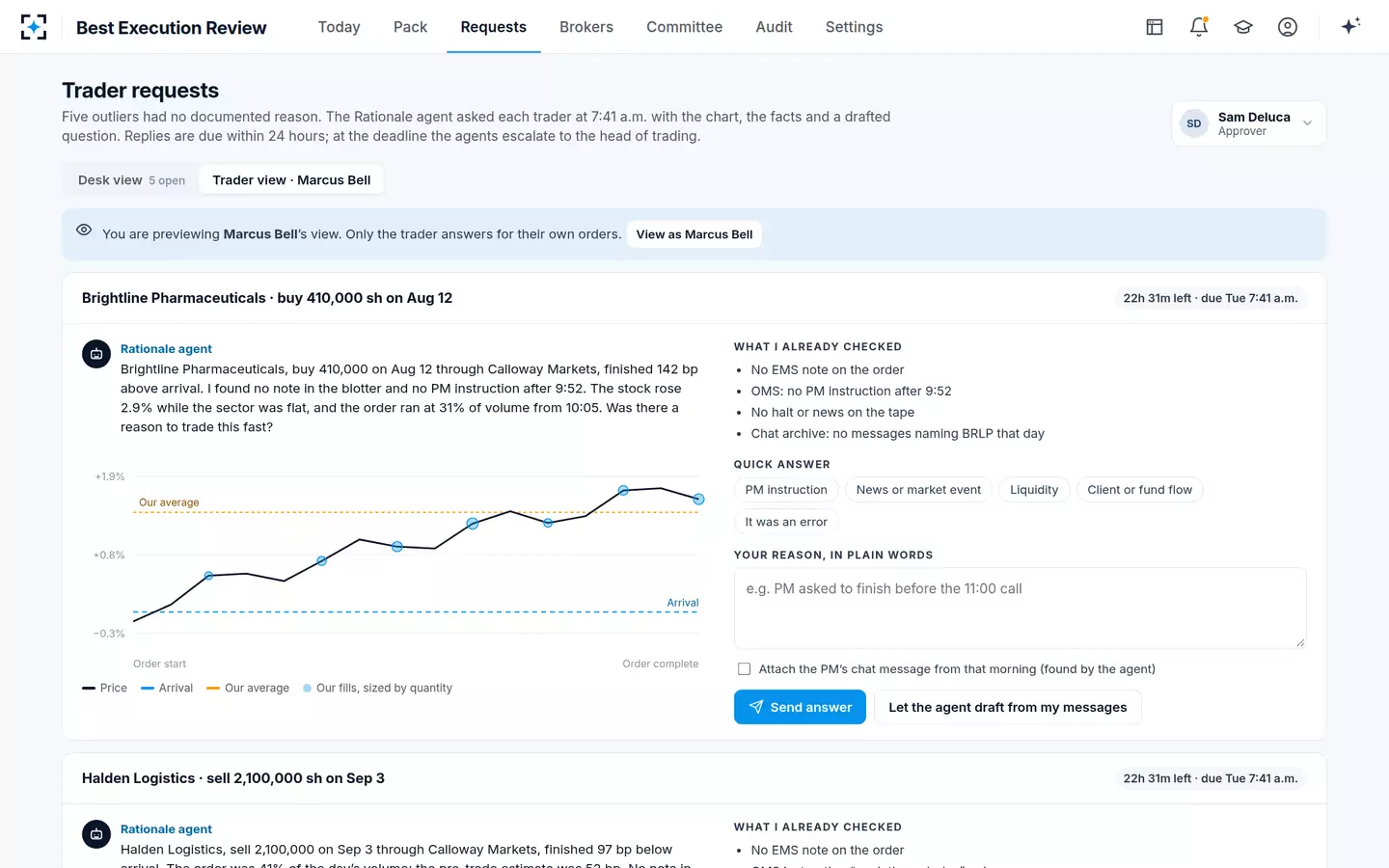
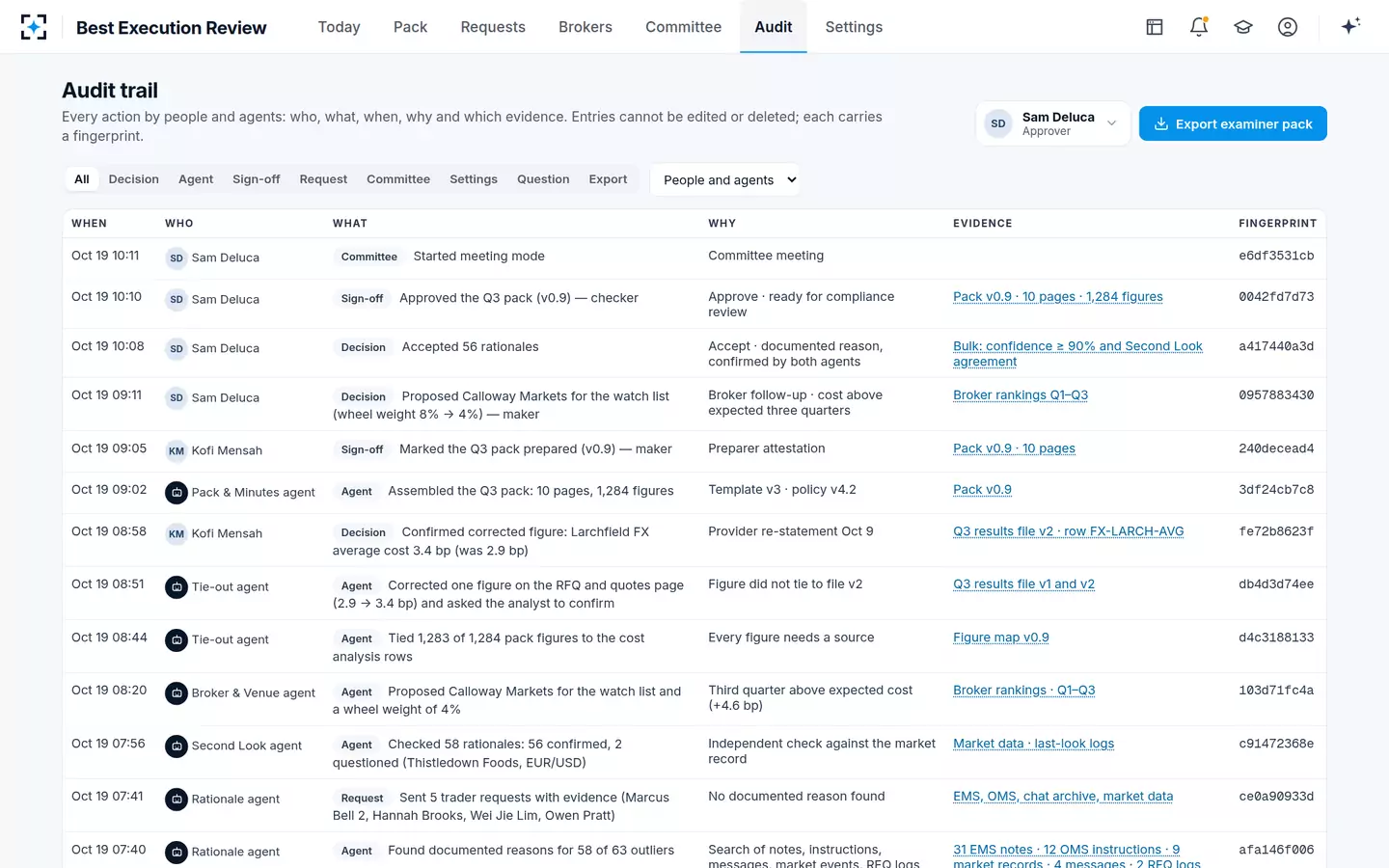
What an examiner asks for is the audit trail: who did what, when, why and on which evidence, for people and agents alike, with entries that cannot be edited and a one-step export of the quarter. That is the direct answer to "unable to demonstrate". Twelve questions to put to best execution monitoring software turns the alert's findings into a buyer's test.
The audit trail behind a quarter's review, ready for an examiner
To see the whole review on a quarter's orders, start from Best Execution Review.
Questions people ask
What are the most common best execution deficiencies?
In the SEC staff's 2018 list: not performing reviews or not being able to prove them, not weighing qualitative factors or traders' input, not comparing other brokers, incomplete disclosure of execution and soft dollar practices, unsupported mixed use allocations, and policies that are missing, ill-fitting or not followed. FINRA's 2026 list for broker-dealers adds missing reviews by order type and no procedures for thinly quoted securities.
Is the 2018 best execution risk alert still relevant?
Yes. It remains the staff's most detailed public list of adviser best execution deficiencies, and its standard of proof, "through documentation or otherwise", is the one examiners apply. Enforcement orders since, such as Kahn Brothers in 2022 and E. Magnus Oppenheim in 2023, describe the same failures.
Can best execution failures lead to enforcement, not just a deficiency letter?
Yes. The SEC has brought settled cases under Section 206(2), which "may rest on a finding of simple negligence", including where a deficiency found in one examination was still open at the next. Penalties in the orders cited here ranged from $50,000 to $250,000, plus disgorgement where clients overpaid.
Does a best execution finding mean the firm got bad prices?
Not necessarily. Most findings in the alert concern evidence and process, such as no documented review, no comparisons or no trader input, rather than proof that clients were harmed. The cases cited here combined the missing process with identifiable client cost, such as commissions or share classes that were more expensive than alternatives.
Who wrote the SEC best execution risk alert?
The SEC's Office of Compliance Inspections and Examinations, now the Division of Examinations, published it on July 11, 2018. It states the views of the staff; the Commission "has expressed no view on the contents of this Risk Alert".