Best execution AI tools are worth buying for one job above all: getting a documented, checked reason for every outlier trade before the committee meets. That is where reviews break today. An analyst writes to traders weeks after the trade, replies come back as "market conditions" or not at all, and nobody checks the ones that do arrive. An AI agent can search the trader's notes, the portfolio manager's instructions, the message archive and market data for the reason, test it against what the market was doing, and, only where nothing is on file, ask the trader one specific question with the evidence attached. What it must never do is decide: accept a reason, approve the review, change a threshold or move order flow. Botminds' Best Execution Review is built on that division of labour, and the screen below is where it shows most clearly.
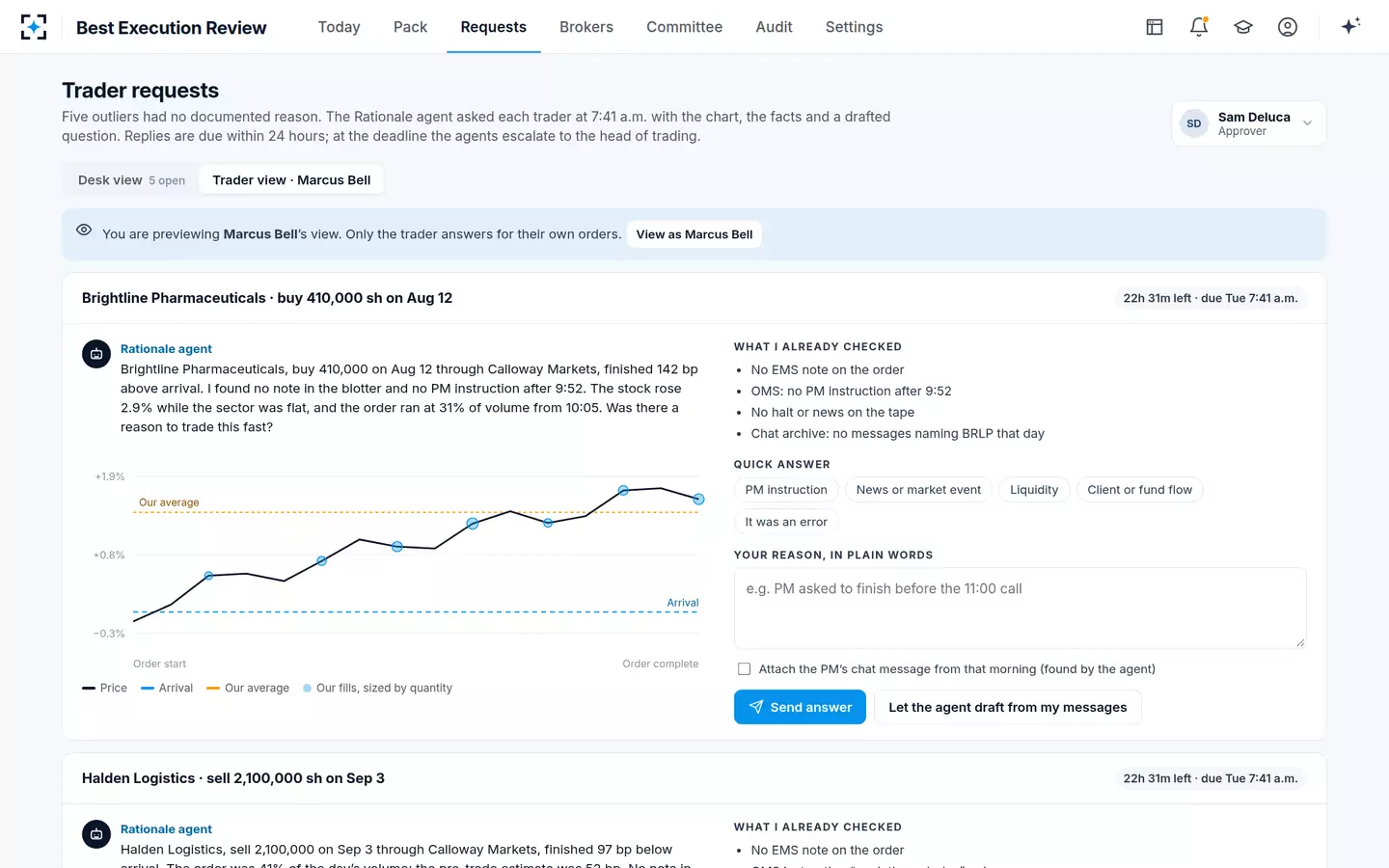
An agent's question to a trader: what it already checked, and the one thing it needs
Can AI do a best execution review?
AI can do most of the assembly and none of the judgement. Pulling and reconciling the quarter's orders, applying the policy's thresholds, finding reasons, testing them, ranking brokers and tying figures to their sources are tasks a well-controlled agent does faster and more consistently than a person working through spreadsheets. Accepting a reason, approving the committee papers, voting on a broker and changing a threshold are decisions the firm's people must take and sign.
The line is not only prudence; it follows from how regulators frame accountability. FINRA's guidance is that its rules are "technologically neutral" and "apply when member firms use AI, including Gen AI or similar technologies, in the course of their business" (FINRA Regulatory Notice 24-09). An adviser's duty to evaluate execution "periodically and systematically" does not change because an agent did the evaluating. The firm still owns the conclusion.
Where agents help a best execution review
Agents help in five places, each a step where a person currently spends hours on retrieval rather than judgement. The chain below shows how the work divides in Best Execution Review, with the person's decision at the end.
Seven agents assemble the best execution review; people decide every reason and sign
Agent
Data agentPulls the quarter's orders, instructions, fills, notes, cost analysis files, RFQ logs and market events, and reconciles order counts before anything else runs.
Never: changes a source or fills in a missing number
Agent
Outlier agentApplies the policy's thresholds by asset class and codes every order it sets aside.
Never: removes an order without a code, or changes a threshold
Agent
Rationale agentFinds the documented reason for each outlier in notes, instructions, messages, market data and RFQ logs, in the original language; drafts the trader request when none exists.
Never: invents or accepts a reason; contacts anyone but the trader and their desk head
Agent
Second Look agentTests every reason against market data, without seeing the first agent's confidence, on a different model family.
Never: overrides a person
Agent
Broker, tie-out and minutes agentsRank brokers and check last quarter's actions; tie every figure to its cost analysis row; assemble the pages and draft the minutes.
Never: change routing or wheel weights, edit a figure silently, or distribute before sign-off
A person decides
Head of trading, compliance, committeeAccept, question or refer each reason with a reason code; approve the papers with an attestation; countersign; vote.
How does an agent get a trader's reason for an outlier?
It looks first and asks last. For each outlier the agent searches the places reasons are written: the trader's execution notes, the portfolio manager's instruction history in the order system, the chat and email archive, exchange data on pauses and auctions, news, and request-for-quote logs. Most outliers have a reason somewhere. In a sample quarter for a fictional manager, the agent found documented reasons for 58 of 63 outliers, and only five needed a question.
The question is the part that changes behaviour. A request that says what was already checked, no execution note, no instruction after 9:52, no halt, no message naming the stock, and asks one specific thing, such as why the order ran at 31% of volume, gets an answer a reviewer can test. It also arrives while the trader still remembers. The SEC staff faulted advisers whose reviews never asked their own traders and portfolio managers what had happened (OCIE, July 2018); a structured request, kept with its answer, is that input in a form an examiner can read.
What should AI never decide in best execution?
Anything that changes an outcome for a client or a conclusion of the review: accepting a reason, approving or distributing the committee papers, changing a threshold, changing broker routing or algorithm wheel weights, and voting. Those need a named person who can be held to them. The table sets out where the line sits in practice.
Best execution AI: what an agent may do, and what it must never do
| Step | An agent may | An agent must never |
|---|---|---|
| Outlier selection | Apply the approved thresholds and code each exclusion | Change a threshold or drop an order without a code |
| Reasons | Find, quote and cite a documented reason; draft a question to the trader | Write a reason of its own, or accept one |
| Testing | Check a reason against market data and flag it for a person | Override the person who decides |
| Brokers | Rank, trend and propose a watch list or a weight | Change routing or algorithm wheel weights |
| Figures | Tie each figure to its source and log any correction with both values | Edit a figure silently |
| Committee | Build the agenda, draft minutes with citations, record votes | Vote, approve minutes or distribute papers before sign-off |
What do FINRA and ESMA say about AI agents?
FINRA's 2026 oversight report treats an AI agent as software that can take on and finish a task for its user without being walked through each step, and it names the risks in that order: an agent acting with no person validating or approving what it does; an agent reaching past the scope and authority its user meant to give it; reasoning spread over so many steps that the result is hard to trace or explain; careless handling of sensitive data; a lack of domain knowledge; and misaligned reward functions (FINRA, December 2025; the report's own wording is quoted in why the reader is never the checker). Its suggested considerations read like a specification for a review tool: decide where a person must stay in the loop, keep a trail of what each agent did and decided, and put guardrails on what an agent may do at all.
ESMA's statement on AI, written for firms providing retail investment services, makes accountability explicit: the management body answers for the firm's decisions whether a person or an AI tool made them, and ESMA warns against leaning on AI so far that human judgment is neglected (ESMA, 30 May 2024). The SEC staff use their own term. The Division of Examinations' fiscal 2027 priorities describe registrants building what the staff call "super intelligence" (SI) into their businesses, compliance monitoring and surveillance among them, and say examinations will look at the policies firms use to monitor SI, including in trading (SEC, FY2027 priorities; how asset managers are using AI reads that section in full).
FINRA's AI agent risks, and the control a best execution review tool should show for each
| FINRA risk (2026 report) | What it would look like in a review | The control to ask for |
|---|---|---|
| Autonomy | An agent accepts a reason, or approves the review, without a person | Every acceptance and approval needs a named person and a reason code |
| Scope and authority | An agent changes a threshold, a broker weight or routing | Thresholds and routing are outside what agents can touch; changes need compliance approval |
| Auditability and transparency | A reason appears with no way to see where it came from | Every reason cites its source passage, with the system it came from |
| Data sensitivity | An agent copies trader messages into a new store | Read-only access; sources searched in place, not copied |
| Domain knowledge | A plausible reason that does not fit the market that day | An independent check against spread, depth, volume, pauses and peer costs |
| Rewards and reinforcement | An agent tuned to "explain" as many outliers as possible | Bulk acceptance only when two independent checks agree; a fixed test set before any model change |
Is AI-generated evidence acceptable to examiners?
The evidence should never be AI-generated; the retrieval can be. What an examiner relies on is the trader's note, the portfolio manager's instruction, the exchange's halt data and the cost analysis row. An agent's job is to find those, cite them precisely and show which ones support which reason. A reason with no source behind it is not evidence whether a person or a model wrote it.
Two record-keeping points follow. Under Rule 204-2 an adviser must keep written communications "relating to ... the placing or execution of any order", so the trader's answer to an agent's question is part of the books (17 CFR 275.204-2). And ESMA expects firms using AI to keep records of how decisions were reached, which data and algorithms were used, and every change made to them since (ESMA, 2024). A tool that cannot show which model version produced which finding fails the second test before an examiner opens the first.
An agent may find a reason, test it and draft it. Only a named person may accept it, and the committee still decides what the firm does next.
Who is accountable when the AI is wrong?
The firm, and within it the people who accepted what the AI produced. That is why acceptance has to be a separate, recorded act, not a default. If an agent finds a reason and a second, independent agent agrees with it, the head of trading still accepts it, with a reason code, and compliance still countersigns the review. If either agent is wrong, the audit trail shows who accepted it and on what evidence.
Design choices make errors cheaper. In Best Execution Review the checking agent scores blind, without seeing the first agent's confidence, and runs on a different model family, so the two do not share the same blind spots. Bulk acceptance is allowed only when the first agent's confidence is at least 90% and the second agent agrees; anything else goes to a person one by one. In the sample quarter, the checker questioned two of 58 reasons. One was a trader's "wide spread" note on a day when the spread was 3.1 basis points against a 20-day average of 3.0. How to test an outlier reason against market data works through that case.
How is an AI agent's work audited?
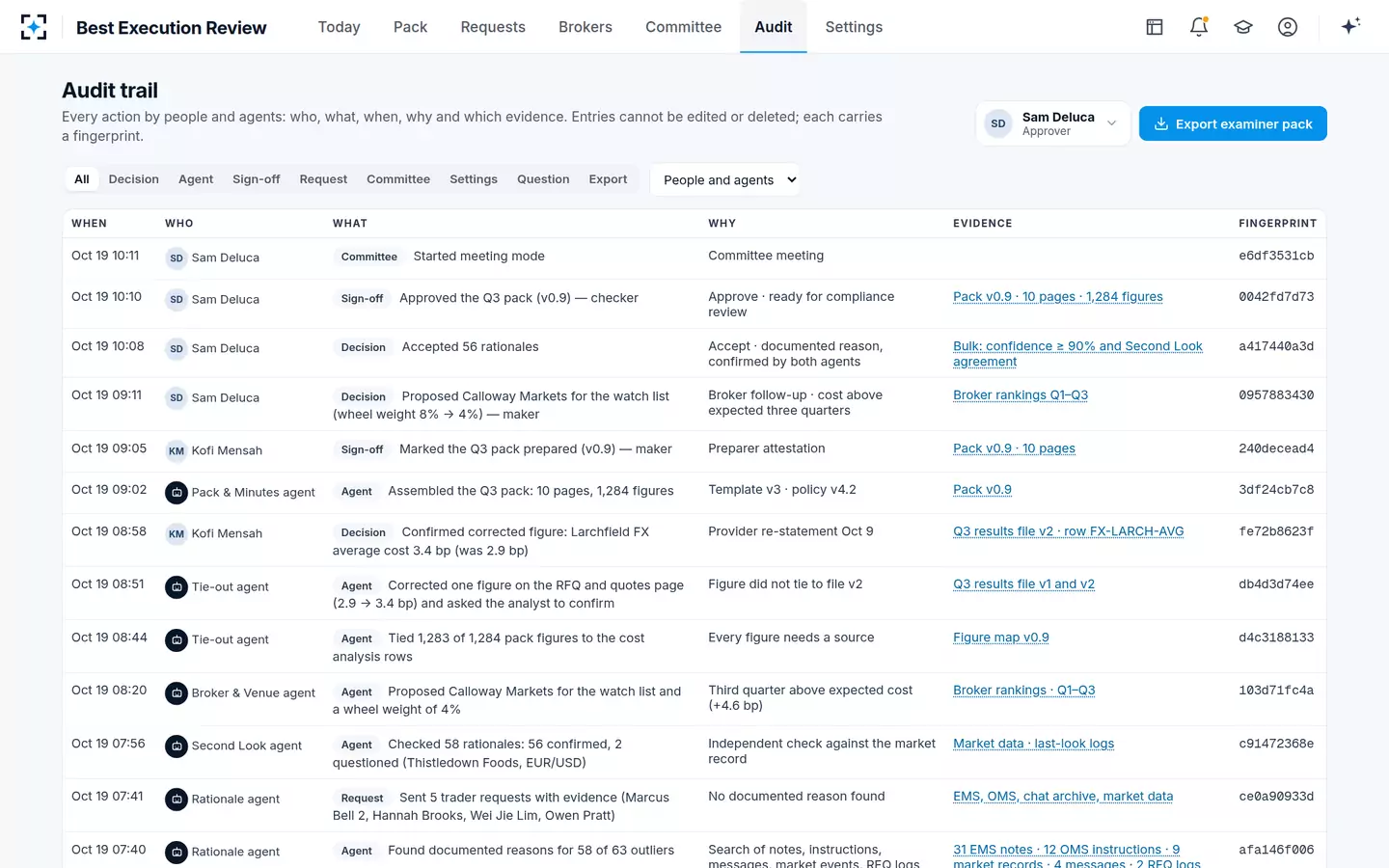
The same way a person's is, plus two things only machines need: the model version, and a fixed test. Among FINRA's effective practices for generative AI are keeping the prompts and outputs so a result can be accounted for and debugged, recording which model version ran and when, and having a person validate model outputs before they are relied on. A best execution tool should add a test set of past outliers whose right answers are known, re-run whenever an agent or model changes, with the result approved by compliance before the change goes live.
Every agent and every person on one audit trail, with evidence and fingerprint
What to ask before buying best execution AI tools
Ask how the tool finds reasons, how it checks them, what it can change and how you would prove all of that to an examiner. Demonstrations tend to show the finding; the controls are what you are buying. The checklist below is a starting point for a selection, and twelve questions for best execution monitoring software covers the wider platform.
Eight questions to put to any best execution AI tool
- Where does it look for reasons, and does it cite the passage?
Execution notes, order instructions, messages, market data, RFQ logs; every reason linked to its source, in the original language.
- Who checks the reason, and can the checker see the finder's answer?
An independent check, scored blind, is what turns a plausible reason into a tested one.
- What can the agents never change?
Thresholds, routing, wheel weights, figures without a log, decisions. Ask to see where that is enforced, not just stated.
- How does it ask a trader, and what happens if they do not answer?
One specific question with the evidence, a deadline and an escalation path.
- What is recorded about each agent action?
Who, what, when, why, which evidence and which model version, in a trail nobody can edit.
- How is a model or agent change tested before it goes live?
A fixed set of past outliers with known answers, re-run and approved by compliance.
- Does it need your data copied out of your systems?
Read-only access that searches sources in place is easier to defend than a new copy of trader messages.
- Can you test it on a quarter you already reviewed?
Replaying last quarter shows, outlier by outlier, whether it finds what your people found, and what they missed.
Where AI does not help a best execution review
AI cannot supply a reason that was never written down, cannot make a poor benchmark fair, and cannot replace the cost analysis it reads. If traders never write notes and portfolio managers give instructions by telephone, an agent will find little and ask a great deal; the first quarter is often the one that shows a desk how much of its reasoning was never recorded. If the cost analysis measures a market-on-close order against arrival, an agent will faithfully flag it; the fix is the policy's benchmark, not the tool.
Nor should AI shrink the committee's role. The committee decides whether a broker stays, whether a threshold moves and whether the reasons it heard are good enough, and those are judgements about the firm's risk appetite, not retrieval tasks. Regulators' own interest points the same way: the SEC proposed in 2023 a rule on conflicts in firms' use of predictive data analytics, and withdrew it on June 17, 2025 (90 FR 25531), while the fiscal 2027 priorities keep the focus on whether firms still meet the obligations they already had, which apply whatever technology does the work. The obligations stay with the people. To see the agents and the people working on a quarter's orders, start from Best Execution Review.
Questions people ask
What are best execution AI tools?
They are tools that use AI models, increasingly as agents, to do parts of a best execution review: selecting outliers, finding and testing the reasons behind them, ranking brokers and preparing committee papers. The useful ones cite every source and leave every decision to a named person; FINRA lists autonomy without human validation as the first risk of AI agents.
Can AI replace transaction cost analysis?
No. AI agents in a best execution review read cost analysis; they do not replace the benchmarks, peer data and pre-trade models it provides. They make better use of it by tying each figure to its row and explaining the outliers it flags.
Do regulators allow AI in best execution reviews?
Yes, under the same rules as any other method. FINRA says its rules are technologically neutral and apply when firms use AI; ESMA says decisions remain the management body's responsibility whatever tool made them; the SEC's fiscal 2027 priorities say examiners will look at how firms monitor their use of what the staff call super intelligence. None prohibits AI; all expect supervision and records.
How accurate does a best execution AI tool need to be?
Accurate enough that a second, independent check agrees with it most of the time, and honest enough to say when it is unsure. Measure it on a quarter you already reviewed: how many reasons it found that your people found, how many it found that they missed, and how many it got wrong.
Will traders accept an AI asking them about their trades?
They are more likely to than to accept an email weeks later. A request that arrives on the morning the review runs, shows what was already checked and asks one specific question is quicker to answer, and lets the trader explain while they still remember. In the sample setup the trader has 24 hours before the request escalates to the head of trading.