A best execution review is the periodic check, usually quarterly, of whether a firm's trades were executed as well as they reasonably could have been: every order measured against a benchmark, those beyond the policy's thresholds singled out as outliers, a reason recorded for each, and the results taken to a committee that decides what to change. The measuring is mechanical. The reasons are where reviews fail, because they are gathered weeks late, written vaguely and rarely tested. A reason a committee can defend is one written close to the trade, tied to the specific order, and confirmed against the market data of that moment by someone other than the trader. Botminds' Best Execution Review builds the review around that standard: agents find the documented reason for each outlier, a second agent tests it blind, and the head of trading decides.
Take a sample asset manager, fictional Quillfield Capital, as its third quarter of 2026 runs through the solution. The figure below follows its outliers from the raw band to the reasons the committee saw.
From 1,146 orders beyond a band to 56 checked reasons: where a best execution review's work goes
1,146 orders beyond a raw benchmark band, sorted
- Market-on-close, measured against the close · 33.9%
- Below the $250,000 size floor, reviewed by broker · 24.1%
- Client-directed brokerage · 18.5%
- Program and transition trades · 14.9%
- Crosses and new issues · 3.1%
- Outliers under the policy (63) · 5.5%
63 outliers, by where the reason was found
- Trader notes (31) · 49.2%
- Portfolio manager instructions (12) · 19%
- Market data: pauses, auctions, news (9) · 14.3%
- Messages (4) · 6.4%
- RFQ logs (2) · 3.2%
- No reason on file: trader asked (5) · 7.9%
58 documented reasons after a blind second check
- Confirmed by both agents (56) · 96.6%
- Questioned, sent to a person (2) · 3.4%
What is a best execution review?
A best execution review is the evidence that a firm evaluates the execution its clients receive, periodically and systematically, and acts on what it finds. For a US adviser it answers the SEC's expectation that an adviser seeks the best result "under the particular circumstances occurring at the time of the transaction" (SEC, 2019); for a broker-dealer it is FINRA's regular and rigorous review; for a European firm it is the monitoring MiFID II requires. Each looks at the same material: orders, benchmarks, thresholds, outliers and reasons.
The phrase "at the time of the transaction" is the one that governs reasons. A trade is judged on what the trader knew and faced when it was done: the portfolio manager's urgency, a trading pause, a thin book, a news headline. A reason reconstructed in a committee room three months later describes what someone now believes happened. That is why the best reviews treat the reason as part of the trade, captured close to it, rather than as a question for the quarter end.
What should a best execution review include?
A complete review includes the population, the thresholds and benchmarks, the exclusions with their codes, the outliers with a sourced reason for each, broker and venue comparisons, and the decisions taken. The table below is a review procedure in eight steps, with what each produces; it doubles as a template.
A best execution review procedure, step by step, and the evidence each step leaves
| Step | What happens | What it leaves behind |
|---|---|---|
| 1. Population | Pull every order in scope and reconcile the count between the order system and the cost analysis file, including late bookings. | A reconciliation: orders in, orders analysed, differences explained. |
| 2. Thresholds | Apply the policy's thresholds by asset class: cost against arrival, composite mid or mid at fill, or a multiple of the pre-trade estimate. | The policy version and the thresholds applied. |
| 3. Exclusions | Set aside orders that need a different benchmark or a different review, each with a code. | A count per code; every excluded order can be reopened. |
| 4. Reasons | Find the documented reason for each outlier: trader note, PM instruction, market event, message, RFQ log. | A reason with its source and time, or a request to the trader. |
| 5. Test | Check each reason against market data, by someone who did not write it. | Confirmed or questioned, with the data used. |
| 6. Decide | The head of trading accepts, questions or refers each reason; compliance countersigns. | A decision per outlier, with a reason code. |
| 7. Compare | Rank brokers and venues against benchmark, expected cost and peers; check last quarter's actions. | A scorecard and proposals for the committee. |
| 8. Record | Minute the committee's decisions; lock the quarter. | Minutes, actions with owners, and the file an examiner will ask for. |
How do you explain an outlier trade?
Explain it with the specific cause, its time, and its source: what happened, when, and where that is written down. "Halt 14:02, limit up-limit down. PM wants out today on guidance cut." is a good reason. It names an event that can be checked, a time that can be matched to the tape, and an instruction that can be found in the order system. "Difficult market" is not a reason; it is a mood. And when the honest reason is a mistake, such as a wrong quantity or the wrong side, the outlier stops being a best execution question and becomes a trade error, with its own clock and its own approvals, set out in the trade error process.
Most outliers already have a reason somewhere, and the work is finding it. In the sample quarter, 58 of 63 outliers had one on file: 31 in the trader's own execution notes, 12 in portfolio managers' instructions, 9 in market data such as trading pauses and auctions, 4 in messages and 2 in request-for-quote logs. Only five had nothing, and those went back to the traders who placed them on the morning the review ran, with the price chart, what had already been checked and one drafted question.
Five tests of an outlier reason a best execution committee can defend
- It was written at, or close to, the time of the trade
A note made minutes after a trading pause carries weight that an email answered in October cannot.
- It is tied to the order, not the day
The order ID, the instrument and the fills it explains; a reason that fits every trade that day explains none of them.
- It names something that can be checked
A pause, an auction, a headline, a PM instruction with a time stamp, a quote not hit.
- It survives a check by someone who did not write it
Spread, depth, volume and peer costs at the time either agree with it or they do not.
- Its source is kept with it
The note, the instruction or the market data, so an examiner can follow the reason to its origin.
Is "market conditions" an acceptable reason for an outlier?
Not on its own. "Market conditions" is acceptable only when it names the condition, and the condition shows in the data: a spread several times its normal width, depth that vanished, a pause, a gap on news. A generic phrase that fits any bad trade is precisely what a reviewer should send back.
The FCA's December 2025 review of eight wholesale banks found the same problem from the regulator's side, and one fix. At one bank, compliance used its own access to market data "to independently verify the trader commentary provided for outlier trades", and in doing so "moved away from generic feedback logic to specific explanations of trades" (FCA, December 2025). The practice is the point: commentary that someone independent checks against market data gets more specific, because traders learn that it will be checked.
In doing so, they moved away from generic feedback logic to specific explanations of trades.
FCA, Best execution in UK listed cash equities, December 2025
How do you check a trader's explanation against market data?
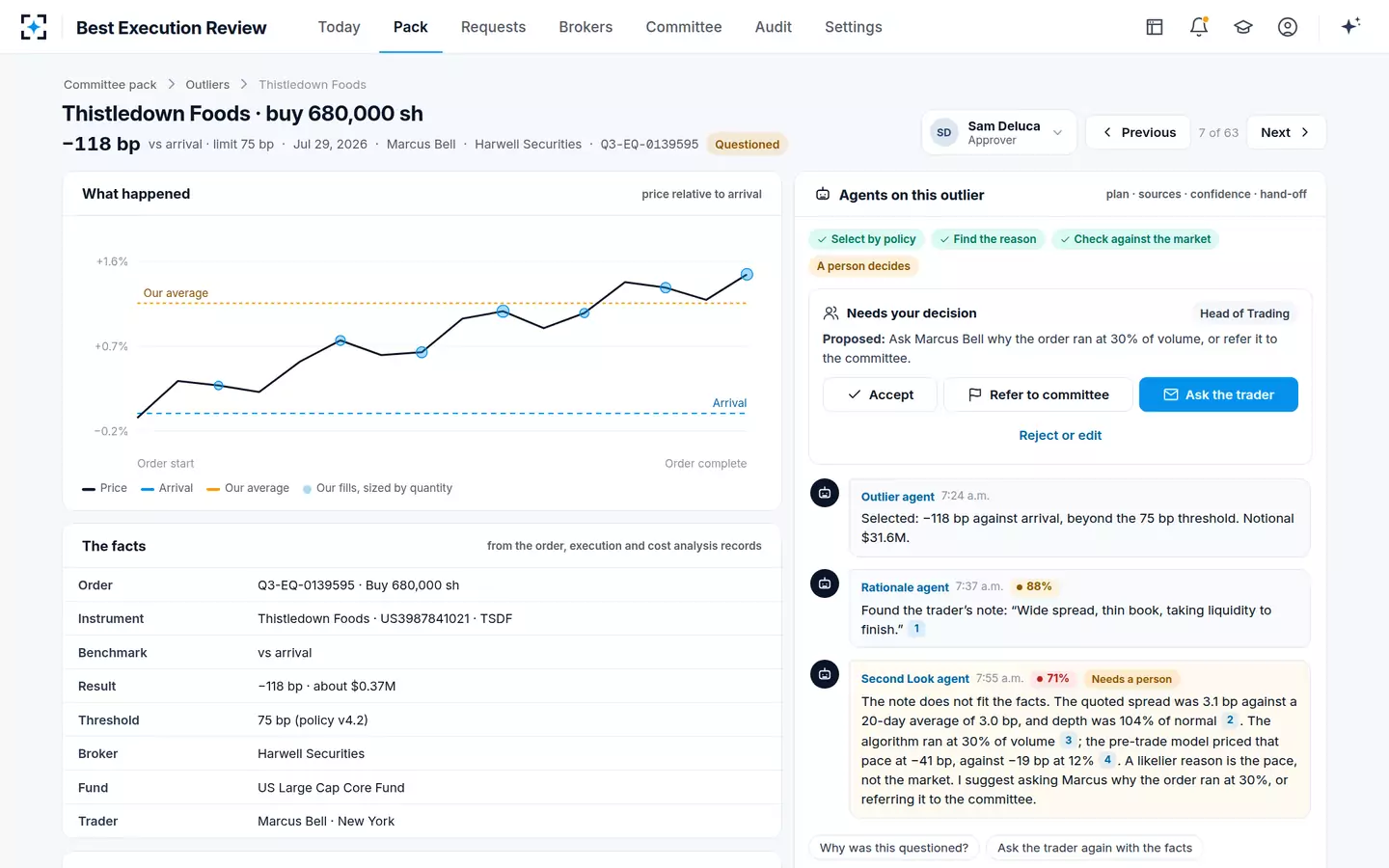
Test the claim the reason makes, with the data for that instrument and that time, without first looking at how confident anyone was in it. A "wide spread" note is tested against the quoted spread at the time and its recent average; "thin book" against depth; "a pause" against the exchange's halt data; "everyone paid" against peer costs that day; an algorithm's pace against the pre-trade model's estimate for that pace. The comparison below shows a reason that held and one that did not, from the same sample quarter.
Two trader notes tested against market data: one held, one did not
Norvik Energy: sell, −184 bp: "Halt 14:02, limit up-limit down. PM wants out today on guidance cut."
Thistledown Foods: buy, −118 bp: "Wide spread, thin book, taking liquidity to finish."
Norvik Energy: sell, −184 bp: A trading pause, and an instruction to sell the full position that day.
Thistledown Foods: buy, −118 bp: Spreads were wide and depth was thin, so the trader paid up.
Norvik Energy: sell, −184 bp: Pause from 14:02:31 to 14:07:31; the PM's instruction time-stamped before the order reached the desk; other sellers that day paid a median of −171 bp.
Thistledown Foods: buy, −118 bp: Quoted spread 3.1 bp against a 20-day average of 3.0 bp; depth 104% of normal; the algorithm ran at 30% of volume, a pace the pre-trade model priced at −41 bp.
Norvik Energy: sell, −184 bp: 97% and 96%: both agree.
Thistledown Foods: buy, −118 bp: 88% from the finder, 71% from the checker: questioned.
Norvik Energy: sell, −184 bp: Ready for the head of trading to accept.
Thistledown Foods: buy, −118 bp: Ask the trader why the order ran at 30% of volume, or refer it to the committee.
The second column is the valuable one. Nothing in the note was false in an obvious way; it simply did not fit that day. Without the check the trade would have been accepted with a reason that was probably wrong, and the real question, whether a 30% participation rate was the right instruction, would never have reached anyone who could answer it.
A 'wide spread' note questioned against the spread, depth and pace on the day
Who should give the reason: the trader or compliance?
The trader gives it; someone else accepts it. The trader is the only person who knows what they were facing, and the SEC staff's 2018 risk alert counted reviews that left traders and portfolio managers out as a deficiency (OCIE, July 2018). But the person who placed the order cannot be the one to decide that its cost was acceptable. Commonly the head of trading accepts or questions each reason, and compliance countersigns the result.
Two rules keep the arrangement honest. A trader never accepts the reason for their own order, and the person who tests a reason is not the person who found it. In the sample setup, reasons can be accepted in bulk only when the finding agent's confidence is 90% or more and the checking agent agrees; in the sample quarter that covered 56 of the 58, and the head of trading accepted them in one step with a reason code. The two questioned reasons and the five open requests stayed on the committee's agenda.
Exclusions are reasons too
Every order set aside from the outlier review needs a reason as much as every outlier does. A market-on-close order measured against arrival will look like an outlier on a volatile afternoon, but its benchmark is the close; a transition trade belongs in the transition manager's report. Setting them aside is right. Setting them aside silently is the problem, because an examiner who sees 41,280 orders shrink to 63 will ask about the other 41,217.
The FCA's review found practice varied widely here among the banks it visited: "Two banks checked all their outlier trades, one bank checked all trades beyond a certain limit of their tolerance threshold and the others took a sample-based approach" (FCA, December 2025). Whatever the method, write it down and code what falls outside it. The EU's Delegated Regulation 2026/825, which applies from February 2028, will require monitoring "based on a representative sample for each class" against thresholds the firm sets in advance (2026/825, Article 7), and a sample rule is only defensible if it is written before the quarter.
How long should best execution review evidence be kept?
At least five years for a US adviser, and in practice longer. Rule 204-2 requires an adviser to keep the written communications it sends and receives about placing or executing orders, and to keep most required books and records for at least five years after the end of the fiscal year of the last entry, the first two in an appropriate office (17 CFR 275.204-2; investment adviser recordkeeping requirements reads the rule line by line). A trader's written note explaining an order is the kind of communication the rule describes.
The practical consequence is that the reason has to live where it can be found five years on, with its source. A reason pasted into a slide is hard to defend; a reason linked to the note, the instruction and the market data it relied on can be followed by anyone. The sample firm keeps its committee papers, minutes, decisions and audit trail for seven years, with legal hold.
Outlier reasons in the language they were written in
A global desk's reasons are not all in English, and translation is where a reason can quietly change. A broker's note from Tokyo explaining that a stock was in special quote after its results reads differently once paraphrased by a London analyst. The defensible version keeps the original beside the translation, with the exchange's own data and the cost analysis row.
A broker's note in Japanese, kept beside its translation and the exchange data
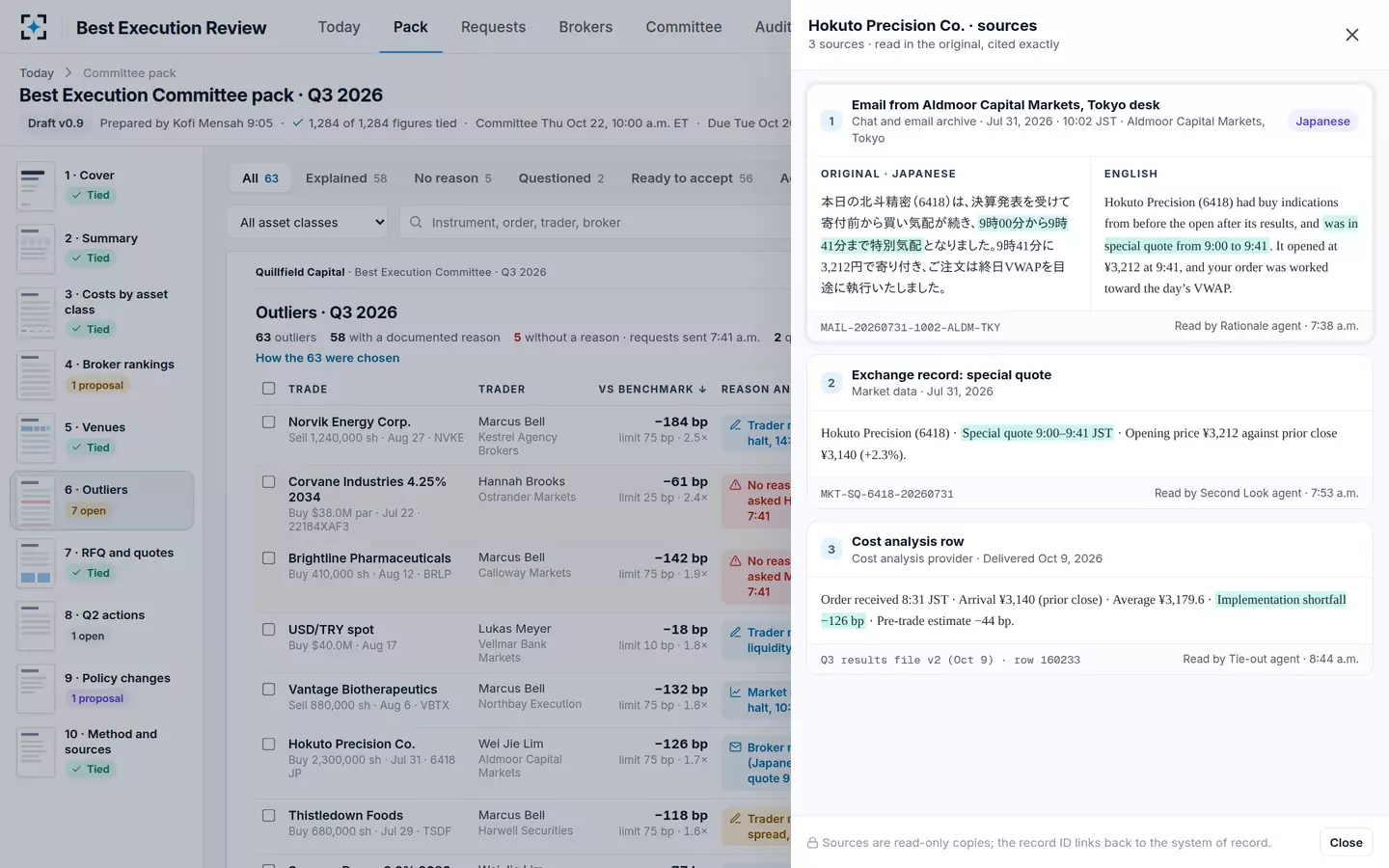
In the sample quarter two of the 58 documented reasons were found in languages other than English, one Japanese and one Portuguese. Both were tested the same way as the rest. What AI should and should not do in a best execution review looks at the agents behind these steps, and the best execution committee covers who decides the reasons the agents question. To see the full review on a quarter's orders, start from Best Execution Review.
Questions people ask
What is an outlier trade in best execution?
An outlier is an order whose cost against its benchmark goes beyond a threshold the firm's best execution policy sets, such as 75 basis points against arrival for equities or 25 basis points against composite mid for investment-grade bonds in the sample policy. Being an outlier does not mean execution was poor; it means the trade needs a documented reason.
What is a best execution review template?
It is the standard structure of the quarterly review: population and reconciliation, thresholds and exclusions, outliers with sourced reasons, tests of those reasons, broker and venue comparisons, and decisions. The eight-step table on this page can serve as one; the part most templates leave out is the test of each reason by someone other than the trader.
How many outliers should a best execution review have?
There is no right number; it depends on the thresholds and the flow. What matters is that thresholds are set before the period, reviewed regularly and not loosened to shrink the list. The FCA found one bank whose thresholds "hadn't been revised since their introduction several years ago", which it said raised concerns about their effectiveness.
Should a trader be able to change their reason after the review?
A trader can add to a reason or answer a follow-up question, but the original note should be kept, with the time it was written, beside any later explanation. The value of a contemporaneous reason disappears if it can be edited silently after the fact.
What do regulators want to see for outlier trades?
Evidence that outliers were identified by a consistent rule, investigated, explained and acted on. FINRA lists exception reports among effective practices and expects firms to be "prepared to explain and evidence" their analysis; the FCA's 2025 review found banks that regularly analysed outlier trades "demonstrated more actions to continuously evolve their arrangements" than those that did not.