The trade error process runs from the first sign that a trade went wrong to the moment the client is whole: the error is reported to compliance, the order is rebuilt from its records, the position is corrected in the market, the cost is priced per client, compliance decides who pays under the firm's policy, a second person approves, operations books the payment and fund accounting confirms the money arrived. Each step belongs to a different person, and each waits on the one before. That is where the time goes, and under T+1 settlement time is money, because an uncorrected error carries market risk every hour. Botminds' Trade Error Management does the rebuilding, pricing and checking between the signatures, so the people in the chain wait on evidence that is already assembled.
The example on this page comes from the solution's fictional sample firm, Quillfield Capital. A block of 120,000 Corvane Industrial shares bought on Thursday, October 15, 2026 for the Equity Income fund was allocated to the Global Value fund by a saved block template. It settled on Friday and surfaced on Monday morning as a cash break in Equity Income.
One trade error, step by step: who does what, and who signs
Agent
Signal and reportA cash break, reconciliation exception, post-trade alert, custodian notice, broker letter or trader report opens the case. Duplicate reports of the same error are merged.
Never: close a case
Agent
Rebuild the orderOrder system audit trail, FIX messages, central trade matching, custodian and the chat archive, read into one timeline with each event cited.
Never: edit a source system
A person decides
Approve the correctionThe head of trading operations approves the corrective trades on the rebuilt timeline; the trader executes them.
Agent
Price the cost per clientPrice difference, commissions, fees, currency and opportunity cost, as the correction fills. A second agent recomputes from the raw fills.
Never: net one client's gain against another's loss
A person decides
Decide cause, payer and amountA compliance officer, on the clause the policy agent proposes and the evidence behind it, with a reason code.
A person decides
Check or approveA second compliance officer under the firm's threshold; the CCO at or above it; the COO and a board notice at the top tier.
A person decides
Book and confirmOperations books the payment from the firm's error account; fund accounting confirms each fund received it. Then the case closes.
What happens after a trade error is found?
Three things, in this order: contain it, establish what happened, and correct the client's position. Containment means stopping the error from growing, such as cancelling the rest of a duplicate order or holding further allocations from a faulty template. Establishing what happened means comparing what was intended with what was entered, executed and booked, from the records rather than recollection. Correcting means putting each client account where it would have been, which since T+1 usually means a trade in the market.
Only then comes the money question: what the correction cost, who pays it and who approves. Firms that start with the money question, before the facts are fixed, tend to argue about clauses with the wrong numbers. In the sample case the Intake agent opened the case at 7:12 a.m. from the cash break, merged the trader's own report at 7:58, and the Reconstruction agent had rebuilt 15 events by 8:05. The head of trading operations approved the correction at 8:20.
Who must be told about a trade error, and how fast?
Compliance first, within hours; then, depending on the error, the head of trading operations, the portfolio manager, the broker, the client and, for funds, the board. No SEC rule sets the clock, so the firm's policy must; the sample policy says within one hour of discovery. The outer parties are told when the facts are fixed, but the delay should be measured in days, not years.
"By concealing the error, Western Asset avoided reimbursing clients for their losses."
Michele Wein Layne, director of the SEC's Los Angeles Regional Office, January 27, 2014
The case behind that sentence was not about a trade the firm failed to notice: it identified the affected accounts within a day of being told and then spent nearly two years before notifying the plan clients (SEC press release 2014-13). For funds, Franklin's own policy required reporting "the errors and corrective action to the board of trustees", and the SEC's 2020 order turned partly on the board not hearing about the losses for more than two years (SEC, Franklin Advisers, 2020).
Who calculates the cost of a trade error?
Usually trading operations, from the correction fills, and that is the step that most often goes wrong quietly: a commission forgotten, fees left out, a currency leg priced at the wrong rate, or a gain in one account used to reduce a loss in another. The calculation should be per client, from the actual fills, and checked by someone other than the person who did it. Who keeps the gain, and who pays the loss sets out the arithmetic.
In the sample case, the cost to correct was $38,412.00 for the firm to pay: a $33,768.00 loss on unwinding the wrong purchase in Global Value, $3,600.00 of commissions on the wrong buy and the corrective sale, $144.00 in transaction fees, and $900.00 because Equity Income paid a higher price when it finally bought. Minutes after the correction filled, the Review agent recomputed it on its own from the raw fills and matched it to the cent.
Who decides who pays for a trade error, and who approves?
A compliance officer decides cause, payer and amount; a second person approves. The decider should not be the trader who made the error or the desk that will bear it. The approver should be someone other than the decider, with seniority scaled to the amount. Under the sample policy, a second compliance officer checks decisions under $25,000, the CCO approves from $25,000, and the COO joins with a fund board notice from $250,000.
The SEC's September 2026 order against Truist Advisory Services shows the approval step failing under pressure. The adviser's policies required it to review correction requests and to "monitor[ ] for patterns of errors by individual [investment adviser representatives]". It approved ten requests that moved a representative's losing trades into four clients' accounts, $503,659 in all, including three in the five trading days after its custodian asked about them (SEC, Truist Advisory Services, 2026). On the broker's side, FINRA requires that a change to the account on an order, "(including error accounts)", be "authorized by a qualified and registered principal" with "the essential facts relied upon" documented (FINRA Rule 4515). Both rules point the same way: the person who approves must look at the evidence, and the evidence must be kept.
The CCO approves on the same page as the decision in Trade Error Management
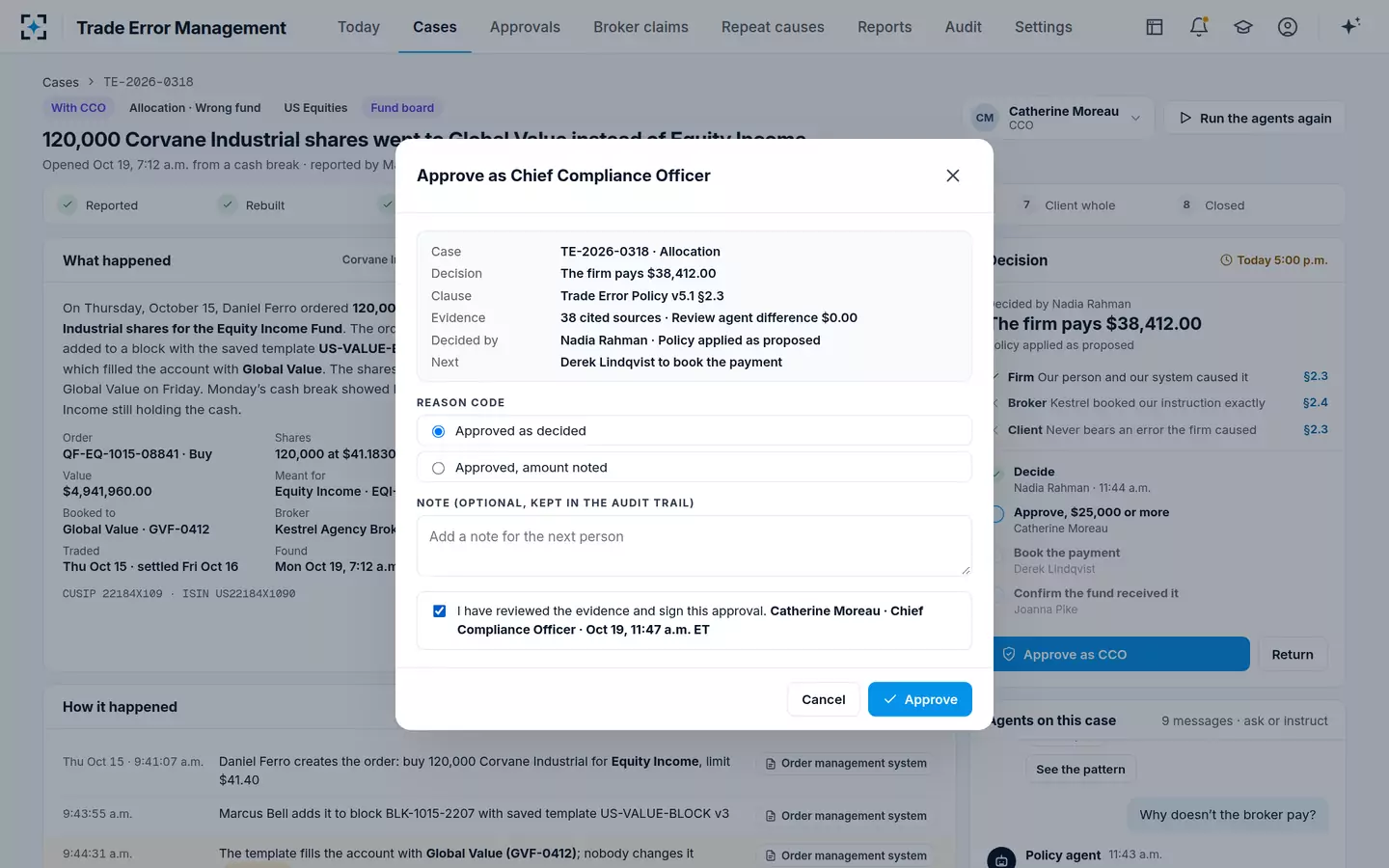
Five roles in the trade error process, and what each one keeps
A sound process gives each role one thing it alone may do, and one thing it may never do. The trader reports and executes but never approves the correction of an error they made. Operations rebuilds and books but books nothing before the decision is signed. Compliance decides but does not check its own decision. The CCO approves the large cases but does not decide them. Fund accounting confirms receipt independently of everyone who handled the money.
Written down, these become the segregation-of-duties clause of the policy; enforced by the system, they stop the shortcut that a busy desk will otherwise take. In the solution the maker of a decision can never check or approve it, administrators never sign, and every override carries a reason code. The agents sit outside the chain of signatures altogether: they prepare each step and propose, and a person clicks.
Five people in the trade error process: their week by hand, and with the agents
Today
Reports an error by email or chat, often without the order facts, and is asked for them again later.
With agents
Gives the order ID and one sentence; the agents read the order and fills and come back only with questions.
Still theirs: Executes the corrective trade once it is approved. Never approves the correction of an error they made.
Today
Rebuilds the order from four systems by hand, approves corrections by chat and books payments from a workbook.
With agents
Approves the correction on the rebuilt timeline, and books the payment only after the decision is signed.
Still theirs: The correction trade and the booking from the firm's error account.
Today
Pieces each case together from emails, a spreadsheet and the policy PDF, then picks the clause from memory.
With agents
Opens each case rebuilt, priced and checked, asks the agents what she needs, and decides with a reason code.
Still theirs: The decision on cause, payer and amount.
Today
Re-reads decisions against the workbook and the policy, and signs large ones between other deadlines.
With agents
Sees the maker, the clause and every cost line on one page, recomputed by a second agent.
Still theirs: The second signature: a check under the threshold, the CCO's approval above it.
Today
Finds the error as a cash break, then waits to hear what happened and when the money will arrive.
With agents
Confirms each fund received its payment, which closes the case.
Still theirs: Independent confirmation that the client is whole.
When must the client be made whole?
As soon as the facts are fixed and the decision is signed, and the policy should set a limit. There is no SEC deadline, but every day of delay is a day the client's money is in the wrong place, and the settled orders show the SEC expects reimbursement with interest when payment comes late. The sample policy allows five business days from the decision.
Luxembourg sets the expectation in writing for funds: the CSSF "expects the corrective actions relating to any error/non-compliance within the scope of this Circular (including the payments necessary to correct the loss suffered) to be carried out as soon as possible with a view to ensuring the interests of UCIs/investors are safeguarded" (CSSF Circular 24/856, point 158). The make-whole step has two halves, booking the payment and confirming the client received it, and the second belongs to someone outside the trading chain, usually fund accounting or the custodian.
Where does the trade error process stall?
At the hand-offs. The work in each step is short; the wait for the next person is long. The rebuild waits for someone with access to four systems to find time; the decision waits for the cost; the second signature waits for a senior person between other deadlines; the booking waits for the signature; the confirmation waits for the booking to show up.
Where a trade error's business days go, by hand and with the agents preparing each step
- Report and log1 d
- Rebuild1 d
- Price½ d
- Clause and signatures1½ d
- Book and confirm2 d
- Report
- Rebuild
- Price
- Sign
- Book
Two stalls deserve particular attention. The first is the rebuild, because nothing else can start until it is done, and because a hand-built timeline is where errors in the error case begin. The second is the approval, because it is where the evidence is supposed to be read; a senior signer under time pressure who approves from a summary is the control the Truist order found missing. The FCA's 2014 notice against Invesco Perpetual shows a third stall, at the start: trades booked late. Its internal audit found 9% of fixed income trades over two years were not recorded on the day of execution, "approximately 17% of these late trades were booked two or more days after execution and in one instance, a late trade was not recorded" until 27 days after (FCA, Invesco, 2014). An error that is not visible cannot enter the process at all.
The trade error process at a glance: who acts, what they wait for, and the evidence they leave
| Step | Who | Waits for | Evidence left behind |
|---|---|---|---|
| Report | Trader, operations, fund accounting, or an automated signal | Someone to notice | Report time, reporter, first description |
| Rebuild | Operations (with the solution, an agent) | Access to the order system, FIX logs, matching and custodian | Timeline with each event cited to its record |
| Correct | Head of trading operations approves; trader executes | The rebuilt facts | Correction approval and the corrective fills |
| Price | Operations (with the solution, an agent, rechecked by a second) | The final correction fill | Cost per client, line by line |
| Decide | Compliance officer | The final cost and the evidence | Cause, payer, amount, clause, reason code, signature |
| Approve | Second compliance officer, CCO, COO | The decision | Second signature, never the maker's |
| Book and confirm | Operations; fund accounting | The approval | Payment from the error account; confirmed receipt |
| Learn | Compliance and the head of trading | Enough cases to see a pattern | Repeat cause, fix requested, result measured |
Trade error resolution with Trade Error Management
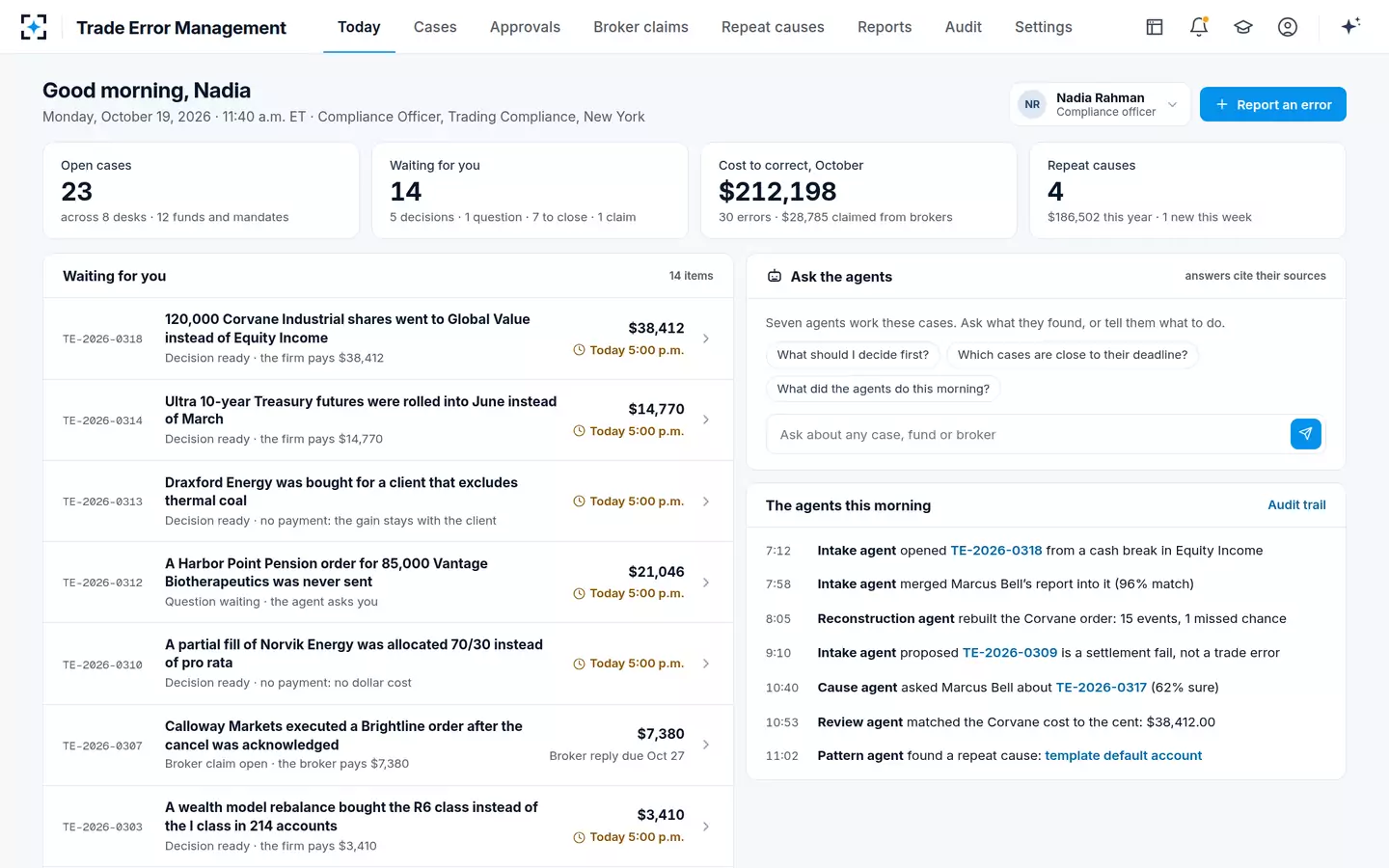
The solution keeps the people and the signatures and removes the waits between them. Its agents open the case from the first signal without anyone typing it up, rebuild the order from the systems of record, meter the cost per client as the correction fills, and apply the firm's own policy clause by clause, routing the approval by amount. The compliance officer's Today screen ranks what needs her: in the sample, 23 open cases across 8 desks, 14 waiting for her, with the deadline and amount on each.
The compliance officer's queue in Trade Error Management, ranked by deadline and amount
Resolution in this sense is not only the payment. The case closes when fund accounting confirms receipt, and it stays open for learning: the Pattern agent linked the Corvane case to two earlier errors on the same block template, three in 60 days costing $54,482 together, and drafted a change request for the head of trading to approve. Allocation controls before the next quarter-end follows that fix. Every step, by a person or an agent, is in an audit trail the sample firm keeps for seven years, a setting above Rule 204-2's five-year minimum, and the cases themselves form the error log an examiner asks for, as the trade error log template sets out.
Questions people ask
What is trade error resolution?
Trade error resolution is the part of the process after the facts are fixed: the decision on cause, payer and amount, the approval, the payment and the confirmation that the client is whole. A resolution is complete when each of those has a signature and evidence behind it, not when the corrective trade settles.
Who approves a trade error reimbursement?
The firm's policy decides, but the pattern is a decider plus a second signer scaled to the amount. In the sample policy that is a second compliance officer under $25,000, the CCO from $25,000, and the COO with a fund board notice from $250,000. The person who made the error never approves its correction.
Should the trader who made the error execute the correction?
Often yes, because the trader knows the order and the market, but only after someone else approves the correction. Execution and approval are different acts; separating them is what stops a correction being used to move a loss, as in the Truist case.
What if the broker caused the error?
The firm should still make the client whole on its own clock and pursue the broker in parallel. In the sample, the Policy agent drafts the claim, reads the broker's reply in any language and keeps a 10-business-day clock, after which the firm pays the client and pursues the claim.
How long should the trade error process take?
No rule says. The sample policy's clocks are one hour to report, the same business day to decide once the cost is final, and five business days to make the client whole. The design target for the solution is the same day from report to signed decision.