A trade error correction puts each affected client account where it would have been if the error had not happened, and the firm that caused the error pays the cost: the loss on unwinding the wrong trade, the commissions and fees on both the error and the fix, any worse price the right account paid when it finally traded, and, for a missed trade, the opportunity lost. A gain from an error stays with the client account in which it arises. One client's gain may never offset another client's loss, and within one account only the legs of the same error belong together. Botminds' Trade Error Management prices every correction this way, per client, as the correction fills, and has a second agent recompute it from the raw fills before anyone signs.
Netting is where corrections go wrong, and the money moves in only one direction when it does: from clients to the firm. The arithmetic below is ours, on an invented pair of accounts, and it is the whole argument in two bars.
One error, two clients: netting turns the firm's cost into a client's
Not netted · the firm pays $40,000
- Firm pays client A's loss · $40,000 · 100%
Netted · the firm pays $25,000
- Firm pays · $25,000 · 62.5%
- Client B's gain covers the rest · $15,000 · 37.5%
How is a trade error corrected?
In three moves: fix the positions, price the difference, pay it. Since US trades began settling one business day after the trade on May 28, 2024, an error found the next morning has usually settled, so fixing the positions means trading: selling what the wrong account should not hold and buying for the account that should. Where the error is caught before settlement, the broker may be able to rebook the allocation instead, which costs nothing in the market but needs the broker's principal to approve the account change.
Pricing compares each account after the correction with where it would have been. Paying means booking the firm's share from its own error account to each client, separately, and confirming each received it. In the solution's fictional sample, a block of 120,000 Corvane Industrial shares bought for the Equity Income fund on Thursday, October 15, 2026 was allocated to Global Value by a saved template. On Monday the head of trading operations approved the correction: Global Value sold the 120,000 shares at $40.9016 and Equity Income bought 120,000 at $41.1905.
How do you calculate the cost of a trade error correction?
Term by term, per client, from the actual fills. The cost is the sum of what each client lost because of the error and the correction, less nothing: no term is offset by another client's gain.
The cost of a trade error correction, term by term
Unwind loss
Shares × (price the wrong account paid − price it sold at)
Reversed for a wrong sale: the cost of buying back. Positive only if the move went against the client.
Operations, from the correction fills
Commissions and fees
Commission on the wrong trade + on the corrective trade + transaction fees
The client paid both commissions; neither should stay with it.
Operations, from the commission schedule and fee tables
Replacement difference
Shares × (price the right account paid − price it would have paid)
What the intended account lost by buying later, or selling later, than it should have.
Operations
Currency and opportunity
FX on the error legs + value of a missed trade, if the policy pays it
Opportunity cost usually only for a firm order; see the policy clause.
Operations, with compliance on the clause
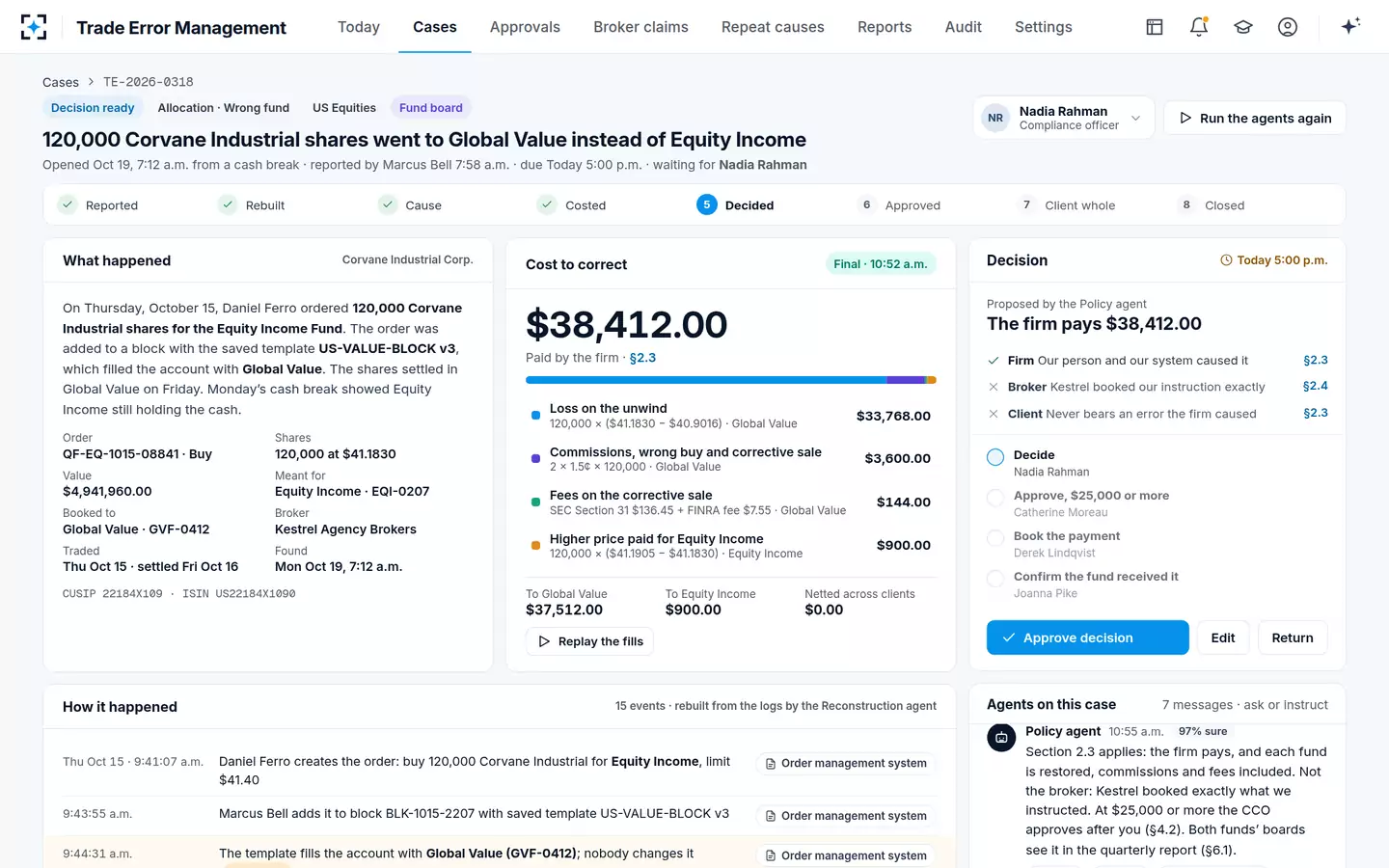
Applied to the sample case, the arithmetic gives $38,412.00, and it is worth reading line by line because each line is a place where a hand calculation commonly slips.
One correction priced line by line: the sample Corvane allocation error
| Line | Arithmetic | Client | Amount |
|---|---|---|---|
| Loss on the unwind | 120,000 × ($41.1830 − $40.9016) | Global Value | $33,768.00 |
| Commissions, wrong buy and corrective sale | 2 × 1.5¢ × 120,000 | Global Value | $3,600.00 |
| Transaction fees on the corrective sale | Regulatory fees on the sale | Global Value | $144.00 |
| Higher price paid for the right fund | 120,000 × ($41.1905 − $41.1830) | Equity Income | $900.00 |
| Paid to Global Value | $37,512.00 | ||
| Paid to Equity Income | $900.00 | ||
| Netted across clients | Nothing offset | $0.00 | |
| Total paid by the firm | From its error account, never from client commissions | $38,412.00 |
The $900 line is the one most often missed. The error cost Equity Income nothing directly, because it never held the wrong position, but it bought on Monday at a higher price than it would have paid on Thursday. Leaving that line out would have made the client pay for the delay the firm's error caused.
Who keeps the gain from a trade error?
The client account in which it arises. If the market moved in the client's favour while it held a position by mistake, the client keeps the gain; the firm does not take it to its error account. This is the standard the SEC saw in one firm's published policy, "to retain in a client's account, a net gain resulting from an error" (SEC, Western Asset, 2014), and the one Luxembourg writes into its fund circular for allocation errors: "Where the erroneously allocated investments generated a profit, the UCI will retain this profit" (CSSF Circular 24/856, point 115).
The reason is the duty of loyalty. An adviser "cannot favor its own interests over those of a client" (84 FR 33669), and a firm that keeps the gains from its errors while paying the losses has a stake in when and how errors are found and corrected. Keeping gains with clients removes the stake. In the sample, one case shows exactly this: a stock bought for a client whose mandate excluded it produced a gain, so the decision was "no payment: the gain stays with the client".
Can trade error gains offset losses across clients?
No. Netting one client's gain against another client's loss shifts the firm's cost onto a client, as the bars at the top of this page show, and no fiduciary standard allows the firm to pay its debts with one client's money. The question usually arises in a disguised form: an allocation error between two funds, where one fund's windfall seems to "cover" the other's shortfall. It does not; they are two clients with two accounts.
Can trade error gains offset losses in the same account?
Only within the same error, and the SEC's 2020 Franklin order shows where the line sits. The adviser made corrective sales of three exchange-traded funds held by its allocation funds. It lost money on one and made money on the other two, and it "ultimately concluded, as a result of offsetting gains that the Allocation Funds earned from selling two different securities—shares in ETF Nos. 2 and 3— that FAV would not reimburse the Allocation Funds' losses in ETF No. 1" (SEC, Franklin Advisers, 2020).
Franklin's gains on two other ETFs were larger than its loss, and still could not offset it
The order found that the decision "created a conflict of interest due to FAV's financial incentive to avoid having to reimburse", that the board was not told, and that it departed from the firm's own policy. The lesson for a policy is precise: within one account, the legs of one error may be netted, such as a wrong buy and its corrective sale; gains on different securities, or on different errors, may not.
Luxembourg's circular puts the same principle into a rule for funds: "the impact of an instance of non-compliance with investment rules must be determined individually for each instance of non-compliance", with aggregation allowed only for closely linked simultaneous instances and only where the fund can "demonstrate that the aggregated treatment did not cause a loss to investors" (CSSF Circular 24/856, points 86–88).
The cost meter in Trade Error Management: per fund, line by line, nothing netted
Does opportunity cost count in a trade error correction?
For a missed or late trade, it is the whole cost, and policies usually pay it only when the order was firm. There is no wrong position to unwind; the client lost the price it would have had. The arithmetic is shares × (price eventually paid − price available when the order should have executed). In the sample, a pension plan's 85,000-share order given by chat "today if under 31" was never entered; bought the next day at $31.2476, the opportunity cost was $21,046 if the chat counts as a firm order.
Where a position was wrong for weeks, a fair measure can be harder than one price difference. The SEC's Western Asset settlement used a comparison: the payment to 89 plan clients rested on "a methodology comparing the performance of Glen Meadow and the performance other corporate financial bonds held by such ERISA client accounts during the relevant period", plus reasonable interest, $9,620,392 in all (SEC, Western Asset, 2014). Luxembourg calls the same idea the economic method.
Two ways to measure what a fund lost: the CSSF's accounting and economic methods
Accounting method: "the gain or loss realised in the accounting of the UCI", from the transaction that caused the breach and the one that fixed it.
Economic method: The accounting result compared with how the money would have performed if invested within the fund's policy.
Accounting method: "By default, the accounting method is the method to be used by UCIs."
Economic method: Only if "formally provided for in the internal policy in place for the UCI", with its comparative reference.
Accounting method: All costs of the purchase and the sale are included.
Economic method: The reference "must not have been carried out with the purpose of reducing to the minimum the compensations to be paid".
Who pays the commissions and fees on a corrective trade?
The party that caused the error, and never the client. That includes the commission on the original wrong trade, which the client already paid, and the commission and transaction fees on the corrective trade. In the sample, both commissions, $3,600.00, are in the firm's bill. Luxembourg extends the rule to the cost of the correction process itself: "The fees resulting from the corrective actions of an error/non-compliance must not be borne by the UCI" (CSSF Circular 24/856, point 133), including staff costs and legal fees.
One shortcut deserves a clause of its own: a broker offering to absorb the cost of an error in exchange for future business. The client pays for that favour through commissions on later trades, so the sample policy books the firm's share from its own error account, "never from client commissions".
What do ERISA rules say about correcting trade errors?
That the plan must be made whole, and more strictly than an ordinary account. A fiduciary that breaches its duties is personally liable to repay the plan's losses from each breach and to hand back any profit it made with plan assets (ERISA §409). Because the duty attaches breach by breach, a plan policy can reasonably refuse to net even within one account; what the SEC rules actually say sets §409 beside the Advisers Act.
The Department of Labor's correction program, which covers listed fiduciary breaches rather than trade errors as such, shows how the department measures "whole": "the correction amount is the amount that must be paid to the plan as a result of the Breach in order to make the plan whole", usually the principal involved plus "Lost Earnings", which "is intended to approximate the amount that would have been earned by the plan on the Principal Amount, but for the Breach" (DOL, Voluntary Fiduciary Correction Program, effective March 17, 2025). A trade error policy for plan accounts can borrow that discipline: price the loss, add what the money would have earned, and pay it to the plan, not to a netting pool. Correcting a plan error by moving securities to another client is a separate problem, covered in the cross trade rules.
Trade error correction in Trade Error Management
The solution splits the money work between two agents and two people. The Cost agent meters the correction per client as fills arrive: price, commissions, fees, currency and opportunity cost, from the correction fills, commission schedules, fee tables and FX rates. It never nets gains against losses across clients and never books money. The Review agent, running on a different model family, recomputes every cost from the raw fills and blocks the case if its total differs by more than $1. A compliance officer decides; operations books.
Asked whether anything can be netted, the agents answer from the policy and the facts
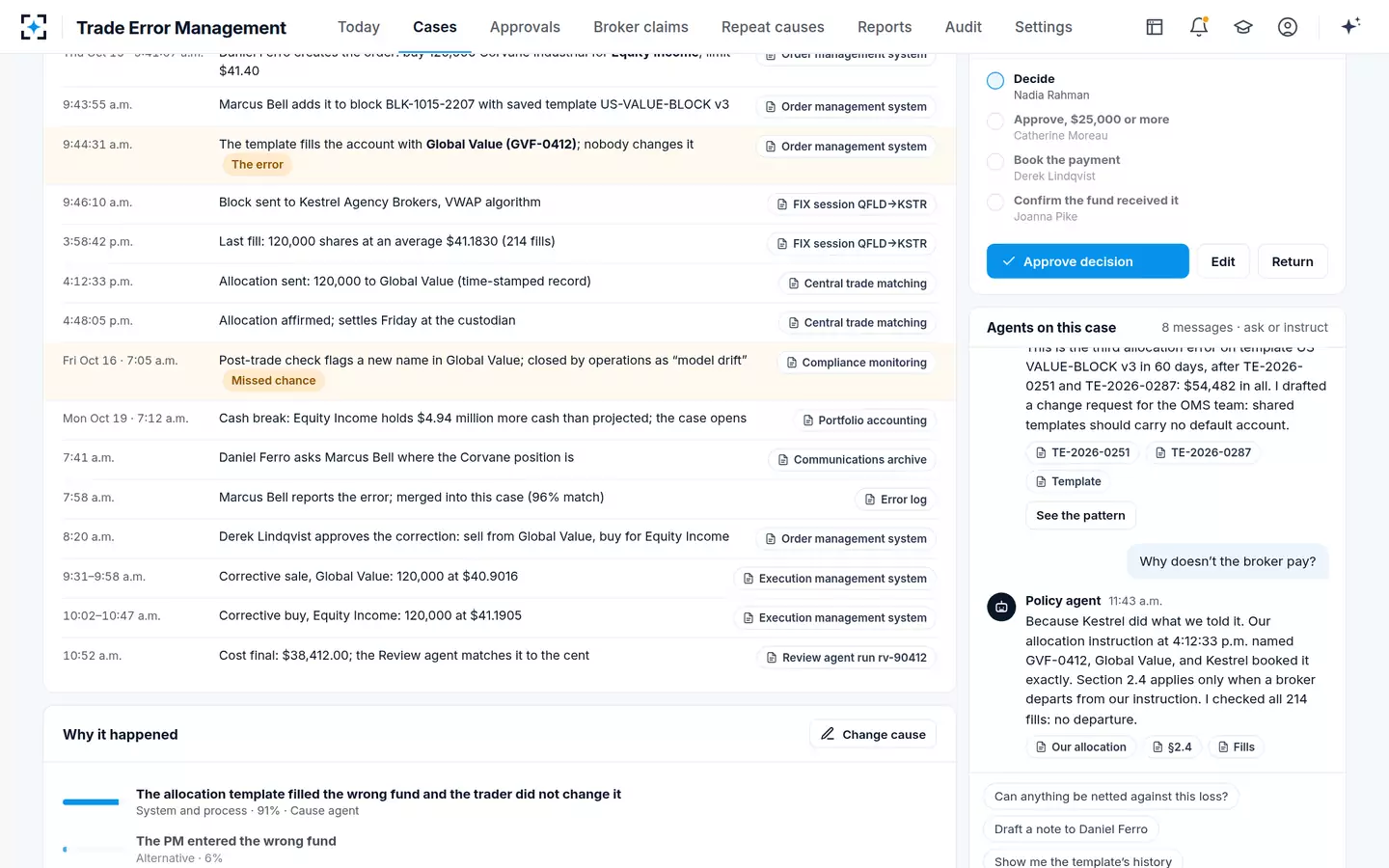
The design target is that every error closes with cause, clause, two signatures and cited evidence, and that every figure in the case can be traced to a fill. That is what makes a correction defensible years later, when an examiner asks why a client received $900 and not more. For what goes into the record of each correction, see the trade error log template.
Questions people ask
Is a trade error correction the same as a cancel and rebill?
A cancel and rebill is one way to correct an allocation before or after settlement: the broker cancels the trade from the wrong account and books it to the right one at the original price. It avoids a market trade, but it is also the mechanism the SEC found was used in 2026 to move a representative's losing trades into clients' accounts, so every rebill needs approval on the evidence.
Should the firm pay interest on a trade error reimbursement?
When payment is not prompt, yes. The settled orders show reimbursement "including interest" (Franklin) and "plus reasonable interest" (Western Asset). A short make-whole clock is cheaper than the interest.
What if the correction produces a gain for the client?
The client keeps it, and there is nothing to pay. The case should still be logged with the cause and the evidence, because the next error from the same cause may go the other way.
Can the firm use its error account gains to fund losses?
A firm's error account should hold only the firm's own money and the positions it takes over to correct errors. If the error account ends up with a gain, it is because a position moved after the firm took it over, which is the firm's risk; a policy that keeps client gains in that account has the conflict this page describes.
Who checks the cost calculation?
Someone other than the person who made it, from the raw fills rather than from the first person's workbook. In the solution a second agent does the recomputation, and a second person signs the decision, so the check is both arithmetic and judgment.