A trade error is a mistake in placing, executing or booking a trade, judged against what the investment adviser intended when the decision was made: the wrong security, side, quantity, price, account or timing, an order never sent, or a trade the client's mandate did not allow. A bad investment decision carried out exactly as intended is not one. The line matters because no SEC rule defines the term, so the adviser's own written definition decides which losses the firm restores to clients at its own cost. Botminds' Trade Error Management exists for the work that follows that line: it opens a case for each error, rebuilds the order from its logs, prices the correction per client and applies the firm's error policy, while people decide and sign.
Definitions sound academic until one is wrong. In 2014 the SEC sanctioned an adviser whose compliance staff decided that an allocation caused by a mis-coded security was not an "error" under its own policy, so 99 pension accounts were not told or reimbursed for nearly two years (SEC, Western Asset, 2014). The definition was the failure.
Twelve kinds of trade error, in four families
Order entry
- Wrong securityThe ticker, CUSIP or share line keyed is not the one the portfolio manager chose.
- Wrong sideA buy entered as a sell, or a sale marked long that should be short.
- Wrong quantityTen times the size, or shares keyed as dollars: the classic fat finger.
- Wrong price or limitA limit of $81.40 keyed for $18.40, or a market order where a limit was ordered.
Routing and execution
- Order never sentA firm instruction that never reached the order system or the broker.
- Sent lateWorked hours after the instruction, on the wrong day, or after the close it was meant for.
- Duplicate orderThe same order sent twice, or resent after a reject that had already filled in part.
- Filled after a cancelThe broker executes an order the desk had already cancelled.
Allocation and booking
- Wrong account or fundThe block is allocated to a fund the order was not for.
- Wrong share class or currency lineThe right fund, the wrong class: R6 for I, or a hedged class for the unhedged one.
- Unfair split of a partial fillA part-filled block shared 70/30 where the allocation policy says pro rata.
Mandate and restriction
- Breach of a guideline or legal limitA trade the client's guidelines, the prospectus or a statute did not allow, caused by the trade itself.
Three losses that are not trade errors
- A decision that lost moneyExecuted exactly as the portfolio manager intended.
- Ordinary market costSlippage and impact on an order worked as instructed.
- A counterparty's settlement failThe trade was right; delivery was late.
What is a trade error? The test is intent at the time of the trade
The working test is a comparison: what the adviser meant to do when it decided, against what was entered, executed and booked. Where the two differ because someone or something in the chain made a mistake, there is a trade error. Where they match and the trade simply lost money, there is not. Nor is an order that was entered correctly but executed expensively: that is a question for the best execution review, described in what best execution means in practice. The comparison needs evidence of intent, which is why the order memorandum the SEC requires an adviser to keep, recording each order's terms and any later change or cancellation, is the first exhibit in most error cases (17 CFR 275.204-2(a)(3)).
Two things make the test harder than it looks. Intent is often recorded in more than one place, such as a model, a chat, an order ticket and a block template, and they can disagree. And the error is usually found by someone other than the person who made it: a cash break at the fund accountant, a reconciliation exception, a broker's letter. The definition therefore has to work from the evidence, not from anyone's memory.
The SEC's 2019 interpretation of the fiduciary duty explains why the definition carries money. It holds that an adviser's "federal fiduciary duty may not be waived" (84 FR 33669), and the duty of loyalty forbids an adviser to "subordinate its clients' interests to its own". A loss the firm caused and left in a client account is the firm's cost carried by the client. What the interpretation does not do is use the word "error" at all; the full text, footnotes included, never mentions it. What the SEC rules say about trade errors follows that gap from rule to rule.
What are examples of trade errors? Twelve kinds in four families
Grouping errors by where they enter the chain, rather than by how much they cost, tells a compliance team where the control failed. The four families are order entry, routing and execution, allocation and booking, and mandate and restriction.
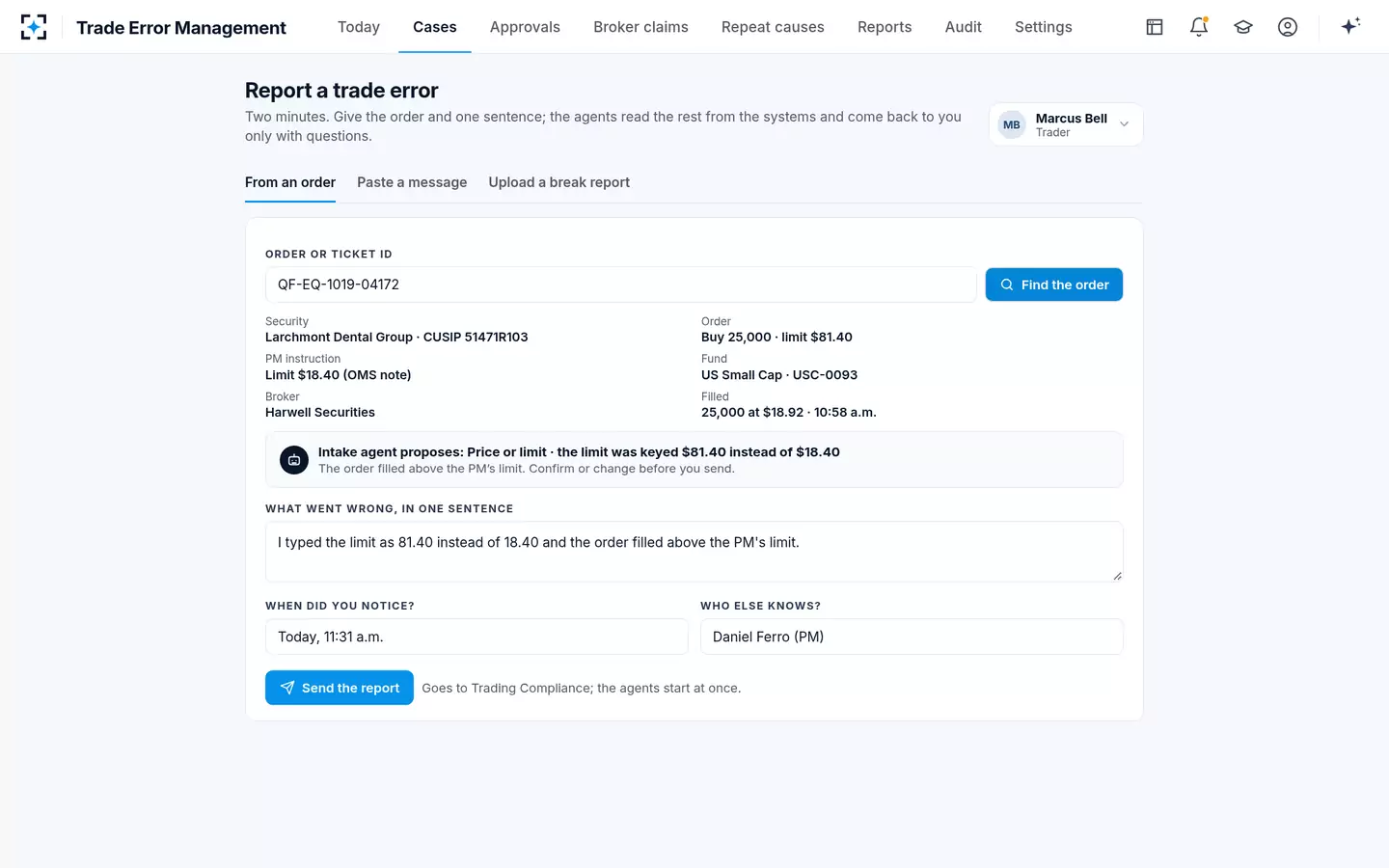
Order entry errors happen before the order leaves the desk. A wrong side can also be a regulatory problem: Regulation SHO requires a broker to "mark all sell orders of any equity security as 'long,' 'short,' or 'short exempt'" (17 CFR 242.200(g)), so a sale booked to an account that does not hold the shares becomes, in effect, a short sale that was neither marked nor located as one. A wrong price shows in a sample case from the solution's fictional firm, Quillfield Capital: a limit keyed as $81.40 instead of $18.40, filled at $18.92, above the portfolio manager's limit.
Routing and execution errors happen between the desk and the fill. They are the family where the broker is most often at fault: an order filled after the desk's cancel was acknowledged, or a Tokyo broker's trader keying 64,000 shares for an order of 46,000, both sample cases the solution carries as broker claims.
Allocation and booking errors happen after the fill, when the block is split among accounts. They are quiet, because every individual trade looks right; only the account is wrong. Luxembourg's fund-error circular names the same kinds: "a security that should have been allocated to sub-fund A of a UCI was erroneously allocated to sub-fund B", one fund instead of another, and "transactions (e.g., currency hedging transactions) were allocated to the wrong share class" (CSSF Circular 24/856, point 113).
Mandate and restriction errors are trades the client never permitted. In the SEC's 2020 case against Franklin Advisers, the adviser's own trade error policy covered "losses incurred by clients for a security bought or sold in contravention of regulatory investment restrictions" (SEC, Franklin Advisers, 2020). A breach caused by a trade belongs in the error policy; a limit crossed by market movement alone, with no trade, is usually handled under the guideline-monitoring procedures instead. Stopping the trade before it is sent is a different control, the pre-trade check, covered in pre-trade vs post-trade compliance; this guide starts where that check was missed or overridden.
A wrong limit reported in two minutes: Trade Error Management's Intake agent proposes the kind of error
Is a bad investment decision a trade error?
No. A decision that turns out badly, carried out as the portfolio manager intended, is investment risk the client accepted when it hired the adviser. The firm does not owe the client the difference between the decision it made and a better one it might have made.
The difficulty is that a bad decision and an error can look identical in the accounts. A purchase in a stock that fell 12% the next day is a decision; the same purchase in the wrong fund is an error, and the loss belongs to the firm. The only thing that separates them is the evidence of intent at the time. That is also where the conflict lies: an adviser deciding whether its own loss was an error has an interest in the answer, which is why the decision belongs with compliance, not the desk, and why it should be written down with the evidence it rested on.
Errors and non-errors that look alike in the accounts
A trade error, owed to the client: Bought in the wrong fund, or ten times the intended size.
Not a trade error: Bought as the portfolio manager decided, and the price fell.
A trade error, owed to the client: A limit keyed wrongly, or an order sent hours late against the instruction.
Not a trade error: An order worked as instructed in a market that moved; the cost is for execution review.
A trade error, owed to the client: A firm order, written with a quantity and a limit, that was never entered.
Not a trade error: An indication of interest that never became an order.
A trade error, owed to the client: A sale booked to an account that did not hold the shares.
Not a trade error: A counterparty that failed to deliver on a trade booked correctly.
A trade error, owed to the client: A trade that put the account outside its limits.
Not a trade error: A limit crossed by market movement alone, with no trade.
Is a fat finger order a trade error, and can the market undo it?
Yes, a fat finger order is a trade error, and usually it stands. Broker-dealers with market access must have controls to "prevent the entry of erroneous orders, by rejecting orders that exceed appropriate price or size parameters, on an order-by-order basis or over a short period of time, or that indicate duplicative orders" (SEC Rule 15c3-5(c)(1)(ii)). Those controls catch the extreme cases before they reach the market, not the ones that look plausible.
Once an order executes, breaking it is rare. FINRA's clearly erroneous rule lets a FINRA officer void a trade in an exchange-listed security if "the transaction is clearly erroneous", generally acting within 30 minutes, and its numerical guidelines start at a 10% deviation from the reference price for trades priced up to $25 in normal hours (FINRA Rule 11892). The guidelines measure how far the price strayed. A wrong quantity filled at a fair price does not stray, so it is the adviser's error to unwind in the market, at whatever the market charges for the round trip.
Is a missed trade a trade error?
It depends on whether there was a firm order. A missed trade is an error when an instruction specific enough to execute existed and was not carried out; it is not when the instruction was still an idea. Most policies draw the line at a written order with a quantity and a time or price limit.
The cost of a missed trade is different from the others: there is no wrong position to unwind, only the opportunity the client lost. In one sample case the portfolio manager asked by chat to buy 85,000 shares for a pension plan "today if under 31", the order was never entered, and the stock was bought the next day at an average of $31.2476. If the chat was a firm order, the client is owed 85,000 × ($31.2476 − $31.00), or $21,046. The sample policy pays it only for a firm order, so the agent asks compliance instead of deciding, as the screen below shows. How a trade error correction is priced covers the opportunity-cost arithmetic in full.
Is a settlement fail a trade error?
Not by itself. A fail where the counterparty did not deliver on a correctly booked trade is a settlement problem, handled by operations under the settlement rules, and it may cost the client nothing beyond a delay. A fail caused by the adviser, such as a sale allocated to an account that does not hold the shares, is a trade error that happens to surface as a fail.
The distinction matters for the log. A firm that counts every fail as a trade error inflates its error rate and buries the real ones; a firm that counts none misses the ones it caused. In the sample, the Intake agent's morning included proposing that one signal was "a settlement fail, not a trade error" and routing it to the settlement team, with the reason on the case.
Who decides whether it counts as a trade error?
Compliance should, under a written definition, with the evidence attached and the decision recorded. The trader who made the mistake, and the desk whose budget may carry the cost, should report and explain but not decide. Two SEC orders show what happens otherwise.
"By applying a narrow definition of the term “error” under its error correction policy, WAM was able to conclude that a coding and allocation issue affecting 99 ERISA client accounts did not require disclosure."
SEC order, In re Western Asset Management Co., January 27, 2014
In that case the policy covered "regulatory, trading and settlement errors". A security had been coded as eligible for pension plans when its offering terms excluded them; the adviser bought $204 million of it for 233 accounts, including more than $90 million of face value for 99 accounts governed by ERISA, the federal law for private-sector pension plans. When a former client pointed it out in October 2008, compliance staff "first determined that there was no 'error' within the meaning of WAM's error correction policy". Clients were told in August 2010. The SEC found that the firm, "by interpreting its error correction policy narrowly", had "effectively exempted" the problem "from its own compliance controls" (SEC, Western Asset, 2014).
The lesson for drafting is to define errors by their effect on the client account, not by a list of departments where they can occur. A coding mistake that causes an allocation the client never permitted is an allocation error, wherever the mistake was made.
Who usually pays, by family of trade error
| Family | Usual cause | Who pays under a typical policy | What decides it |
|---|---|---|---|
| Order entry | The adviser's trader, portfolio manager or order system | The adviser | The order memorandum and the order system's audit trail |
| Routing and execution | Either side: a late or missing order is usually the adviser's; a fill after a cancel or a keying slip at the broker is the broker's | The adviser, or the broker when it departed from the instruction | The FIX messages: what was sent, acknowledged and filled, and when |
| Allocation and booking | The adviser's allocation instruction or template, occasionally the broker's booking | The adviser, unless the broker booked something other than the instruction | The time-stamped allocation the adviser sent |
| Mandate and restriction | Missing or wrong data in the pre-trade check, or an override | The adviser | The guideline, the security's data and who approved the trade |
How often do trade errors happen? The nearest published measure
No regulator publishes a count of advisers' trade errors. The nearest published measure comes from banks' operational losses, collected by the Basel Committee using a standard set of event types. One of them, execution, delivery and process management, covers the failed processing that trade errors are made of.
In banks' trading businesses, most operational losses are process errors
76.7%
of trading and sales internal losses of €20,000 or more were execution, delivery and process failures
30.6%
of losses of €20,000 or more across all business lines were the same event type
121banks
in 17 countries took part in the exercise
The committee put it plainly: "in Trading & Sales the highest internal loss frequency (76.7%) was associated with EDPM" (BCBS, 2009), its abbreviation for execution, delivery and process management. The point for an adviser is the shape, not the number: in trading, losses come mostly from processing, not from fraud or system outages, so a definition and a log that catch processing errors early catch most of the loss.
How Trade Error Management sorts a signal before anyone decides
The solution applies the definition at intake, not at the end. Its Intake agent opens a case from a reconciliation break, a post-trade compliance alert, a custodian notice, a broker letter or a trader's report, merges duplicate reports of the same error, and proposes a kind of error for a person to confirm. Signals that are not trade errors, such as a counterparty's settlement fail, are routed to the team that owns them with the reason written on the case.
When the definition does not settle it, the agent asks
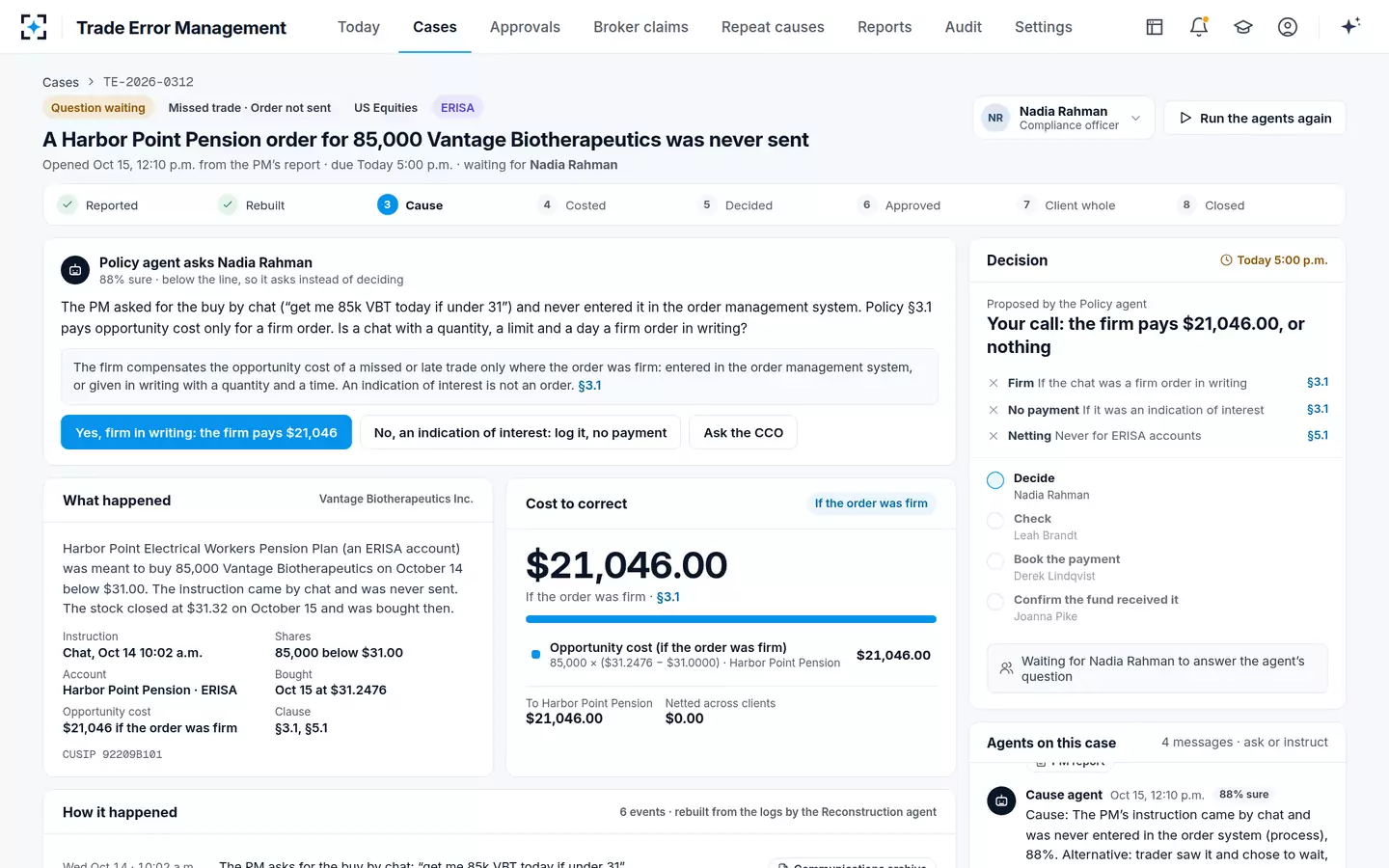
Where the classification is uncertain, the agents do not guess. The Cause agent asks the trader or compliance when its confidence is below 85%; the Policy agent asks when a clause does not settle the case. Every answer, and every override of a proposal, is kept with a reason code. A definition applied the same way to every signal is the best protection against the narrow reading that cost Western Asset its examination. Once a signal is confirmed as an error, the trade error process sets out who waits on whom until the client is whole.
Five questions that classify a loss
- What did the adviser intend at the time?
Find the order memorandum, the model or the written instruction, with its time.
- What was actually entered, executed and booked?
Order system audit trail, FIX messages, the allocation sent and the custodian's booking.
- Where did the two first diverge?
That step names the family and usually the party that pays.
- Did the divergence cost the client, or benefit it?
A gain usually stays with the client; a loss is restored.
- Does a clause of the policy settle it?
If not, compliance decides and writes down why, and the policy is reviewed.
Questions people ask
What is a non-market trade error?
The phrase is used loosely for an error that costs the client nothing in the market, such as a misallocation caught and rebooked before settlement at the same price, or a wrong share class with no price difference. It is still an error: it belongs in the log with its cause, even when the correction amount is zero, because the same cause can cost money next time. One sample case, a partial fill split 70/30 instead of pro rata, had no dollar cost and still went to a fairness review.
Is a trade error the same as a guideline breach?
Not always. A breach caused by a trade the client's guidelines did not permit is a trade error in most policies, and the cost of unwinding it is restored to the client. A limit crossed only because prices moved involves no trade and is usually handled under guideline-monitoring procedures, often with time to cure.
Can a broker cause a trade error?
Yes. A fill after an acknowledged cancel, a wrong quantity keyed at the broker, or a booking that departs from the adviser's allocation instruction are the broker's errors. In the sample policy the broker pays only when it departed from the adviser's instruction; when it booked exactly what the adviser sent, the error is the adviser's.
Is a trade error the same as a cancel and rebill?
No. A cancel and rebill is a correction mechanism: the broker cancels a trade from one account and books it to another. It can fix an allocation error, and it can be abused. In September 2026 the SEC found that an adviser approved ten such corrections moving a representative's losing trades from his own account to clients', $503,659 in all (SEC, Truist Advisory Services, 2026).
Do I have to log errors that cost nothing?
A good policy says yes. The log is how a firm finds causes that repeat, and a cause that cost nothing this time is the cheapest one to fix. It is also what an examiner reads to judge whether the definition is applied consistently, which is the question the Western Asset order turned on. A trade error log template lists the fields each entry needs.