A trade allocation system is the part of an investment adviser's trading stack, usually inside the order management system, that records the intended split of a block order among client accounts, divides the fills according to the firm's allocation policy, sends the allocation instruction to the broker before the end of trade date, and keeps a time-stamped record of each step. It is where most allocation errors are born: a saved template naming a default fund, a partly filled block split by hand, a change made after the price moved. Botminds' Trade Error Management is not an allocation system; it works the errors the allocation system lets through and turns the causes that repeat into fixes. This guide covers the controls an allocation system should enforce, how to switch them on without a disruptive cut-over, and how the two fit together.
The examples here come from the solution's fictional sample firm, Quillfield Capital, where the same allocation template caused three errors in 60 days. The plan below is our suggestion, built around four checkpoints rather than a single launch date.
Four checkpoints to put allocation controls live before quarter-end
- 1 · Baseline: count last year's allocation errors by cause
From the trade error log: which templates, desks, account types and order types produced errors, and what each cost. This is the number the new controls must lower.
- 2 · Configure: write the policy into the system
Allocation method by order type, partial-fill rule, who may change an allocation after execution and with whose approval, templates cleaned of default accounts, warnings set.
- 3 · Replay: run last quarter's errors through the new controls
Each past error is a test case: would the new control have stopped it, warned, or let it through? Record the result for every case.
- 4 · Live, then measure through quarter-end
Switch on with daily review of every override, then compare errors per thousand orders before and since, cause by cause.
What is a trade allocation system?
It is the record and the engine of who gets what from a block trade. The record holds the intended allocation before the order goes out, the fills, the final allocation, every change and who approved it, and the time each instruction was sent. The engine applies the firm's method, usually the same average price for every account and a pro rata split of a partial fill, and produces the instruction the broker and central matching receive.
Regulation reaches the system through its outputs. Advisers must keep each allocation and affirmation with a date and time stamp showing when it was sent or received (Rule 204-2(a)(7)(iii)), brokers must have procedures to finish allocation "no later than the end of the day on trade date" (Rule 15c6-2), and the SEC's 2003 compliance release lists, among the issues an adviser's policies should address, how it "allocates aggregated trades among clients" (68 FR 74714). Post-trade allocation under T+1 covers the deadlines in detail.
What controls stop trade allocation errors?
The controls that work are the ones that act before the allocation is sent, and they are mostly mundane. The table lists them with the rule or case that makes each one matter and the evidence it leaves behind.
Allocation controls, why each one matters, and the evidence it leaves
| Control | Why it matters | Evidence it leaves |
|---|---|---|
| Intended allocation recorded before the order is sent | The FCA found a manager "failed to make or retain records of the initial decision to deal and the intended allocation" | Pre-trade allocation with its time stamp |
| No default accounts on shared block templates | The sample firm's template filled Global Value on every block it touched | Template register with owner and last review |
| Warning when a child order's fund differs from the allocation | Catches the template slip at the desk, on trade date | Warnings shown and the trader's response |
| Allocations locked after execution, changes only with compliance approval | The SEC's Cetera order: allocations made "after the opportunity to observe price movements" | Every post-execution change with approver and reason |
| Partial fills split by the written method | UK and EU rules require an order allocation policy covering "the treatment of partial executions" | Allocation method applied, and any deviation approved |
| Size warning against the trader's usual order | Seven sample errors in a year from quantities keyed far above normal | Warning, second click and who made it |
| Same-day check of allocations against intent and positions | Finds a wrong fund before settlement, when a rebook is still cheap | Exceptions and how each was closed |
| Outcome monitoring by account group | Shows whether any group is consistently favoured: the CFTC rule forbids it for futures allocations, and the Cetera order shows the test examiners run | Periodic comparison of allocation results by account group |
The template control deserves a word of its own because templates are invisible until they fail. A saved block template is a decision made once and applied silently to every order that uses it. James Reason's description of "latent conditions" in safety-critical work fits exactly: they "may lie dormant within the system for many years" before combining with an ordinary slip (BMJ 2000;320:768). The sample template had filled the Global Value account on every block; it took a trader not changing it, three times, to surface.
How does pre-allocation work under T+1?
The intended split is recorded at order entry, account by account; the system applies it to the fills automatically when the block completes; the instruction goes to the broker the same afternoon; and any change after execution needs a reason and an approver. Under T+1 the timing is not optional. In the sample case the allocation was sent at 4:12:33 p.m. and affirmed at 4:48:05 p.m. on trade date, and the trade settled the next day, so a wrong fund found on Monday cost a market correction of $38,412.00.
The FCA's 2014 notice against Invesco Perpetual shows the pre-allocation discipline as a remedy. After internal audit found trades booked late and no record of intended allocations, the firm "enhanced its processes so that investment decisions and intended allocations are now recorded on a pre-trade basis" (FCA, Invesco, 2014). A pre-trade record turns a post-trade allocation from a judgment into a comparison.
What does FINRA Rule 4515 require?
It binds brokers, and it shapes what an adviser's allocation system must send. Before any customer order is executed, the broker must record the account or accounts it is for, and "no change in such account name(s) (including related accounts) or designation(s) (including error accounts) shall be made unless the change has been authorized by a qualified and registered principal", with the essential facts documented (FINRA Rule 4515). Supplementary Material .01 lets brokers accept advisers' bulk-order allocations as an exception.
From November 16, 2026, FINRA's amendment removes the principal-approval step for advisers' bulk allocations whatever time they arrive; Regulatory Notice 26-17 says the change is meant "to eliminate operational burdens that can delay timely allocation processing" and that "the investor safeguards in Rule 4515.01 remain unchanged" (FINRA RN 26-17). The safeguards are the ones an allocation system should enforce on its own side: allocations follow the adviser's intent at execution, never the trade's performance afterwards.
What is a trade allocation policy, and how do you prove allocations were fair?
The allocation policy is the written method the system applies: which accounts take part, how fills are priced and split, how partial fills and minimum lots are handled, how new issues are rotated, and who may override. The SEC's 2019 interpretation ties it to the fiduciary duty: when allocating investment opportunities an adviser "must eliminate or at least expose through full and fair disclosure the conflicts associated with its allocation policies, including how the adviser will allocate investment opportunities" (84 FR 33669).
"The allocation methodology must be sufficiently objective and specific to permit independent verification of the fairness of the allocations using that methodology by appropriate regulatory and self-regulatory authorities and by outside auditors."
CFTC Rule 1.35(b)(5)(iv)(C), on allocating bunched futures and swaps orders
Proving fairness means testing outcomes, not only following the method. The SEC's Cetera order shows the test regulators use: one representative's own accounts earned average first-day returns of about 0.50% on equity trades while his clients' earned about –2.10%, a difference the SEC called statistically significant, with "the probability of these results occurring by chance" "nearly zero" (SEC, Cetera, 2024). An allocation system that can produce that comparison by account group, routinely, lets the firm run the test before an examiner does.
The outcome test the SEC applied: first-day returns by account group
What must be tested before go-live?
Every control against the errors it is meant to stop, and every override path against misuse. The best test set is the firm's own trade error log: each past allocation error is a case with a known answer. In the sample, the year's log held 318 errors across 132,840 orders, 71 of them allocation errors; a replay of last quarter's share of those through the new controls tells the firm which would have been stopped, warned or missed.
Tests before allocation controls go live
- Replay last quarter's allocation errors
Record, for each, whether the new control stops it, warns or misses it, and why.
- Try to change an allocation after execution
As a trader, as a portfolio manager and as an administrator; only the approval path should work, and it should leave a reason.
- Allocate a partial fill
Check the written method is applied without manual edits, including minimum lots and rounding.
- Send an allocation at 4:55 p.m.
Check the time stamps, the broker's receipt and the affirmation, and who is told if it is late.
- Use a template with a default account
The template register should not allow it; if one slips through, the fund-mismatch warning should fire.
- Produce the fairness report
Allocation outcomes by account group for a past period, in a form an examiner could read.
- Close an exception
Follow one same-day exception from alert to closure and check the reason is recorded; "model drift" is not a reason.
How long does it take to implement trade allocation controls?
Plan in weeks, not quarters, by phasing it: the controls that need no system change, such as cleaning templates and requiring reasons for overrides, can go live first, while warnings and locks follow the system's release cycle. The timeline below is our suggestion for a firm aiming at a quarter-end, not a measured duration.
A twelve-week path to allocation controls live by quarter-end
- Baseline2 weeks
- Configure4 weeks
- Replay2 weeks
- Live, daily review4 weeks
Where Trade Error Management fits beside the allocation system
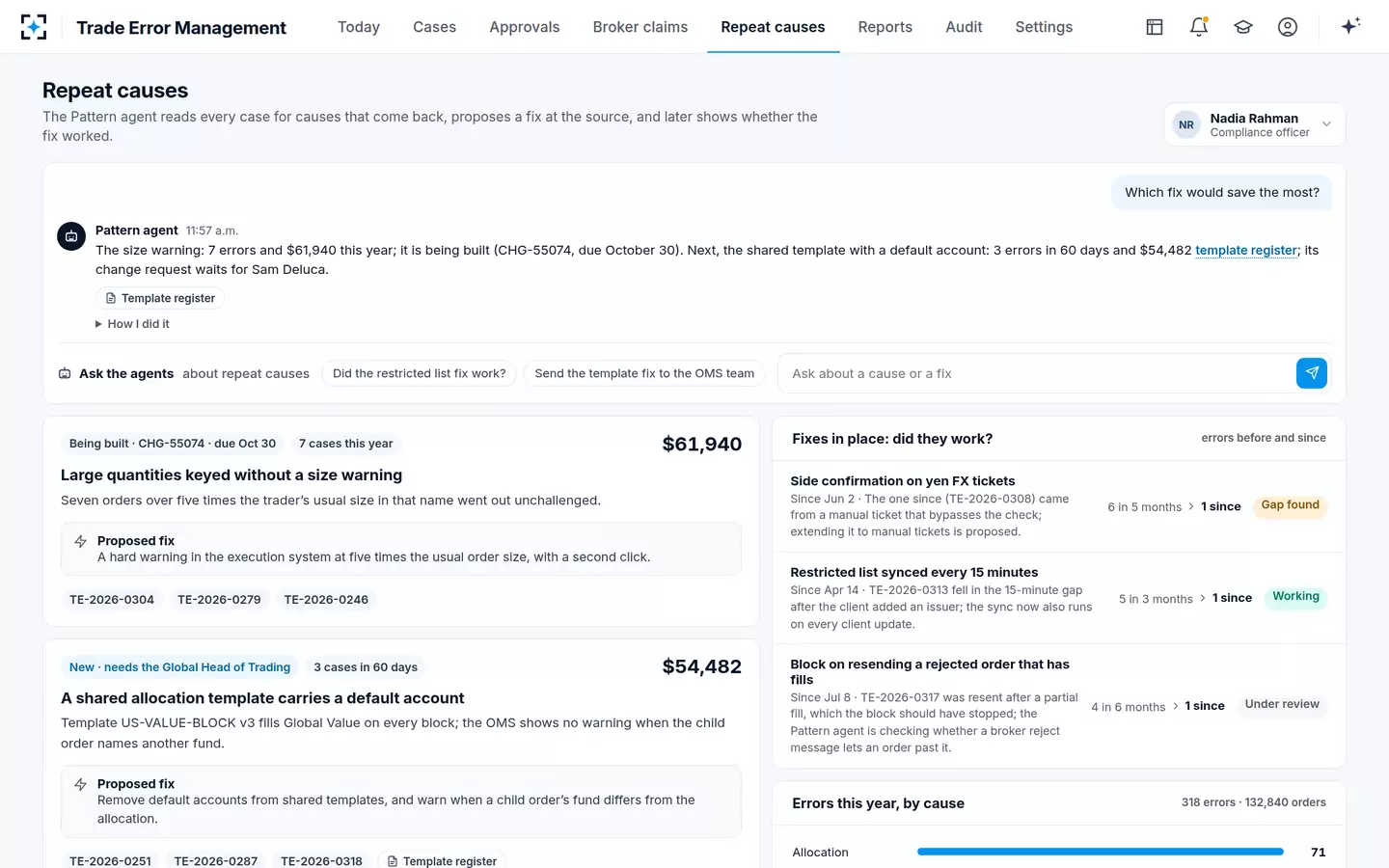
The allocation system prevents; the solution learns from what gets through. Its agents open a case from the first signal, rebuild the allocation from the order system and central matching, price the correction, apply the policy, and keep the case for the log. The Pattern agent reads every case for causes that come back, drafts the control fix for the order-system team with the cases as evidence, and later measures whether the fix worked. It never changes a system: in the sample, a change request needs the Global Head of Trading.
Repeat causes in Trade Error Management: which fix would save the most, and whether past fixes worked
An allocation system and Trade Error Management: different jobs, one loop
Allocation system: Before and at allocation, on trade date.
Trade Error Management: From the first sign that something went wrong, before or after settlement.
Allocation system: Intended and final allocations, changes, time stamps.
Trade Error Management: Each error's timeline, cause, cost per client, clause, signatures and payment.
Allocation system: The split, by the written method.
Trade Error Management: Nothing: it proposes; compliance decides and a second person approves.
Allocation system: Allocations, within its approval rules.
Trade Error Management: No system; it drafts change requests for the people who own them.
Allocation system: Supplies the records each error case is built from.
Trade Error Management: Returns repeat causes as fixes, and measures errors before and since.
Measured this way, the loop has a target: the solution's design aims for 30% fewer repeat errors in a year as causes are fixed at their source, a target to test on your own log rather than a result. The cases that feed it are the same ones described in the trade error log template.
Questions people ask
What is a trade allocation policy?
The written method for dividing block trades among accounts: participation, pricing, partial fills, minimum lots, new issues and overrides. UK and EU firms must have one under COBS 11.3 and the EU's Delegated Regulation 2017/565; US advisers write one because their compliance policies must address how they allocate aggregated trades, and because the fiduciary duty requires the conflicts in it to be disclosed.
Is average price allocation required?
No rule requires it, but it is the common default because it gives every account in a block the same price and removes the question of who got the best fills. Whatever method is used, it must be applied as written and be objective enough for someone else to verify.
Should portfolio managers be able to change allocations after execution?
Only through an approval path that records the reason and the approver, and never on the basis of the trade's performance since execution. FINRA's rule forbids brokers to knowingly facilitate performance-based allocations, and the SEC's Cetera order shows what happens when changes after the price is known go unchecked.
Do we need a new allocation system to meet T+1?
Not necessarily. The requirements are outputs: allocations sent by the end of trade date, time-stamped records kept, and changes approved. A firm may meet them with its current order system plus cleaned templates, warnings and an exception review; the replay of past errors shows whether that is enough.
How do you know the new controls worked?
Count errors per thousand orders, cause by cause, before and after, and keep counting. In the sample, each fix in place shows its errors before and since, and one, a confirmation on yen FX tickets, showed a gap: a manual ticket bypassed the check, which a before-and-after count found and a launch-day test would not have.