Trade error management is how an investment adviser handles a trade that went wrong: it logs the error, finds the cause, corrects the client's position, prices the cost per client, decides who pays under its trade error policy, gets a second signature, pays, and confirms the client is whole. Software for it should do the evidence work, rebuilding the order from its records, metering the cost and applying the policy's clauses, while people decide and sign. Botminds' Trade Error Management does that work as a conversation with seven agents that open each case, rebuild it, price it, check it and propose the clause, and this guide looks inside the one that matters most to a controller: the Cost agent, which meters the correction as it fills, refuses to net, and never books money.
The design of that one agent shows the design of the whole. It works per client, from the actual fills; a second agent recomputes its answer on its own; it never decides who pays; and every number it produces opens to the record it came from. The screen below is the case it serves, from the solution's fictional sample firm, Quillfield Capital.
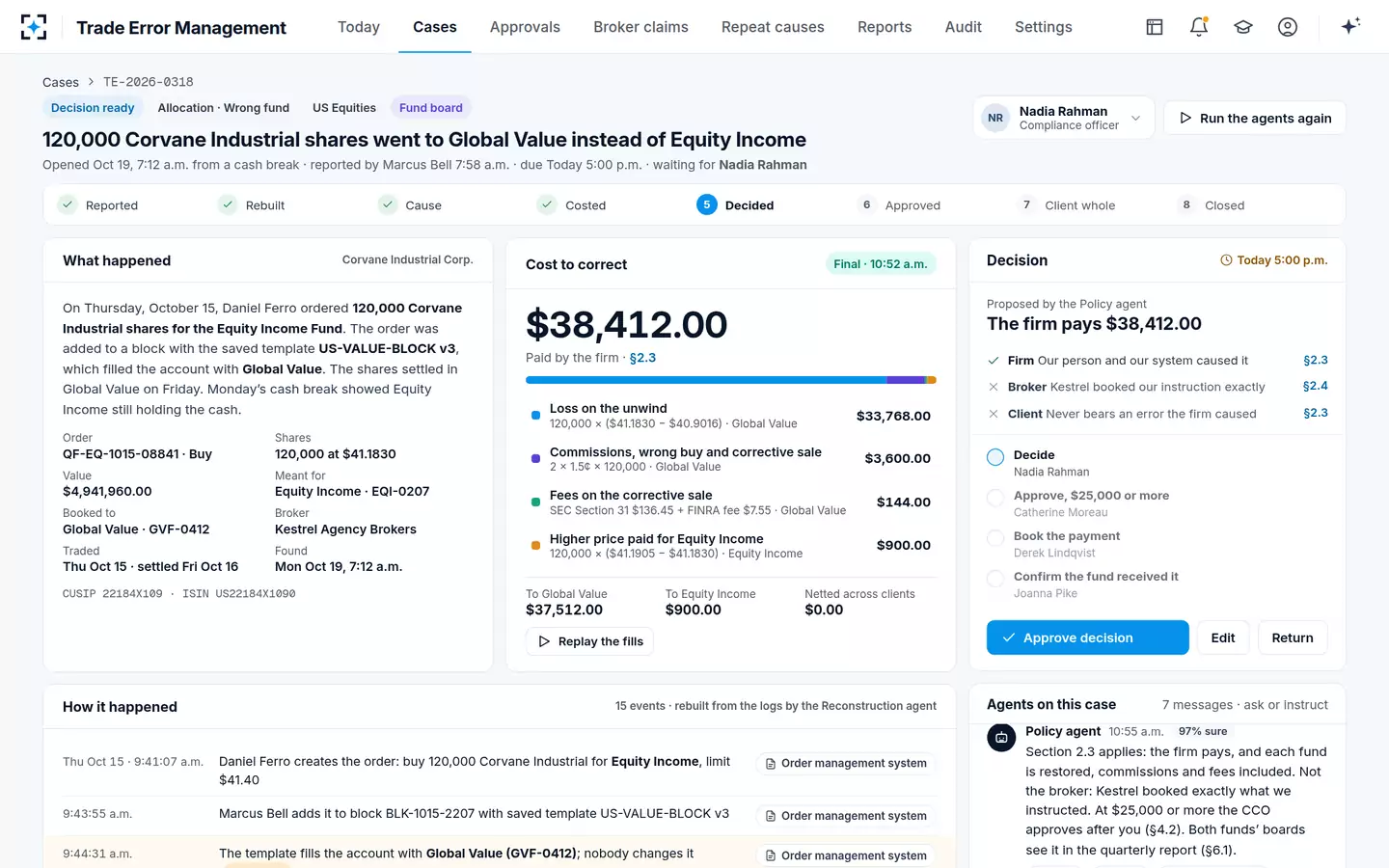
The cost meter in Trade Error Management: built fill by fill, per fund, nothing netted
What is trade error management?
It is the part of an adviser's compliance program that turns a mistake into a client made whole and a cause fixed. The SEC described the purpose of compliance policies in 2003 as to "prevent violations from occurring, detect violations that have occurred, and correct promptly any violations that have occurred" (68 FR 74714); trade error management is the "correct promptly" part for trading, with the prevention coming back round when repeat causes are fixed.
In most firms it runs on email, a spreadsheet log and a policy PDF. That works until it does not: a commission is left out, a gain is netted, the second signature is a rubber stamp, and an examiner's request for every error and how it was resolved takes a week to assemble. Software earns its place by removing those failure points, not by making the decision faster. The trade error process maps where the time goes.
How is the cost of a trade error calculated?
Per client, from the fills, term by term: the loss on unwinding the wrong position, commissions and fees on both the error and the fix, any worse price the right account paid, currency effects, and for a missed trade the opportunity cost if the policy pays it. In the sample case that came to $38,412.00: $33,768.00 on the unwind, $3,600.00 of commissions, $144.00 of fees and $900.00 because the right fund bought later at a higher price. The correction, line by line explains each term and why netting fails.
The Cost agent builds that figure as the correction fills rather than at the end. On Monday morning the corrective sale filled between 9:31 and 9:58 and the corrective buy between 10:02 and 10:47; the meter ticked with each fill, so the compliance officer could see the cost forming and the final figure was ready at 10:52. Nothing about the arithmetic is novel. What is new is that it is done the same way every time, from the source fills, and shown line by line.
What costs are included in a trade error?
Everything the client lost because of the error and its correction, and nothing the client gained elsewhere. The table sets out each term, where its inputs come from, and the rule the agent applies to it.
What the Cost agent in Trade Error Management prices, from which records, under which rule
| Term | Inputs | Rule the agent applies |
|---|---|---|
| Unwind loss or gain | Original fills; correction fills | Per account; a gain stays with the client account in which it arises |
| Commissions | Commission schedule for the broker and the trade type | Both the wrong trade and the fix; never paid from client commissions |
| Transaction fees | Regulatory and exchange fee tables in force on the trade date | Included on the corrective trades |
| Replacement difference | The right account's fills against the original price | Charged to the firm when the right account paid more, or received less |
| Currency | FX rates for each leg | Each leg at its own rate; differences kept per client |
| Opportunity cost | The price available when the order should have run; the later fills | Only where the policy pays it, usually a firm order; otherwise the agent asks |
| Across clients | All of the above | Never netted; the agent refuses and says why |
Can software calculate trade error costs automatically?
Yes, when it has the records and the rules, and it should stop where either runs out. The records are the correction fills, the commission schedules, the fee tables and the FX rates. The rules are the firm's policy clauses: whether opportunity cost is paid, how a partial fill is split, what is netted within an account. Where the records are missing, a good system marks the gap rather than filling it; where a clause does not settle the case, it asks.
In the solution, the meter's limits are written into the agent, and it says so on every case: it never nets gains against losses across clients, and it never books money. A missed trade given by chat is the standard example of a stop. The meter can compute that the opportunity cost would be $21,046 if the order was firm; whether it was firm is a compliance call, and the case waits for it.
How is a trade error calculation checked?
Independently, from the raw inputs, by something that did not make the first calculation. In the solution that is the Review agent: it recomputes every cost from the raw fills, on a different model family from the Cost agent, opens every citation before a person sees the case, and blocks the case if its total differs by more than $1. In the sample it matched $38,412.00 to the cent.
The point of two calculations is not that either is likely to be wrong. It is that a check which uses the first calculation's workbook only confirms the workbook. The same logic applies to people: under the sample policy, the person who decides a case can never check or approve it, and the trader who made the error can never approve its correction. The SEC's 2026 Truist order is a reminder of what a check without independence looks like: an adviser approved ten correction requests that moved a representative's losses into clients' accounts, $503,659, because nobody looked at whose account the trades came from (SEC, Truist, 2026).
Seven agents in Trade Error Management, and what each may never do
Agent
Intake agentOpens cases from reconciliation breaks, post-trade alerts, custodian notices, broker letters and trader reports; merges duplicates with a match score; routes non-errors, such as a settlement fail, to their team.
Never: close a case, or merge below 90% without a person's yes
Agent
Reconstruction agentRebuilds the order's life from the order system audit trail, FIX logs, central trade matching, the custodian and the communications archive, each event cited.
Never: edit a source system, or fill a gap it cannot source
Agent
Cause agentNames the root cause with a confidence and an alternative, from the timeline, the cause categories and past cases.
Never: decide below 85% confidence; it asks the trader or compliance
Agent
Cost agentMeters the correction per client as fills arrive: price, commissions, fees, FX and opportunity cost.
Never: net gains against losses across clients, or book money
Agent
Review agentRecomputes every cost from the raw fills on a different model family and opens every citation.
Never: let a case through when its total differs by more than $1
Agent
Policy agentApplies the firm's policy clause by clause: who pays, the approval route, plan and fund notices; drafts broker claims and keeps the reply clock.
Never: decide; it proposes, and asks when a clause does not settle the case
Agent
Pattern agentFinds causes that come back across cases, drafts the fix with the cases as evidence, and later measures whether it worked.
Never: change a system; a change request needs the Global Head of Trading
A person decides
Compliance, the CCO, operations, fund accountingA compliance officer decides with a reason code; a second person or the CCO approves; operations books from the error account; fund accounting confirms receipt.
Can AI decide who pays for a trade error?
It should not, and in this solution it cannot. Deciding who pays is a judgment about the firm's own liability, made under a policy the CCO owns, and an adviser's examiners will ask who made it. The Policy agent proposes the clause and the payer and shows the evidence; a compliance officer decides with a reason code such as "policy applied as proposed" or "policy applied, payer edited"; a second person approves. When a clause does not settle the case, the agent asks instead of proposing.
What the agents can do is make the decision well-informed and fast. Asked why the broker does not pay in the sample case, the Policy agent answered from the record: the firm's allocation instruction at 4:12:33 p.m. named the Global Value account, the broker booked it exactly, and the clause that makes the broker pay "applies only when a broker departs from our instruction. I checked all 214 fills: no departure." The decision stayed with the compliance officer; the evidence came with the answer.
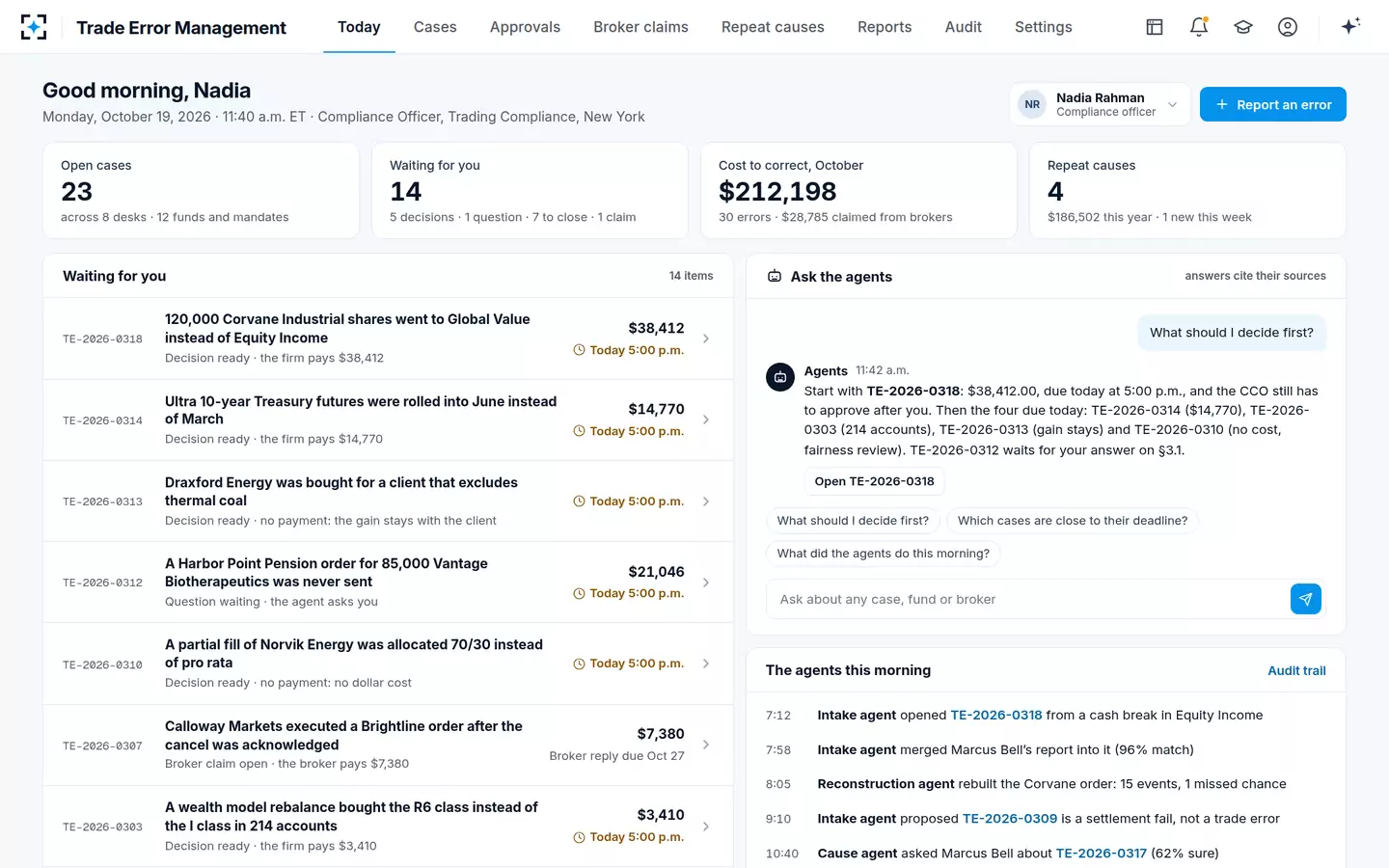
Asking the agents where to start: the day ranked by deadline and amount
What should you look for in trade error management software?
Look for the controls an examiner will test, not the dashboard. The questions below are the ones we would put to any system, including ours; a vendor that cannot answer one with a screen and a record has not built it.
Questions to ask any trade error management software
- Does it apply our policy, or its own?
Ask to see your clauses read into rules, each accepted by compliance, with versions dated and approved by the CCO.
- Does every number open to its source?
Fills, schedules, fee tables, the allocation record. A total without its lines is a workbook in a new window.
- Is the cost checked independently?
Recomputed from raw inputs by something other than the first calculation, with a tolerance that blocks the case.
- Can it net across clients?
The right answer is no, enforced, with the refusal shown on the case.
- Who can approve what?
Maker and checker enforced by the system: no one approves their own decision, and the trader never approves the correction.
- What happens when the policy is silent?
The system should ask a named person and record the answer, not guess.
- Does it handle plans, funds and non-US funds?
ERISA clauses, board reporting, and for Luxembourg funds a CSSF Circular 24/856 assessment.
- Can it touch our systems?
Read access to the order system, FIX logs, matching and custodian; writes to the general ledger only after approval; never edits a source system.
- What does the examiner get?
The log of every error and its resolution, each case file with evidence, the policy versions, signatures and the audit trail, kept at least as long as Rule 204-2 requires.
- Can we test it on our own past errors?
Replaying a sample of last year's cases and comparing the system's proposals with what your people decided is the only evaluation that counts.
A spreadsheet log and Trade Error Management, on the points examiners test
Spreadsheet, email and a policy PDF: When someone writes it up, often a day or more after the first signal.
Trade Error Management: From the first signal, by the Intake agent; duplicate reports merged.
Spreadsheet, email and a policy PDF: Rebuilt by hand from four systems; screenshots pasted into email.
Trade Error Management: Rebuilt from the records, each event cited, gaps marked.
Spreadsheet, email and a policy PDF: A workbook; terms forgotten; netting possible.
Trade Error Management: Metered per client from the fills; netting refused; recomputed independently.
Spreadsheet, email and a policy PDF: Picked from memory; the version in force not recorded.
Trade Error Management: Quoted from the policy version in force, with the approval route.
Spreadsheet, email and a policy PDF: Chat approvals; maker and checker not enforced.
Trade Error Management: Reason codes and signatures; maker-checker enforced; every override logged.
Spreadsheet, email and a policy PDF: Each case closed on its own.
Trade Error Management: Linked across cases; fix drafted with the evidence; result measured.
Where Trade Error Management fits, and where it does not
It fits between the systems that make trades and the people who answer for errors. It reads the order system, execution and FIX logs, central trade matching, portfolio accounting and the custodian, broker mailboxes and portals, and writes to the general ledger only after a booking is approved. It works the error from first signal to confirmed receipt and keeps the record an examiner reads.
It does not execute trades, allocate blocks or replace the order management system; corrections are approved by the head of trading operations and executed by traders in the firm's own systems. It does not decide who pays; people do. It is not a settlement-fail tool: signals that are fails rather than errors are routed to the team that owns them. And it is not pre-trade compliance: it learns from errors after the fact and proposes fixes, while the checks that stop a trade before it goes out live in the order system. The design targets, measured in the live solution and not results from any customer, are below.
Design targets for Trade Error Management
100%
of errors closed with cause, clause, two signatures and cited evidence
Sameday
from a reported error to a signed decision on cause, payer and amount
30%
fewer repeat errors in a year, as repeat causes are fixed at their source
The fastest way to judge it is on your own errors: a sample of past cases, your trade error policy and the order records behind them, replayed so the agents' proposals can be compared with what your people decided. Disagreements are as useful as matches; each one is either a clause the policy needs or a case the agents should have asked about. The trade error log template lists the fields that replay should produce for every case.
Questions people ask
Is trade error management software the same as an order management system?
No. The order management system places and allocates trades and holds the audit trail of what was done. Trade error software reads that trail, with the FIX logs, matching and custodian records, to work an error after it happens. The two connect: the error software's repeat-cause findings usually become change requests for the order system.
How long does it take to set up?
The work is connecting the systems of record read-only, reading the policy into rules for compliance to accept, mapping funds, approvers and thresholds, and replaying past cases to compare the agents with what people decided. The firm's own data access and review time usually set the pace, so ask for a plan with named checkpoints rather than a date.
Can the agents book the reimbursement?
No. In the solution the Cost agent never books money; operations books the payment from the firm's error account after the decision is approved, and fund accounting confirms receipt independently.
What happens if the two cost calculations disagree?
The Review agent blocks the case when its total differs from the Cost agent's by more than $1, and a person sees both calculations line by line before anything moves. A disagreement is usually a missing fill, a fee table or an FX rate, and the citation on each line shows which.
Does the software decide whether something is a trade error?
It proposes a classification; compliance confirms it. That matters because a narrow reading of "error" was the failure in the SEC's 2014 Western Asset order, where compliance staff decided an allocation caused by a coding mistake was not an error under the firm's policy (SEC, Western Asset, 2014).