A cross trade is a purchase and sale of the same security between two accounts managed by the same adviser, done without exposing the order to the market. No single investment adviser rule governs it: Section 206(3) of the Advisers Act requires written disclosure and client consent when the adviser acts as principal or as broker for the other side, Rule 17a-7 sets the conditions under which registered funds may cross with affiliates, ERISA prohibits crosses involving pension plans unless the statutory exemption's conditions are met, and the fiduciary duty governs the price in every case. On October 15, 2026 the SEC proposed to rewrite Rule 17a-7, with comments due December 14, 2026; it is a proposal, not a rule. For trade errors, a cross is tempting because it fixes a misallocation without market cost, and that is when the conditions matter most. Botminds' Trade Error Management treats a proposed corrective cross as something the firm's policy must allow, clause by clause, before anyone books it.
The benefit is real, and the SEC said so in an enforcement order: "Internal cross trades can benefit clients because the practice enables a manager to move securities among client accounts without having to expose the security to the market, thereby saving transaction and market costs" (SEC, Western Asset, 2014). The same sentence continues that the practice poses "substantial risks to clients due to the inherent conflict of interest for the adviser".
Rule 17a-7 today, and what the SEC's October 2026 proposal would change
Which securities
TodayOnly those "for which market quotations are readily available".
As proposedSecurities valued on quoted prices or observable inputs (level 1 and level 2), which brings most bonds back in; level 3 stays out.
Price
TodayThe "independent current market price": last sale for NMS stocks, the bid–offer average for most others.
As proposedEither the value in the fund's next NAV, or a price the adviser determines from one or more unaffiliated pricing sources.
Fit and best interest
TodayThe trade must be consistent with each fund's policy.
As proposedThe adviser must determine, before the trade, that it is in the best interest of the fund.
Payments
TodayNo commission, fee or other remuneration, except customary transfer fees.
As proposedDe minimis payments to unaffiliated parties for clearing, settlement, custody, recording or reporting.
Oversight
TodayBoard adopts procedures and determines at least quarterly that the trades complied.
As proposedCCO reviews quarterly and reports to the board; at least annual back testing of prices realised later.
Reporting
TodayNone to the SEC.
As proposedAggregate trading and cross-trading activity by asset class on Form N-PORT and Form N-MFP.
What is a cross trade?
A cross trade moves a security from one account the adviser manages to another, with one client selling and the other buying at a single price. It can be done directly between the accounts, through a broker matching both sides, or with a dealer buying from one client and reselling to the other by prearrangement. The form does not change the substance: the SEC's Western Asset order found that "the interpositioning of a dealer in these transactions does not remove them from the prohibitions of Section 17(a)" of the Investment Company Act.
The adviser sits on both sides of the price. A higher price helps the seller and hurts the buyer by the same amount, so every cross trade is a decision about how to divide a fixed sum between two clients the adviser owes the same duty. That is why each rule below is mostly about price and process, and why a cross belongs in the same evidence as any other execution the adviser must justify (best execution vs best price shows how that evidence is weighed).
What does Section 206(3) require?
Section 206(3) makes it unlawful for an adviser, "acting as principal for his own account, knowingly to sell any security to or purchase any security from a client, or acting as broker for a person other than such client, knowingly to effect any sale or purchase of any security for the account of such client, without disclosing to such client in writing before the completion of such transaction the capacity in which he is acting and obtaining the consent of the client to such transaction" (15 U.S.C. 80b-6(3)). It covers two situations: the adviser trading with a client from its own account, and the adviser acting as broker for the other side.
The second is an agency cross. Rule 206(3)-2 defines it as a transaction in which the adviser or an affiliate "acts as broker for both such advisory client and for another person on the other side of the transaction", and allows it on prospective written consent, a confirmation for each trade and an annual summary of the number of such trades and the commissions received (17 CFR 275.206(3)-2). The rule is unavailable where the adviser "recommended the transaction to both any seller and any purchaser", and it does not relieve the adviser of "acting in the best interests of the advisory client, including fulfilling the duty with respect to the best price and execution". A discretionary cross between two of the adviser's own clients therefore rests on the fiduciary duty and on whatever the clients were told.
Can an investment adviser cross trades between clients?
Yes, if the adviser's policies and disclosures permit it, the price is fair to both sides, and any rule that applies to the particular accounts is satisfied: Rule 17a-7 for registered funds, ERISA for plans. The price is where firms fail. In the Western Asset case the SEC found that the firm crossed bonds at the bid, so the buying clients received the whole benefit of avoiding the market, "even though both were advisory clients of Western and owed the same fiduciary duty".
"By cross trading securities at the bid, rather than at an average between the bid and the ask, Western favored the buyers in the transactions over the sellers."
SEC order, In re Western Asset Management Co., January 27, 2014
What crossing at the bid cost Western Asset's selling clients
$12.4M
market costs saved by not exposing the crossed bonds to the market
$6.2M
the selling clients' share of the saving, which went to the buyers instead
$7.44M
paid into a distribution fund for affected clients
$1M
civil penalty
The order also found that "at no time did Western's compliance systems and controls identify the impermissible cross trading", although most of the trades were done at identical spreads, which suggested prearrangement. A pattern visible in the data that nobody looked at is the same failure the SEC found in later allocation and correction cases.
What does Rule 17a-7 allow for funds?
Section 17(a) of the Investment Company Act forbids most purchases and sales between a registered fund and its affiliates; Rule 17a-7 exempts crosses between funds, and between a fund and certain affiliated accounts, that are affiliated only through a common adviser, directors or officers. The conditions are strict: cash against prompt delivery of a security "for which market quotations are readily available"; execution "at the independent current market price"; no "brokerage commission, fee (except for customary transfer fees), or other remuneration"; board-adopted procedures with a quarterly determination that every cross complied; and a written record of each cross kept "for a period not less than six years" (17 CFR 270.17a-7).
Two details trip up corrections. The price for a security other than an NMS stock is usually "the average of the highest current independent bid and lowest current independent offer", so a cross at the bid fails the rule, as Western Asset's did. And the requirement for readily available market quotations has kept many bonds out of the rule since the SEC's fund valuation rule took effect, which the 2026 proposal says has been the case "since September 8, 2022, the compliance date of rule 2a-5".
What would the SEC's 2026 cross trading proposal change?
Its stated aim is "to expand the scope of securities that are eligible for cross trading, modernize the rule's conditions, and enhance investor protection" (91 FR 65622). Eligibility would extend to securities valued on observable inputs, an approach the SEC says is designed "to reduce the risk of subjectivity, bias, or error in determining the price of the cross trade". Pricing would move to two methods, the fund's next NAV or a price the adviser derives from unaffiliated sources. Oversight would shift from the board's quarterly determination to an adviser's best-interest determination before each trade, a CCO's quarterly review, and "at least annual back testing of cross trades", including the prices realised when securities bought in a cross are later sold.
For a trade error policy, two points follow even before any rule is adopted. A corrective cross into or out of a fund must still meet today's rule. And the proposal's controls, a best-interest determination before the trade and testing of prices afterwards, describe what a careful adviser can already ask of any corrective cross.
Are ERISA cross trades allowed?
Only within the statutory exemption, and its conditions rule out most quick fixes. Section 408(b)(19) exempts a cross between a plan and another account of the same manager if, among other things, the trade is for cash in a security with readily available market quotations, at the independent current market price under Rule 17a-7(b), with no commission; a plan fiduciary independent of the manager has authorised cross trading in advance in a separate document; "each plan participating in the transaction has assets of at least $100,000,000"; the manager sends a quarterly report of every cross; and the manager follows "written cross-trading policies and procedures that are fair and equitable to all accounts participating in the cross-trading program" (29 U.S.C. 1108(b)(19)).
Three cross trade rules side by side: who they protect and what they demand
| Advisers Act §206(3) and Rule 206(3)-2 | Rule 17a-7 (registered funds) | ERISA §408(b)(19) (plans) | |
|---|---|---|---|
| Applies when | The adviser acts as principal, or as broker for the other side | A fund trades with an affiliate through a common adviser, directors or officers | A plan trades with another account of the same manager |
| Consent | Written disclosure and the client's consent; for agency crosses, prospective written consent | The fund's board adopts procedures | An independent plan fiduciary authorises in advance, in a separate document |
| Price | Best price and execution for each client | Independent current market price | Independent current market price, as in Rule 17a-7(b) |
| Payments | Disclosed commissions for agency crosses | None except customary transfer fees | None except disclosed customary transfer fees |
| Size or scope | Not available where the adviser recommended both sides | Securities with readily available market quotations | Plans of at least $100 million |
| Ongoing | Confirmation per trade; annual summary | Quarterly board determination; six years of records | Quarterly report to the plan; annual written compliance report |
The Labor Department's regulation adds the content of those policies: a statement of the criteria for deciding that a cross "will be beneficial to both parties to the transaction", a description of how the price is set "including the identity of sources used", and "a requirement that the investment manager allocate cross-trades among accounts in an objective and equitable manner" (29 CFR 2550.408b-19). A cross arranged after the fact to move an error out of a plan account is hard to fit into a program that must be authorised, priced and allocated in advance, which is why the sample policy in the solution simply says no corrective cross trades for plan accounts.
Can a cross trade correct a misallocation?
Sometimes, and it is the case the rules were least written for. Suppose a block was allocated to Fund B when it was bought for Fund A, and the error is found after settlement. Crossing the shares from B to A at today's price looks clean, but it leaves B with the loss or gain from the price move and makes A buy at a price it never chose, so the cross does not by itself make either client whole. The firm still owes each fund the difference from where it would have been, and a cross between two registered funds must meet Rule 17a-7, including its price.
Corrected in the market, not crossed: the sample allocation error in Trade Error Management
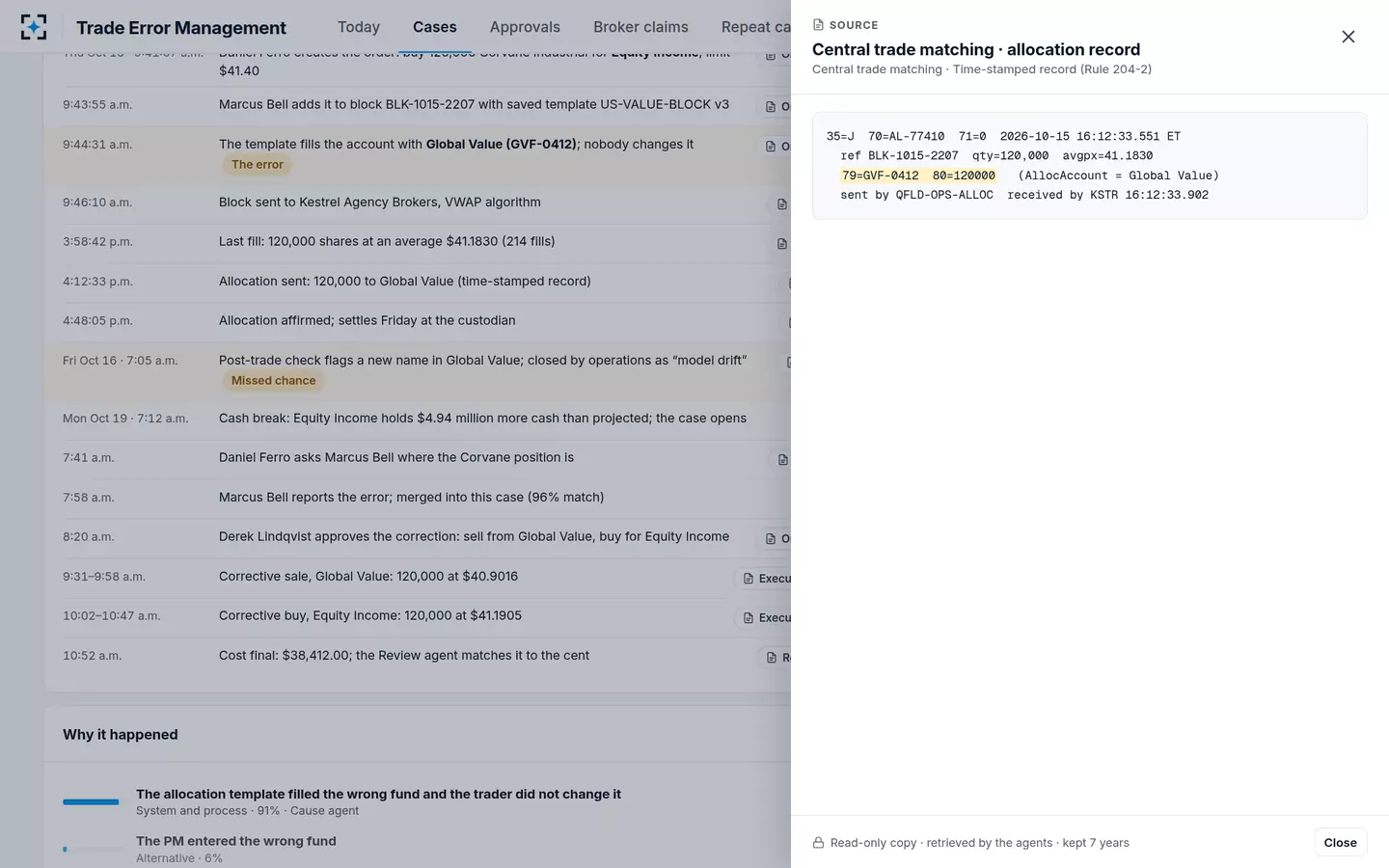
A cross can still be the better correction when the market for the security is thin and selling and rebuying would cost both funds more. Futures and swaps work differently again: the CFTC permits post-execution allocation of bunched orders provided "allocations must be fair and equitable" and "no account or group of accounts may receive consistently favorable or unfavorable treatment" (17 CFR 1.35(b)(5)), so a misallocated futures order is corrected within that fairness standard. How a trade error correction is priced shows the per-client arithmetic either way.
Before using a cross trade to fix a trade error
- Does the policy allow corrective crosses for both accounts?
Many policies exclude plan accounts entirely, and some exclude funds.
- Which rule applies to each side?
Rule 17a-7 if either side is a registered fund; ERISA §408(b)(19) if either is a plan; disclosure and consent under the Advisers Act otherwise.
- Is the price independent and current?
The bid–offer average or last sale, documented from a source the firm does not control; never the bid or the offer.
- Is anyone paid?
No commission for a fund or plan cross; any transfer fee disclosed.
- Does each client end where it would have been?
Price the remaining difference for each account and pay it; the cross moves shares, not the firm's obligation.
- Who approves, and who reviews afterwards?
Compliance before the trade; the CCO or the board in the periodic review, with the evidence kept.
How Trade Error Management treats a proposed corrective cross
The solution's Policy agent applies the firm's own policy to every case, including whether a cross may be used to correct it. Where the sample policy forbids corrective crosses for ERISA accounts, the agent says so and proposes a market correction instead; where a policy allows a cross under conditions, the agent lists each condition with the evidence for it and leaves the decision to compliance. The Cost agent then prices each client's remaining difference separately, and nothing moves until the head of trading operations approves the correction.
Plan accounts follow their own clauses in Trade Error Management
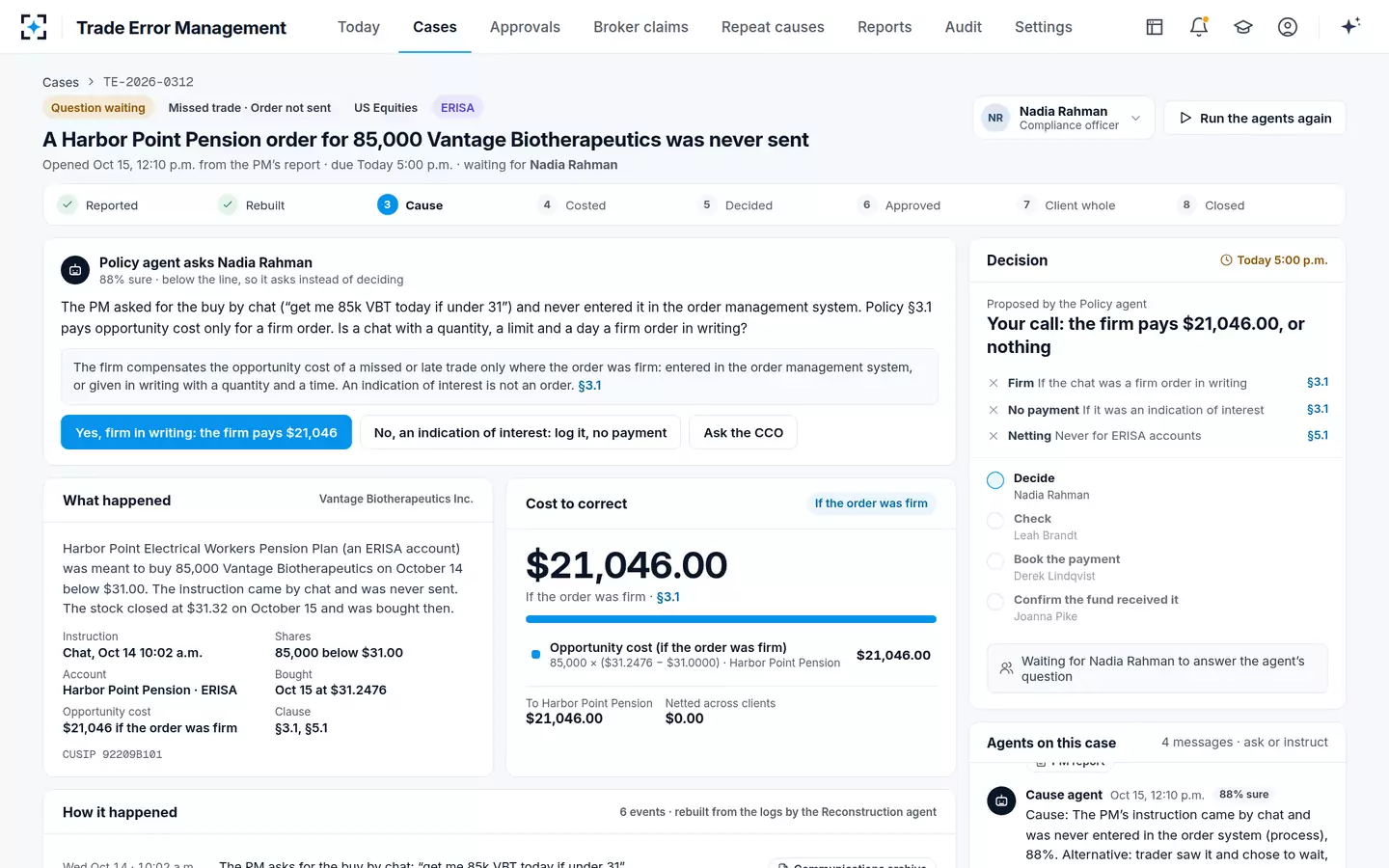
The audit trail matters as much as the rule. Every proposed and executed correction, with its price source and approver, is kept, so the quarterly review a fund board or a plan fiduciary is owed can be answered from the cases. For crosses that are part of normal portfolio management rather than corrections, the same discipline applies, and the trade error policy is where a firm says which corrections may use them.
Questions people ask
What is an agency cross trade?
A transaction in which the adviser, or a broker-dealer affiliated with it, acts as broker for both its advisory client and the person on the other side. Rule 206(3)-2 permits it on the client's prospective written consent, a confirmation for each trade and an annual summary, but not where the adviser recommended the trade to both buyer and seller.
Is a cross trade the same as a principal trade?
No. In a principal trade the adviser or an affiliate buys from or sells to the client for its own account; in a cross trade both sides are clients. Both are covered by Section 206(3) when the adviser acts as principal or as broker, and both are governed by the fiduciary duty on price.
When do comments on the SEC's cross trading proposal close?
December 14, 2026, for the proposal published in the Federal Register on October 15, 2026 (Release IC-36358). Until the SEC adopts a final rule, current Rule 17a-7 applies in full.
Can a private fund cross trade with a client account?
Rule 17a-7 applies only where a registered fund is involved, but the fiduciary duty, Section 206(3) where the adviser acts as principal or broker, and ERISA where a plan is involved still apply. Where the adviser or an affiliate is itself on one side, Section 206(3)'s written disclosure and consent before completion apply.
How often must cross trades be reviewed?
For registered funds, the board must determine at least quarterly that all crosses complied with its procedures; for plans, the manager sends a quarterly report and an annual compliance report. An adviser's own review should run at least as often as its clients' strictest requirement.