Post-trade allocation is how an investment adviser that trades one block order for many accounts divides the fills among those accounts after the order has executed, usually at the block's average price, by sending the broker an allocation instruction that names each account and its shares. Under T+1 settlement, in force in the US since May 28, 2024, brokers must complete allocation, confirmation and affirmation "as soon as technologically practicable and no later than the end of the day on trade date", and advisers must keep each allocation with a date and time stamp. The consequence for errors is blunt: an allocation to the wrong account found the next morning has usually settled, so correcting it means trading in the market at a cost the firm pays. Botminds' Trade Error Management reads those time-stamped allocations into each error case and opens the case from the first signal, so a slip is costed and decided the day it is found.
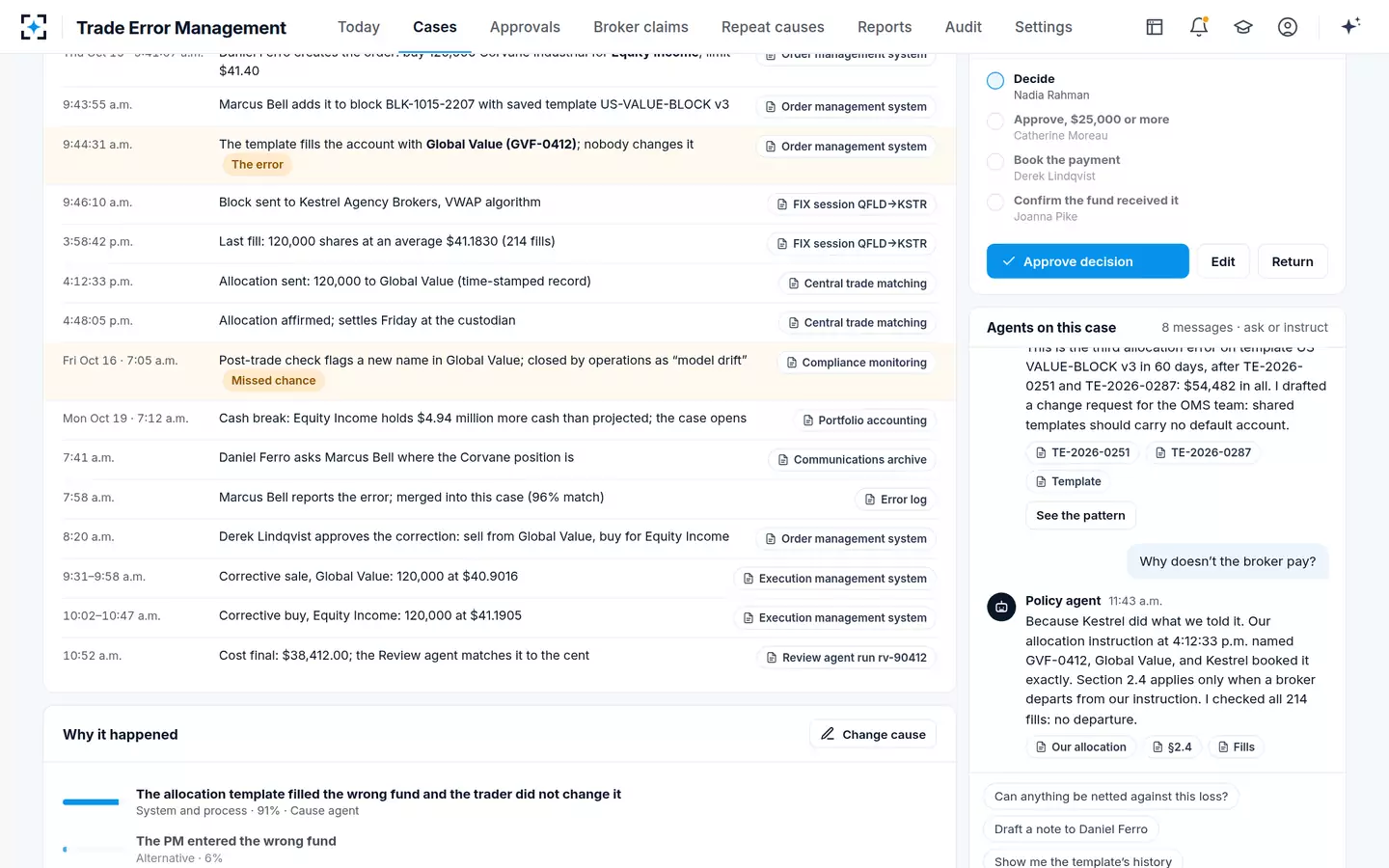
The example on this page is the solution's fictional sample case: a block of 120,000 Corvane Industrial shares bought for Quillfield Capital's Equity Income fund on Thursday, October 15, 2026, allocated by a saved template to the Global Value fund instead.
From trade date to the Monday cash break: one sample allocation error, day by day
- Trade date: allocate and affirmT: allocate
- T+1: settleT+1: settle
- After settlement: any fix is a new tradeFix = market trade
- Thu: wrong fund, 4:12 p.m.Thu: wrong fund
- Fri: settles; flag closedFri: missed chance
- Weekend unnoticed; Mon 7:12 a.m. cash breakMon: cash break
What is post trade allocation in trading?
It is the allocation of a block's fills to accounts after execution. An adviser buying the same stock for twenty accounts sends one order rather than twenty, so it gets one price and one market footprint, and then tells the broker how to split the shares. The alternative, pre-allocation, fixes the accounts and shares before the order goes out. The two can be combined: the intended split is recorded before the order, and the final allocation follows the fills, especially when the block is only partly filled.
The discretion in that final step is what makes it sensitive. If the split can be decided after the price is known, it can be decided in someone's favour. FINRA therefore forbids its members to knowingly facilitate allocations other than in line with "the investment adviser's intent at the time of trade execution to allocate shares on a percentage basis to the participating accounts" and its fiduciary duty, "including but not limited to allocations based on the performance of a transaction between the time of execution and the time of allocation" (FINRA Rule 4515.01).
Pre-trade and post-trade allocation, and what each protects against
Pre-trade allocation: Before the order is sent, account by account.
Post-trade allocation: After execution, from the fills, at the block's average price.
Pre-trade allocation: The intent is on record before anyone knows the price.
Post-trade allocation: Handles partial fills and late changes without breaking the block.
Pre-trade allocation: A stale template or model naming the wrong account, as in the sample case.
Post-trade allocation: Discretion after the price is known; a late or wrong instruction.
Pre-trade allocation: The recorded pre-trade split, compared with the final allocation.
Post-trade allocation: The allocation policy applied mechanically, with every deviation approved and explained.
When must allocations be done under T+1?
By the end of trade date. Rule 15c6-1 sets the standard settlement cycle: a broker may not enter a contract that settles, with payment and delivery, later than one business day after trade date (17 CFR 240.15c6-1). For institutional trades, Rule 15c6-2 requires a broker that takes part in allocation, confirmation or affirmation either to have a written agreement with the adviser, or written policies and procedures, to complete them "as soon as technologically practicable and no later than the end of the day on trade date" (17 CFR 240.15c6-2(a)).
The SEC explained why the deadline sits on trade date and not the morning after: "failing to affirm by the end of trade date increases the likelihood that errors or exceptions will not be resolved in time for settlement" (88 FR 13872). When it adopted the rule, its own starting figure was that only about two trades in three, roughly 68%, were affirmed on the day they were done.
What does Rule 15c6-2 require of the broker, and what does it mean for the adviser?
The rule binds brokers, but its policies-and-procedures route reaches into the adviser's day. The broker's procedures must "set target time frames on trade date for completing the allocation, confirmation, and affirmation", "investigate any discrepancies in trade information", describe how the broker will "identify and address delays if another party, including an investment adviser or a custodian, is not promptly completing the allocation or affirmation", and "measure, monitor, and document the rates of allocations, confirmations, and affirmations completed" on time (Rule 15c6-2(b)). An adviser whose allocations arrive late will hear about it from its brokers.
What the rule does not do is check that the allocation is right. A timely allocation to the wrong fund passes every deadline. In the sample case the allocation went out at 4:12:33 p.m. and was affirmed at 4:48:05 p.m., well inside the day; it named Global Value because the template did.
What allocation records must advisers keep?
Since the T+1 amendments, Rule 204-2(a)(7)(iii) requires an adviser, for transactions subject to Rule 15c6-2(a), to keep "each confirmation received, and any allocation and each affirmation sent or received, with a date and time stamp for each allocation and affirmation that indicates when the allocation and affirmation was sent or received" (17 CFR 275.204-2). The order memorandum under Rule 204-2(a)(3) adds the account each order was for and any modification or cancellation. Both are kept for at least five years.
Those two records are the spine of an allocation error case. The memorandum shows the intent; the time-stamped allocation shows what the adviser actually told the broker, and when. If the broker booked what the allocation said, the error is the adviser's; if it booked something else, the broker's. The Invesco notice shows what happens when the first record is missing.
"Whilst Invesco Perpetual retained records of how each aggregated trade was ultimately executed and therefore allocated, it failed to make or retain records of the initial decision to deal and the intended allocation."
FCA Final Notice, Invesco Asset Management Ltd and Invesco Fund Managers Ltd, 24 April 2014
Without the intended allocation, the firm "was not able to monitor: (1) whether there were any reallocated trades; and (2) if so, whether fund managers were allocating such trades fairly" (FCA, Invesco, 2014). The fix the firm reported was the one T+1 now pushes everyone toward: "investment decisions and intended allocations are now recorded on a pre-trade basis". The same notice found 9% of fixed income trades over 2010 and 2011 were not recorded on the day of execution, some of them days late, and estimated on a sample that around 35% of those late trades missed the funds' valuation point.
Late and unrecorded allocations, by the regulators' own numbers
68%
of US trades affirmed on trade date when the SEC adopted T+1 in 2023
9%
of one UK manager's fixed income trades not recorded on the day of execution, 2010–2011
27days
after execution before one late trade was recorded
£18.6M
FCA penalty on that manager, for these and other failings
What did FINRA change for adviser allocations in 2026?
It removed the principal-approval step for late allocations of advisers' bulk orders. Until now, Rule 4515.01 let brokers accept advisers' allocations without a principal's approval only if they received the account designations "by no later than the end of the day on the trade date"; later allocations needed a registered principal to approve the account change. The SEC approved the change on September 2, 2026, published on September 8 (91 FR 57174), and FINRA's Regulatory Notice 26-17, published October 9, 2026, makes it effective on November 16, 2026: the amendments "eliminate the requirement that a principal review and approve allocations of bulk investment adviser orders" (FINRA RN 26-17).
Two things did not change, and an adviser's procedures should not relax because of the amendment. "The investor safeguards in Rule 4515.01 remain unchanged": brokers still may not knowingly facilitate allocations that depart from the adviser's intent at execution or that are based on the trade's performance after execution. And the trade-date deadline in Rule 15c6-2 still binds the brokers. A late allocation is no longer a principal-approval event at the broker; it remains a risk at the adviser.
Why does a late or wrong allocation become a trade error?
Because of what settlement does to it. Before settlement, a wrong allocation can often be fixed by rebooking: the broker cancels the allocation to the wrong account and books it to the right one at the same price, with a principal's approval of the account change. After settlement, the shares and cash have moved between the custodian accounts of two different clients, and putting them back means selling from one and buying for the other at whatever prices the market offers that day.
In the sample, the post-trade compliance check flagged a new name in Global Value at 7:05 a.m. on Friday and operations closed it as "model drift". That was the last cheap moment. By Monday the correction was two market trades: Global Value sold the 120,000 shares at $40.9016 and Equity Income bought 120,000 at $41.1905, against the block's average of $41.1830. The firm's cost was $38,412.00. How the correction is priced sets out each line.
The allocation rules an adviser works under, and what each one asks
| Rule | Who it binds | What it asks |
|---|---|---|
| SEC Rule 15c6-1 | Brokers | Settlement no later than the first business day after trade date, since May 28, 2024 |
| SEC Rule 15c6-2 | Brokers, reaching advisers through agreements or procedures | Allocation, confirmation and affirmation by the end of trade date; target times; rates measured |
| SEC Rule 204-2(a)(3) and (a)(7)(iii) | Registered advisers | Order memoranda with account and any change; time-stamped allocations and affirmations; five years |
| FINRA Rule 4515 and .01 | FINRA member brokers | Principal approval for account changes, including error accounts; from Nov. 16, 2026 no principal approval for advisers' bulk allocations; intent at execution still governs |
| FCA COBS 11.3 / EU Delegated Regulation 2017/565 Arts 68–69 | UK and EU investment firms | An order allocation policy covering partial fills; no reallocation detrimental to a client |
| CFTC Rule 1.35(b)(5) | Account managers allocating futures and swaps | Fair and equitable allocation; uncleared swap allocations to the counterparty by the end of the calendar day |
Who decides the split of a partly filled block?
The allocation policy, not the person allocating. The UK and EU rules say so directly: a firm may aggregate client orders only if "the firm has established and effectively implemented an order allocation policy" that "provides for the fair allocation of aggregated orders and transactions, including how the volume and price of orders determines allocations and the treatment of partial executions", and when an aggregated order is partly filled "it must allocate the related trades in accordance with its order allocation policy" (FCA COBS 11.3.7AR and 11.3.8AR; the same requirements in Articles 68 and 69 of the EU's Delegated Regulation 2017/565).
A US adviser has no equivalent rule text, but the SEC's 2024 order against First Allied and Cetera shows the same principle enforced. Two representatives bought in their own accounts and "then, later in the day and after the opportunity to observe price movements, allocated shares among personal and clients' accounts"; one firm's policy required a "pre-trade allocation statement" to the trade desk "prior to the trade being entered", and the other's systems "do not allow modifications to order allocations after a trade has been placed", but neither control was applied to these two (SEC, Cetera, 2024). In the sample, one open case is exactly this kind: a partial fill split 70/30 where the policy says pro rata, with no dollar cost and still a fairness review.
Allocation checks in Trade Error Management
The solution does not allocate trades; the order system does. It watches what the allocation produced and rebuilds what happened when something looks wrong. Its Intake agent opens a case from a reconciliation break, a post-trade compliance alert, a custodian notice or a broker letter, so an allocation error enters the process from the first signal rather than the day someone writes it up. Its Reconstruction agent reads the time-stamped allocation from central trade matching into the timeline beside the order system's audit trail, and marks the missed chance: in the sample, Friday's flag closed as model drift.
The allocation error and the missed chance, marked on the rebuilt timeline in Trade Error Management
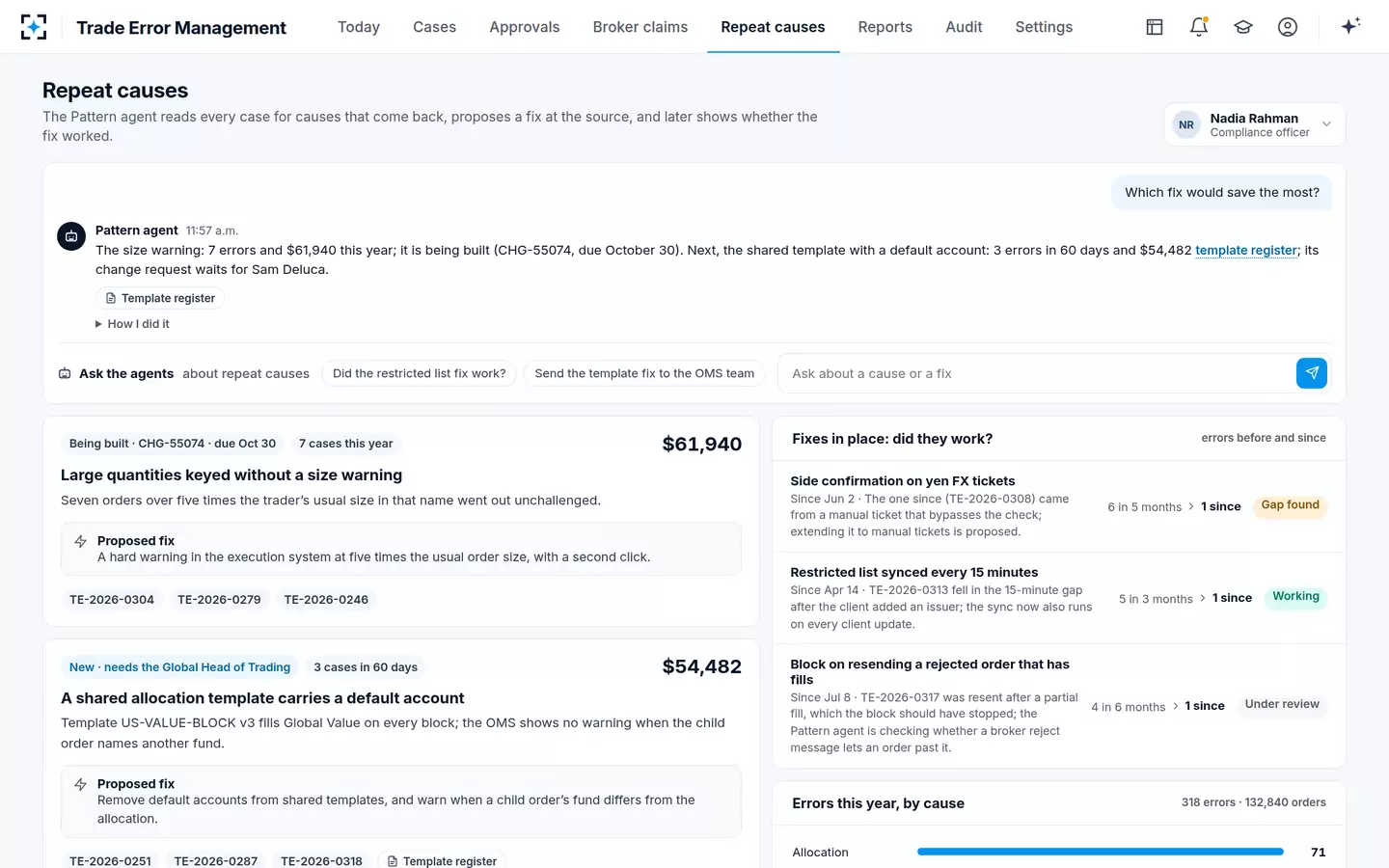
The fix belongs upstream, and the solution's Pattern agent proposes it: in the sample it linked this case to two earlier errors on the same block template, three in 60 days costing $54,482, and drafted a change request to remove default accounts from shared templates and warn when a child order's fund differs from the allocation. Putting allocation controls live before quarter-end covers that work, and what counts as a trade error covers the kinds of allocation error to log.
Three allocation errors on one block template, turned into one fix in Trade Error Management
Questions people ask
What is the difference between allocation and affirmation?
Allocation is the adviser telling the broker how a block's shares are split among accounts. Confirmation is the broker's statement of each allocated trade's terms, and affirmation is the adviser or its custodian agreeing that the confirmation is right. Under Rule 15c6-2 all three are due by the end of trade date.
Does Rule 15c6-2 apply to investment advisers?
It binds brokers, who must have either written agreements with advisers and custodians or policies and procedures to finish allocation, confirmation and affirmation on trade date. Advisers are reached through those agreements and through Rule 204-2, which requires them to keep each allocation and affirmation with a date and time stamp.
Can an adviser change an allocation after trade date?
A correction is possible, but it must follow the adviser's intent at execution, never the trade's performance since, and the change and its reason must be kept. Before November 16, 2026 a broker needs a principal's approval for an adviser's allocation received after trade date; from that date FINRA's amended Rule 4515.01 removes that approval for bulk orders, but not the restriction on performance-based allocation.
What is average price allocation?
Giving every account in a block the same average price across all the fills, so no account gets the best fills and another the worst. It is the usual default in allocation policies because it removes the question of which fill went where; a partly filled block is then split pro rata to the intended quantities unless the policy says otherwise.
Does T+1 apply to bonds and options?
Rule 15c6-1 covers brokers' contracts in securities "other than an exempted security, a government security, a municipal security, commercial paper, bankers' acceptances, or commercial bills", so corporate bonds and listed options are inside it and Treasuries and municipal bonds are outside it. Security-based swaps are excluded; futures and swaps follow the CFTC's allocation rule instead.