A trade error log template should capture, for every error, what was intended and what happened, how it was found and reported, its kind and root cause, how it was corrected, what it cost each client, who paid under which clause, who decided and approved, when each client was made whole, and who was told. Eighteen fields cover it, and each one should point to the record it came from: the order memorandum, the time-stamped allocation, the fills, the policy version, the signatures. An entry built that way survives an examination; an entry typed from memory into a spreadsheet does not. Botminds' Trade Error Management builds the log from the cases themselves, so each field is filled from, and opens to, its source.
The examiner's request is predictable: every trade error since the last exam and how each was resolved. The log is the index to that answer; the case files are the answer. A template that asks only for a date, a description and an amount produces an index without the files.
A trade error log template: 18 fields, and the record each one comes from
Case number and status
SourceThe log itself
One number per error, never reused; open, decided, approved, client whole, closed.
Discovered: when and from what
SourceThe first signal: a break, alert, notice, letter or report
Shows how errors are found, and how long they hid.
Reported: by whom and when
SourceThe report, with its time
Tests the policy's reporting clock on every case.
Order, block and broker
SourceOrder memorandum (Rule 204-2(a)(3)); order system audit trail
Ties the case to the records the SEC requires.
Security, side, quantity, price or limit
SourceOrder ticket and FIX messages
What was actually sent.
What was intended
SourceOrder memorandum, model or written instruction, with its time
The yardstick for whether this is an error at all.
What was executed and booked
SourceFills; time-stamped allocation (Rule 204-2(a)(7)(iii)); custodian booking
Where the chain diverged, and who booked what.
Accounts affected, by type
SourceAccount master and fund register
Plan, registered fund, non-US fund or separate account: each has its own clauses.
Kind of error
SourceThe policy's definitions
Family and kind, applied the same way each time.
Root cause
SourceThe timeline, cause categories and past cases
Who, what and why, with the alternative considered.
Correction
SourceCorrection approval; corrective fills
Method (rebook, market trade, cross), who approved, when filled.
Cost per client, line by line
SourceFills, commission schedule, fee tables, FX rates
Each client separately; nothing netted across clients.
Gain retained
SourceThe same calculation
A gain stays with the client account and is logged as such.
Payer and clause
SourceThe policy version in force
Firm, broker or nobody, and the clause that says so.
Decision
SourceThe decider's signature and reason code
Who decided, when, and on what evidence.
Approval
SourceSecond signature by threshold
Never the decider; never the person who made the error.
Payment and receipt
SourceError account booking; confirmation of receipt
The date each client was actually made whole.
Notices, claims and follow-up
SourceClient and board notices; broker claim; regulator notice where required
Plus the repeat cause it was linked to and the fix requested.
What should a trade error log include?
Enough to rebuild the error and its resolution without asking anyone: the eighteen fields above. They fall into four groups. The first six identify the error and its evidence of intent. Fields seven to ten establish what went wrong and why. Eleven to fourteen record the money: the correction, the cost per client, any gain, and who paid. The last four record the people: decision, approval, payment and notices.
Two fields carry most of the weight in an examination. Field six, what was intended, decides whether the event is an error at all, and its source must be a record made before the trade, not an explanation made after. Field fourteen, the payer and clause, is where a reviewer looks for gains netted against losses, losses left with clients and clauses applied inconsistently. What counts as a trade error sets out the kinds that field nine should use.
Does every trade error need a log entry?
Yes, including errors that cost nothing and errors caught before settlement. The free ones are where repeat causes show up first, and a log that only holds expensive errors cannot show an examiner that the definition is applied consistently. In the SEC's 2020 Franklin order, the adviser's own policy required every trade error to be documented, circulated to senior officers and reported to the fund board with the corrective action, and the order found those steps were not followed for the losses at issue (SEC, Franklin Advisers, 2020).
The log should also hold the cases that were opened and found not to be errors, with the reason. A signal routed to the settlement team as a counterparty fail, or a loss classified as a decision rather than an error, is exactly the judgment an examiner may want to see. In the sample, the Intake agent proposed that one morning signal was "a settlement fail, not a trade error" and routed it, with the reason kept on the case.
How do you record the root cause of a trade error?
As who, what and why, with a category and the alternative you rejected. "Human error" is not a cause; "the saved block template filled the Global Value account and the trader did not change it" is. The alternative matters because it shows the cause was weighed, not assumed: in the sample the Cause agent put the template cause at 91% and the alternative, that the portfolio manager entered the wrong fund, at 6%, and it asks the trader or compliance when it is below 85% confident.
"The same set of circumstances can provoke similar errors, regardless of the people involved."
James Reason, Human error: models and management, BMJ, 2000
Reason's paper, written for medicine, distinguishes the "person approach", which "focuses on the errors of individuals", from the system approach, which "concentrates on the conditions under which individuals work" (BMJ 2000;320:768). A cause field that records only who erred cannot find the template, the default or the missing warning that will produce the same error with someone else. The SEC's 2026 Truist order shows the opposite need too: the firm's policy required it to monitor "for patterns of errors by individual" representatives (SEC, Truist, 2026), so the log must record who made the error as well as why.
What evidence should be attached to a trade error report?
The records behind each field, not a summary of them. For an allocation error that is the order memorandum, the order system's audit trail entries, the FIX messages to and from the broker, the time-stamped allocation and affirmation, the custodian's booking, the correction approval and fills, the cost calculation with its inputs, the policy clause, and the signatures. For a broker's error add the claim and the broker's reply; for a fund, the board notice.
Luxembourg's fund regime shows what a regulator expects of the text fields. Its notification form asks for an "origin of the error" and a "remediation plan" that are "clear and precise", and requires that "a quantitative impact calculation allowing the CSSF to trace how the impact of the errors/instances of non-compliance and of the corrective actions was determined must be attached to the notification" (CSSF Circular 24/856, points 153–154). Traceable is the standard to write to, wherever the fund is domiciled.
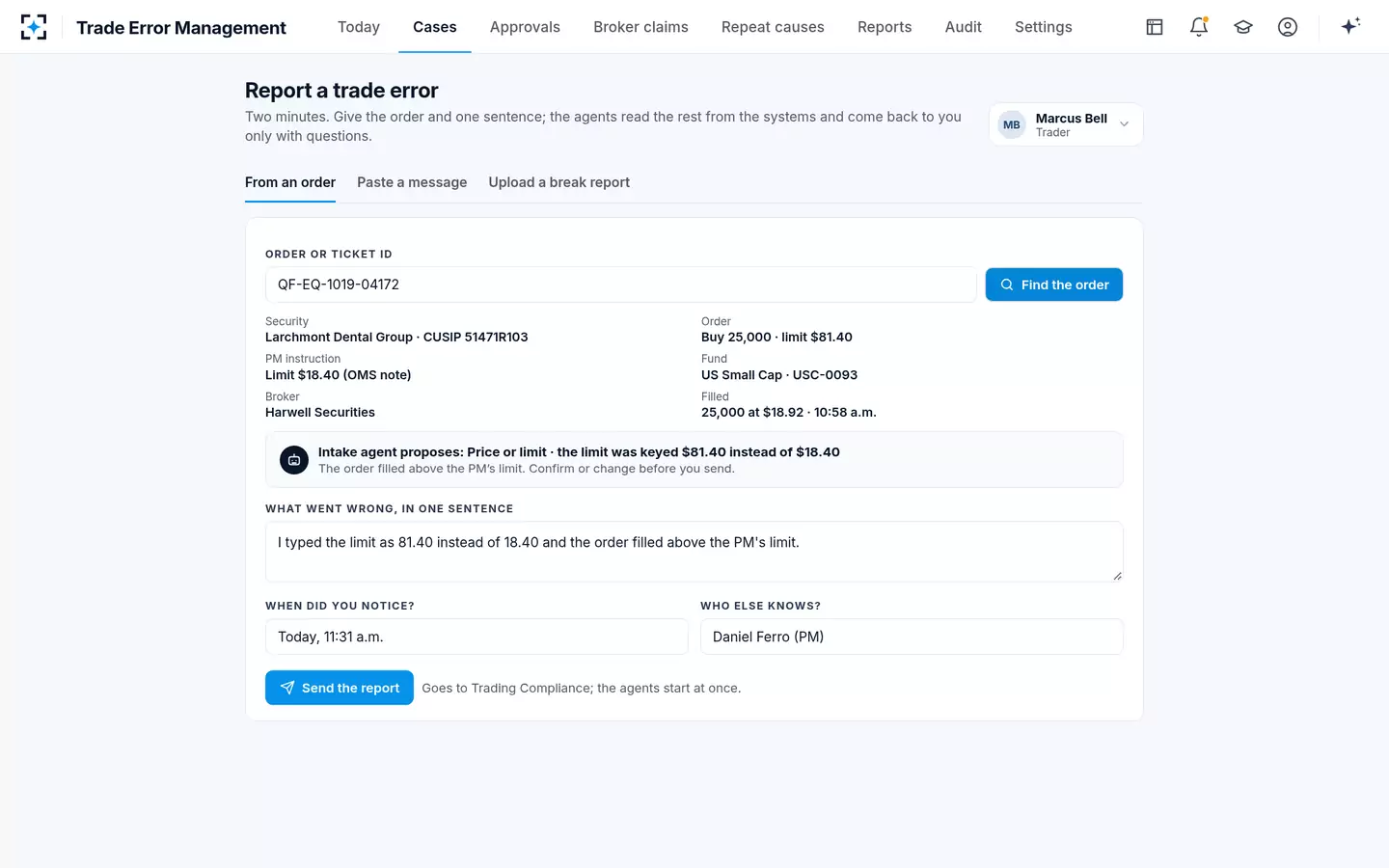
A trade error report in two minutes, with the order read in by Trade Error Management
How do you log a broker's error and the claim that follows?
As a trade error like any other, with three extra fields: the claim, the broker's answer, and the date the client was paid regardless. The error belongs in the adviser's log because the client is the adviser's; the broker's liability changes who ultimately pays, not whether the client is made whole on time. A good policy pays the client first and pursues the broker afterwards, and the log should show both dates.
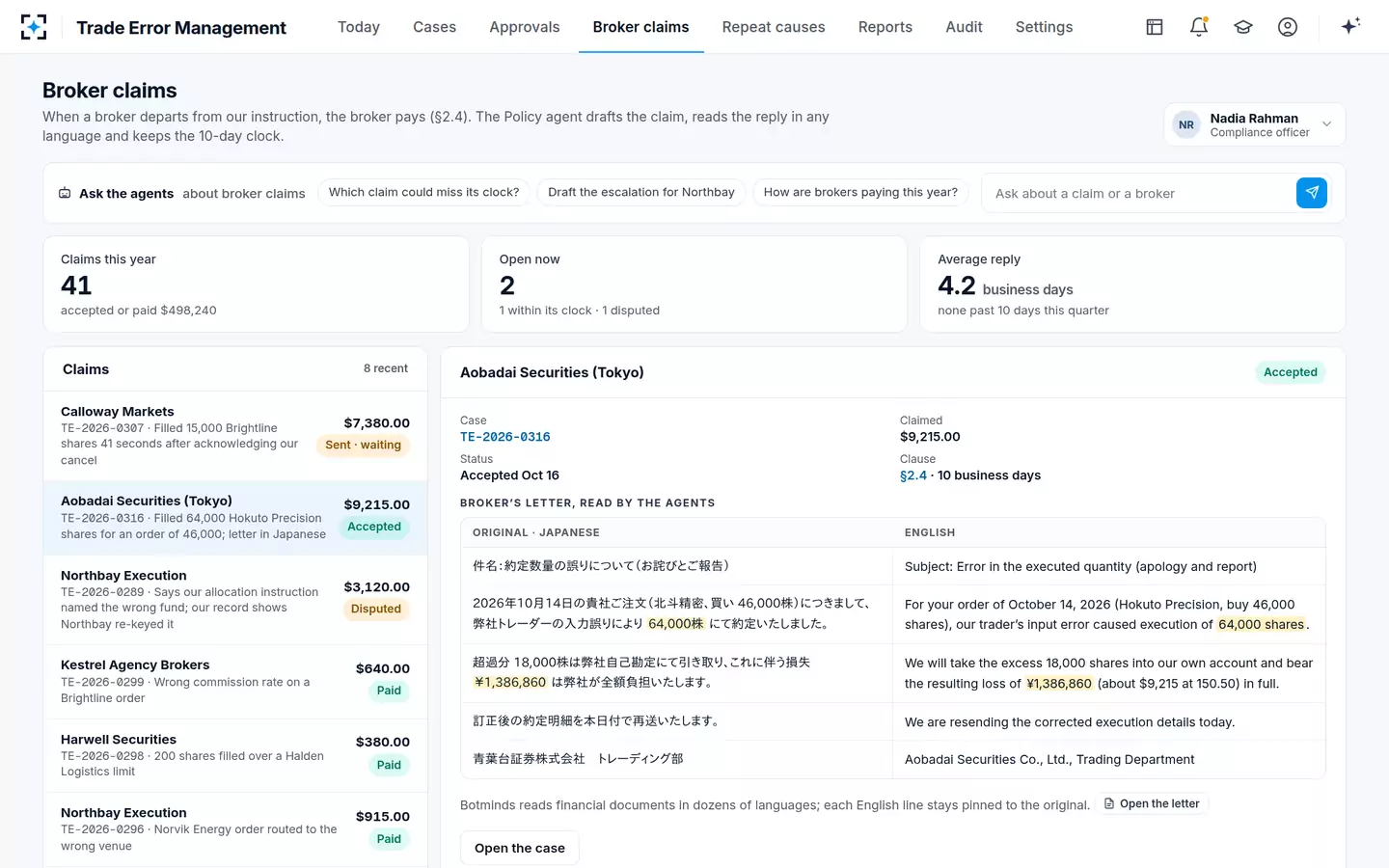
The claim fields should hold the evidence that the broker departed from the instruction: the adviser's order or allocation as sent, the broker's fills or booking, and the broker's own words. In the sample, a Tokyo broker filled 64,000 shares for an order of 46,000; its letter, in Japanese, accepted the error and said it would take the excess 18,000 shares into its own account and bear the loss of ¥1,386,860, about $9,215 at 150.50. The case logs the claim, the letter, its translation line by line, and the acceptance on October 16.
Broker claims in Trade Error Management: the claim, the letter and the 10-day clock
How long must a trade error log be kept?
At least five years, because the records it is built from must be. Under Rule 204-2(e)(1) most of an adviser's books and records must survive five full years past the fiscal year of their last entry, and for the first two of those years they must sit in an appropriate office of the adviser (17 CFR 275.204-2(e)(1); investment adviser recordkeeping requirements covers the rest of the rule). The same rule requires a copy of the compliance policies in effect "at any time within the past five years" and "any records documenting the investment adviser's annual review" (Rule 204-2(a)(17)).
Retention clocks that touch a trade error log
5years
adviser books and records under Rule 204-2(e)(1), the first two in an office of the adviser
5years
policies in effect, and records of each annual review, under Rule 204-2(a)(17)
6years
records of each fund cross trade under Rule 17a-7(g)
7years
the audit trail in Trade Error Management, as configured
A practical point follows: the log must keep the policy version each case was decided under. In the sample, Trade Error Policy v5.1 took effect on March 1, 2026; a case decided in February belongs to the version before it, and an examiner reading the log in 2028 will ask which one applied.
What will an examiner ask for about trade errors?
The log of every error in the review period, a sample of case files, the policy versions in force and evidence that the policy was followed, including the annual review. The SEC's fiscal 2027 priorities name trading among the parts of a compliance program examiners review, and say they typically read the annual review as well (SEC, FY2027 priorities).
An examiner's trade error request, and the field that answers each item
- All trade errors since the last examination, with resolution
The log: fields 1, 9, 12, 14 and 17 for every entry, including the free ones.
- Case files for a sample of errors
Fields 4–7 with their source records attached; the cost lines; the signatures.
- Errors where the client was not reimbursed
Field 14, with the clause and the reason; gains retained (field 13) shown separately.
- Errors caused by brokers, and claims
Fields 14 and 18: claim date, reply, amount recovered, and whether the client was paid first.
- Errors in plan and fund accounts
Field 8 by account type, with the plan or fund clauses applied and the board or plan notices.
- Repeat causes and what was done
Field 10 grouped, and field 18's fix with its result.
- The policy, its versions and the annual review
Each version with its dates; the review record and what it changed.
From a spreadsheet log to a case file in Trade Error Management
The solution does not keep a separate log; the cases are the log. Each case holds the eighteen fields because the agents fill them as they work: the Intake agent records the signal and the report, the Reconstruction agent the order, intent and execution with each event cited, the Cause agent the cause with its confidence and alternative, the Cost agent the cost per client, the Policy agent the clause and route, and the people their decisions, approvals, booking and confirmation. The examiner pack is built from that record: the log, each case file with its evidence, policy versions, decisions and signatures, the audit trail and the agents' versions, hash-verified, with wealth clients' names and account numbers masked and every download logged.
The same error in a spreadsheet row and in a case file
Spreadsheet row: "Meant for Equity Income" typed by operations.
Case file in Trade Error Management: The order memorandum, opened from the order system, with its time.
Spreadsheet row: A sentence and a pasted screenshot.
Case file in Trade Error Management: Fifteen events from four systems and the chat archive, each cited, the error and the missed chance marked.
Spreadsheet row: One total; the lines in someone's workbook.
Case file in Trade Error Management: Each line per client from the fills; recomputed independently; $0 netted shown.
Spreadsheet row: "Approved by CCO" in a comment.
Case file in Trade Error Management: Clause, reason code, maker, approver and times, each signed.
Spreadsheet row: A date the row was marked done.
Case file in Trade Error Management: Payment booked and receipt confirmed by fund accounting, each with a name and time.
A closed case in Trade Error Management: the log entry and its evidence in one place
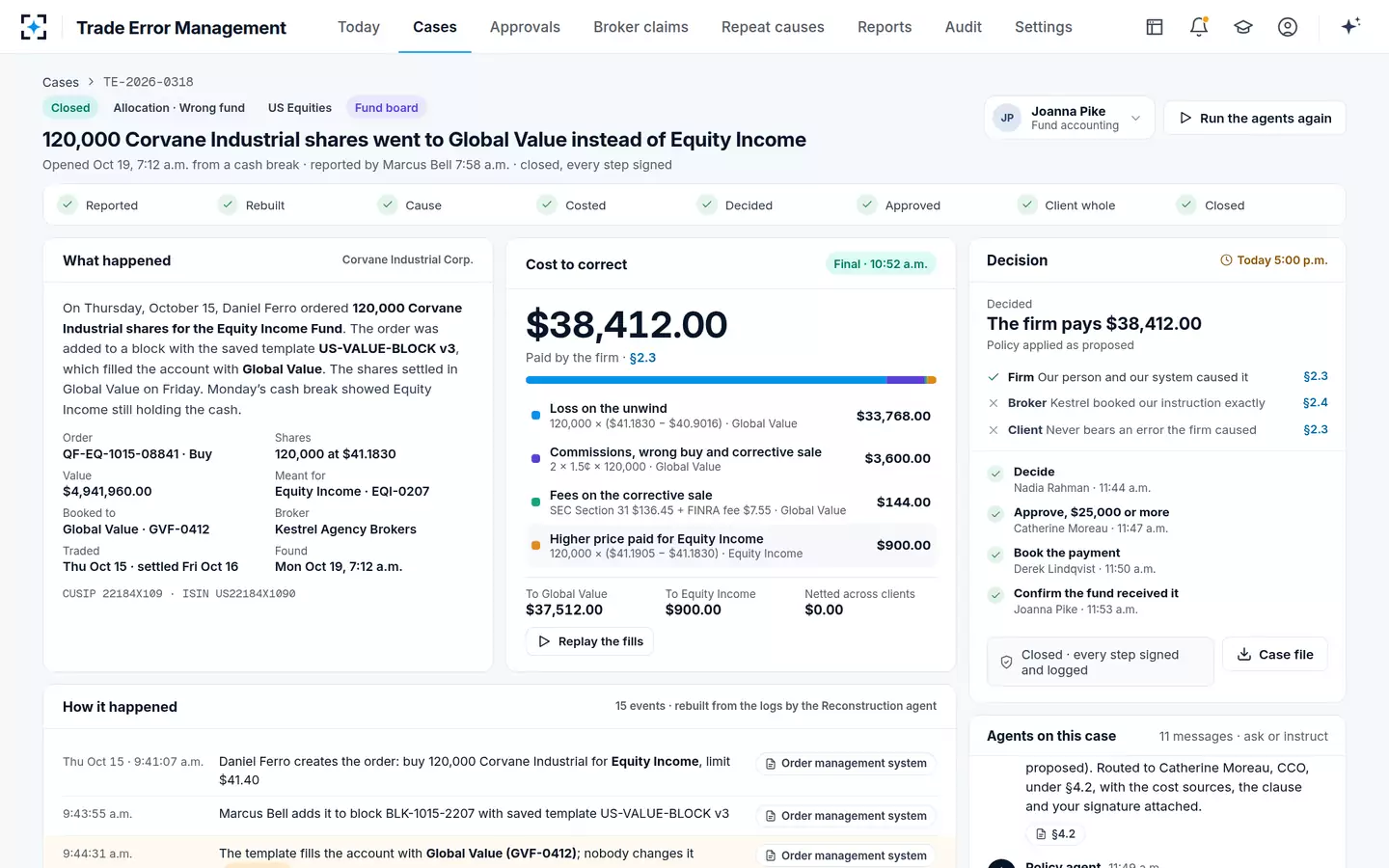
Because the cases carry the fields, the log can be cut any way the reader needs: by cause for the head of trading, by fund for a board, by broker for a claims review, by period for an examiner. What to ask of trade error software covers the controls behind the fields, and the trade error process shows who fills each one.
Questions people ask
What is a trade error report form?
The first document in a case: who found the error, when, on which order, and one sentence on what went wrong. It should take minutes, because a slow form delays the report and every hour after T+1 settlement costs money. The rest of the log should be filled from records, not from the form.
Should the log record the name of the person who made the error?
Yes, alongside the system cause. Patterns by individual are a control the SEC enforced in the Truist order, and patterns by system are what fixes repeat errors. Recording both, without treating the log as a disciplinary file, serves both purposes.
Is a trade error log a required record?
Rule 204-2 does not name one, but the records it is built from are required, and an adviser that documents errors under its policy must keep the policy and the review records the rule names. In practice the log is how an adviser shows its policy was followed, which is what Rule 206(4)-7 asks.
Can a broker's error log replace the adviser's?
No. A broker documents its own account changes, with FINRA requiring "the essential facts relied upon by the person approving the change" to be kept (FINRA Rule 4515), but the adviser's duty runs to its client. The adviser's log should reference the broker's correction, not depend on it.
What is the difference between a trade error log and an incident log?
An incident log usually covers any operational event; a trade error log covers events that put a client's account somewhere it should not be, with the money and the payer recorded. Keeping trade errors as a category of an incident log works if the eighteen fields are kept for that category.