A trade error policy is an investment adviser's written rule for trade errors: what counts as one, how fast it must be reported, how it is corrected and priced, who pays, what happens to a gain, who approves the payment and what is kept as evidence. The SEC has no rule written for trade errors, but Rule 206(4)-7 requires every registered adviser to put in place, and follow, written policies and procedures designed to prevent Advisers Act violations, so the policy becomes the yardstick: an examiner tests each error against what the firm said it would do. Botminds' Trade Error Management reads the firm's own policy into rules that compliance accepts one by one, then applies them to every case, quoting the clause it used.
Writing a policy is the easy half. The SEC's 2020 order against Franklin Advisers turned on a firm that had a policy, gave it to the funds' boards, and then did not follow it (SEC, Franklin Advisers, 2020). A clause that cannot be tested on a real case, or that nobody checks was followed, is the gap an examination finds.
The clauses of a trade error policy, and the question an examiner asks of each
- Definition
Does the definition cover allocation, coding and restriction errors, not only keying mistakes? Who decides when it is unclear?
- Reporting clock
How soon after discovery must an error reach compliance, and was that met on each error in the log?
- Correction
Who approves the corrective trade, and how is the client's position restored: in the market, by rebooking, or by a cross?
- Pricing the cost
Which costs count (price, commissions, fees, currency, opportunity) and who checks the arithmetic?
- Who pays
Firm, broker or nobody: on what evidence, and what happens while a broker claim is open?
- Gains and netting
Does a gain stay with the client? Is netting forbidden across clients, and limited within an account?
- The error account
Who may move trades into or out of it, with whose approval, and how is it reconciled?
- Plan and fund accounts
What is different for ERISA plans, registered funds and non-US funds?
- Approvals
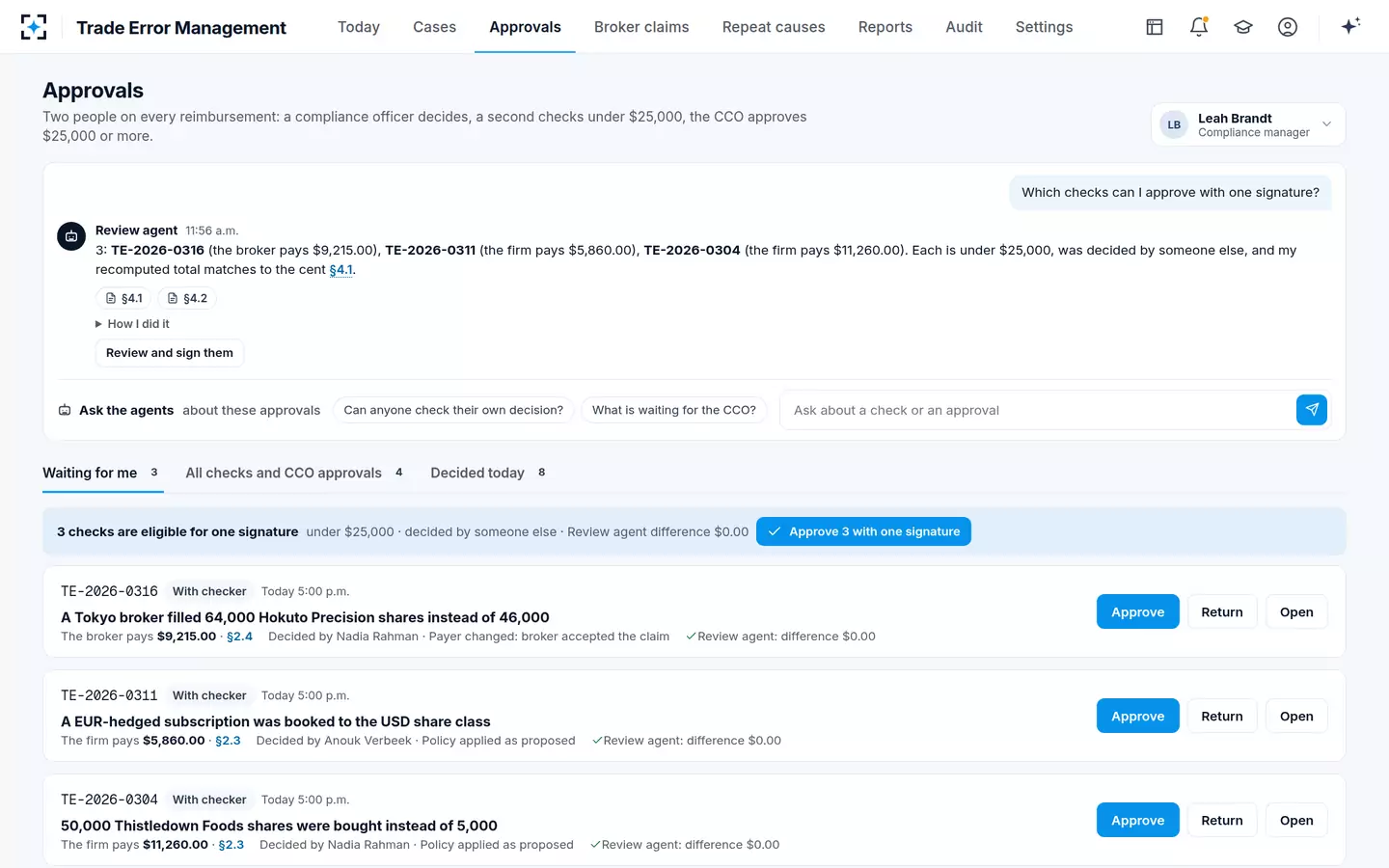
Who signs at which amount, and can a person approve a correction of their own error?
- Disclosure and records
When are the client and the fund board told, and is every error, including the free ones, logged?
- Review
When did the policy last get a full review, what did the error log show, and what changed?
Do advisers need a written trade error policy?
In practice, yes. No rule uses the words "trade error policy", but Rule 206(4)-7 requires written policies and procedures, an annual review and a chief compliance officer (17 CFR 275.206(4)-7). When the SEC adopted it, the Commission listed the issues it expects policies to address "at a minimum", "to the extent that they are relevant", and one of them is "Trading practices, including procedures by which the adviser satisfies its best execution obligation, uses client brokerage to obtain research and other services ('soft dollar arrangements'), and allocates aggregated trades among clients" (68 FR 74714).
The same release sets the purpose a trade error policy serves almost word for word: policies "should be designed to prevent violations from occurring, detect violations that have occurred, and correct promptly any violations that have occurred". A trade error policy is the "correct promptly" part for the trading desk. The SEC's fiscal 2027 examination priorities, published on October 23, 2026, list trading among the areas of an adviser's compliance program that examiners will review, alongside valuation, portfolio management and custody (SEC, FY2027 priorities). What the SEC rules say about trade errors follows the duty behind the policy.
The definition clause decides every other clause
The definition should describe effects on the client account, not departments: a trade that differs from what the adviser intended at the time, or that the client's mandate did not allow, whatever caused it. A list such as "trading and settlement errors" invites the argument that a coding or data mistake is neither. What is a trade error sets out twelve kinds and the losses that are not errors.
The clause should also say who decides when a case is unclear. Compliance should, with the reason written on the case, because the desk whose mistake it may be, and whose budget may carry the cost, has a conflict in the answer. A missed trade given by chat is the classic unclear case: was it a firm order or an idea? The sample policy in the solution pays opportunity cost only "where the order was firm: entered in the order management system, or given in writing with a quantity and a time", and leaves the call on a chat to the compliance officer.
How fast must trade errors be reported?
No rule sets a reporting clock for advisers, so the policy must, and T+1 settlement argues for hours, not days. Since May 28, 2024 most US securities trades settle one business day after the trade, so an error found the next morning has often already settled, and the correction becomes a market trade at the next day's prices. Every hour between discovery and correction is market exposure the firm will pay for.
A workable policy sets four clocks: report to compliance within an hour of discovery; decide cause, payer and amount on the same business day as the final cost; make the client whole within a set number of business days of the decision; and give a broker a fixed period to answer a claim before the firm pays the client itself. The sample policy below uses exactly those four, and names who is told when each is missed.
One sample trade error policy, read into rules: the settings and who may change them
| Setting | Sample value | What happens at the limit |
|---|---|---|
| Report an error | Within 1 hour of discovery (§2.1) | The compliance officer is told |
| Decide cause, payer and amount | Same business day as the final cost, 5:00 p.m. ET | Clock held while an agent's question is open; then the compliance manager, then the CCO |
| Client made whole | Within 5 business days of the decision | The head of trading operations and the CCO are told |
| Broker reply to a claim | 10 business days (§2.4) | The firm pays the client and pursues the claim |
| CCO approves reimbursements of | $25,000 or more (§4.2) | Proposed by an administrator or compliance, approved by the CCO |
| CCO, COO and fund board at | $250,000 or more (§4.2) | Proposed by an administrator or compliance, approved by the CCO |
Who pays under a trade error policy?
A typical policy makes the adviser pay for errors caused by its people, systems and vendors, makes the broker pay when the broker departed from the adviser's instruction, and never leaves a loss the firm caused with the client. The sample policy says the same in three clauses: the firm pays (§2.3), the broker pays when it departed from the instruction (§2.4), and the client "never bears an error the firm caused".
The hard part is the evidence for the broker clause. A broker that booked exactly what the adviser's allocation instruction said has not departed from anything, however the error began. The clause should say what proves a departure, usually the time-stamped allocation the adviser sent and the broker's fills, and what the firm does while a claim is open. Paying the client first and pursuing the broker afterwards keeps the client out of a dispute it did not cause.
Some firms let a broker absorb an error against future business. A policy should forbid it, because the client pays for the favour through the commissions on later trades. The sample policy books the firm's share from its own error account, "never from client commissions" (§2.6).
Gains, netting and the error account: where policies fail in practice
The gains clause should say that a gain from an error stays with the client account in which it arises, and the netting clause that one client's gain may never offset another client's loss. Within one account, netting is narrower than most drafters assume, and the Franklin case shows why.
"FAV did not reimburse the funds for these losses despite its stated policy, previously provided to the boards, that FAV would normally reimburse the funds for losses due to trade errors."
SEC order, In re Franklin Advisers, Inc., July 2, 2020
The losses came from corrective sales of one fund holding, $2,184,031 in all. The adviser decided not to reimburse them "as a result of offsetting gains that the Allocation Funds earned from selling two different securities" (SEC, Franklin Advisers, 2020). The order found a conflict the boards were never told about, a departure from the policy's approval route, and a policy that "required FAV to document all trade errors, circulate the documentation to senior officers in the affected departments, and report the errors and corrective action to the board of trustees", which was not followed. Who keeps the gain, and who pays the loss works through the arithmetic.
What Franklin's trade error policy said, and what the SEC found happened
The policy: The adviser would normally reimburse client losses on trade errors, including trades in breach of regulatory investment restrictions.
What happened, per the SEC's order: Losses of $2,184,031 on one ETF were not reimbursed, because of gains on two other ETFs.
The policy: Allowed only in certain circumstances, with approval from designated officers.
What happened, per the SEC's order: No analysis under any alternative method; compliance never obtained the approvals.
The policy: Document every trade error and circulate it to senior officers in the affected departments.
What happened, per the SEC's order: Not followed.
The policy: Report errors and corrective action to the board of trustees.
What happened, per the SEC's order: Violations reported in June and July 2016 without the losses; losses first disclosed in February 2018.
The error account clause belongs here too. When a broker moves a trade between accounts, FINRA's Rule 4515 requires that no change in account designation "(including error accounts)" be made unless "authorized by a qualified and registered principal", with "the essential facts relied upon by the person approving the change" documented (FINRA Rule 4515). The adviser's policy should mirror that discipline on its own side: who may ask for a trade to be moved, who approves, and how the error account is reconciled to zero.
How are ERISA and fund accounts treated in a trade error policy?
They need their own clauses, because the law behind them is stricter or more specific than the Advisers Act. For ERISA plans, a fiduciary that breaches its duties must personally make the plan whole for the losses from every breach (ERISA §409), and moving securities between a plan and another account is a prohibited transaction unless an exemption's conditions are met. A policy can therefore simply forbid fixing an ERISA error with a cross trade; the sample policy does, and forbids netting any gain against any loss in a plan account.
Registered funds add a board. The fund's own compliance program under Rule 38a-1 oversees the adviser's, and an error policy should say which errors go to the board, when, and with what numbers, which is exactly where Franklin's reporting fell short. Funds in Luxembourg add a regulator's procedure: CSSF Circular 24/856 requires every error or instance of non-compliance in its scope to be notified on the CSSF's form, with "a quantitative impact calculation" attached, and requires that "the fees resulting from the corrective actions of an error/non-compliance must not be borne by the UCI" (CSSF Circular 24/856, points 152, 154 and 133).
Thresholds a fund error clause has to name
€50,000
total compensation above which the CSSF asks the fund auditor for an additional control (UCITS and Part II funds)
€5,000
compensation to one investor that triggers the same control
$25,000
reimbursement at which the sample policy routes approval to the CCO
$250,000
reimbursement at which the sample policy adds the COO and a fund board notice
Approvals and segregation of duties: who may sign a correction?
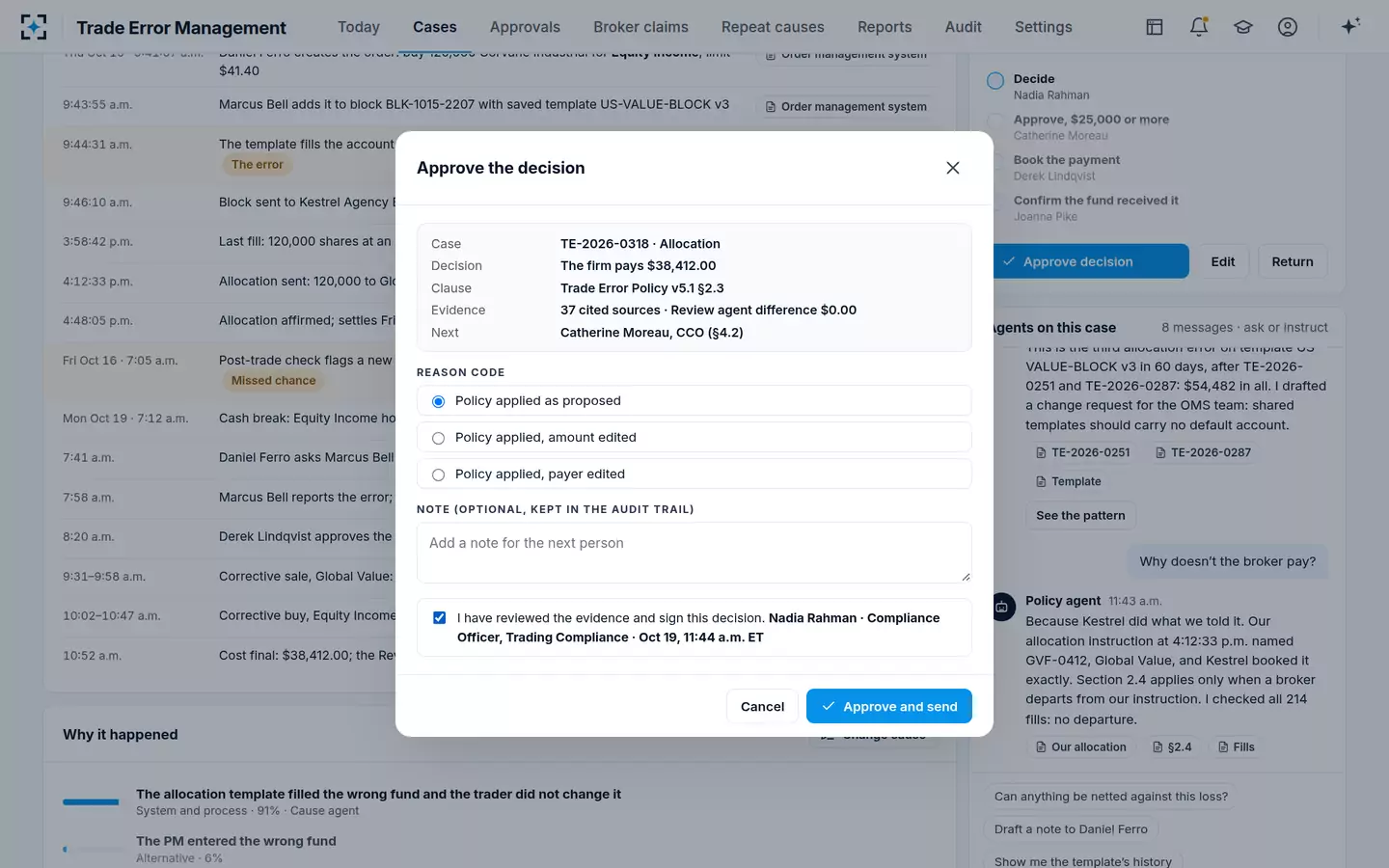
The approval clause should name a decision-maker, a second signer above a threshold, and the people who may never sign. The trader who made the error should never approve its correction; the person who decided a case should never be its checker. These are not formalities. In September 2026 the SEC found that an adviser's policies required it to approve trade corrections and to "monitor[ ] for patterns of errors by individual [investment adviser representatives]", and that it approved ten requests moving a representative's losing trades from his own account into four clients' accounts, $503,659 in all, without either check (SEC, Truist Advisory Services, 2026).
Deciding under the policy: the clause, the evidence and a reason code in Trade Error Management
How often should the trade error policy be reviewed?
At least once a year, and whenever the error log says it should be. Rule 206(4)-7 requires a review at least once a year of whether the policies are adequate and whether they work in practice, and the 2003 release adds that "advisers should consider the need for interim reviews in response to significant compliance events" (68 FR 74714). The fiscal 2027 priorities add that examiners typically read the annual review itself.
The useful review reads the year's errors against the policy: which clauses were used, which cases no clause settled, where approvals ran late, which causes repeated. A cause that keeps coming back is a sign the controls, not the policy, need work; a case no clause covered is a sign the policy does. Either way the review should leave a dated record of what changed and why.
Turning a trade error policy into rules Trade Error Management applies
The solution does not ship a policy; it applies yours. At setup its Policy agent reads the firm's trade error policy into rules, each tied to its clause, and compliance accepts each one; in the sample, Policy v5.1 became 14 rules. On every case the agent quotes the clause it applied, proposes who pays and routes the approval by amount, and asks compliance when no clause settles the case. It proposes and never decides.
Every setting in the table above is versioned: an administrator or compliance proposes a change, the CCO approves it, and it takes effect as a new policy version, so a case decided in March can be shown against the policy in force in March. The agents can also answer what a change would do before it is made. Asked what would happen if the CCO limit fell to $20,000, they answered from the year's cases: "This year 5 more reimbursements would have gone to the CCO: 19 instead of 14."
The checker's queue: two people on every reimbursement
Questions people ask
Is there a sample trade error policy and procedures template?
The SEC does not publish one, and a copied template is a risk: the examiner tests the policy against the firm's actual trading, accounts and systems. Start from the checklist of clauses above, write each one so that it can be tested on a real case, and fill in the firm's own thresholds and clocks.
Does FINRA require a trade error policy?
FINRA's rules apply to broker-dealers, not to advisers acting as advisers. A broker-dealer's error handling falls under its supervisory system and specific rules such as Rule 4515, which requires a registered principal to approve any change in an account designation, including moves into and out of error accounts. A dual registrant needs both sets of procedures to agree.
Can a client agree to bear the cost of trade errors?
Not in general. The SEC's 2019 interpretation states that an adviser's "federal fiduciary duty may not be waived", and that a contract term purporting to waive it, including "a waiver of any specific obligation under the Advisers Act", is inconsistent with the Act "regardless of the sophistication of the client" (84 FR 33669). Agreed limits on scope are possible with full disclosure; a blanket shift of the firm's errors to clients is not.
Should a trade error policy have a de minimis threshold?
For paying clients, a small-amount rule can be sensible when the cost of a payment exceeds the amount, and Luxembourg's circular allows funds a de minimis amount for investor compensation, set per fund with the justification written into the fund's policy. For logging, no: an error that cost nothing still belongs in the log, because its cause is the cheapest one to fix.
Who should own the trade error policy?
The chief compliance officer, who administers the compliance program under Rule 206(4)-7(c). Trading, operations and fund accounting should draft the clauses they carry out, and the CCO should approve changes so that every version in force can be shown with its date.