For trade errors, investment advisers answer to no rule written for trade errors: the phrase "trade error" does not appear anywhere in Title 17 of the Code of Federal Regulations, which holds the SEC's and the CFTC's rules (eCFR full-text search, October 28, 2026). What applies instead is the adviser's fiduciary duty under Section 206 of the Advisers Act, Rule 206(4)-7's requirement to adopt and follow written compliance policies, and Rule 204-2's records, with ERISA, a fund board and, for Luxembourg funds, CSSF Circular 24/856 adding their own requirements. Examiners therefore test each error against two things: the duty, and the firm's own trade error policy. Botminds' Trade Error Management is built for that test: every case it carries is rebuilt from the records, priced per client, decided under the firm's own policy and signed by two people.
The SEC has said this in its orders rather than in a rule. In the four cases on this page, the charges include Section 206(2), which forbids "any transaction, practice, or course of business which operates as a fraud or deceit upon any client", and, in every one, Rule 206(4)-7 for policies that were not reasonably designed or not followed. Fraud here does not need intent: the Franklin order states that the SEC need not prove scienter under Section 206(2), and that negligence alone can support the violation (SEC, Franklin Advisers, 2020).
What each rule says, and what the adviser's own policy has to decide
What the rule says: Duties of care and loyalty; the adviser may not subordinate the client's interests to its own; the duty "may not be waived".
What the trade error policy must decide: That the firm restores losses it caused, and what counts as a loss it caused.
What the rule says: Written policies designed to prevent violations, reviewed at least annually, run by a CCO.
What the trade error policy must decide: The clauses, clocks, thresholds and approvers for errors, and that they are followed.
What the rule says: Memoranda of each order and any modification or cancellation; time-stamped allocations and affirmations; five years' retention.
What the trade error policy must decide: Which records prove intent, cause and correction, and how they are tied to each error.
What the rule says: A breaching fiduciary must "make good to such plan any losses"; self-dealing and most cross trades are prohibited.
What the trade error policy must decide: Stricter clauses for plan accounts: no netting, no corrective cross trades without an exemption.
What the rule says: The fund's program oversees the adviser; Luxembourg funds notify the CSSF and restore the fund.
What the trade error policy must decide: What goes to the board, when, and how fund errors are measured and notified.
Is there an SEC rule on trade errors?
No. The SEC's rules for advisers in 17 CFR Part 275 do not use the term, and the full text of Title 17 returns nothing for "trade error", "trade errors" or "trading error". The phrase "error account" appears only in two CFTC rules. Even the SEC's 2019 interpretation of the adviser's fiduciary duty, which runs to thirteen pages of the Federal Register, never uses the word "error" (84 FR 33669).
That silence is not a gap in the law. It means trade errors are governed by principles, and the principles bite through two routes: Section 206 for what the adviser did to the client, and Rule 206(4)-7 for whether its policies were designed and followed. People searching for SEC trade error guidance usually expect a rulebook; what they find instead is a set of orders that show how the principles are applied.
Does the fiduciary duty require reimbursing trade errors?
In effect, yes, for errors the adviser caused. The duty of loyalty "requires that an adviser not subordinate its clients' interests to its own", and the interpretation adds that an adviser "cannot favor its own interests over those of a client, whether by favoring its own accounts or by favoring certain client accounts that pay higher fee rates" (84 FR 33669). Leaving a loss the firm caused in a client's account is the firm's cost paid by the client. Deciding whether to pay it is also a conflict, because the firm is judging its own bill.
"By negligently buying Glen Meadow for certain of its ERISA clients, delaying disclosure of its error and failing to promptly reimburse its clients, WAM engaged in a transaction, practice or course of business which operated as a fraud or deceit upon its clients."
SEC order, In re Western Asset Management Co., January 27, 2014
The order shows all three elements of the duty at once: a negligent error, a delay in telling the clients, and a failure to reimburse promptly. None of them needed intent. The settlement required a payment of $9,620,392 to 89 affected plan clients, an amount the order calls "an approximation of the amount by which such clients were impacted", "plus reasonable interest" (SEC, Western Asset, 2014).
Rule 206(4)-7: the firm's own policy becomes the rule
Rule 206(4)-7 makes it unlawful to advise clients without written policies and procedures, put into practice, that are designed to prevent violations of the Act, without reviewing them at least annually and designating a chief compliance officer (17 CFR 275.206(4)-7). For trade errors, the rule turns the firm's own policy into the standard. In the Western Asset order, the violation was "failing to implement policies and procedures reasonably designed to ensure that errors and breaches are promptly corrected and disclosed to affected clients".
The SEC's adopting release said a compliance failure stands on its own: an adviser's failure "to have adequate compliance policies and procedures in place will constitute a violation of our rules independent of any other securities law violation" (as quoted in the Western Asset order, from 68 FR 74714). A firm can therefore be charged for how it handles errors even when no single error is large. The trade error policy, clause by clause lists what the written policy needs.
What records must an investment adviser keep for trade errors?
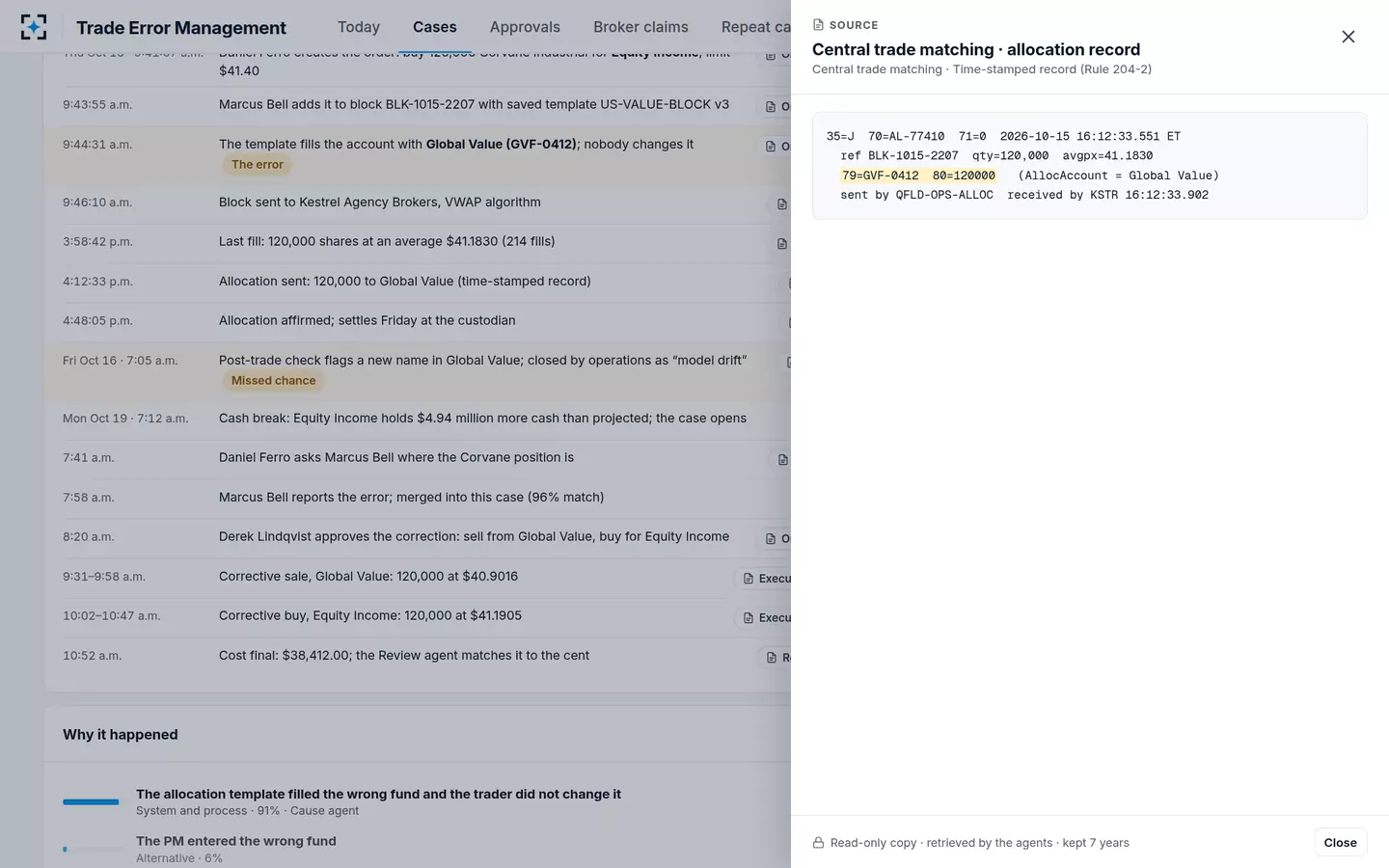
Rule 204-2 has no error log, but it requires the records an error case is built from. An adviser must keep a memorandum of every order it gives, and of any change to or cancellation of it, recording the order's terms and conditions, who recommended it, who placed it and the account it was for (Rule 204-2(a)(3)). Since the T+1 amendments it must also keep, for transactions subject to the same-day allocation rule, "each confirmation received, and any allocation and each affirmation sent or received, with a date and time stamp for each allocation and affirmation" (Rule 204-2(a)(7)(iii)).
The retention period for most of them is five years from the close of the fiscal year of their last entry, two of those years at an appropriate office (Rule 204-2(e)(1); the trade error log template shows how the log draws on them). The order memorandum shows what the adviser intended; the time-stamped allocation shows what it told the broker. Between them they settle most arguments about who caused an allocation error.
The time-stamped allocation, opened beside the order's rebuilt timeline in Trade Error Management
What SEC enforcement cases involve trade errors?
Four settled orders between 2014 and 2026 show the range: an error defined away, a reimbursement netted away, allocations nobody monitored, and a correction process used to move losses onto clients. All four were settled, and in none did the respondent admit the findings.
Four SEC orders on trade errors and allocation, and the control each one tested
| Order | What the SEC found | Control that failed | Sanction |
|---|---|---|---|
| Western Asset Management, Jan. 2014 (Rel. 3763) | A mis-coded private placement allocated to 99 ERISA accounts; compliance decided it was not an "error"; clients told nearly two years later | Definition and prompt disclosure | $9,620,392 to 89 plan clients; $1 million penalty |
| Franklin Advisers, July 2020 (Rel. 5531) | Corrective sales lost $2,184,031; not reimbursed because of gains on two other securities; boards not told | Reimbursement, netting, approvals, board reporting | Censure; $250,000 penalty (and $75,000 on an affiliate) |
| First Allied and Cetera, Sept. 2024 (Rel. 6734) | Two representatives allocated block trades after watching prices, favouring their own accounts | Pre-trade allocation statements; no change to allocations without compliance approval | $200,000 penalty each |
| Truist Advisory Services, Sept. 2026 (Rel. 7016) | Ten "trade corrections" moved a representative's losing trades into four clients' accounts, $503,659 | Review of correction requests; monitoring for patterns of errors | $200,000 penalty; clients reimbursed with interest |
The two later cases matter because they are about the correction process itself. In the Cetera matter, representatives "purchased stocks in their personal accounts and then, later in the day and after the opportunity to observe price movements, allocated shares among personal and clients' accounts", and the firm's own policy said they "are not permitted to modify the allocation for any reason" without compliance approval (SEC, Cetera, 2024). In the Truist matter, the correction requests showed the account was the representative's own and gave the reason that "he had placed the trade in the wrong account" (SEC, Truist, 2026). A trade error process that can move a trade between accounts is also a route for moving losses, and it needs controls built for that.
Must clients be told about a trade error?
When the error is material to the client, the duty of loyalty points to yes: an adviser "must make full and fair disclosure to its clients of all material facts relating to the advisory relationship" (84 FR 33669). A loss the firm caused, and its decision whether to pay it, is hard to call immaterial. Both the Western Asset and Franklin orders turned partly on silence: clients told two years late, and fund boards told of the violations but not of the losses or the decision not to reimburse.
Disclosure has a practical form. A client made whole the same week with a short letter, or a fund board given the error, the cost, the clause applied and who paid at its next meeting, is a client relationship intact. The policy should say which errors are reported to whom and when, and the log should show that it happened.
Are ERISA accounts different for trade errors?
Yes, in three ways. The remedy is statutory: a fiduciary that breaches its duties "shall be personally liable to make good to such plan any losses to the plan resulting from each such breach, and to restore to such plan any profits of such fiduciary which have been made through use of assets of the plan" (ERISA §409). Self-dealing is prohibited outright: a fiduciary shall not "deal with the assets of the plan in his own interest or for his own account" (ERISA §406(b)). And moving a security between a plan and another account the manager runs is a prohibited cross trade unless every condition of the statutory exemption is met, which the cross trade rules sets out.
The Western Asset coding error was an ERISA matter as much as an SEC one: the order notes that the firm negotiated "separate settlements of the Glen Meadow transactions with both the Commission and the Secretary of the United States Department of Labor". An adviser with plan clients should expect both agencies to be interested in the same error.
Funds: the board, Rule 38a-1 and CSSF Circular 24/856
A registered fund's own compliance program, under Rule 38a-1, must provide for oversight of its adviser's compliance, and the board is where that oversight is exercised. In the Franklin case the adviser's policy itself required it to "report the errors and corrective action to the board of trustees"; the SEC found the adviser caused the funds' violation of Rule 38a-1 when it did not.
Luxembourg funds work under a written regime. CSSF Circular 24/856, in force since January 1, 2025, covers NAV errors, "instances of non-compliance with the investment rules applicable to UCIs as well as other errors at UCI level", including allocation errors. Its principle is that "the party having caused an error/non-compliance entailing a loss as a result of non-compliance with the obligations applicable to them, must ensure remediation", and an allocation error is compensated while "where the erroneously allocated investments generated a profit, the UCI will retain this profit" (CSSF Circular 24/856, points 117 and 115).
What the four orders cost, beyond the money owed to clients
$1M
SEC penalty on Western Asset for the coding error, with a separate Labor Department settlement
$250K
penalty on Franklin Advisers, with censure; funds reimbursed with interest in December 2018
$200K
penalty on each of First Allied and Cetera for allocation controls
$200K
penalty on Truist Advisory Services for its correction process
What do examiners ask about trade errors in 2027?
The SEC's fiscal 2027 examination priorities, published on October 23, 2026, open the adviser section with the fiduciary duty: the Division "continues to focus on whether SEC-registered investment advisers (advisers) adhere to their fiduciary duties", and examinations will review whether advisers "adopted and evaluated the effectiveness of compliance policies and procedures" (SEC, FY2027 priorities). On compliance programs, the priorities list trading among the business areas whose policies examiners will review.
For trade errors that translates into a familiar request: the log of every error in the period, the case file for a sample, the policy in force at each date, and the evidence that the firm followed it. An examiner reading the log looks for errors defined away, gains netted against losses, approvals by the person who made the error, and causes that repeat without a fix.
Where Trade Error Management fits under these rules
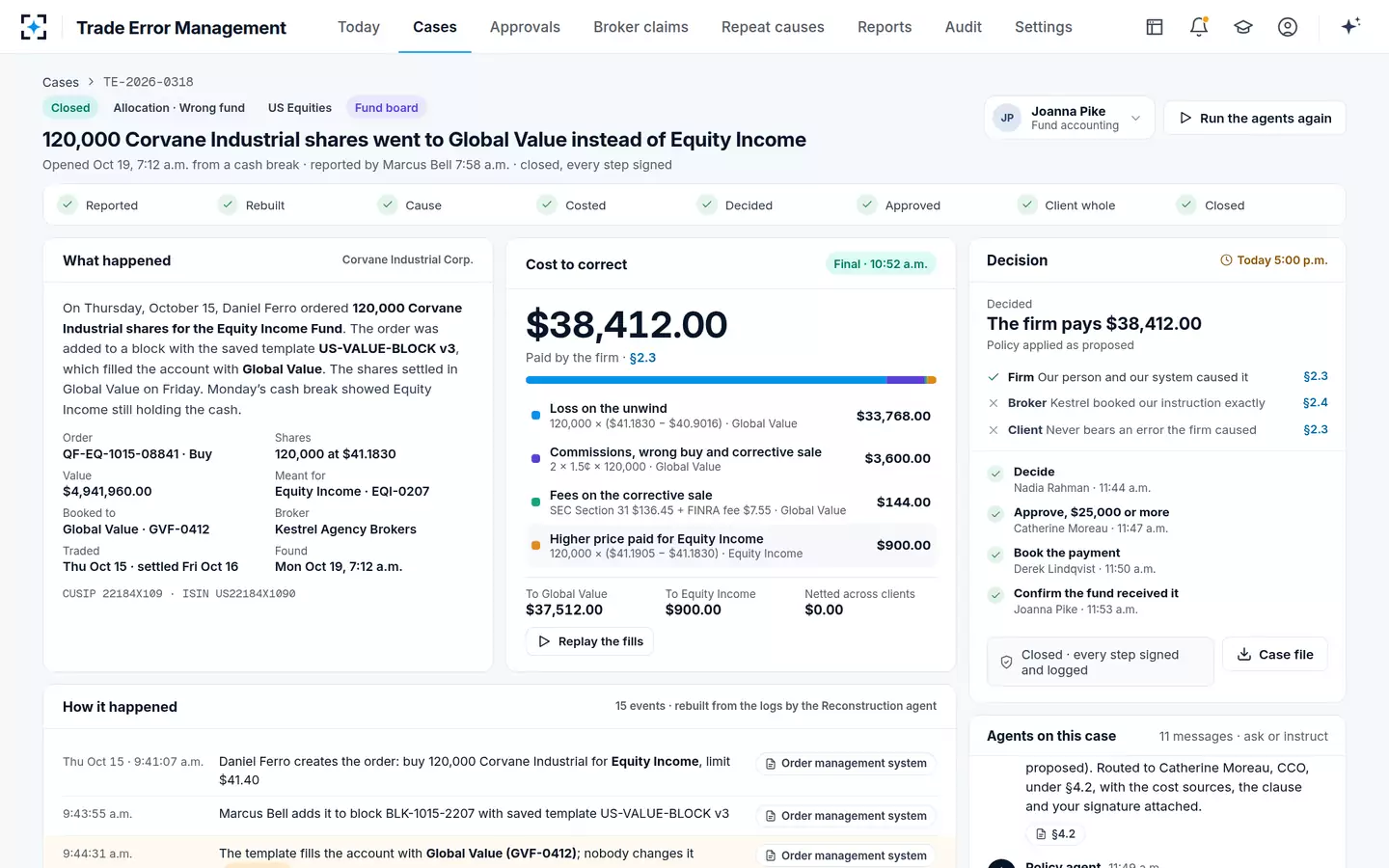
The solution does not decide what the law requires; it makes the firm's compliance with its own policy provable, case by case. Its agents open a case from the first signal, rebuild the order from the order system, the FIX logs, central trade matching and the custodian, each event cited to its source, and price the correction per client without netting across clients, with a second agent recomputing every dollar on its own. The Policy agent quotes the clause it applied; a compliance officer decides, a second person or the CCO approves, operations books the payment, and fund accounting confirms receipt.
Closed with every step signed: what an examiner sees for one error in Trade Error Management
Questions people ask
Do trade errors at an investment advisor have to be reported to the SEC?
There is no routine filing for trade errors under the Advisers Act. They are reported to clients and, for funds, to boards, and kept in the firm's own records for examination. Luxembourg is different: CSSF Circular 24/856 requires errors within its scope at Luxembourg funds to be notified to the CSSF on its form, with an impact calculation attached.
Is negligence enough for the SEC to charge a trade error case?
Yes. A Section 206(2) violation can rest on negligence alone, as the Franklin order says, and Rule 206(4)-7 needs no intent at all. The Western Asset order described the purchase for plan accounts as negligent and still found that the delay and the failure to reimburse operated as a fraud on clients.
Is cherry-picking a trade error?
No. Cherry-picking is deliberately allocating profitable trades to favoured accounts after prices move; it is fraud, not error. It belongs on a trade error page because it uses the same mechanisms, late allocation and moving trades between accounts, which is why allocation timestamps and approval of every reallocation protect against both.
Must a trade error be reimbursed with interest?
No rule sets a rate, but the settled orders show the expectation: Franklin "fully reimbursed the Allocation Funds for these losses, including interest", Truist reimbursed clients "in full with interest", and Western Asset's distribution included "reasonable interest". The longer a client waits, the more the interest matters, which is one reason for a short make-whole clock.
Does an adviser's trade error policy have to be in Form ADV?
No Form ADV item asks for it by name. Some advisers describe their error correction policy in the brochure, as Western Asset did, and then the description becomes a statement the firm must live up to. Whatever a brochure says about errors, the practice has to match it.