Best execution is the obligation of whoever chooses how a client's order is executed to seek the most favourable terms reasonably available for it, and then to keep checking that the choice still holds. For a US investment adviser it means the client's "total cost or proceeds in each transaction are the most favorable under the circumstances", in the words of the SEC's 2019 interpretation; for a broker-dealer it is FINRA Rule 5310; in Europe it is Article 27 of MiFID II. None of them names a price to hit. What each asks for is a process, and evidence that the process ran. That evidence is the hard part: a quarterly review of thousands of orders, the outliers among them, and a reason for each. Botminds' Best Execution Review gives that assembly to agents, so the head of trading and compliance decide the outliers instead of spending the quarter chasing them.
The definition sounds simple. The difficulty is that the duty sits with three different kinds of firm under three different sources of law, and each has its own idea of what counts as proof. The table below sets them side by side.
One duty, three rulebooks: who owes best execution and what proves it
| US investment adviser | US broker-dealer | EU or UK investment firm | |
|---|---|---|---|
| Where the duty comes from | The fiduciary duty of care under the Advisers Act, as the SEC interpreted it in 2019 | FINRA Rule 5310, MSRB Rule G-18 for municipal securities, and the antifraud provisions as the SEC has read them | MiFID II Article 27 (EU); FCA COBS 11.2A (UK); for portfolio managers, Article 65 of Delegated Regulation 2017/565 and COBS 11.2A.34R |
| The test | Total cost or proceeds most favourable under the circumstances; the best qualitative execution, not the lowest commission | Reasonable diligence to find the best market, so the price is as favourable as possible under prevailing market conditions | All sufficient steps to obtain the best possible result, weighing price, costs, speed, likelihood of execution and settlement, size and nature |
| How often it is reviewed | "Periodically and systematically"; the compliance programme itself at least annually (Rule 206(4)-7) | Order by order, or a regular and rigorous review at least quarterly, security by security and by order type | Monitoring on a regular basis; policy and arrangements reviewed at least annually and on any material change |
| What counts as evidence | Proof the evaluation happened, "through documentation or otherwise", including qualitative factors and traders' input | The review itself, its comparison with competing markets, and the reasons routing changed or did not | Monitoring results, the annual assessment, and the ability to show a client or the regulator that orders followed the policy |
What is best execution? A duty to seek, not a price to hit
Best execution is a duty of process: the firm must seek the best result its client could reasonably get, and it is judged on how well it sought, not on whether every fill was the best print of the day. That distinction matters because every manager will have trades that, with hindsight, cost more than they should. The duty is breached by not looking, not by a bad fill that was looked at and explained.
For advisers, the SEC put it in one sentence in 2019: an adviser "must seek to obtain the execution of transactions for each of its clients such that the client's total cost or proceeds in each transaction are the most favorable under the circumstances". The same release then declined to say how. Two commenters had asked the Commission to prescribe specific best execution obligations, and it answered that "prescribing specific requirements of how an adviser might satisfy its best execution obligations is outside of the scope of this Final Interpretation" (84 FR 33669). The method, in other words, is the firm's to design and the firm's to defend.
That is also why there is no single US "best execution rule" for advisers to quote back to an examiner. The SEC published a proposed Regulation Best Execution for broker-dealers in January 2023, with detailed policies and procedures and "related review and documentation requirements", and withdrew it on 17 June 2025, stating that it will not adopt final rules on the proposal (90 FR 25531). The duty did not go away with the proposal. It stayed where it was: in fiduciary law, in FINRA's rulebook and in the firm's own written policy.
An adviser must seek to obtain the execution of transactions for each of its clients such that the client's total cost or proceeds in each transaction are the most favorable under the circumstances.
SEC, Commission Interpretation Regarding Standard of Conduct for Investment Advisers, 2019
Who owes best execution — the adviser or the broker?
Both, separately. An investment adviser owes best execution to its clients whenever it has "the responsibility to select broker-dealers to execute client trades (typically in the case of discretionary accounts)", as the 2019 interpretation puts it. The broker-dealer that receives the adviser's order owes its own duty under FINRA Rule 5310. Neither duty discharges the other: a manager that sends every order to one broker with a good reputation has still not shown that it compared that broker with anyone else.
FINRA says the same about its own members in plain terms. "A firm cannot transfer its duty of best execution to another person," its 2026 oversight report states, and a firm that routes order flow to another firm "must either conduct its own regular and rigorous review of the execution quality received, or periodically review the statistical results and rationale of the other firm's regular and rigorous review" (FINRA, December 2025). The adviser's position is analogous: it may lean on a broker's data and a cost analysis provider's numbers, but the evaluation and the conclusion are its own.
Where the adviser does not choose the broker, the duty narrows. A client that directs its brokerage to a named firm takes that choice out of the adviser's hands, which is why reviews commonly code client-directed orders separately rather than measure them against the adviser's routing. The adviser still has to tell the client the price of that choice: Form ADV Part 2A, Item 12, asks an adviser that permits directed brokerage to "explain that directing brokerage may cost clients more money" (Form ADV Part 2). And where the adviser uses an affiliated broker, the 2019 release adds, the conflict "must be fully and fairly disclosed and the client must provide informed consent".
What is the best execution rule for investment advisers?
For advisers the rule is a standard, not a checklist: seek the most favourable total cost or proceeds, weigh the full quality of each broker's service, and evaluate the results periodically and systematically. The weighing comes from the SEC's 1986 release on Section 28(e), which the 2019 interpretation quotes: an adviser should consider "the full range and quality of a broker's services in placing brokerage including, among other things, the value of research provided as well as execution capability, commission rate, financial responsibility, and responsiveness".
Two other rules give the standard its teeth. Rule 206(4)-7 requires every registered adviser to keep written policies designed to prevent Advisers Act violations and to review them at least once a year (17 CFR 275.206(4)-7), so a best execution policy that is never tested fails twice. And the books-and-records rule makes the evidence durable, which is where reviews tend to fall down: a reason given by telephone in October is not evidence in an examination two years later.
The SEC staff's 2018 risk alert, drawn from deficiency letters in "over 1,500 adviser examinations", shows how the standard is applied in practice. The first deficiency on its list is advisers that "could not demonstrate that they periodically and systematically evaluated the execution performance of broker-dealers used to execute client transactions" (OCIE Risk Alert, July 11, 2018). The verb that matters is demonstrate. The SEC best execution risk alert, finding by finding works through the rest of the list.
FINRA Rule 5310 and the regular and rigorous review
FINRA Rule 5310 requires a broker-dealer to "use reasonable diligence to ascertain the best market for the subject security" so that the resulting price is "as favorable as possible under prevailing market conditions". It names five factors: the character of the market, the size and type of the transaction, the number of markets checked, the accessibility of the quotation, and the terms and conditions of the order as communicated (FINRA Rule 5310).
Supplementary Material .09 is where the review lives. A firm that does not check every order individually must run a "regular and rigorous" review "on a security-by-security, type-of-order basis", and "at a minimum, a member must conduct such reviews on a quarterly basis". FINRA's main guidance, Regulatory Notice 15-46, adds three points that most adviser policies borrow. The review must compare execution quality with what "it could obtain from competing markets", including venues the firm is not connected to. Where it finds "material differences in execution quality", the firm should change its routing or "justify why it is not modifying its routing arrangements". And orders a firm executes internally are not covered by the quarterly review at all: they need an order-by-order analysis.
The review cadence the rules set, in numbers
4a year
regular and rigorous reviews at a minimum for a broker-dealer, under Rule 5310.09
1a year
review of an adviser's compliance policies at the least, under Rule 206(4)-7
1a year
review of a UK portfolio manager's execution policy at the least, under COBS 11.2A.34R
1,500+
adviser exams behind the SEC staff's 2018 list of best execution deficiencies
How often must best execution be reviewed?
At least quarterly for a broker-dealer relying on a regular and rigorous review; periodically and systematically for an adviser, which in practice means a quarterly committee; and at least annually, plus on any material change, for a UK or EU portfolio manager's execution policy. The numbers differ because the obligations differ, but most firms that run more than one regime simply run the strictest cadence across all of them.
The quarterly rhythm is also what examiners recognise. FINRA's 2026 report lists, among effective practices, "Best Execution Committees: Establishing committees that meet quarterly or more frequently to conduct 'regular and rigorous' reviews and determine, if necessary, to modify the firm's order routing and execution arrangements" (FINRA, December 2025). The committee's composition and minutes are a subject of their own: who sits on a best execution committee, and what each signature means.
In Europe the cadence is about to become more prescriptive, not less. A Commission regulation adopted on 14 April 2026 requires investment firms to assess the effectiveness of their order execution policy "at least annually", and to monitor it against thresholds the firm sets in advance for each class of instrument; it applies from 12 February 2028 (Delegated Regulation (EU) 2026/825).
Is best execution the same as the best price?
No. Price matters most often, but every regime names other factors too: costs, speed, likelihood of execution and settlement, size and the nature of the order in MiFID II's list; execution capability, financial responsibility and responsiveness in the SEC's. The 2019 interpretation makes the quality of the whole execution, not the lowest commission, the deciding test, and best execution vs best price prices the difference on one trade.
The practical consequence is that a review cannot stop at a ranking of commissions. A broker that charges two basis points less and costs ten more in market impact is the more expensive broker, and only a cost analysis against a fair benchmark will show it. Best execution vs best price works through what that difference is worth on a fund's turnover.
What do examiners ask to see?
Examiners ask to see that the review happened, that it weighed more than price, that it compared alternatives, and that its conclusions changed something when they should have. The 2018 alert's phrase for the evidence is "through documentation or otherwise", and its deficiencies read like a list of documents a firm could not produce: an evaluation when a broker was selected, qualitative factors, traders' and portfolio managers' input, comparisons with competing broker-dealers.
Priorities shift from year to year, and what the SEC says it will examine is worth reading closely. Its fiscal 2026 priorities named "advisers seeking best execution with the goal of maximizing value for their clients". The fiscal 2027 priorities, published in October 2026, keep best execution in the broker-dealer section, where the Division "will also review broker-dealers' routing and execution of orders, including compliance with best execution obligations", and list "trading" among the components of an adviser's compliance programme the staff will review (SEC Division of Examinations, FY2027). A smaller mention is not an exemption: the 2018 alert's findings came from routine examinations, not a sweep.
What a defensible best execution review file holds
- The written policy in force for the quarter, with its version and approver
Rule 206(4)-7 requires written policies and an annual review of their adequacy; an examiner tests the quarter against the policy that applied to it.
- The population: every order in scope, reconciled to the order management system
An outlier list built from an incomplete file silently drops the late bookings, which are often the trades worth looking at.
- The thresholds and the exclusions, each with a coded reason
Market-on-close, client-directed and program orders need a different benchmark, not no benchmark.
- A written reason for every outlier, with its source
The trader's note, the portfolio manager's instruction, the market event, or the request sent when none exists.
- Qualitative factors and traders' input
Both appear by name in the SEC staff's list of deficiencies.
- Comparisons with brokers and venues not used
FINRA guidance says a review limited to current routes "would not satisfy the duty of best execution".
- Decisions, votes and what happened to last quarter's actions
A committee that finds the same broker expensive three quarters running and changes nothing has minutes, but not a defence.
Does best execution apply to bonds and FX?
For bonds, yes, explicitly. Regulatory Notice 15-46 is FINRA's guidance on best execution "in Equity, Options and Fixed Income Markets", and Rule 5310 has supplementary material on debt securities and on securities with limited quotations, which FINRA's 2026 report still finds firms failing to write procedures for. The same notice accepts that bond markets differ and that firms "may determine that their review of execution quality for fixed income securities may be less frequent than that of equity securities or options". Less frequent is not never, and the benchmark has to fit the market: a composite mid or the best of the dealer quotes received, not an arrival price that never existed for an inactive bond.
For an adviser, the 2019 interpretation speaks of securities transactions, and MiFID II applies to financial instruments, which include FX derivatives. Many managers bring FX and listed futures into the same review because their committee wants one view of execution across the desk. Where they do, the same standard of evidence applies: a threshold per asset class, a fair benchmark, and a reason for each order beyond it.
What a best execution review looks like in practice
A best execution review is a quarterly cycle: pull every order and its cost analysis, apply the policy's thresholds, explain each outlier, rank brokers and venues, then take the result to the committee and minute what it decided. The steps are easy to name. The weeks go into the middle of the cycle, where an analyst writes to traders about trades they placed months ago.
Take a sample asset manager, fictional Quillfield Capital, as its third quarter of 2026 runs through Botminds' Best Execution Review: 41,280 orders. Of those, 1,146 sat beyond a raw benchmark band; the agents set aside 1,083 with a coded reason, such as market-on-close orders measured against the close, and left 63 outliers under the firm's policy. They found a documented reason for 58 of the 63 in trader notes, portfolio manager instructions, market events and messages, and sent the remaining five to the traders who placed them.
How a quarter of orders became 63 outliers, every exclusion counted
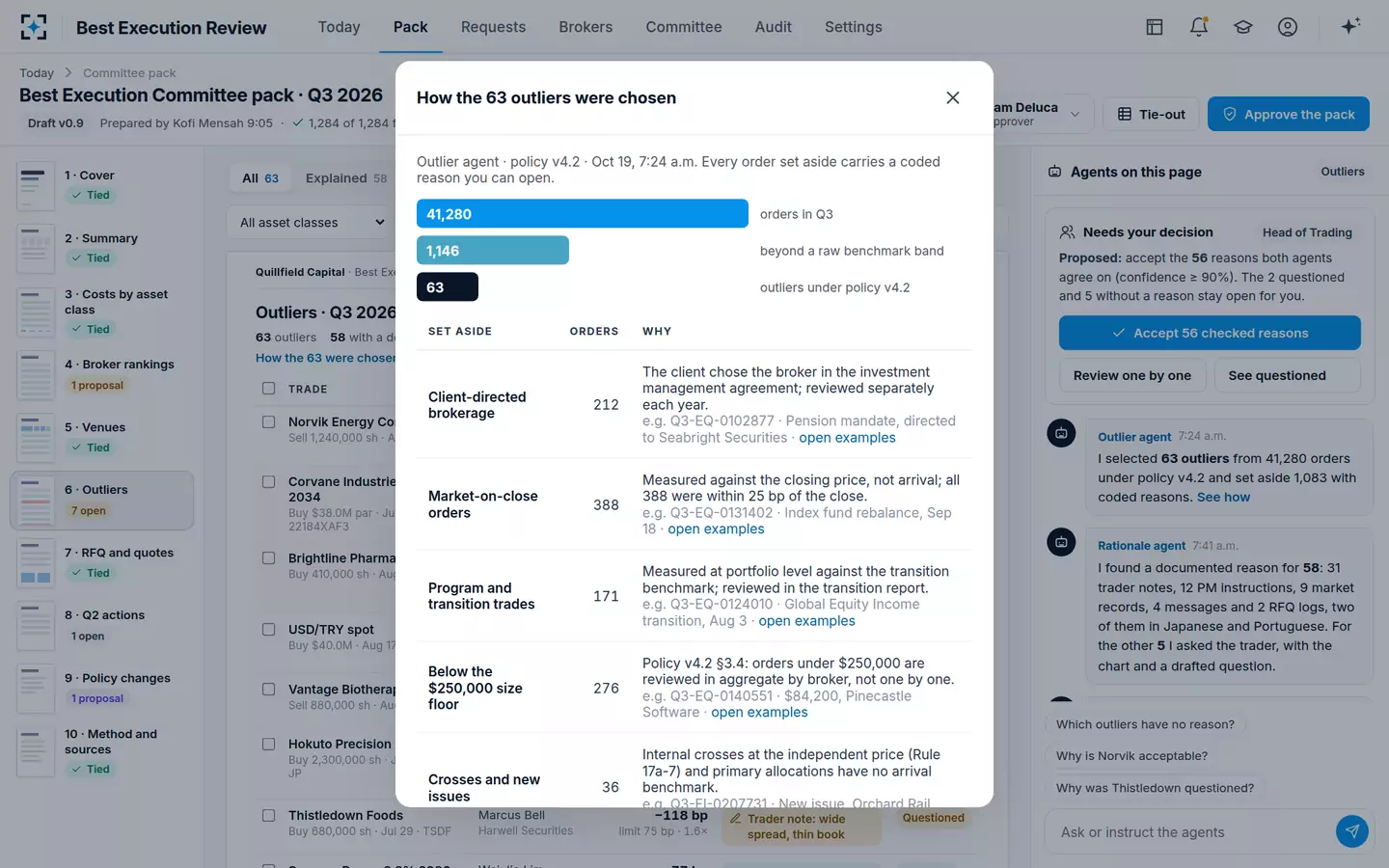
The figure that matters in that funnel is not 63; it is 1,083. A review that silently narrows 1,146 orders to 63 invites the question every examiner asks first: what happened to the rest? Coding each exclusion, and measuring it against the right benchmark rather than none, is what turns a filter into evidence.
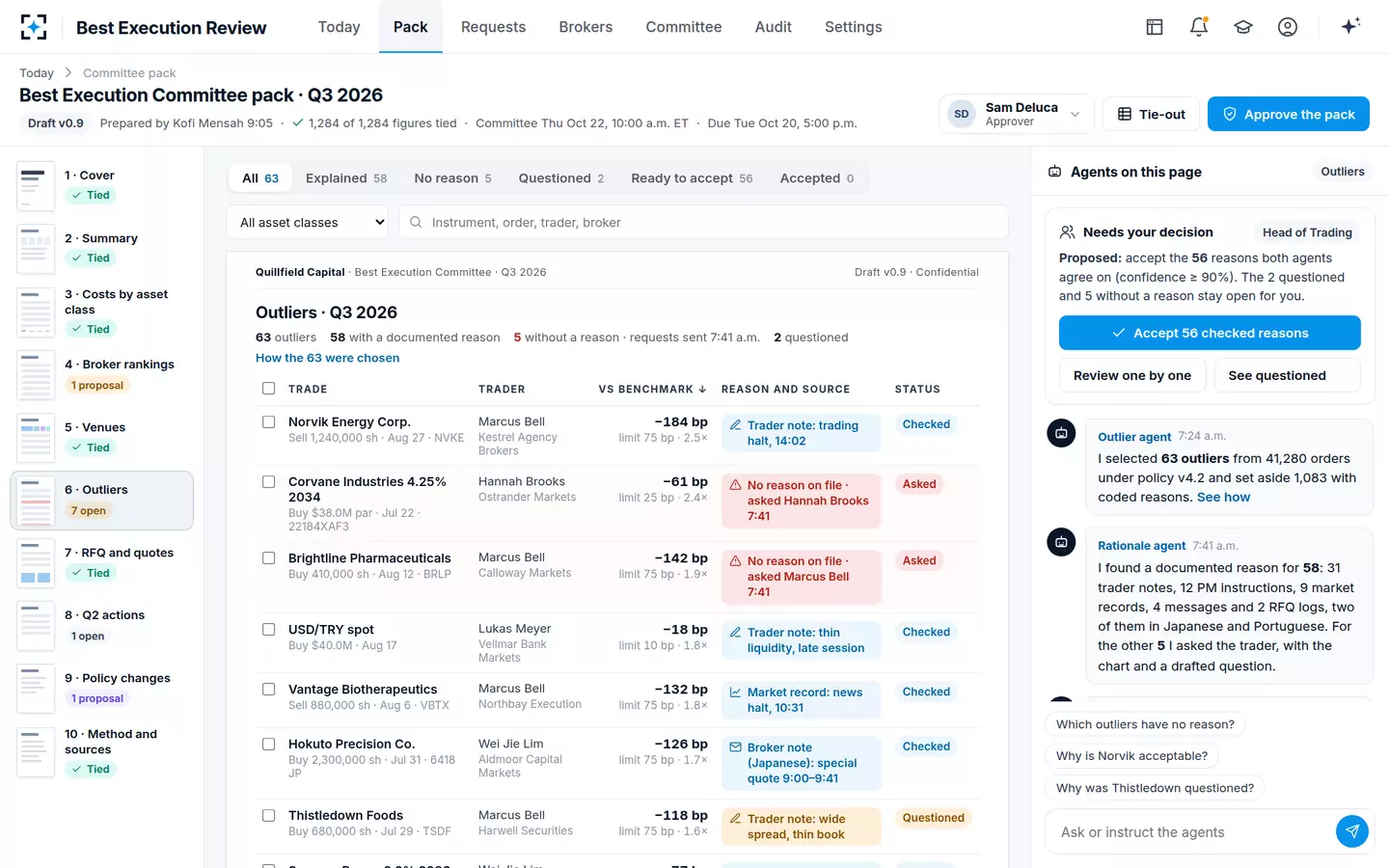
The people stay where the rules put them. The head of trading accepts or questions each reason, compliance countersigns the papers before they reach the committee, and traders explain their own orders but can never accept them. The agents select, find, check and tie figures; they never change a threshold or a broker's routing weight. What makes an outlier reason defensible takes one quarter's reasons apart, including the ones a second agent questioned.
The outlier page of the committee papers: each trade, its limit and the source of its reason
To see the whole cycle on a quarter's orders, start from Best Execution Review.
Questions people ask
What does best execution mean in trading?
In trading, best execution means handling a client's order so that the overall result is the most favourable reasonably available, weighing price with costs, speed, likelihood of completion, size and the nature of the order. For a large institutional order it is judged on the whole order, not each child fill; the SEC has described institutional customers expecting the analysis to evaluate "whether the parent order was executed at the most favorable price possible under prevailing market conditions".
Is best execution a legal requirement?
Yes. For US advisers it is part of the fiduciary duty of care under the Advisers Act; for broker-dealers it is FINRA Rule 5310 and MSRB Rule G-18; in the EU and UK it is MiFID II Article 27 and FCA COBS 11.2A. What is not prescribed in the US is the method: the SEC declined in 2019 to set specific requirements for advisers and withdrew its proposed Regulation Best Execution in June 2025.
What is a best execution policy?
A best execution policy is the firm's written statement of how it selects brokers and venues, which factors it weighs for each asset class, what thresholds identify an outlier, how often it reviews execution and who decides. US advisers need one as part of their Rule 206(4)-7 compliance policies, reviewed at least annually; the SEC staff have cited advisers whose policies "did not take into account the current business of the adviser, including the type of securities traded".
What is a regular and rigorous review?
It is FINRA's term for the periodic review a broker-dealer runs instead of examining every order: security by security and by order type, at least quarterly, comparing its execution quality with competing markets. Where it finds material differences, the firm should change its routing or document why it has not.
Who is responsible for best execution at an asset manager?
The firm is, and in practice the head of trading owns the process while compliance challenges it and a committee, often chaired from risk, decides. FINRA's 2026 report lists quarterly best execution committees among effective practices, and the FCA's December 2025 review of eight banks found the strongest second-line challenge where compliance had "the right data and tools".