Best execution under MiFID II means an investment firm must "take all sufficient steps to obtain, when executing orders, the best possible result for their clients taking into account price, costs, speed, likelihood of execution and settlement, size, nature or any other consideration relevant to the execution of the order" (MiFID II, Article 27(1)). A portfolio manager that places orders with brokers carries the same duty through Article 65 of the Delegated Regulation, and in the UK through FCA COBS 11.2A. What has changed since 2021 is disclosure, not the duty: the yearly RTS 27 and RTS 28 reports were removed in the UK and deleted in the EU, while the obligation to monitor execution quality, and to review the policy at least annually, stayed. Botminds' Best Execution Review is built for that monitoring: it applies the firm's thresholds by asset class, finds and checks a reason for each outlier, and keeps the evidence a supervisor asks for.
The timeline below draws the reports and the duty on the same scale. One lane ends; the other never breaks.
RTS 28 went; the duty to monitor best execution never did
- Published yearlyJan 2018 – Nov 2021
- Removed by the FCAfrom 1 Dec 2021
- Published yearlyJan 2018 – Feb 2024
- Deprioritised13 Feb 2024
- Deletedby 29 Sep 2025
- Monitor; review the policy at least annuallyfrom 2018
- 2026/8252028
What does MiFID II require for best execution?
MiFID II requires a firm to take all sufficient steps to obtain the best possible result for its clients, to set out how in an order execution policy, to monitor that policy's effectiveness and correct deficiencies, and to be able to show a client that its orders were executed in line with the policy. The test is "all sufficient steps", not every possible step, and not a guaranteed outcome on each order.
Article 27(1) names the factors: price, costs, speed, likelihood of execution and settlement, size, nature, and any other relevant consideration. For a retail client the best possible result "shall be determined in terms of the total consideration, representing the price of the financial instrument and the costs relating to execution", including venue, clearing and settlement fees. A specific instruction from the client changes the duty for the part of the order it covers: the firm "shall execute the order following the specific instruction". The FCA's December 2025 review of eight banks found client-specific instructions were the "biggest driver of outlier trades for most banks" (FCA, December 2025), which is why a review needs a code for them.
Portfolio managers: the duty when you place orders with brokers
A buy-side firm usually does not execute; it decides to deal and places the order with a broker. MiFID II covers that through Article 65 of Delegated Regulation 2017/565: a firm providing portfolio management must "take all sufficient steps to obtain the best possible result for their clients", establish a policy identifying "in respect of each class of instruments, the entities with which the orders are placed", and "monitor on a regular basis the effectiveness of the policy ... and, in particular, shall monitor the execution quality of the entities identified" (Delegated Regulation 2017/565, Article 65).
The same article sets the cadence: "Investment firms shall review the policy and arrangements at least annually", and whenever "a material change occurs that affects the firm's ability to continue to obtain the best possible result". In the UK the identical duty now sits in the FCA's own rulebook. When the FCA transferred the MiFID Organisational Regulation into its Handbook, with rules in force from 23 October 2025, Article 65 became COBS 11.2A.34R (FCA PS25/13), which requires a firm to "review its order execution policy and order execution arrangements at least annually and whenever a material change occurs" (COBS 11.2A.34R).
The FCA's guidance adds one line that sets the evidential bar: "In order to obtain the best execution for a client, a firm should compare and analyse relevant data" (COBS 11.2A.33G). And a firm "must be able to demonstrate to the FCA, at the request of that authority, its compliance" with the best execution rule (COBS 11.2A.32R). Demonstrate is the same verb the SEC staff used in 2018.
Is RTS 28 still required?
No, in either the EU or the UK. RTS 28 was the yearly publication, required by Article 27(6) of MiFID II, of each firm's top five execution venues per class of instrument and the quality of execution obtained; portfolio managers published the equivalent for the brokers they used under Article 65(6) of the Delegated Regulation. Directive (EU) 2024/790 states simply "paragraph 6 is deleted", and Member States had to transpose it "by 29 September 2025" (Directive (EU) 2024/790). The UK removed the reports from 1 December 2021.
Between the political agreement and transposition, ESMA told national supervisors in February 2024 not to prioritise "supervisory actions towards investment firms relating to the periodic reporting obligation to publish the RTS 28 reports", and its footnote made the scope clear: the term "includes reports to be published by investment firms that select other firms to provide order execution services in accordance with Article 65(6)" (ESMA, 13 February 2024). The same statement left no doubt about the rest of the regime.
Apart from the content of this statement, investment firms are required to strictly adhere to best execution requirements and NCAs are expected to supervise their compliance.
ESMA public statement on RTS 28 reporting, 13 February 2024
When did the FCA remove RTS 27 and 28?
On 1 December 2021. The FCA's policy statement PS21/20 said "the removal of the best execution reporting in RTS 27 and RTS 28, will come in to force on 1 December 2021", and recorded strong support for it, with "33 out of 34 respondents supporting removal" (FCA PS21/20, November 2021). The FCA's reason was that the reports "are little used by investors or firms with best execution obligations and are costly to produce".
The FCA also said in PS21/20 that it would "continue monitoring firms' compliance with the UK MiFID inducement and best execution rules", and its later work shows how. The December 2025 multi-firm review of UK listed cash equities started from banks' transaction reports and their own data, then tested monitoring, outlier investigation, management information and second-line challenge (FCA, December 2025). None of that depended on a published report.
Best execution in the EU and UK: the dates that matter now
33of 34
respondents to the FCA who supported removing the RTS 27 and 28 reports
29 Sep2025
deadline for EU states to transpose the deletion of the RTS 28 duty
30 Jun2026
end of the last national exemptions from the EU ban on payment for order flow
12 Feb2028
the EU's new criteria for testing an execution policy apply
What did Directive 2024/790 change in best execution?
It removed the reports and sharpened the monitoring. In Article 27 it deleted paragraph 2, replaced paragraph 3 so that a firm need only tell a client where an order in instruments subject to the trading obligation was executed, deleted paragraph 6, rewrote paragraph 7 and gave ESMA a new mandate in paragraph 10. Recital 8 gives the reason for removing the reports bluntly: "those reports are rarely read and do not enable investors or other users of those reports to make meaningful comparisons", and the consolidated tape's data "can be used for proving best execution".
Article 27 of MiFID II before and after Directive (EU) 2024/790
Before: Execution venues publish quarterly data on execution quality (RTS 27), suspended until 28 February 2023 by Directive 2021/338.
After (transposed by 29 September 2025): For instruments under the trading obligation, the firm informs the client where the order was executed. The venue reports are gone.
Before: Firms publish yearly their top five venues per class of instrument and the quality obtained (RTS 28).
After (transposed by 29 September 2025): "Paragraph 6 is deleted."
Before: Monitor the effectiveness of execution arrangements and policy, taking into account the RTS 27 and 28 information.
After (transposed by 29 September 2025): Monitor effectiveness "for the purpose of identifying and, where appropriate, correcting any deficiencies", and "assess, on a regular basis" whether the venues in the policy give the best possible result.
Before: ESMA standards on the content of the reports.
After (transposed by 29 September 2025): ESMA standards on "the criteria to be taken into account in establishing and assessing the effectiveness of the order execution policy", separately for retail and professional clients.
What the EU will require from February 2028
From 12 February 2028, firms in the EU must monitor their execution policy against thresholds they set in advance for each class of instrument, and assess the policy at least annually. Commission Delegated Regulation (EU) 2026/825, adopted on 14 April 2026 from ESMA's draft and published on 23 July 2026, says so in two articles, and repeals the regulations that defined RTS 27 and RTS 28 (Delegated Regulation (EU) 2026/825). ESMA's final report had proposed an 18-month lead time for firms to prepare (ESMA, 10 April 2025).
Article 7 is the part a monitoring system must answer to. A firm must check whether orders were executed in line with the policy, the quality obtained, the price "taking into account the reference data", and, "for each class of financial instruments ... based on a representative sample for each class, whether the execution quality is obtained on a consistent basis, based on thresholds pre-determined by the investment firm". The table sets out what each element asks for and the evidence that answers it.
Delegated Regulation (EU) 2026/825: what the monitoring must cover, and the evidence for each
| Requirement | What the text says | Evidence a firm keeps |
|---|---|---|
| Compliance with the policy | Art. 7(a): "whether client orders are executed in compliance with the order execution policy" | Every order in scope reconciled; exceptions coded and explained |
| Price against reference data | Art. 7(c): the price of execution against reference data, including the consolidated tape where used | Cost against a stated benchmark per asset class, with the data source and version |
| Pre-set thresholds per class | Art. 7(d): accepted deviation from reference prices, minimum share of volume and minimum number of orders meeting them | Thresholds written in the policy before the period, with approver and version |
| Representative sample | Art. 7(d): "based on a representative sample for each class" | The sampling rule, or the full population where the firm reviews every order |
| At least annually, and on triggers | Art. 8(1): assess "at least annually", and when monitoring shows non-compliance or a material change occurs | Dated assessments, including any triggered off-cycle |
| What the assessment weighs | Art. 8(2): costs and fees, monitoring results, market developments such as "liquidity dry-ups", new venues | Committee papers and minutes that cite each element |
What are the execution factors under COBS 11.2A?
The FCA's list mirrors MiFID's: "price, costs, speed, likelihood of execution and settlement, size, nature or any other consideration relevant to the execution of an order" (COBS 11.2A.2R). Their relative importance depends on the client, the order, the instrument and the venues available, and a firm's policy has to say how it weighs them for each class of instrument.
The FCA's 2025 review shows what a supervisor expects the weighing to look like in practice. All but one of the eight banks "monitored delivery of best execution across these factors using a combination of widely adopted transaction cost metrics and proprietary measures, benchmarking outcomes against pre-defined tolerances"; one "failed to evidence that it was monitoring more than the price of its executions", which the FCA called contrary to its expectations. Some banks reviewed their outlier thresholds at least annually; at one, the thresholds "hadn't been revised since their introduction several years ago" (FCA, December 2025).
The review covered sell-side banks, but the lesson transfers directly to an asset manager monitoring its brokers: a threshold set once and never revisited stops measuring anything. How to explain an outlier a committee can defend covers the next step, once a trade is beyond its threshold.
Is payment for order flow banned in the EU?
Yes. Regulation (EU) 2024/791 inserted Article 39a into MiFIR: firms acting for retail or professional clients "shall not receive any fee, commission or non-monetary benefit from any third party for executing orders from those clients on a particular execution venue", which the article defines as payment for order flow (Regulation (EU) 2024/791). Member States where the practice existed before 28 March 2024 could exempt their firms "until 30 June 2026". That window has closed.
Recital 9 of the amending directive ties the ban back to best execution: diverging national readings of Article 27 were "particularly evident in the different ways in which practices related to receiving payment for order flow are regulated across the Union". For a buy-side firm the practical point is narrower: rebates on venue fees remain permitted only where they "exclusively benefit the client", so a broker's pricing arrangements still belong in the annual assessment.
Keeping the monitoring evidence without the reports
Without RTS 28, the monitoring evidence is whatever the firm keeps: thresholds per class of instrument, the orders beyond them, a reason for each, and an assessment that weighs the results. That is also the work a quarterly committee already does, so the most economical approach is to run one review that answers the SEC, the FCA and the EU's 2028 criteria at once, at the strictest cadence among them.
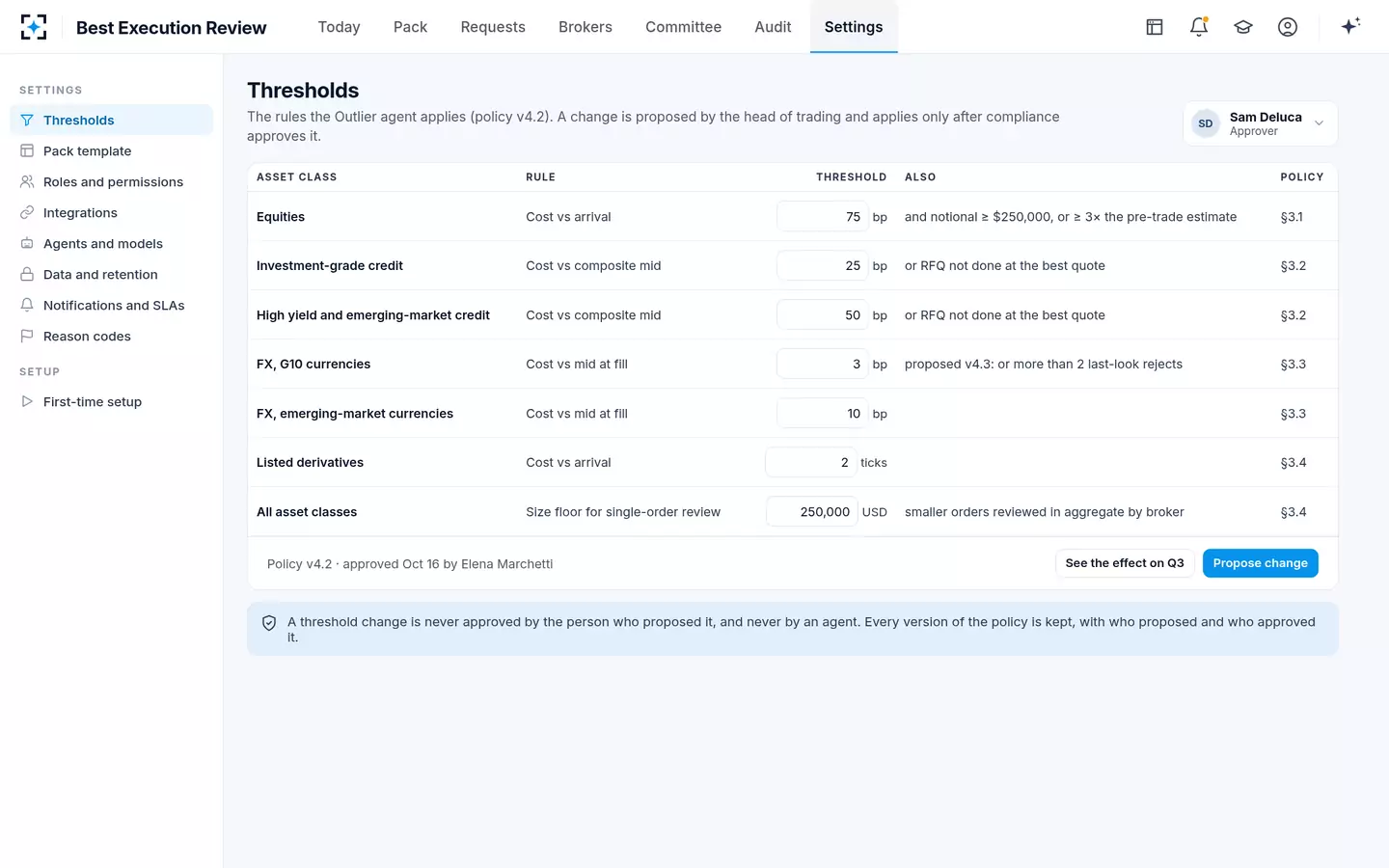
In Best Execution Review the thresholds come from the firm's own policy, clause by clause, and apply only after compliance approves them. Take a sample manager, fictional Quillfield Capital, with entities in New York, London and Singapore: its policy sets equities at 75 basis points against arrival, investment-grade credit at 25 and high-yield and emerging-market credit at 50 basis points against composite mid, G10 FX at 3 and emerging-market FX at 10 basis points against mid at fill, and listed derivatives at 2 ticks. Those are the "thresholds pre-determined by the investment firm" the 2026 regulation asks for, held with their version and approver.
Best execution thresholds by asset class, from the firm's own policy, with version and approver
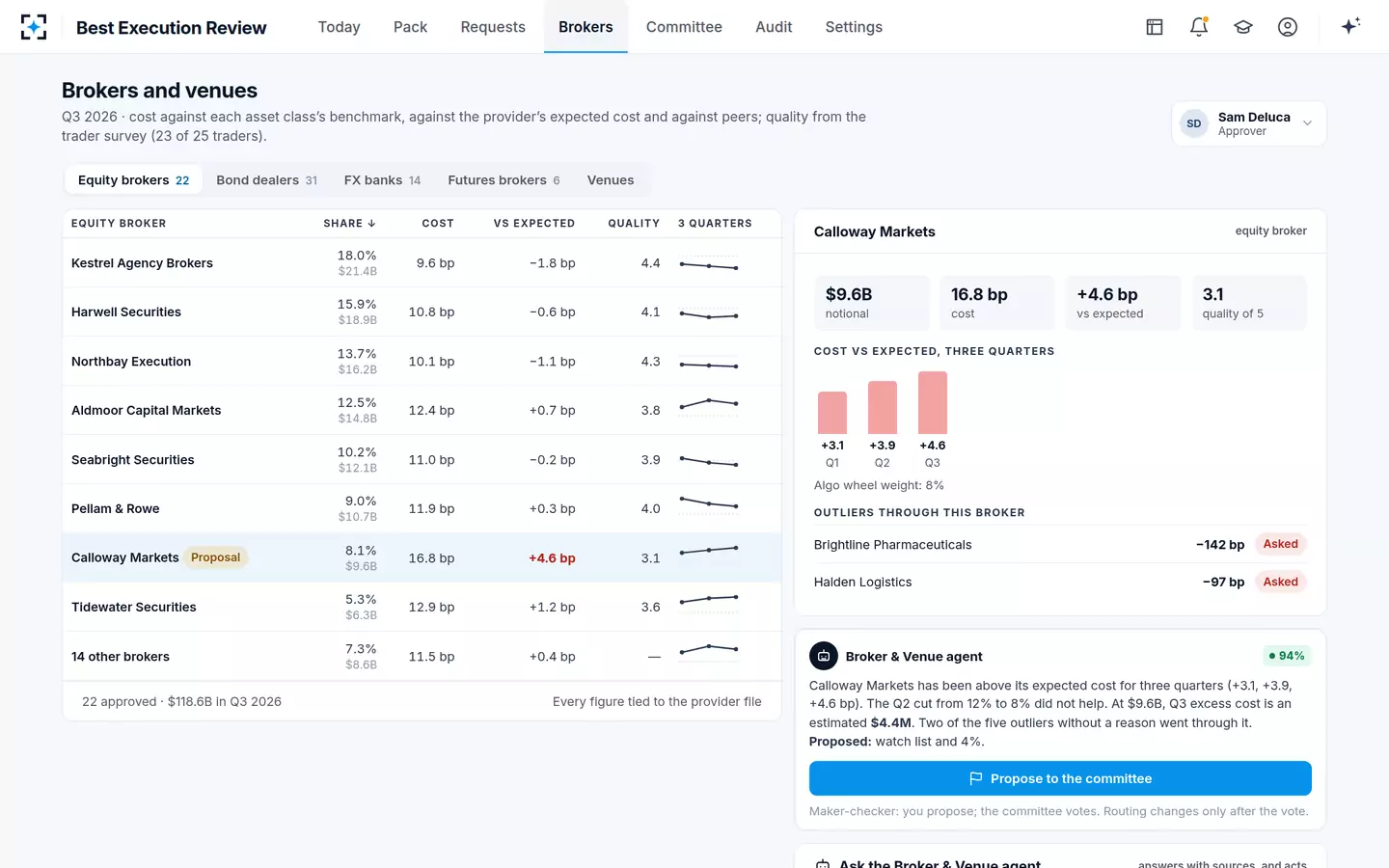
The annual assessment then draws on four quarters of the same evidence: costs against expected and against peers for every broker, the outliers and their reasons, and whether last year's actions worked. In the sample quarter one equity broker ran above its expected cost for three quarters running, and the agent's proposal to cut its share went to the committee with the trend attached.
Monitoring the brokers in the execution policy: cost, cost against expected and quality
For the US side of the same review, what best execution means for an adviser and a broker-dealer sets the three regimes next to each other. To see the monitoring on a quarter's orders, start from Best Execution Review.
Questions people ask
What replaced RTS 28 reports?
Nothing replaced them as a publication. The monitoring duty in Article 27(7), rewritten by Directive 2024/790, and Article 65 for portfolio managers remain; from 12 February 2028 Delegated Regulation 2026/825 sets the criteria for testing an execution policy, including pre-set thresholds and an assessment at least annually. Firms must still tell clients about material changes to their arrangements.
Do UK firms still need a best execution policy?
Yes. COBS 11.2A requires an order execution policy, monitoring of its effectiveness and, for portfolio managers under COBS 11.2A.34R, a review at least annually and on any material change. The FCA removed only the RTS 27 and 28 reports, from 1 December 2021.
Does best execution apply to professional clients under MiFID II?
Yes. Article 27 applies when a firm executes or places orders for retail or professional clients; Directive 2024/790 asked for criteria that take into account "whether the orders are executed on behalf of retail or professional clients". Transactions with eligible counterparties are excluded: Article 30 of MiFID II exempts them from Article 27.
Does a US adviser with European clients face MiFID best execution?
MiFID II and COBS bind firms authorised in the EU and the UK, not a US adviser as such. A European firm that delegates management or places orders through a US manager still has to monitor execution quality under its own rules, so it will often ask that manager for evidence that meets the European standard: thresholds by class of instrument, outlier reasons and an annual assessment.
How often must a MiFID II best execution policy be reviewed?
At least annually, and whenever a material change affects the firm's ability to obtain the best possible result: Article 65(7) of Delegated Regulation 2017/565 in the EU and COBS 11.2A.34R in the UK. From February 2028 the EU adds an assessment whenever monitoring indicates non-compliance with the policy.