Pre-trade vs post-trade compliance is a question of timing and of purpose. A pre-trade compliance check tests a proposed order against every investment restriction that binds the fund or account before the order is placed, so the breach never happens. Post-trade compliance monitoring tests the portfolio after trades settle, usually overnight or at the next NAV, so a breach that did happen is found, classified and cured. A fund needs both, because some limits can only be protected at the moment of purchase and others move with prices after it. Botminds' Pre-Trade Compliance Checks works on the first side: before an order, it answers "may this fund buy it, and how much?" for every fund the order might touch, quoting the clause in the prospectus, management agreement or side letter that decides it.
Luxembourg's fund supervisor made both checks a written requirement from 1 January 2025, and its first year of breach reports shows where the failures cluster. The examples of the solution on this page use its sample data, on fictional funds and people; the regulatory figures come from the regulators themselves, linked where they appear.
Pre-trade and post-trade compliance do different jobs, at different moments
Pre-trade compliance: At the portfolio management decision, before the order goes to the trader or the market.
Post-trade compliance monitoring: After the trade, at the latest by the next NAV calculation; often an overnight batch across all accounts.
Pre-trade compliance: May this fund buy it, and how much? Headroom in dollars against each limit, for each fund the order may go into.
Post-trade compliance monitoring: Is every fund inside every limit now? If not, did a decision cause it (active) or the market (passive)?
Pre-trade compliance: This morning's holdings plus today's fills, current prices, the security's identity and ratings, the issuer's facts, and the clause that applies.
Post-trade compliance monitoring: Settled positions, end-of-day prices, the NAV, corporate actions and the coded rules.
Pre-trade compliance: The portfolio manager asks; compliance rules on what is unclear; the trader works an order already answered.
Post-trade compliance monitoring: Compliance investigates, classifies the breach and drives the cure; the board or management body is told.
Pre-trade compliance: A breach that a decision caused: under UK and Luxembourg rules, corrected at once at the manager's cost, and reported where the rules require it.
Post-trade compliance monitoring: A breach found late, after the fund has carried it, sometimes through several NAVs.
What is pre-trade compliance?
Pre-trade compliance is the test of an intended trade against the fund's investment rules before it is executed. The clearest regulatory definition is Luxembourg's: Circular CSSF 24/856 requires "pre-trade controls aiming at verifying, at the moment of the portfolio management decisions (e.g., decisions by the IFM or the delegate), that the envisaged investment transactions comply with the investment rules applicable to the UCI and thereby prevent that non-compliance with the investment rules occurs" (CSSF Circular 24/856, point 58). The circular adds that these controls matter most for funds that may hold less liquid or illiquid assets, which are the hardest to sell back inside a limit.
US rules do not use the phrase, but they point the same way. A fund's compliance policies under Rule 38a-1 must be reasonably designed to prevent violations, and several Investment Company Act limits are framed around the purchase itself: Rule 22e-4 says a fund may not "acquire any illiquid investment if, immediately after the acquisition," it would hold more than 15% of net assets in illiquid investments (17 CFR 270.22e-4(b)(1)(iv)). A test that speaks of "immediately after the acquisition" can only be honoured by looking before the acquisition.
In practice a pre-trade check has three parts. It identifies which funds and which documents apply to the order. It reads the limits in those documents, including the ones no system holds. And it computes headroom: how much of the security each fund can still take, in dollars, from current holdings. The third part is what most order management systems do well, for the limits someone has coded. The first two are where questions go to email.
Pre-trade compliance answers whether a fund may buy, and how much. It is often confused with two neighbouring checks that answer different questions. How to buy well, at what price and through which broker, is best execution, measured before and after the trade by transaction cost analysis and reviewed against the duty itself in what best execution means. And a trade that went wrong after it was placed, whatever the reason, is handled as a trade error, with its own correction and cost rules under Trade Error Management. A pre-trade compliance check prevents one kind of trade error; it does not replace the other two disciplines.
What is post-trade compliance monitoring?
Post-trade compliance monitoring re-tests the whole portfolio after trades are done, to confirm that every limit still holds and to catch what changed without a trade. The same circular requires "post-trade controls that must be performed after the conclusion of investment transactions in order to ensure their compliance", says they must determine whether a breach is active or passive, and sets the deadline: "This post-trade control must occur at the latest when calculating the next NAV" (CSSF Circular 24/856, point 58).
The post-trade side does work the pre-trade side cannot. Prices move overnight, a NAV falls, a bond matures into cash, a corporate action changes the share count, a data vendor revises a rating. None of these is an order, so none passes through a pre-trade check. Post-trade monitoring is also where the classification happens that decides what a breach costs, active or passive, and a passive breach of investment limits has its own rules and cure clocks.
Post-trade monitoring has a structural weakness: it finds what it was told to look for. A side-letter exclusion that was never turned into a coded rule fails the overnight run exactly as it failed the order screen. That is why the regulator's two controls are complements, not substitutes, and why the coverage of the coded rules matters more than the speed of either check.
Pre-trade vs post-trade compliance, side by side: the order that tests both
The cleanest way to see the division of labour is one order passing through both checks. In the solution's sample data, a portfolio manager at a fictional global manager wants $20 million of a new, split-rated bond across five credit funds, each with different documents. The pre-trade side answers per fund before anything is sent; the order system's rules engine re-checks what it holds at entry; the overnight run confirms the portfolio after settlement.
One order through pre-trade and post-trade compliance
A person decides
Portfolio managerAsks whether $20M of the bond can go into five credit funds, before calling the trader.
Agent
Pre-trade checkReads the prospectus, SAI, UCITS supplement, management agreements and side letter; computes headroom from 6:00 a.m. holdings plus today's fills; quotes the deciding clause per fund.
Never: Never sends or changes an order
A person decides
Investment compliance officerRules on the one fund where two readings of the documents disagree, with a reason code.
Agent
Rules engine at order entryRe-checks every fund against the limits it has coded, and blocks a hard-limit breach.
A person decides
TraderAccepts the order against the written answer as the second key, then works it.
Agent
Post-trade monitoringRe-tests every account after settlement and at the next NAV; flags any limit now exceeded.
A person decides
ComplianceClassifies any breach as active or passive and decides the cure.
Each check has a different failure it is built to stop. The pre-trade answer stops the order that should never have been placed: the fund that a client side letter excludes from a coal miner, the fund whose own policy reads a split rating at the lowest grade. The entry check stops the order that drifted from its answer, for example a size typed wrong. The post-trade run catches everything that happened after: the price move, the late fill, the data correction.
Which restrictions can only be tested before the trade?
Any limit that is measured "immediately after the acquisition" must be tested before it, because once the purchase settles the breach is active and the cost is the manager's. Four families of limits work this way, and each appears in rule text.
Limits that only a pre-trade check can protect
| Limit | Why it is tested at purchase | Where it is written |
|---|---|---|
| Diversification (75-5-10) | A diversified fund keeps its status through later market moves, but not when a purchase caused the shortfall. | Investment Company Act §5(c) |
| Illiquid investments, 15% of net assets | The bar is on acquiring an illiquid investment when the fund would be over 15% immediately after. | Rule 22e-4(b)(1)(iv) |
| Securities of brokers, dealers and advisers | The caps on a securities-related issuer apply "immediately after the acquisition" of its equity or debt. | Rule 12d3-1(b) |
| Client and prospectus exclusions | A security a mandate prohibits is a breach the moment it is bought, whatever the price does next. | The prospectus, IMA or side letter |
| UCITS holding limits | Limits on a single issuer's debt, non-voting shares and money market instruments are measured at acquisition. | Directive 2009/65/EC Art. 56(2) |
The diversification row is the one most often misunderstood. Section 5(c) of the Investment Company Act protects a diversified fund from losing its status when later changes in value pull it outside the test, so long as no purchase caused the gap (15 U.S.C. 80a-5(c); the breach no trade caused). The test is in effect applied at each purchase, which is why the 1940 Act diversification test is a headroom calculation in dollars, run before the order.
Exclusions are the purest pre-trade case. There is no passive version of buying an excluded issuer: either the order was checked against the right list with the right facts about the issuer, or it was not. When the facts come from a data vendor that has not caught up with the issuer's latest filing, the check can pass and still be wrong.
Is post-trade monitoring enough for a fund?
No, not for a fund that buys anything its coded rules do not fully describe. Post-trade monitoring finds a breach after the fund has carried it, and for a decision-caused breach the remedy is a correction at the manager's cost, not a clean reversal. The supervisor that defined both controls requires both, and adds that a fund "must comply at all times with the applicable investment rules, i.e. at every NAV and between two NAVs (including on an intra-day basis)" (CSSF Circular 24/856, point 60).
US examiners make the same point from the other side of the table. In a risk alert drawn from "nearly 300 fund examinations over a two year period", the SEC's examination staff reported funds "that did not have policies and procedures reasonably designed to prevent the funds from violating their own investment limitations and guidelines" (SEC OCIE Risk Alert, November 7, 2019). The word that matters is prevent. A monitoring report that lists last night's breaches documents them; it does not prevent them.
Post-trade monitoring alone can be defensible for a narrow set of funds: an index fund whose only limits are coded, for instance, or a fund with no client side letters and no exclusions that depend on facts about the issuer. For most active managers, the open question is not whether to test before the trade but which limits the pre-trade test actually covers.
Where active breaches came from in one fund centre's first year
1,393
breaches of investment rules notified to the CSSF in 2025
41%
of them broke a limit set in the fund's own offering document or prospectus
210
broke ESG-related limits the fund had made binding
565
broke UCITS diversification, holding or borrowing limits
Where pre-trade breaches actually come from
Most decision-caused breaches are not exotic rules; they are the fund's own words. In the first full year under the new circular, Luxembourg's supervisor received 1,393 notifications of breaches of investment rules, which under the circular means active breaches, and 573 of them, 41%, concerned "specific investment policy limits/rules set out in the offering document/prospectus", which the report calls "the main category", in line with previous years (CSSF Feedback Report, 2026).
The regulator also listed the root causes behind the 210 ESG-related breaches, and each one is a pre-trade failure. Systems whose settings were not updated after the fund documents changed. Pre-trade alerts that were overridden or misread. Data problems that "affected the accuracy of the controls of the investment restrictions". Every one of these happens before the order, and none of them is fixed by a faster overnight batch.
The pattern has a simple explanation. Regulatory limits are the same for every fund of a type, so they are coded once and well. Prospectus, mandate and side-letter limits are written one fund at a time, in prose, and change with every amendment. They are the limits most likely to be missing from the rules engine, and the ones an investment compliance analyst ends up answering by email.
What happens when a pre-trade warning is overridden?
An override turns a prevented breach into a decision someone must defend. Most order systems let a user acknowledge a soft warning and proceed, and that is legitimate for a firm's own house limits, which exist to be stricter than the law. It is not legitimate for a regulatory, prospectus or client limit, which no one inside the manager can waive. The CSSF counted overridden pre-trade alerts among the causes of the active breaches it was notified about in 2025.
A defensible override has four parts: the limit is one the firm may override at all; a reason is written down before the order; someone other than the requester approves it; and it expires. Without the first, the override is a breach with a signature on it. Without the others, the examiner sees a trade that broke a limit and an email thread. Which limits can never be overridden, and who signs the ones that can, is the line any pre-trade compliance solution has to draw.
Six questions a pre-trade check must answer before the order
- Which funds and accounts could this order go into?
Not the PM's intended split: every account the order or its allocation may touch.
- Which documents bind each of them, in which version?
Prospectus and SAI, supplement, management agreement, guidelines, side letters, board resolutions. Amendments change limits.
- Which clause decides, and does any document override another?
A fund-level policy can be stricter than the law; an SAI can govern a prospectus description. Write the hierarchy down.
- What does each fund already hold, including today's fills?
Headroom from yesterday's positions without today's orders is how two desks breach the same limit.
- Does the answer depend on a fact about the issuer?
Revenue mix, securities-related activities, ownership by a sanctioned person. Read the filing when the vendor value is near the line.
- Is the answer written down against the order?
An answer by email that nobody can find is, for an examiner, an answer that was never given.
Where Pre-Trade Compliance Checks sits between the two
Pre-Trade Compliance Checks covers the pre-trade questions a rules engine cannot answer and leaves the rules engine and post-trade monitoring in place. A portfolio manager asks in plain words; the agents read every document that applies to each fund, compute headroom from that morning's holdings plus the day's fills, and return one verdict per fund: yes, yes up to an amount, no, or compliance to decide, each with its deciding clause quoted. A second reader on a different model reaches its own verdict without seeing the first, and any disagreement goes to a compliance officer.
The written answer travels with the order
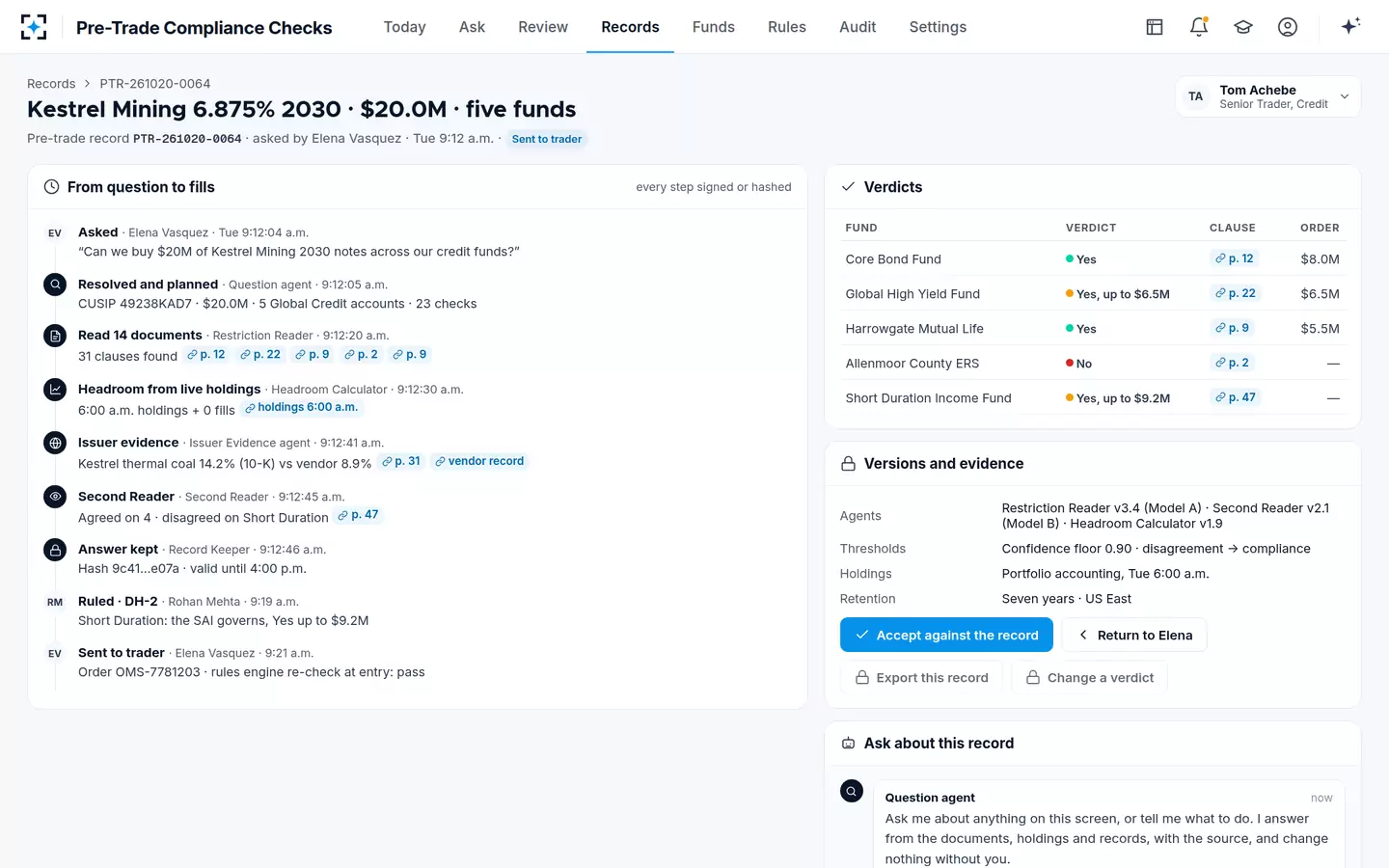
In the sample run, the answer for five funds came back in 42 seconds: three yes, one no from a client's coal exclusion, and one sent to compliance because the prospectus and the SAI read a split rating differently. The order went to the trader with the answer attached, and the rules engine re-checked the three funds in the order at entry. Nothing in that sequence replaces the overnight run; it changes what the overnight run is likely to find.
The portfolio manager's morning: answers, rulings and expired answers re-checked
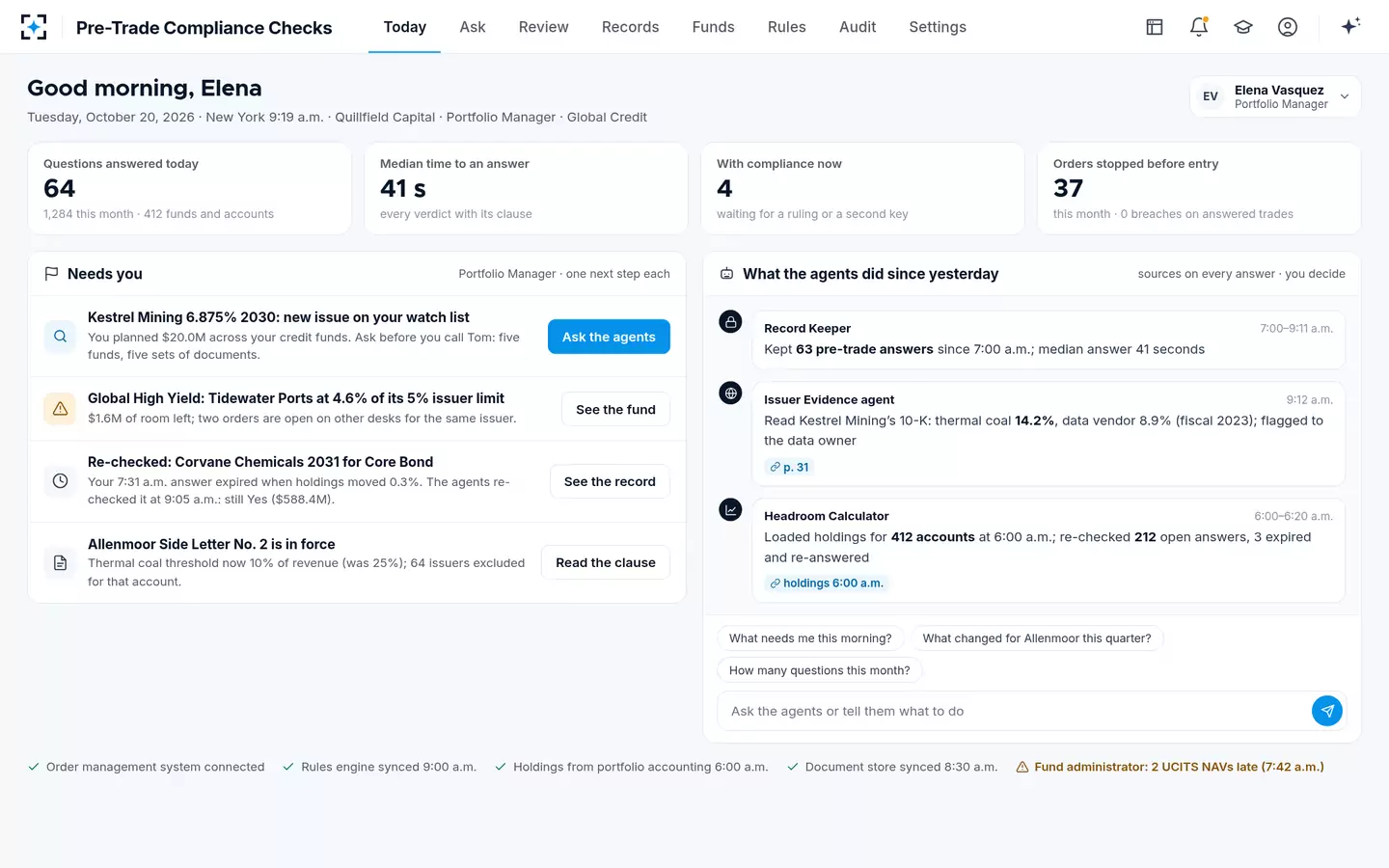
The boundary is deliberate. Post-trade guideline monitoring, the overnight test of every account, remains a separate job with its own systems and owners. What the pre-trade side adds is coverage of the clauses that never became coded rules, and a written answer for every question, which is what both the CSSF's control duties and the SEC's examiners ask to see. To see the full sequence on the sample funds, start from Pre-Trade Compliance Checks.
Questions people ask
What is pre and post trade compliance?
They are the two controls on a fund's investment restrictions. Pre-trade compliance tests a proposed order before it is placed; post-trade compliance tests the portfolio after the trade, at the latest by the next NAV under Luxembourg's Circular CSSF 24/856, and classifies any breach as active or passive.
Are pre-trade compliance checks required by law?
In Luxembourg, yes: Circular CSSF 24/856, in application since 1 January 2025, requires pre-trade controls as well as post-trade controls for investment funds. US rules do not name pre-trade checks, but Rule 38a-1 requires policies reasonably designed to prevent violations, and limits such as Rule 22e-4's 15% illiquid cap are framed around the acquisition itself.
What are pre-trade compliance rules?
They are the coded versions of a fund's restrictions that the order management system tests at entry: issuer and industry limits, rating floors, eligible markets, exclusion lists. They cover only what someone has coded; the SEC's 2019 risk alert found funds without procedures to prevent breaches of their own investment limitations and guidelines.
Can a pre-trade compliance check stop a passive breach?
Not the breach itself, because a passive breach comes from market moves or other events outside the manager's control. It can stop the next order from deepening it: a check that computes headroom from current holdings will show a fund already over a limit has no room left, so a further purchase would be active.
What is the difference between a hard and a soft pre-trade limit?
A hard limit blocks the order; a soft limit warns and lets an authorised person proceed. Regulatory, prospectus and client limits belong in the hard category because no one inside the manager may waive them. The CSSF counted overridden pre-trade alerts among the causes of active breaches notified in 2025.