An investment compliance analyst, also called an investment guidelines analyst or investment compliance officer, makes sure every fund and account a manager runs stays inside its investment restrictions: the regulatory limits of the 1940 Act or the UCITS rules, the policies in each prospectus and SAI, the guidelines in each client's investment management agreement and side letters, and the firm's own house rules. Day to day that means coding restrictions into the compliance rules engine, clearing pre-trade alerts, investigating post-trade breaches, and answering portfolio managers' questions about what a fund may buy. The last of those is the least visible and the most consequential, because every question the engine cannot answer lands on this seat. Botminds' Pre-Trade Compliance Checks is built for that seat: it reads the documents and computes the headroom for each question, and sends the analyst only what needs a ruling.
The examples use the solution's sample data, on fictional funds and people. The regulatory findings are the SEC's own, linked where they appear.
The questions that land on the investment compliance analyst
Today
Open the client's side letter, find the exclusion, look up the issuer's revenue mix, reply by email.
With agents
The clause is quoted and the issuer's filing read; the verdict arrives with the page cited.
Still theirs: Whether a vague exclusion covers this issuer at all.
Today
Check which agencies rate the bond, find which rule the fund uses, recompute the below-grade bucket.
With agents
Both readings of the documents are laid side by side with the bucket computed each way.
Still theirs: Which document governs, with a reason code.
Today
Is this bank a securities-related issuer? Find the segment note, add the joint ventures, divide.
With agents
The filing's figures are quoted and a second reader confirms them.
Still theirs: A filing that does not split the revenue cleanly.
Today
Read a 40-page agreement, often in another language, and draft coded rules one by one.
With agents
Each restriction is extracted with the original under the English and a proposed coded rule back-tested.
Still theirs: Approval of every new coded rule, with a second signature.
Today
A PM asks to exceed a limit; the analyst checks whether it is a house rule and who must sign.
With agents
What passes and what is over is shown with the evidence and the limit type.
Still theirs: The first key on any house-limit override; regulatory and client limits cannot be overridden.
What is an investment compliance analyst?
The investment compliance analyst is the person who answers "may this fund do this?" for the portfolio management side of an asset manager, and documents the answer. The role sits in the compliance function, usually reporting to a head of investment compliance and, through that person, to the chief compliance officer who reports to the fund boards under Rule 38a-1. Larger firms split it into a pre-trade desk, a post-trade monitoring team and a rules-coding team; smaller ones put all three in one seat.
The role is nearly invisible in official statistics. The US occupational database has no investment compliance occupation: the nearest entry, Compliance Officers (13-1041.00), lists sample job titles such as "License Examiner" and "Licensing Analyst" (O*NET OnLine). Its task list still describes the work: finding compliance issues that need follow-up or investigation, and checking that the firm's and regulators' policies are documented, put into effect and communicated.
What does investment compliance do? The four sources of restrictions
Investment compliance tests every portfolio against four layers of restrictions, and the SEC examines all four. In a 2021 risk alert covering "more than 50 fund complexes – covering more than 200 funds and/or series of funds – and nearly 100 advisers", the staff listed among the weaknesses it found "Monitoring for adherence to each fund's specific investment restrictions (e.g., investment concentration restrictions, limitations on investments in alternative investments, and/or restrictions on lower-rated securities)" (SEC Division of Examinations Risk Alert, October 26, 2021).
Four layers of investment restrictions, and where each one lives
| Layer | Examples | Where it is written | Who can change it |
|---|---|---|---|
| Regulatory | 75-5-10 diversification, 15% illiquid, Rule 12d3-1, UCITS 5/10/40 | Statute, SEC rules, UCITS Directive and national law | Nobody at the firm |
| Prospectus and SAI | Industry concentration, rating floors, a fund's own 5% issuer limit | Registration statement; fundamental policies change only by shareholder vote | Shareholders or, for non-fundamental policies, the board |
| Client mandate | Exclusions, rating methods, country and currency limits, benchmarks | Investment management agreement, guidelines, investment policy statement, side letters | The client, in writing |
| House | Single-name caps stricter than the law, restricted lists, concentration warnings | Compliance manual and policies | Investment compliance, under its own approval rules |
The layers explain why the analyst's queue never empties. Regulatory limits are the same for every fund of a type and are coded once. The other three are written fund by fund, in prose, and change with every prospectus update, mandate amendment and side letter. The professional standard behind them is short: a manager responsible for a portfolio "to a specific mandate, strategy, or style" must "take only investment actions that are consistent with the stated objectives and constraints of the portfolio" (CFA Institute Standards of Professional Conduct, III(C)). The analyst is the person who knows what the stated constraints actually say.
Investment compliance analyst job description: what the seat really does
A realistic job description has five parts, and only one of them is visible in a rules engine. The analyst codes and maintains the rules the order system tests. Clears pre-trade alerts and decides which can be acknowledged. Investigates post-trade exceptions and classifies breaches. Answers portfolio managers' questions the engine cannot. And keeps the evidence: who asked what, which clause decided it, which data was used, and who signed.
One sample firm's month at the pre-trade desk
412
funds and accounts under written restrictions
11,860
restrictions coded in the rules engine
~1,280
restriction questions a month the engine does not hold (estimate)
20–40min
per question answered by hand (assumption, to be measured in a pilot)
The fourth part is where the hours go. At the sample firm's assumed rate, 1,280 questions a month at 20 to 40 minutes each is 430 to 850 hours of reading and arithmetic: at roughly 160 working hours a month, three to five full-time analysts doing nothing else. The economics of that queue, and how to measure your own, are worked through in the guide to investment management compliance software and the cost per question.
How is a split rating treated in a fund's limits?
By whatever rule the fund's own documents set, and finding that rule is the analyst's job. Split ratings are common: a Federal Reserve Bank of New York study found that "over 50 percent of all corporate bonds have different ratings from Moody's and Standard and Poor's at issuance" (Cantor, Packer and Cole, Research Paper 9711, 1997). A fund limit on below-investment-grade holdings is therefore only as precise as its rule for reading two or three ratings that disagree.
One bond rated BBB− / Ba1 / BB+: four rating rules, two answers
| Rule in the fund's documents | Rating used | Investment grade? | Effect on a 10% below-grade bucket at 9.6% |
|---|---|---|---|
| Highest rating ("by at least one" agency) | BBB− | Yes | Not counted in the bucket; only the issuer limit applies |
| Lowest rating | Ba1 | No | Counts; 0.4% of the fund left in the bucket |
| Middle of three | BB+ | No | Counts; same as lowest here |
| Second-best of three | BB+ | No | Counts; same as lowest here |
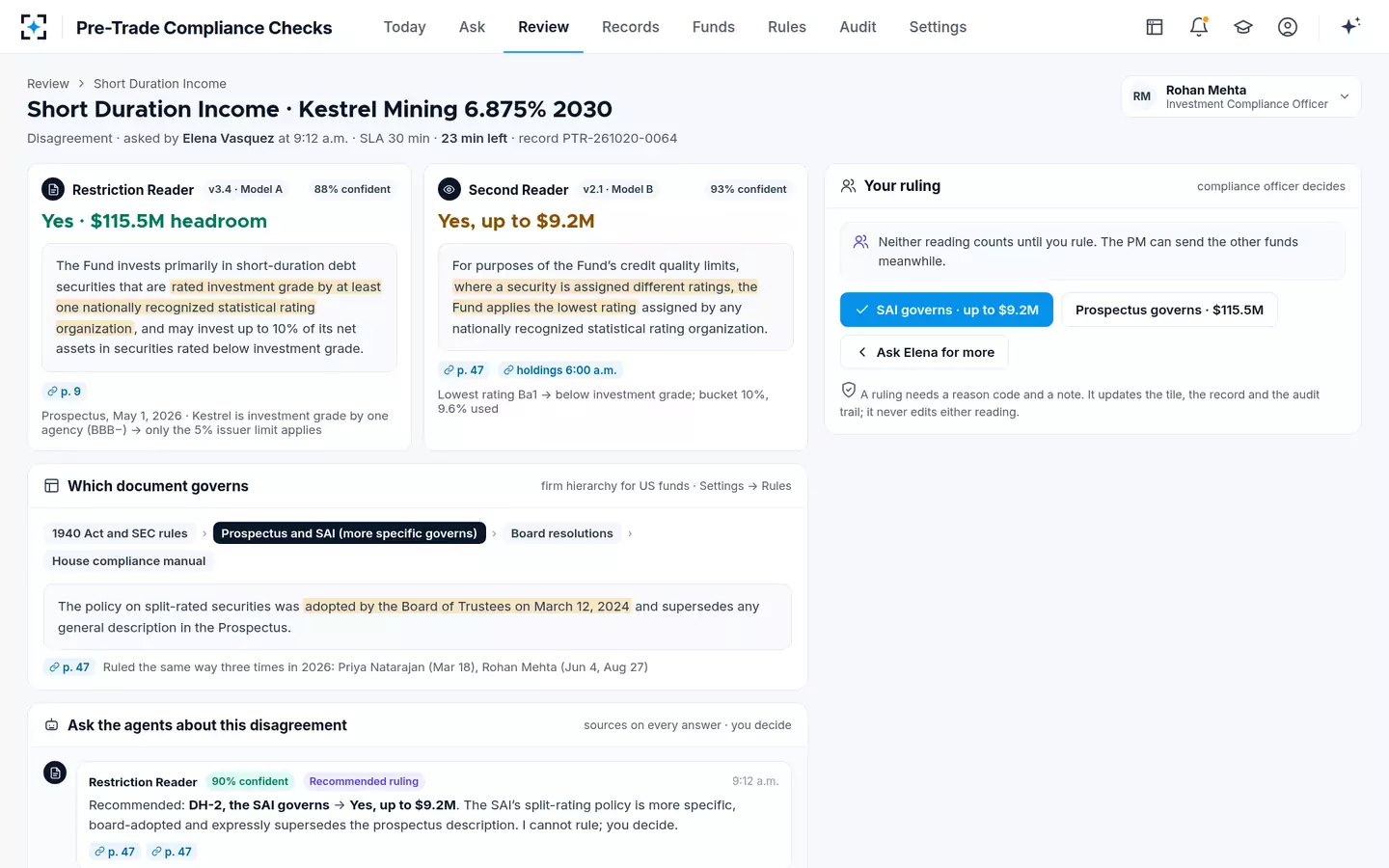
In the solution's sample run this exact disagreement surfaced on one fund of five. The prospectus described the fund as buying securities "rated investment grade by at least one nationally recognized statistical rating organization", which reads the bond as investment grade; the SAI said that where ratings differ "the Fund applies the lowest rating", which does not. The first reader said yes, $115.5 million; the second, reading the SAI, said yes, up to $9.2 million. Neither reading counted until a compliance officer ruled.
Two readings of a split rating, side by side, with the document hierarchy
Where the analyst's answers go missing
The examined weakness is rarely the answer; it is the absence of one on file. The SEC's 2019 fund examination findings described funds without procedures to prevent breaches of their own investment limitations and guidelines, and its 2024 risk alert on fund complexes, a population of "approximately 800 investment company complexes managing nearly 15,000 investment company portfolios", reported policies and procedures that "were not tailored to the funds' business model" (SEC Risk Alert, November 4, 2024). An analyst who answers by email and moves on leaves exactly that gap.
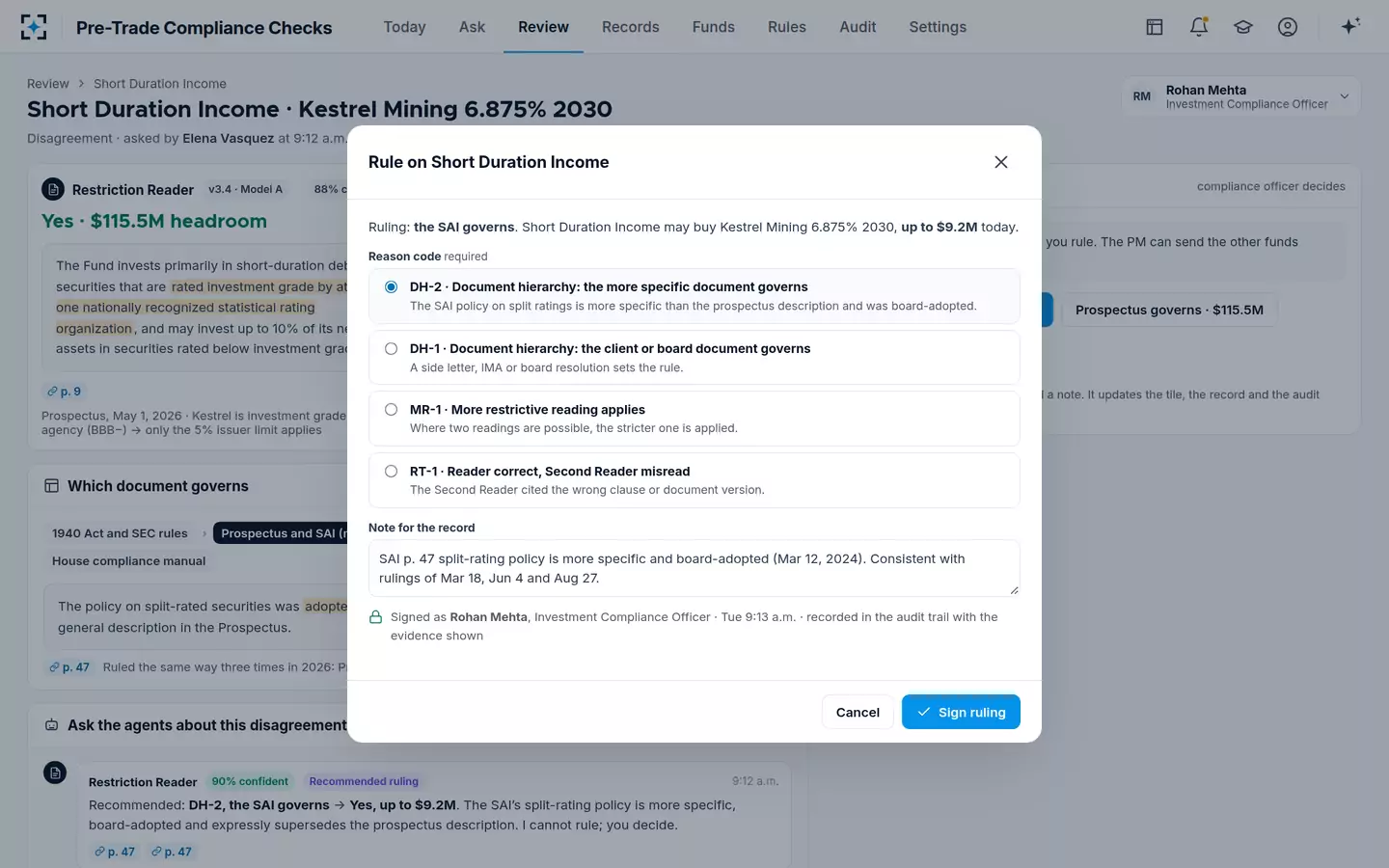
The fix is procedural before it is technical. Every answer should name the funds, the documents and versions read, the clause that decided, the holdings and prices used, and who signed, and it should be attached to the order it answered. That is a lot to type for a question that took twenty minutes; it is nothing to keep if the answer was produced in a form that already contains it.
The ruling: a reason code, a note, and nothing edited
New mandates: from a client's guidelines to coded rules
The analyst's other recurring task is onboarding: turning a new client's guidelines into rules the engine can test, before the first order. The work is slow because the guidelines are prose, often in the client's language, and because each restriction has to be read for its exceptions as well as its limit. A single-issuer cap with EU sovereigns exempt is two rules, not one; a minimum rating based on the second-best of three ratings needs the agencies, the order and the tie-break written down.
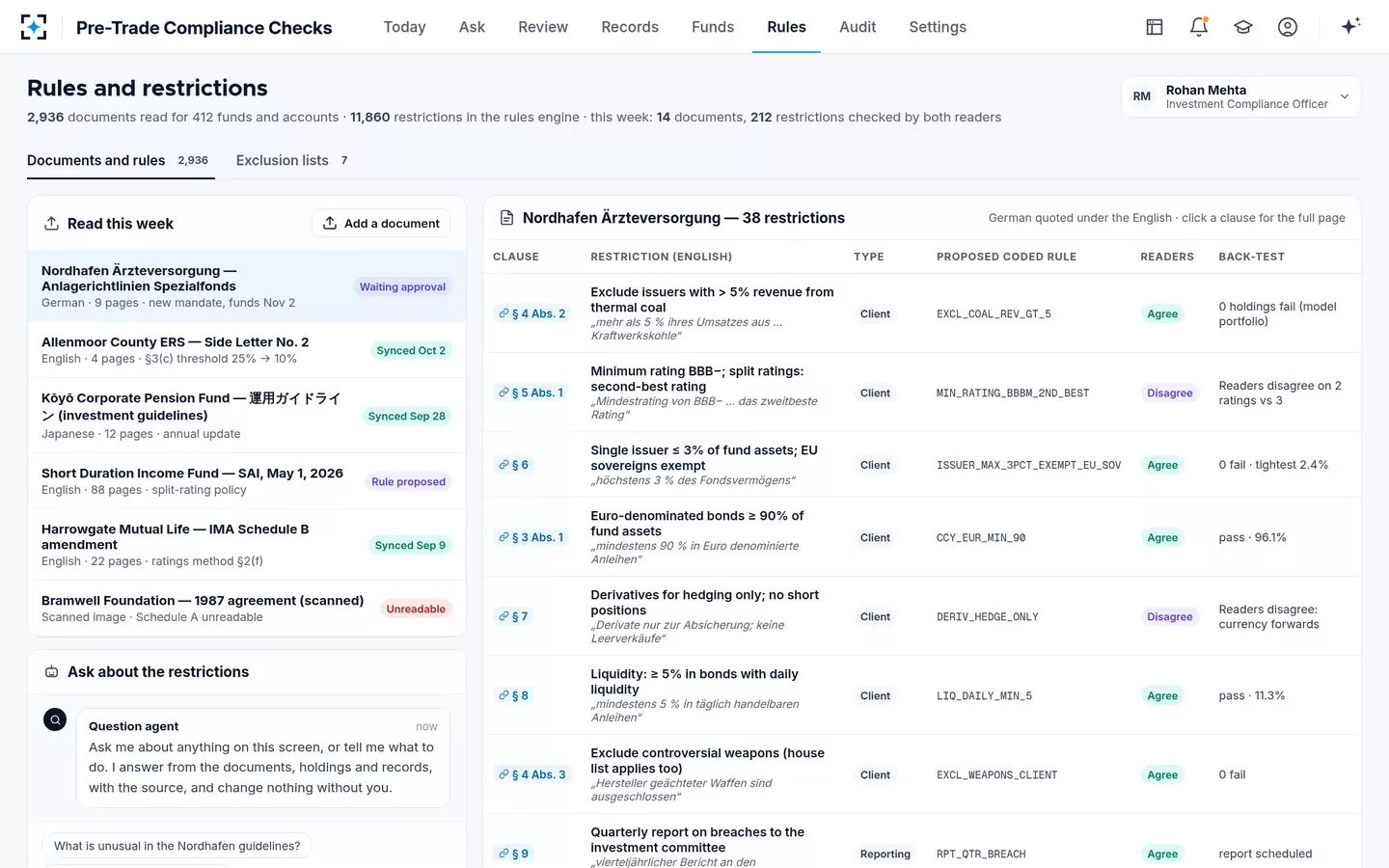
In the solution's sample data, a German pension scheme's special-fund guidelines held 38 restrictions. Each was extracted with the German original quoted under the English, given a proposed coded rule and back-tested on the fund's current holdings; both readers agreed on 36, and two went to a compliance officer for a ruling: the second-best rating rule, and whether currency forwards count as hedging. Nothing reached the rules engine until a compliance officer and the Head of Investment Compliance had both signed.
A new mandate's 38 restrictions, read in German, proposed as coded rules
What skills does an investment compliance analyst need?
The skills are half legal reading and half portfolio arithmetic, with a growing third half in data. An analyst must read a prospectus, an IMA and a side letter as legal texts, know which governs when they conflict, compute headroom on the right base, and know where each input came from and how old it is.
The skills the seat needs, and which ones agents can take
- Reading restrictions as legal text
Fundamental vs non-fundamental policies, defined terms, exceptions. Agents can find and quote; the analyst interprets.
- Knowing the document hierarchy
Law, side letter, agreement, guidelines, IPS, house manual; prospectus vs SAI. A written hierarchy turns most conflicts into a lookup.
- Headroom arithmetic
Total vs net assets, issuer aggregation, today's fills. Mechanical once the inputs are right.
- Rating and classification mechanics
Split ratings, sector codes, securities-related issuers, government securities. Rules first, then data.
- Data skepticism
Vendor values against issuer filings; stale holdings; late NAVs. Know when to read the source.
- Rules-engine coding
Turning prose into tests and back-testing them before they go live, with a second signature.
- Writing the answer down
Clause, data, version, signer. The examiner reads the file, not the analyst's memory.
How agents change the seat, and what stays with it
With Pre-Trade Compliance Checks, the analyst stops being the first reader and becomes the judge. The agents find and quote every clause that applies, compute headroom from that morning's holdings, read an issuer's filing when an exclusion depends on it, and propose an allocation; a second reader on a different model reaches its own verdict. What reaches the analyst is the residue: a split rating read two ways, a confidence below the 0.90 floor, an unreadable scan, an override request, a new coded rule waiting for two signatures. In the sample firm's morning, four questions were with compliance out of 64 answered.
What the analyst keeps is everything that requires authority: deciding which document governs, giving the first key on a house-limit override, approving a new coded rule, and telling a portfolio manager no. The authority line in a pre-trade compliance solution sets out who decides what, and why some limits have no override at all.
Questions people ask
What is the difference between an investment compliance analyst and an investment compliance officer?
Mostly seniority and sign-off. Firms often use "officer" for the person who rules on questions and approves overrides, and "analyst" for the person who prepares the answer and monitors breaches. Both work under the chief compliance officer, who reports to fund boards under Rule 38a-1.
What does an investment guidelines analyst do?
The same work focused on separate accounts: turning each client's investment guidelines, IMA and side letters into coded rules, checking trades against them, and reporting breaches to the client. The SEC's 2020 adviser findings listed compliance with client investment restrictions among the weaknesses examiners saw.
Is investment compliance a good career path?
It sits where law, portfolio management and data meet, and the work grows with every new mandate and side letter. The US occupational database has no separate category for it; its nearest entry, Compliance Officers, lists sample titles such as License Examiner, so published pay and employment figures for that entry describe a much broader group.
What qualifications does an investment compliance analyst need?
A finance, law or economics background helps, with working knowledge of the 1940 Act or the UCITS rules and of an order management system's compliance module. The CFA Institute's Standard III(C) sets the professional duty the job enforces: actions consistent with a portfolio's stated objectives and constraints.
How is a split rating treated when a fund's documents are silent?
There is no default in the 1940 Act; the fund needs a written rule. Without one, two careful readers can reach different answers, as in the sample case where "at least one" agency gave $115.5 million of headroom and "the lowest rating" gave $9.2 million. A board-adopted policy settles it.