Rule 12d3-1 is the SEC exemption that decides when a registered fund may buy securities of a "securities-related issuer": a broker, dealer, underwriter or investment adviser, which section 12(d)(3) of the Investment Company Act otherwise bars a fund from buying. Under the rule, a fund may buy any issuer that in its most recent fiscal year earned 15% or less of its gross revenues from securities-related activities, unless the fund would control it; above 15%, the fund may still buy, but immediately afterwards it may own no more than 5% of the class of equity, 10% of the issuer's outstanding debt, and 5% of the fund's own total assets in that issuer. The test turns on a figure that lives in the issuer's annual report, not in trading data, so it is a pre-trade question security-master codes cannot settle. Botminds' Pre-Trade Compliance Checks is built for limits like this: where an answer depends on a fact about the issuer, the agents read the issuer's latest filing and cite the page.
The worked figures below use invented issuers and an invented fund; the screens show the solution's sample data, on fictional funds and issuers.
Rule 12d3-1 in four numbers
15%
of the issuer's gross revenues from securities-related activities: the line between free and capped
5%
of the outstanding securities of a class of the issuer's equity, after the purchase
10%
of the outstanding principal amount of the issuer's debt, after the purchase
5%
of the fund's total assets in all the issuer's securities, after the purchase
What is Rule 12d3-1, and why does section 12(d)(3) need it?
Section 12(d)(3) is a flat prohibition, and Rule 12d3-1 is the door through it. The statute makes it unlawful for a registered fund "to purchase or otherwise acquire any security issued by or any other interest in the business of any person who is a broker, a dealer, is engaged in the business of underwriting, or is either an investment adviser of an investment company or an investment adviser registered under subchapter II of this chapter", with only a narrow exception for broker-dealers owned entirely by funds (15 U.S.C. 80a-12(d)(3)). Read literally, that would keep funds out of most large banks and every listed asset manager.
The rule opens the door in two steps. Paragraph (a) lets a fund "acquire any security issued by any person that, in its most recent fiscal year, derived 15 percent or less of its gross revenues from securities related activities unless the acquiring company would control such person after the acquisition." Paragraph (b) lets it buy issuers above 15% too, provided three conditions hold "immediately after" the acquisition. Paragraph (c) then closes parts of the door again, whatever the revenue mix.
Rule 12d3-1: the decision path from issuer to order size
Agent
Is the issuer in the business at all?Broker, dealer, underwriter, registered investment adviser, or adviser to a fund, directly or through enterprises it owns 20% or more of. If not, section 12(d)(3) does not apply.
Agent
Is it on the closed list?A general partnership interest, the fund's own promoter or principal underwriter or their affiliates, or the fund's own adviser or its affiliates are never exempted, subject to a narrow sub-adviser carve-out.
Agent
Securities-related revenue shareOwn securities-related revenues plus the ratable share from 20%-owned enterprises, divided by gross revenues, for the most recent fiscal year.
Never: Never taken from an industry code alone
Agent
15% or lessThe fund may buy, unless it would control the issuer.
Agent
Above 15%: three capsAfter the order: equity no more than 5% of the class, debt no more than 10% of the issuer's outstanding principal, all the issuer's securities no more than 5% of the fund's total assets.
A person decides
ComplianceRules where the revenue split cannot be read from the filing, or the issuer is near 15%, and signs the answer.
What counts as securities-related activities?
The rule defines them by role, not by product. "Securities related activities are a person's activities as a broker, a dealer, an underwriter, an investment adviser registered under the Investment Advisers Act of 1940, as amended, or as an investment adviser to a registered investment company" (Rule 12d3-1(d)(1)). Trading for its own book makes a bank a dealer; managing mutual funds makes an insurer an adviser; underwriting bond issues makes a bank an underwriter.
The numerator is wider than the issuer's own operations. "An issuer's gross revenues from its own securities related activities and from its ratable share of the securities related activities of enterprises of which it owns 20 percent or more of the voting or equity interest should be considered" (Rule 12d3-1(d)(2)). A holding company whose broker-dealer is a 35% joint venture carries 35% of that venture's securities-related revenue into its own test.
And the rule itself says where to look: "Such information may be obtained from the issuer's annual report to shareholders, the issuer's annual reports or registration statement filed with the Commission, or the issuer's chief financial officer." That sentence is the reason a pre-trade check for Rule 12d3-1 is a reading task. The segment note of a 10-K, not a sector code, is where the answer lives.
Does Rule 12d3-1 apply to bank stocks?
Yes, when the bank or its holding company earns more than 15% of gross revenues from broker, dealer, underwriting or advisory work, counting its 20%-owned enterprises. The question used to be easier. The 1940 Act's original definition of broker said it "does not include a bank". The Gramm-Leach-Bliley Act of 1999 replaced it: the term "broker" now "has the same meaning as given in section 3 of the Securities Exchange Act of 1934" (15 U.S.C. 80a-2(a)(6) and its amendment notes), and the old blanket exclusion of banks is gone from the 1940 Act's text.
For a diversified bank holding company the test is usually a matter of arithmetic on its segments. The invented example below shows why the answer cannot come from a "Banks" classification.
Is an invented bank holding company above the 15% line?
| Revenue line, most recent fiscal year | Ownership | Counts toward securities-related revenue |
|---|---|---|
| Gross revenues, consolidated | — | Denominator: $18,400M |
| Registered broker-dealer subsidiary | 100% | $2,100M |
| Registered investment adviser subsidiary | 100% | $900M |
| Investment banking joint venture, revenues $1,600M | 35% (ratable share) | $560M |
| Retail and commercial lending, deposits, cards | 100% | $0 |
| Securities-related share | ($2,100M + $900M + $560M) ÷ $18,400M | 19.3%: above 15%, the three caps apply |
A small change flips the answer. Without the joint venture stake the share would be 16.3%, still above the line; a sale of the adviser subsidiary as well would take it to about 12%. Both are events an issuer announces during the year and that show up in its next annual report. The rule's reference to the "most recent fiscal year" means the test should be refreshed when that report arrives, not when a vendor next updates a field.
What limits apply above 15 percent? The three caps, worked to dollars
Above 15%, all three caps of paragraph (b) must hold after the purchase, and for a typical diversified equity fund the binding one is usually the third. Paragraph (b)(3) requires that "Immediately after any such acquisition, the acquiring company has invested not more than five percent of the value of its total assets in the securities of the issuer." Unlike the 1940 Act's diversification test, this cap has no 25% bucket to absorb a larger position: it applies to the whole fund, diversified or not.
An invented $3.2 billion fund buying the same bank holding company
| Cap after the order | Today | Limit | Room |
|---|---|---|---|
| (b)(1) Equity: 5% of the class | 2.3M of 1,050M common shares (0.22%) | 52.5M shares | 50.2M shares, far from binding |
| (b)(2) Debt: 10% of outstanding principal | $25.0M of $62,000M of notes (0.04%) | $6,200M | Not binding |
| (b)(3) All the issuer's securities: 5% of total assets | $110.4M of shares + $25.0M of notes = $135.4M (4.23%) | 5% × $3,200.0M = $160.0M | $24.6M |
| Proposed order: $40.0M of common shares | Total after: $175.4M (5.48%) | $160.0M | Fails by $15.4M; the most the fund can buy is $24.6M |
Two details make the third cap harder than it looks. It counts every security of the issuer together, so a credit desk's holding of the issuer's notes uses the same 5% as the equity desk's shares. And paragraph (d)(6) says that where a fund holds or is buying "options, warrants, rights, or convertible securities of a securities related business, the determination required by paragraph (b) of this section shall be made as though such options, warrants, rights, or conversion privileges had been exercised." A convertible bond counts as the shares it converts into for the equity cap.
The trades Rule 12d3-1 never allows
Paragraph (c) lists acquisitions the exemption does not cover at any revenue share: a general partnership interest; a security issued by the fund's promoter, principal underwriter or their affiliated persons; and a security issued by the fund's investment adviser or an affiliated person of the adviser, with a narrow exception for a sub-adviser that does not advise the portion of the fund making the purchase and whose contract bars it from consulting on the fund's trades.
For a pre-trade check, these are the most dangerous rows, because they are about the fund's own corporate family rather than the issuer's business. A fund managed by a subsidiary of a listed financial group cannot buy that group's shares under this rule, however small the securities business is. The data a check needs here is not the issuer's revenue but the fund's own affiliations: who the adviser is, who controls it, and who the principal underwriter is.
An issuer fact read from the filing, with the page cited
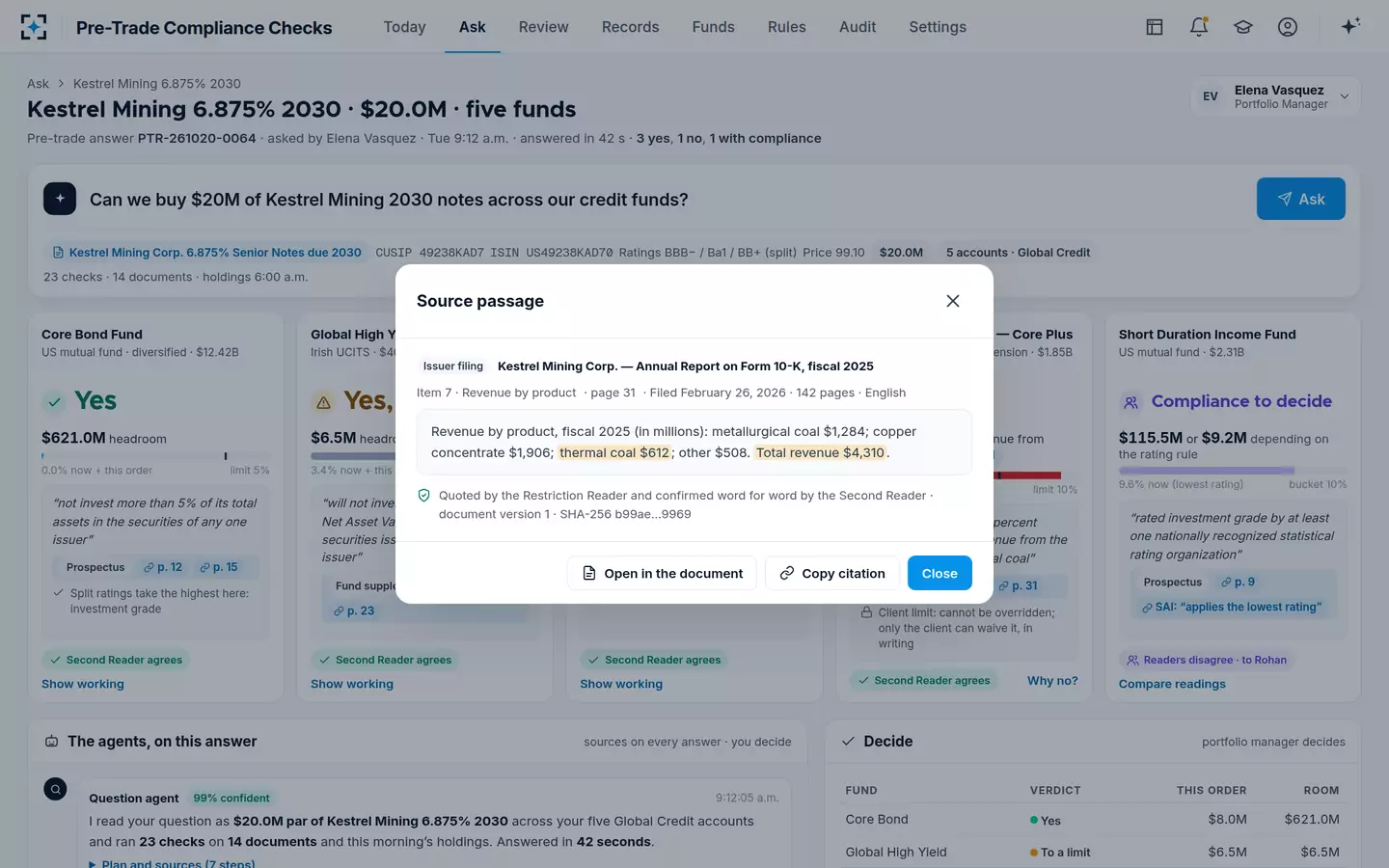
Can a rules engine test Rule 12d3-1 from security master data?
Partly. An order system can hold the three caps once it knows an issuer is above 15%, and it can flag likely candidates from an industry code: banks, brokers, asset managers, insurers with fund businesses. What it cannot do from a code is decide the 15% question, because the rule defines it by the issuer's revenue in its most recent fiscal year, including ratable shares of 20%-owned enterprises. That figure has to be read, computed and refreshed.
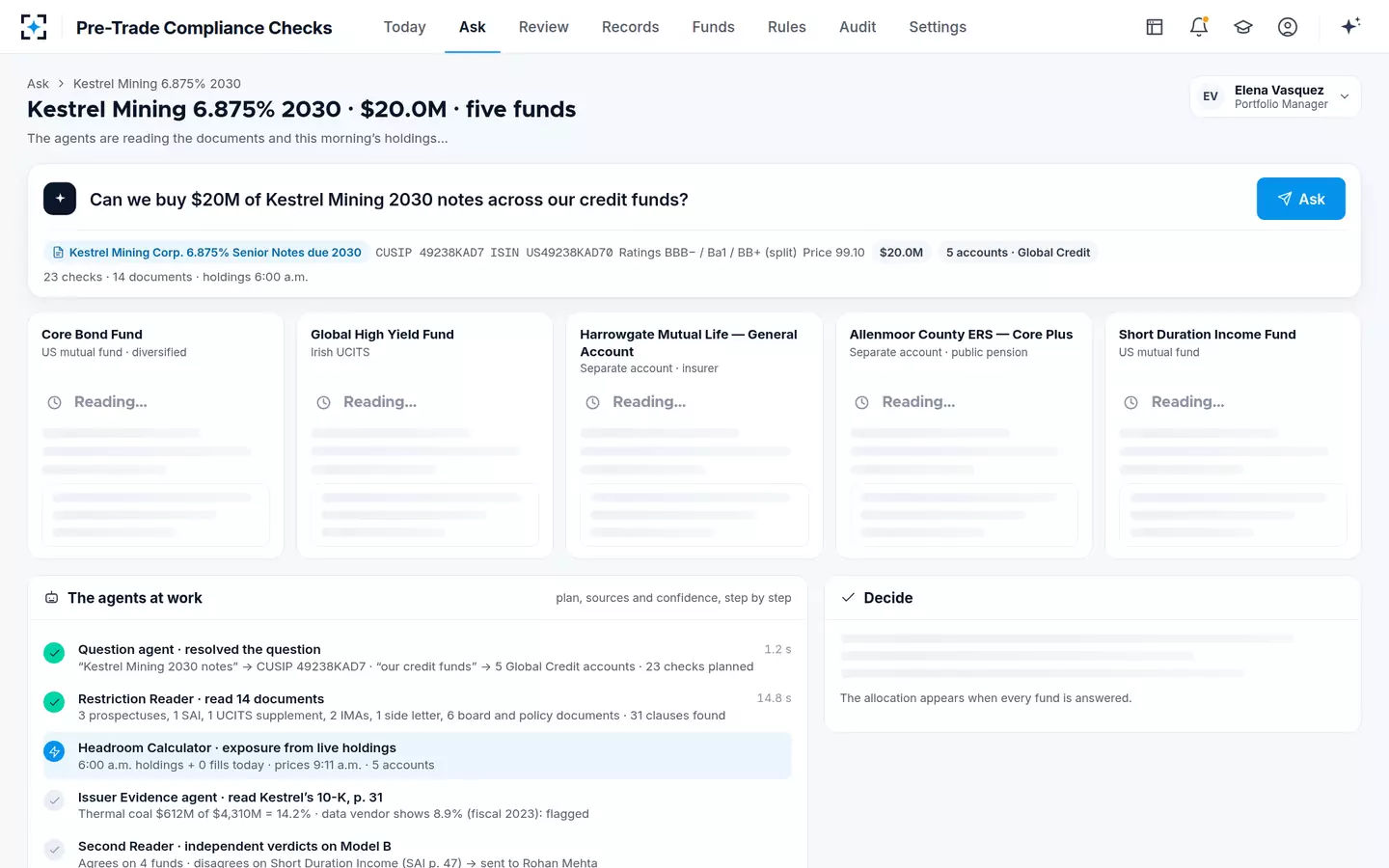
The workable split is the one the rule invites. A list of securities-related issuers, each with its revenue share, the fiscal year it comes from and the page it was read on, is maintained outside the engine and refreshed as annual reports arrive; the engine then tests the caps for issuers on the list. Pre-Trade Compliance Checks covers the first half: its agents read the issuer's filing and quote the passage, a second reader confirms it independently, and where the filing does not separate the revenue cleanly, the question goes to a compliance officer rather than to a guess. The same discipline applies to exclusion lists that depend on an issuer's revenue.
One question, every check planned and run with its sources
What is section 12(d)(1)(A) of the 1940 Act? The fund-of-funds limits
Section 12(d)(1)(A) is the other part of section 12(d) a pre-trade check meets most often: the limits on one fund buying another. Without an exemption, a fund may not, immediately after a purchase, own "more than 3 per centum of the total outstanding voting stock of the acquired company", securities of the acquired fund worth more than 5% of its own total assets, or securities of all other funds together worth more than 10% of its total assets (15 U.S.C. 80a-12(d)(1)(A)). The shorthand is 3-5-10.
Since 2020, Rule 12d1-4 lets funds exceed those limits on conditions, and some of the conditions are themselves pre-trade steps. If the acquiring fund is a management company, "prior to the initial acquisition of an acquired fund in excess of the limits in section 12(d)(1)(A)(i)", its adviser must evaluate the structure and fees and find that they do not duplicate the acquired fund's (17 CFR 270.12d1-4(b)(2)(i)(A)). A purchase that takes a fund over 3% of another fund's votes for the first time is therefore not just a limit check but a check that a finding exists and was reported to the board.
What a Rule 12d3-1 pre-trade check needs to hold
- A list of securities-related issuers, with evidence
Revenue share, fiscal year, filing and page. Refresh when each annual report arrives.
- Ratable shares of 20%-owned enterprises
Joint ventures and minority stakes in brokers or advisers count in proportion.
- The fund's own affiliations
Adviser, sub-advisers, principal underwriter, promoter and their affiliates: the paragraph (c) rows.
- Outstanding amounts
Shares outstanding by class and outstanding principal of debt, for the 5% and 10% caps.
- Every desk's holdings of the issuer
Shares, notes and convertibles count together toward 5% of total assets.
- Derivatives sized as exercised
Options, warrants, rights and conversion privileges, as paragraph (d)(6) requires.
- Control
Even under 15%, the exemption fails if the fund would control the issuer.
Rule 12d3-1 rarely makes headlines, but it touches a large share of any equity or credit universe: banks, insurers with fund businesses, asset managers, brokers. Answering it well is a matter of having read the right page of the right annual report before the order, and being able to show it. To see an issuer fact read and cited in a live answer, start at Pre-Trade Compliance Checks; the 1940 Act diversification test covers the other per-issuer cap a US fund computes.
Questions people ask
What is a securities-related issuer under Rule 12d3-1?
An issuer whose business includes acting as a broker, dealer, underwriter, registered investment adviser or adviser to a registered fund. Rule 12d3-1 caps a fund's purchases only if the issuer derived more than 15% of its gross revenues from those activities in its most recent fiscal year.
How is the 15 percent revenue test measured?
Securities-related revenues, including the ratable share from enterprises the issuer owns 20% or more of, divided by gross revenues, for the most recent fiscal year. The rule says the information may come from the annual report, filings with the SEC or the issuer's chief financial officer.
Can a fund buy shares of its own adviser's parent company?
Not under Rule 12d3-1. Paragraph (c) excludes securities issued by the fund's investment adviser or its affiliated persons from the exemption, whatever the revenue mix, with a narrow exception for an unrelated sub-adviser that does not advise the portion of the fund making the purchase.
Does a non-diversified fund have to follow Rule 12d3-1?
Yes. Section 12(d)(3) applies to every registered investment company, and the rule's caps, including no more than 5% of total assets in a securities-related issuer above the 15% line, apply whatever the fund's classification.
Do stock dividends or splits count as new acquisitions?
No. Paragraph (d)(7) says receiving stock dividends or split shares on securities bought in compliance, and exercising options, warrants or rights or converting securities acquired in compliance, are not acquisitions of a securities-related business's securities.