A passive breach of investment limits happens when a fund ends up outside a limit without having made an investment decision that caused it: prices move, redemptions shrink the net asset value, a corporate action changes a holding, a subscription right is exercised. Regulators treat it differently from an active breach, the one a trade or a foreseeable inaction causes, and give the manager time to cure it in the investors' interest instead of at once and at its own cost. The catch is that a passive breach stays passive only until the next order touches it. Botminds' Pre-Trade Compliance Checks computes each fund's headroom from that morning's holdings at current prices before an order is placed, so a fund already over a limit shows no room, and the portfolio manager learns that before a purchase turns the market's breach into the manager's.
The fund in the examples below is invented to show the timing; the screens use the solution's sample data, on fictional funds and issuers. Rule text is quoted from the regulators.
The same passive breach, handled two ways
- RallyDays 0–1
- Sold down through normal sales, no new buysDays 2–11
- CompliantDays 12–19
- Rally, carriedDays 0–7
- New buyDays 8–9
- Active: corrected at once, loss to the fund made goodDays 10–19
What is a passive breach?
A passive breach is a contravention the manager did not cause and could not reasonably have avoided. Luxembourg's circular gives the clearest definition: breaches "are passive where they occur for reasons beyond the control of the UCI or as a result of the exercise of subscription rights. Instances of active non-compliance are those that cannot be qualified as being beyond the control of the UCI" (CSSF Circular 24/856, point 55). Its standard example is "non-compliance resulting from market price fluctuations of investments held by a UCI decreasing the NAV serving as a reference for the calculation of a given investment restriction."
The UK rule says the same in the language of the manager's duty. The authorised fund manager must restore compliance "as soon as reasonably practicable having regard to the interests of the unitholders" where the scheme property is invested contrary to the rules and "the contravention is beyond the control of both the authorised fund manager and the depositary" (FCA COLL 6.6.14R(3)). The depositary is part of the test: a breach is passive only if neither of them could have stopped it.
Active breach vs passive breach: the line, and why it costs money
The difference is not academic: an active breach must be corrected immediately and its losses made good, while a passive breach is cured over time without compensation. The UK rule puts it in one sentence: on becoming aware of a breach, the manager must "take action, at its own expense, to rectify that breach, unless the breach occurred as the result of any of the circumstances" that make it passive (COLL 6.6.14R(2)).
Active and passive breaches are judged by cause, and treated differently
Passive breach: Market prices move; redemptions shrink the NAV; subscription rights are exercised; another event beyond the manager's control.
Active breach: A purchase or sale; or no action where the breach was "foreseeable or avoidable", such as cash from a maturing bond.
Passive breach: Neither the manager nor the depositary (UK); no one at the fund (Luxembourg).
Active breach: The fund, its manager or a delegate, by decision, inadvertence, human error or an IT failure.
Passive breach: Within a reasonable period, in the investors' interest; six months at most for most UK limits.
Active breach: At once; for UCITS in Luxembourg, "directly after the detection".
Passive breach: No compensation process (Luxembourg).
Active breach: The manager, for any loss to the fund (UK: "at its own expense").
Passive breach: Not notified to the CSSF in Luxembourg; monitored until cured.
Active breach: Notified to the CSSF; included in the auditor's controls.
The active side is broader than most portfolio managers assume. Luxembourg counts as active not only "voluntary actions/transactions, notably investment or divestment decisions" but also the "absence of actions/transactions or decisions at the level of a UCI where non-compliance with an investment rule was foreseeable or avoidable", and says the cause may be "an intentional decision, inadvertence, human error or from operational or technical/IT failures" (point 56). A coded rule that was never updated after a prospectus change produces active breaches, not passive ones.
The supervisor's FAQ applies the same logic to cash. A bond maturing into a deposit that takes the fund over 20% with one bank is active, because the maturity date was known. Cash timing of this kind is covered in the guide to UCITS investment restrictions; for passive breaches the point is the reverse: only what nobody could see coming is passive.
How long do you have to cure a passive breach?
It depends on the regime, and only the UK puts a number on the general case. The UK's maximum period "starts at the date of discovery of the relevant circumstance and lasts" six months for most limits, until the close of business five business days later for a derivatives or forward transaction, and two years where the transaction relates to an immovable (COLL 6.6.14R(5)). The EU Directive sets no deadline: a UCITS "shall adopt as a priority objective for its sales transactions the remedying of that situation, taking due account of the interests of its unit-holders" (Directive 2009/65/EC, Article 57(2)). Luxembourg asks for corrective measures "within a reasonable period of time, by taking into account the interest of the investors". Pension funds meet the same question in private equity, where no regulator sets the clock and the policy has to: the denominator effect, and why the cure is usually pacing.
Cure clocks for limits broken without a trade
| Regime and limit | What the rule requires | Clock |
|---|---|---|
| UK UCITS and NURS, most COLL 5 limits | Restore compliance as soon as reasonably practicable, in unitholders' interests | At most six months from discovery |
| UK, derivative or forward transaction | Same duty | Close of business five business days later (20 for a commodity delivery) |
| EU UCITS (Directive Art. 57(2)) | Remedy as the priority objective of sales, in unit-holders' interests | No fixed period |
| Luxembourg, all UCIs (CSSF 24/856) | Corrective measures within a reasonable period; monitored until corrected; not notified | No fixed period; non-UCITS may keep the position in duly justified cases |
| US diversified fund (ICA §5(c)) | No loss of status from drift; the next acquisition must not add to the discrepancy | None: the test bites at the next purchase |
| US fund over 15% illiquid (Rule 22e-4) | Report to the board within one business day, with a plan; board reassesses | Board review at 30 days and every 30 days after |
| US fund outside its VaR limit (Rule 18f-4) | Come back into compliance promptly; report to the board if not within five business days | Written report within 30 calendar days of the exceedance |
| US regulated investment company tax test (IRC §851(d)) | Eliminate an acquisition-caused discrepancy | 30 days after the quarter end; six months for a small failure |
Is a passive breach a violation under the 1940 Act?
For the diversification test, no: the Act says a diversified fund does not lose its status because of later changes in the value of its investments, so long as the discrepancy is not the result of an acquisition (15 U.S.C. 80a-5(c)). There is no general US rule that defines a passive breach or sets a cure period for it. Funds write their own in their compliance procedures, and a fund's documents may state that a percentage limit applies only at the time of purchase, in which case later drift is not a breach of that limit at all.
Two SEC rules come close to a passive-breach procedure, and both start a clock on the day the limit is crossed. Under Rule 22e-4, if a fund holds more than 15% of net assets in illiquid investments, it must report "to the fund's or In-Kind ETF's board of directors within one business day of the occurrence, with an explanation of the extent and causes of the occurrence, and how the fund or In-Kind ETF plans to bring its illiquid investments that are assets to or below 15% of its net assets within a reasonable period of time"; if still above 15% after 30 days, the board, including a majority of independent directors, must assess whether the plan "continues to be in the best interest" of the fund (Rule 22e-4(b)(1)(iv)).
Under Rule 18f-4, a fund outside its value-at-risk limit "must come back into compliance promptly after such determination, in a manner that is in the best interests of the fund and its shareholders", and if it is still out after five business days its derivatives risk manager must report to the board and explain within thirty calendar days how it came back (Rule 18f-4(c)(2)). The tax code adds a third clock: a regulated investment company that fails its diversification test at a quarter end because of an acquisition keeps its status "if such discrepancy is eliminated within 30 days after the close of such quarter" (26 U.S.C. 851(d)(1)).
Can you buy more of a holding that is in passive breach?
Not without making the breach active. Under the UCITS rules the remedy must be the priority objective of the fund's sales, which leaves no room for purchases of the same issuer. Under the 1940 Act, a purchase that adds to a diversification discrepancy makes it "the result of such acquisition". Under Luxembourg's circular, buying into a known breach is a voluntary decision, the first item on its list of what makes a breach active.
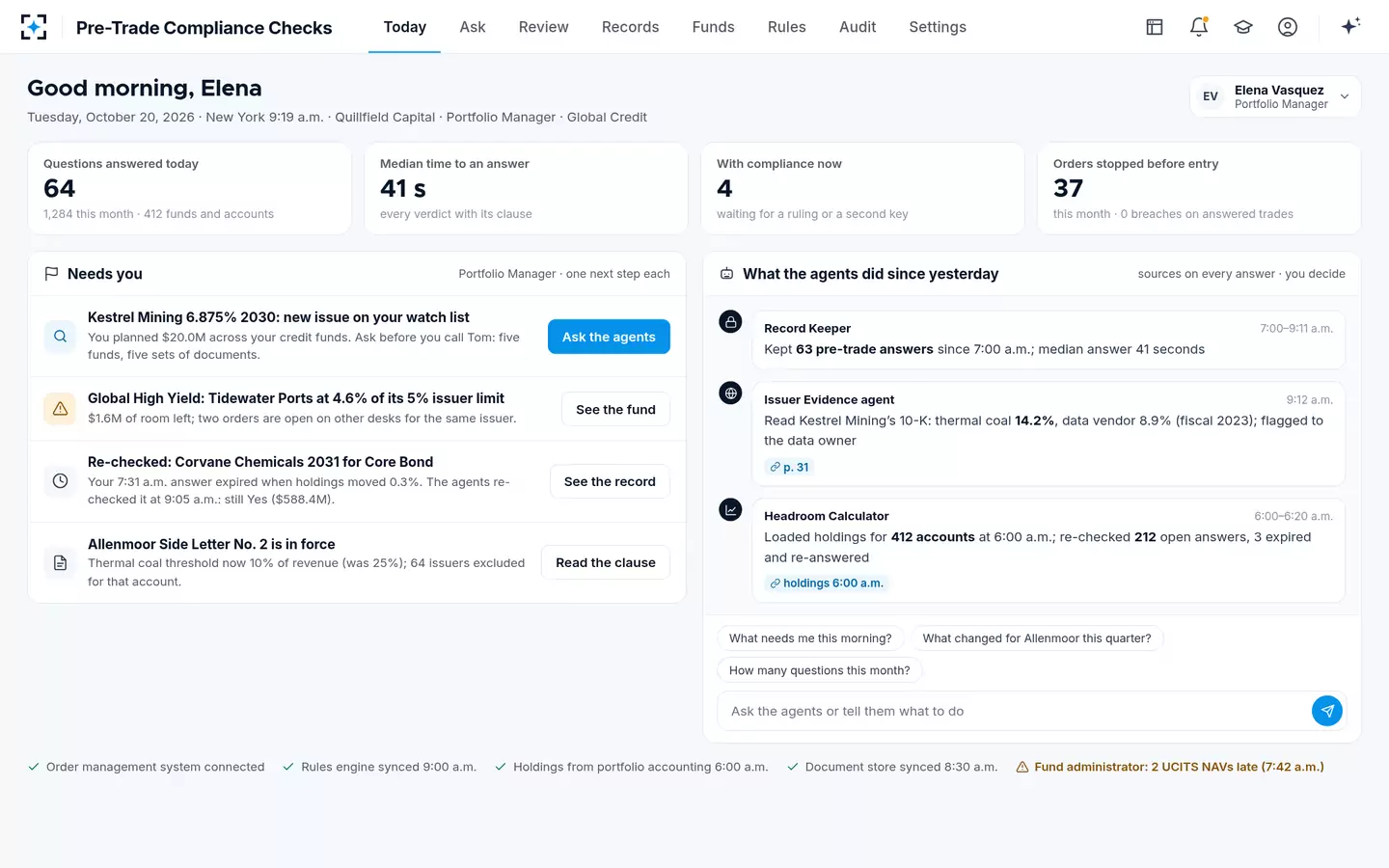
The harder cases are indirect. A fund over its 40% aggregate after a rally can still buy an issuer at 3%, but not one at 5.5%, because that would add another position above 5%. A fund over 15% illiquid cannot buy any illiquid investment at all, whatever the issuer. And a fund at 4.6% of a 5% issuer limit with two orders open on other desks has room for only one of them. Each of these is a question about the fund's position now, not the position in last night's report.
Headroom shrinks without a trade, and the answer is re-checked
Does a passive breach have to be reported?
In Luxembourg, no: passive breaches "are not included in the perimeter of the corrective measures" of the circular "and, as a consequence, must not be notified to the CSSF", but they "must be monitored by the UCI dirigeants" until corrected (CSSF Circular 24/856, point 55). That is why the supervisor's 2025 statistics, 1,393 notified breaches of investment rules, count active breaches only.
In the US, the reporting duty comes from the specific rule: a board report within one business day for an illiquid-investment exceedance, a board report and a Form N-RN filing for value-at-risk breaches as Rule 18f-4 and the form specify. For other limits, the fund's own procedures decide, and the annual report of the chief compliance officer under Rule 38a-1 is where a pattern of breaches, passive or not, ends up in front of the board.
What a pre-trade check can and cannot do about a passive breach
A pre-trade check cannot prevent a passive breach, by definition: no order caused it. What it can do is make sure the next order sees it. That requires headroom computed from current holdings and prices rather than last night's batch, today's fills from every desk, and the NAV the limit is measured against. A check that tests the order in isolation, "is this purchase under 5%?", will pass a purchase into a fund that is already at 10.8%.
A what-if answered against the limit before anyone orders
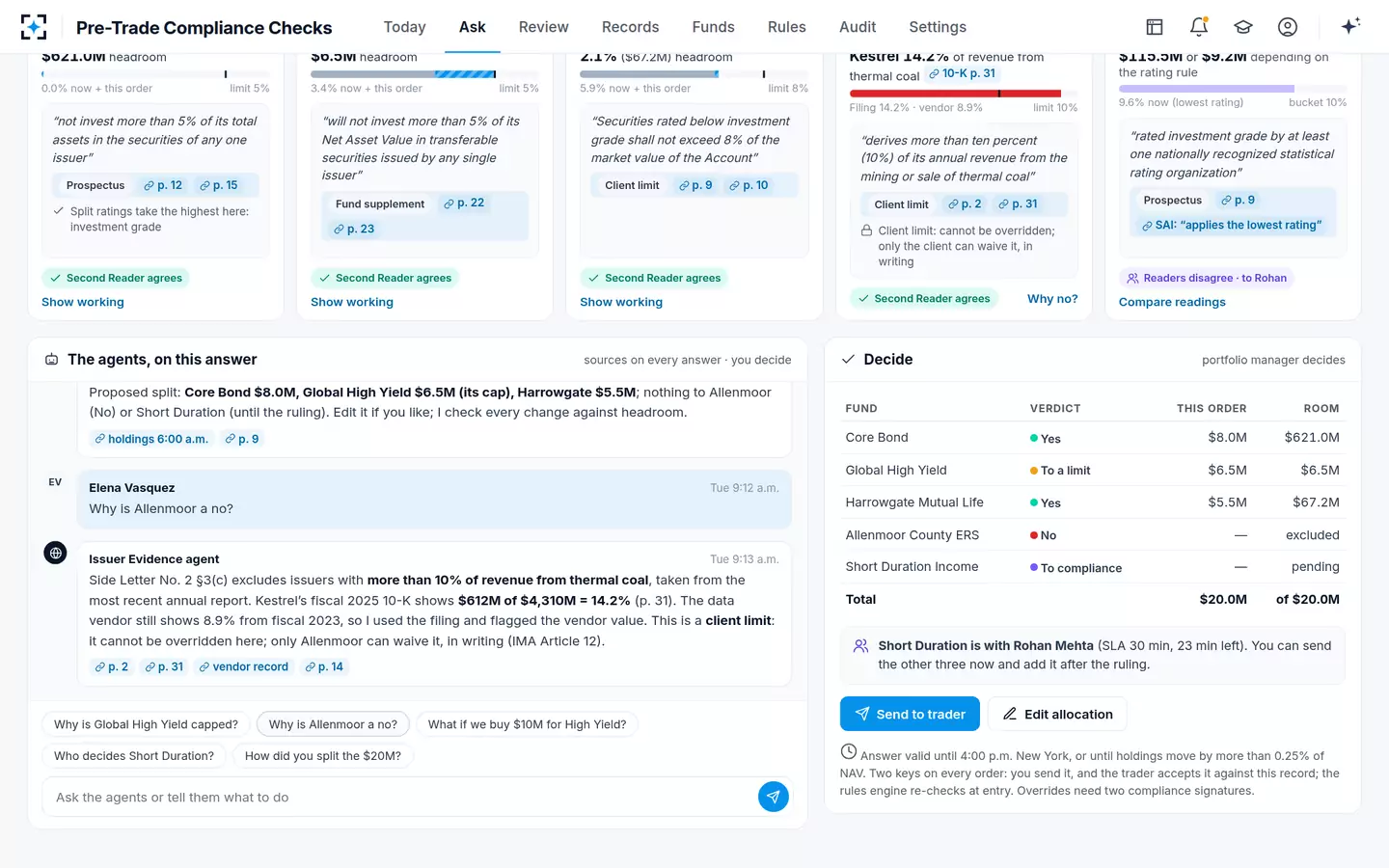
Pre-Trade Compliance Checks also has a rule for staleness. Its headroom calculation never uses holdings older than one business day and flags late feeds, such as a UCITS NAV late from the fund administrator, the input most likely to move a limit measured on net value. When the agents compute headroom from live holdings and the fund is already over, the verdict is no, with the holding, the limit and the clause shown, and the question of whether to sell goes to the people who own the cure.
A passive breach procedure that survives an examination
- Define passive in your own words, per regime
Market moves, redemptions, corporate actions, subscription rights. Name what counts as foreseeable.
- Classify at discovery, in writing
Who decided it was passive, on what evidence, and when it was found.
- Start the right clock
Six months in the UK; one business day to the board for illiquid investments; five business days for VaR; 30 days after quarter end for the tax test.
- Block purchases that would deepen it
Same issuer, same aggregate, same illiquid bucket. The pre-trade check must see the breach today.
- Cure through sales in the investors' interest
Document why the pace chosen served the fund, not the manager's convenience.
- Close it and keep the file
Date cured, how, and what the breach cost the fund while it lasted.
The common thread is timing. A passive breach is the market's doing on the day it happens and the manager's responsibility every day after, and the moment it is most likely to become active is the next order. The guide to pre-trade vs post-trade compliance shows where the post-trade run finds it and where the pre-trade check has to remember it.
Questions people ask
Can a fund allow a passive breach without rebalancing?
Within limits. UK rules require compliance to be restored within six months of discovery for most limits, and EU UCITS must make the remedy a priority of their sales. Luxembourg lets UCIs other than UCITS keep the position in specific, duly justified cases where investors' interest supports it.
What is a passive breach under CSSF Circular 24/856?
A breach of investment rules that occurs for reasons beyond the control of the UCI or from exercising subscription rights, such as a fall in NAV from market prices. It must be corrected within a reasonable period, monitored by the fund's directors, and is not notified to the CSSF.
Is a breach caused by large redemptions passive?
It can be, when the redemptions were not foreseeable and the shrinking NAV pushed a holding over a limit. The CSSF treats predictable flows differently: if the manager knew of a large redemption and did not plan for it, the resulting breach is active.
How long does a US fund have to fix an illiquid investment breach?
Rule 22e-4 sets no deadline to get back under 15%. The fund must report to its board within one business day with a plan to return "within a reasonable period of time", and if it is still above 15% after 30 days the board must assess whether the plan remains in the fund's best interest, and again every 30 days.
Does a rating downgrade cause a passive breach?
Under the CSSF's definition it would be, where a fund's documents cap lower-rated holdings and a downgrade takes it over: the fund did not choose the downgrade. The breach becomes active if the fund then buys more below-grade securities, or ignores a cure its documents require.