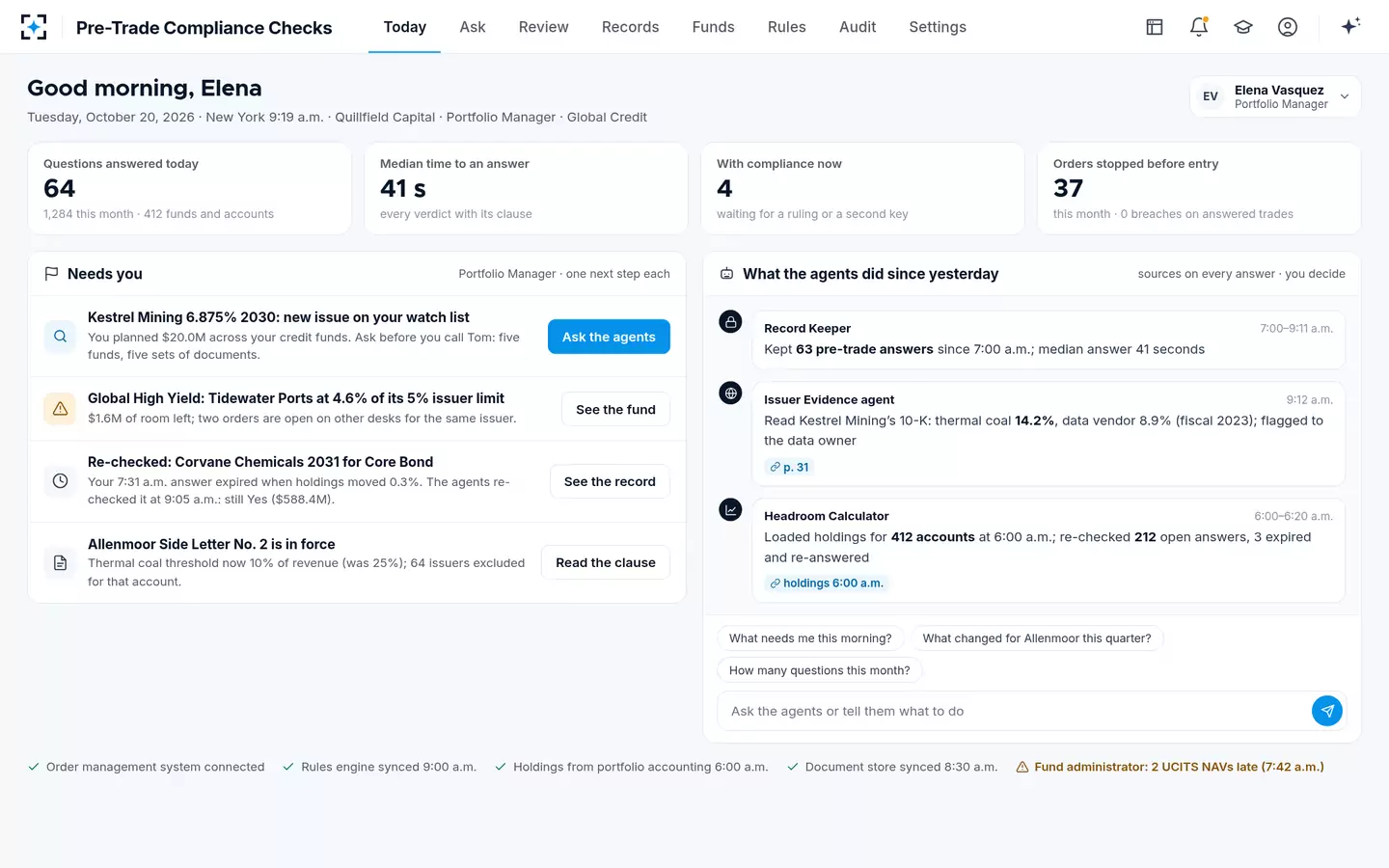
Investment management compliance software covers the systems an asset manager uses to keep portfolios inside their investment restrictions: the rules engine in the order management system, post-trade guideline monitoring, and tools that answer the questions those engines were never coded for. Vendors rarely publish prices, and a licence fee says little on its own. The useful unit is the question: every time a portfolio manager asks compliance "may this fund buy it, and how much?" about a restriction the engine does not hold, someone spends minutes finding the documents, reading them, computing headroom, checking the issuer and writing an answer. Botminds estimates that at a firm with about 1,280 such questions a month, 20 to 40 minutes each, that is 430 to 850 hours of compliance reading a month. Pre-Trade Compliance Checks is designed to take that reading and arithmetic to under a minute per question and leave compliance the rulings; this guide shows how to price both sides with your own numbers.
The volumes and minutes on this page are Botminds' estimates and the solution's sample data, on a fictional firm, labelled where they appear; they are to be measured in a pilot, not taken as results. Regulatory figures are the SEC's and the CSSF's own.
Where one restriction question's 30 minutes go, by hand and with the solution
By hand: about 30 minutes
- Find funds and documents · 20%
- Read prospectus, IMA, side letters · 33%
- Compute headroom · 20%
- Check issuer filing · 17%
- Write and file · 10%
With the solution: under 1 minute
- Funds and documents · 11%
- Reading · 33%
- Headroom · 22%
- Filing · 22%
- Written · 12%
What does investment compliance software cost?
Vendors don't publish prices for investment compliance software, and contracts vary with assets, accounts and modules, so the defensible way to judge cost is the work it removes and the risk it lowers, in your own numbers. Regulators do publish one kind of cost estimate, and it is instructive mainly for what it leaves out. The SEC's 2024 paperwork estimate for Rule 38a-1 put the burden of fund compliance programs at "476,980 hours" a year for "13,628 funds", with external costs of $23,876,256, and added that the estimate "is not derived from a comprehensive or even a representative survey or study" (SEC Paperwork Reduction Act notice, Federal Register, July 12, 2024).
What the SEC's compliance-cost estimates count, and what they do not
35h
a year per fund to keep a compliance program documented (476,980 h ÷ 13,628 funds)
$1,752
of external cost per fund a year in the same estimate ($23,876,256 ÷ 13,628)
80h
a year per adviser to document policies under Rule 206(4)-7, the 2003 estimate
0
hours of either estimate cover answering restriction questions: both count paperwork
The paperwork estimates measure keeping the program written down, not running it. The 2003 adopting release estimated that advisers would spend "an annual average of 80 hours" documenting their policies under Rule 206(4)-7 and that a fund would spend 60 hours documenting its program. Neither estimate counts a single restriction question, which is where an active manager's compliance hours actually go.
How many compliance questions does a portfolio team ask?
No regulator or independent study publishes the figure, so count your own. The sample firm in the solution, 412 funds and accounts under written restrictions, is modelled at about 1,280 questions a month that its rules engine does not hold, roughly three per fund or account per month; that is Botminds' estimate, not a measurement. A firm with mostly index mandates will see far fewer; one with many separate accounts, side letters and exclusions will see more.
The count is easy to take and almost never taken. Pull four weeks of email and chat messages from portfolio managers and traders to investment compliance, mark each one that asks whether a fund may buy or sell something, and note how long the reply took and whether it was attached to the order. That sample gives the three inputs every cost model needs: volume, minutes and how many answers were written down.
How long does a restriction question take to answer?
Botminds assumes 20 to 40 minutes by hand for a question the engine does not hold, and the split above shows where the time goes: a third of it reading documents, a fifth working out which funds and documents apply, a fifth computing headroom. The minutes multiply with the number of funds: a question about one bond across five credit funds with different documents is five questions, each with its own prospectus, agreement or side letter.
Hours of compliance reading a month at 1,280 questions, by minutes per question
A cost model you can fill in
The cost of the uncoded-question queue is volume × minutes × your loaded hourly cost, and the saving is that cost minus the cost of the exceptions that still need a person, minus the price of the tool. Every input below is yours to measure; the middle column shows Botminds' estimates for the sample firm so the arithmetic can be followed.
Cost per restriction question: the inputs and how to measure each
| Input | Sample firm (estimate) | How to measure it at your firm |
|---|---|---|
| A. Questions a month the engine does not hold | 1,280 | Four weeks of PM-to-compliance messages, sorted by type |
| B. Minutes per question by hand | 20–40 (30 used) | Time from question to reply in the same sample |
| C. Hours a month by hand | A × B ÷ 60 = 640 | Arithmetic |
| D. Loaded hourly cost of the people answering | Your figure | Salary, benefits and overhead of the compliance seat |
| E. Monthly cost of the queue | C × D | Arithmetic |
| F. Share still needing a person with the tool | 6% in the sample morning | Pilot on past questions |
| G. Hours a month with the tool | A × F × B ÷ 60 ≈ 38, plus spot reviews | Pilot, including review time |
| H. Answers written down and attached to the order | All, by design | Share of the sample with a findable written answer |
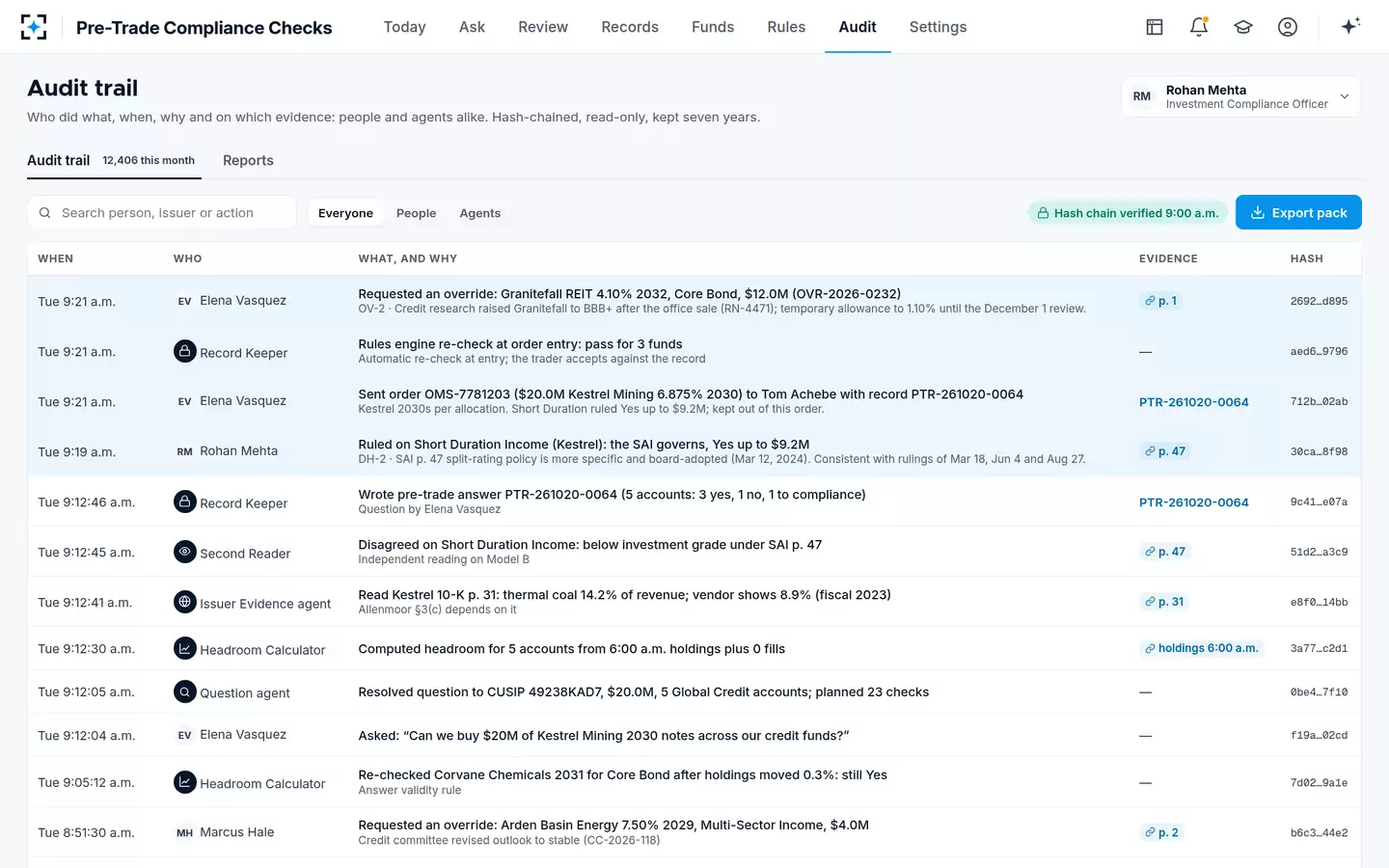
Row H is the one most cost models leave out, and it is the one an examiner reads. An answer that took 30 minutes and lives in someone's inbox has cost the firm the 30 minutes and still left the gap the SEC described in 2019, funds without procedures to prevent breaches of their own investment limitations. The value of having every answer written down, with its clause and data, does not show in hours; it shows in the next examination.
One order, five questions: where the cost per question really lands
A single order is rarely one question. In the solution's sample run, a portfolio manager asked whether $20 million of a new bond could go into five credit funds, and each fund was its own question with its own documents. Pricing them one by one shows where a tool saves time and where it cannot.
The sample five-fund question, priced fund by fund
| Fund (fictional) | What decided it | By hand, the slow part | With the solution | Still for a person |
|---|---|---|---|---|
| US diversified bond fund | Its own prospectus limit, 5% of total assets per issuer | Finding the clause and the fund's total assets | Yes, $621.0M of headroom, clause quoted | Nothing |
| Irish UCITS high-yield fund | Supplement limit of 5% of NAV; UCITS 10/40 | NAV from the administrator, existing holding, today's fills | Yes, up to $6.5M, every line cited | Nothing |
| Insurer's general account | An 8% below-investment-grade bucket in the agreement | Rating method in the agreement; bucket usage | Yes, 2.1% ($67.2M) of the bucket left | Nothing |
| Public pension separate account | Side letter: no issuer above 10% of revenue from thermal coal | Reading the issuer's annual report; the vendor said 8.9% | No: the filing shows 14.2% | Nothing to rule; the vendor value goes to the data owner |
| US short-duration fund | Prospectus and SAI read a split rating differently | Both documents, both readings, the bucket computed twice | Both readings laid side by side, with the hierarchy | A ruling: the compliance officer decided the SAI governs |
Four of the five questions needed no one; the fifth needed exactly the judgement compliance exists to give. That is the shape a buyer should expect, and the shape a pilot should test: the tool does not remove the ruling, it removes the half hour of reading that used to come before every ruling, and the four half hours that came before no ruling at all.
The questions, the answers and what is still with compliance, every morning
What is the cost of a compliance breach?
A breach caused by a trade costs the correction, any loss to the fund, and, when it reaches an enforcement action, penalties and remediation. In the UK and Luxembourg, a decision-caused breach of a fund's investment rules is corrected at once and at the manager's expense; Luxembourg's circular goes on to require an impact calculation of the loss, "possibly followed by the payment of compensation to the UCI and/or the investors" (CSSF Circular 24/856, point 58). In 2025 the CSSF received 1,393 notifications of such breaches.
US enforcement shows the other end of the range. The SEC's WisdomTree order, about funds that held issuers their prospectuses excluded, ended in a $4 million civil penalty, censure and a cease-and-desist order (SEC Press Release 2024-173). The Upright order, about a diversified fund that stopped being diversified through its own purchases, ended in censure, disgorgement of $390,704.92 plus interest from the adviser and a $90,000 penalty (SEC Release No. 33-11010). Neither number includes the cost of the remediation, the independent consultant or the time of the people involved.
Investment management vs investment advisor compliance software: which one is this?
They overlap in name and differ in job. Investment management compliance software, in the sense used here, tests portfolios and orders against investment restrictions: regulatory limits, prospectus policies, client guidelines. Investment advisor compliance software more often means a tool that runs the adviser's compliance program around the portfolios: code of ethics and personal trading, marketing review, books and records, the annual review. A firm usually needs both, and a tool that does one well is rarely the right tool for the other.
The market a registered fund complex sits in is large enough to make the distinction matter. The SEC counted 14,297 registered funds managing $47 trillion at December 2025 (SEC proposed rule on fund cross-trading, October 15, 2026) and 16,442 SEC-registered advisers reporting $177.0 trillion of regulatory assets under management (SEC proposed custody rule, October 6, 2026). Each of those funds and many of those advisers' accounts carry restrictions somebody has to answer for.
Build or buy investment compliance tooling?
Build the parts that are your own policy, buy or partner for the parts that are reading and arithmetic at scale. Your document hierarchy, your house limits, your override rules and your reason codes are policy; no vendor should set them, and in Pre-Trade Compliance Checks they are settings the firm controls, versioned and changed only with a second administrator's approval. Reading thousands of pages across hundreds of funds, keeping every answer with its sources, and running a second independent reading are engineering problems that are expensive to build and to keep current.
The hidden cost of building is maintenance. Every prospectus update, mandate amendment and side letter changes a limit, and the CSSF's review of breaches notified in 2025 traced some of them to systems not updated after fund documents changed. A build plan should budget for keeping the coded rules in step with the documents, not only for writing them once. The pre-trade compliance tool that sits beside your order management system shows how new clauses become coded rules with two signatures.
Every question, reading, ruling and order on one trail
What a pilot must measure before anyone signs
- Volume and minutes on your own past questions
A month of real questions, answered by the tool and compared with the answers compliance gave.
- Agreement with compliance
Where the tool and your officers differ, who was right, and why.
- Share that still needs a person
Disagreements, low confidence, unreadable documents, overrides. This is the cost that remains.
- Time to a usable answer
From question to verdict for every fund, with the clause quoted.
- Clauses found that the engine does not hold
Each is a breach that could have happened; each becomes a proposed coded rule.
- Answers attached to orders
The share findable by an examiner, before and after.
A cost-per-question model will not decide the purchase on its own, but it changes the conversation from licence price to work done and risk removed, which is where it belongs. To see the five-fund sample question answered end to end, start from Pre-Trade Compliance Checks; the investment compliance analyst's seat is where the hours in this model are spent today.
Questions people ask
Why do vendors not publish prices for investment compliance software?
Contracts depend on assets, number of funds and accounts, modules and integration, so list prices say little. The comparison that matters is the work removed and the breaches avoided at your firm, measured on your own past questions in a pilot.
How much compliance time does pre-trade checking take?
No public figure exists. Botminds estimates 20 to 40 minutes per question a rules engine does not hold, which at about 1,280 questions a month is 430 to 850 hours; four weeks of marked-up emails to compliance will give your own number.
Does compliance software reduce regulatory risk?
Only for the limits it actually tests. The SEC's 2019 fund examinations found funds without procedures to prevent breaches of their own investment limitations, and the CSSF's review of 2025 breaches traced some to systems not updated after fund documents changed. Coverage of the real documents matters more than speed.
What is the difference between a rules engine and pre-trade compliance software?
A rules engine tests orders against limits someone has coded. Pre-trade compliance software of the kind described here answers from the documents themselves, including clauses the engine lacks, and proposes new coded rules for compliance to approve.
What should a compliance software business case include?
Volume of uncoded questions, minutes per question, loaded cost, the share still needing a person after the tool, and the share of answers written down against orders. Add the breach costs your firm has actually incurred, not industry headlines.