A pre-trade compliance solution is software that tells a portfolio manager, before an order is placed, whether each fund or account may buy a security and how much, and shows why. The useful test of one is not how much it automates but where it stops: which questions it answers on its own, which it sends to a compliance officer, and which limits it will not let anyone override. Regulatory, prospectus and client limits belong to the law, the shareholders and the client, so no one inside the manager can waive them; only the firm's own house limits can bend, with a reason, an end date and a second signature. Botminds' Pre-Trade Compliance Checks is built on that line: eight agents read the documents, compute headroom and quote the clause, and they never decide, send, override or trade. How the same answers reach the order system, and what the OMS rules engine keeps doing, is a separate decision covered in a pre-trade compliance tool beside your OMS.
The examples use the solution's sample data, on fictional funds and people. Regulators' expectations are quoted from the SEC, ESMA, FINRA and Luxembourg's CSSF.
Who may answer, warn and override, by kind of limit
| Kind of limit | Who set it | Agents may | Override | Who signs |
|---|---|---|---|---|
| Regulatory: 1940 Act, SEC rules, UCITS | Legislators and regulators | Quote the rule, compute headroom, answer yes, no or how much | None | No one: the order is resized or dropped |
| Prospectus and SAI, fundamental | Shareholders, by vote | Same | None | No one; only a shareholder vote changes the policy |
| Prospectus and SAI, other policies | The board | Same; send document conflicts to compliance | None at the desk | Compliance rules on which text governs, with a reason code |
| Client: IMA, guidelines, side letters | The client, by contract | Same; read the issuer's filing for fact-based exclusions | None | Only the client can waive, in writing |
| House rules | The firm's own compliance policy | Same; recommend whether an override fits the policy | Yes, on request, with reason code and end date | Compliance officer, then Head of Investment Compliance; never the requester |
What should a pre-trade compliance solution do?
It should answer the question the portfolio manager actually has, for every fund the order might touch, in a form compliance can defend. That means five things. Identify the security and every account the order or its allocation could reach. Find every clause that applies in every document, including side letters and board-adopted policies. Compute headroom in money from current holdings and today's fills. Quote the deciding clause and link every number to its source. And write the answer down where the order is, so the examiner finds it.
Most order management systems do the third thing well for limits someone has coded, which is why the gap is everywhere else. Luxembourg's supervisor, reviewing the breaches notified to it in 2025, traced a share of them to exactly that gap: compliance systems whose settings had not kept up with changes in fund documents, and data problems that weakened the controls themselves (CSSF Feedback Report on Circular 24/856, 2026). Neither is solved by a faster engine; both are solved by reading the current document and the current data at the moment of the question.
Pre-Trade Compliance Checks: what the agents do, and where a person takes over
A person decides
Portfolio manager asksIn plain words: "Can we buy $20M of this bond across our credit funds?"
Agent
Question agentResolves the security, the size and the accounts, and plans the checks.
Never: Never guesses a security: two matches, and it asks
Agent
Restriction ReaderFinds and quotes every clause that applies, classified as regulatory, prospectus, client or house.
Never: Never answers from memory or without a quote
Agent
Headroom Calculator and Issuer Evidence agentCompute headroom from the morning's holdings and today's fills; read the issuer's filing when an exclusion depends on it.
Agent
Second ReaderReaches its own verdict on a different model, without seeing the first.
Never: Never resolves a disagreement
A person decides
Compliance officer rulesOn a disagreement, low confidence, an unreadable scan or an override request, with a reason code.
A person decides
PM sends, trader acceptsThe order goes with its written answer; the trader accepts it as the second key and cannot change a verdict.
Can AI answer investment restriction questions?
It can do the reading and the arithmetic, on conditions that make its answer checkable. The conditions are the point: every answer quotes the clause it rests on, with document, section and page; every number links to its holdings snapshot or filing; a second, independent reading is compared before anyone sees a verdict; and anything below a confidence floor goes to a person. An answer without those is a guess with good grammar.
Regulators describe the same work. ESMA's 2024 statement on AI in retail investment services lists compliance uses in which "some firms might use AI systems to summarise and analyse financial regulations; compare internal policies and procedures with legal requirements", and says the firm's management body "should have an appropriate understanding of how AI technologies are applied and used within their firm and should ensure appropriate oversight of these technologies" (ESMA35-335435667-5924, 30 May 2024). The comparison of a fund's documents with its limits, clause by clause, is that use.
The design targets that keep people in charge
2readers
on every verdict, on different models; a disagreement always goes to compliance
0.90
confidence floor; below it, the question goes to a compliance officer
2keys
on every house-limit override and every new coded rule
0
override buttons for regulatory, prospectus and client limits
Which limits can never be overridden?
Every limit the manager did not set. Regulatory limits come from statute and rule. Fundamental policies are protected by section 13(a) of the Investment Company Act, under which no registered fund may, without a majority shareholder vote, "deviate from its policy in respect of concentration of investments in any particular industry or group of industries as recited in its registration statement, deviate from any investment policy which is changeable only if authorized by shareholder vote" (15 U.S.C. 80a-13(a)(3)). Client limits are contract terms.
A solution that offers an override button on these limits is offering a documented breach. In Pre-Trade Compliance Checks the button does not exist for them: a client exclusion produces a no, with the clause and a line saying only the client can waive it, in writing. What the portfolio manager can do is resize, choose another fund, or ask the client.
Who can override a pre-trade compliance warning?
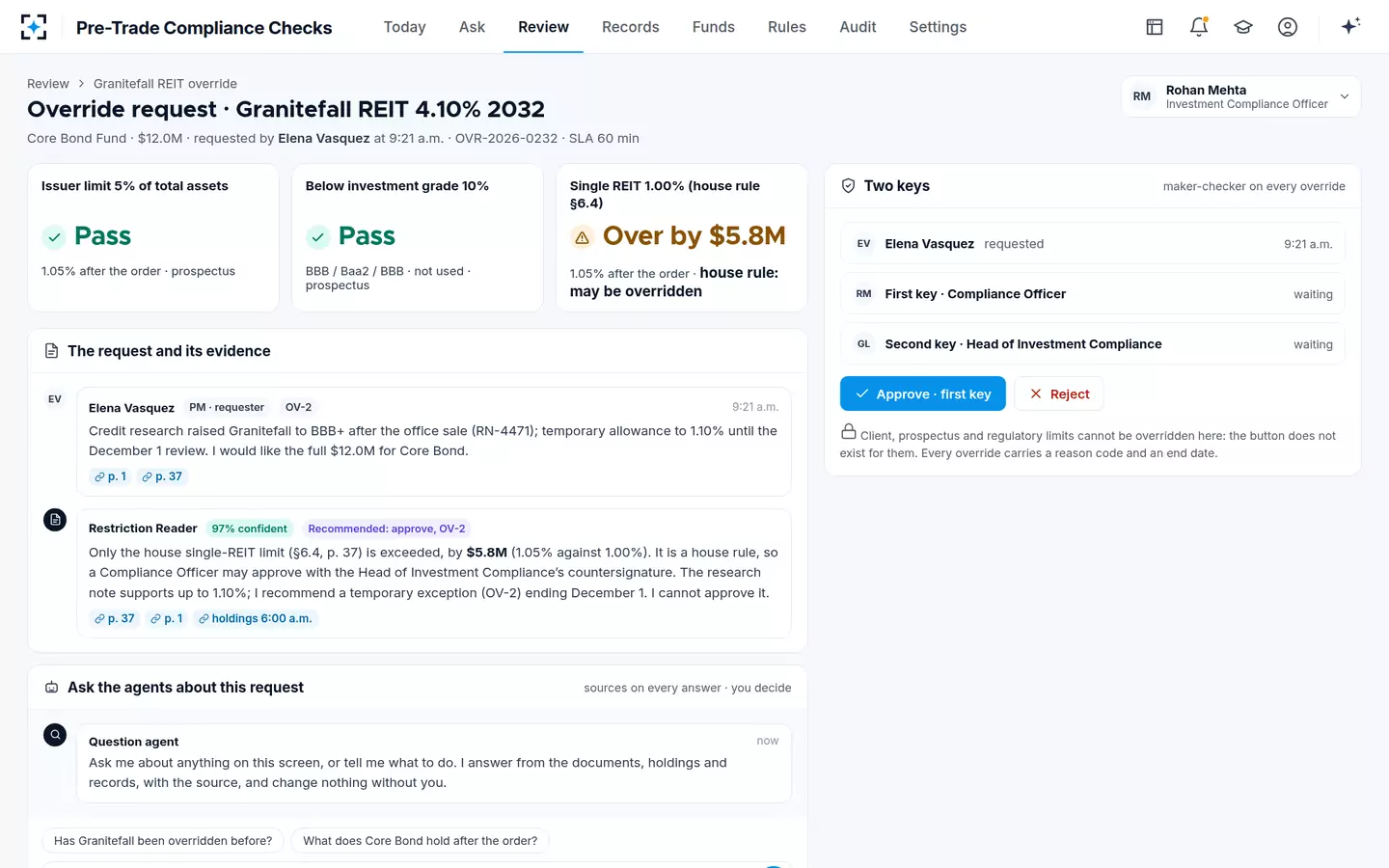
For a house limit, a compliance officer and then a senior compliance approver, on a request from the portfolio manager, and never the person who asked. House limits exist to be stricter than the law, a single-name cap below the regulatory one, a concentration warning, so there are good reasons to exceed them occasionally. The test of the process is whether each override has a written reason, an end date and two people who are not the requester.
A house-limit override: what passes, what is over, and two keys
How are compliance overrides approved, and where they go wrong
They should be approved before the order, with the evidence in front of the approvers, and they go wrong when a warning can be clicked through. Luxembourg's supervisor, listing the root causes of ESG-related breaches notified in 2025, included "portfolio management decisions where, for instance, pre-trade alerts were overridden without adequate justification, system warnings were misinterpreted or sales transactions reduced the UCI exposure below a required minimum level" (CSSF Feedback Report, 2026). Each of those is a decision by a person at the desk, made without a second one.
A defensible approval has five parts, and the solution requires all of them: the limit is a house limit; the request carries a reason code and a note; the evidence, the holdings, the research and the clause, is attached; a compliance officer gives the first key and the Head of Investment Compliance the second; and the override ends on a date. The default review times are targets the firm can change: 60 minutes for an override, 30 for a disagreement, after which the item goes to the Head of Investment Compliance.
One morning, five authority paths
The authority matrix is easiest to judge on real cases. The sample firm's morning in the solution produced five different paths, and each ended with a different person, or nobody, holding the decision.
Who decided what in one sample morning
| Question (fictional funds) | Kind of limit | What the agents did | Who decided |
|---|---|---|---|
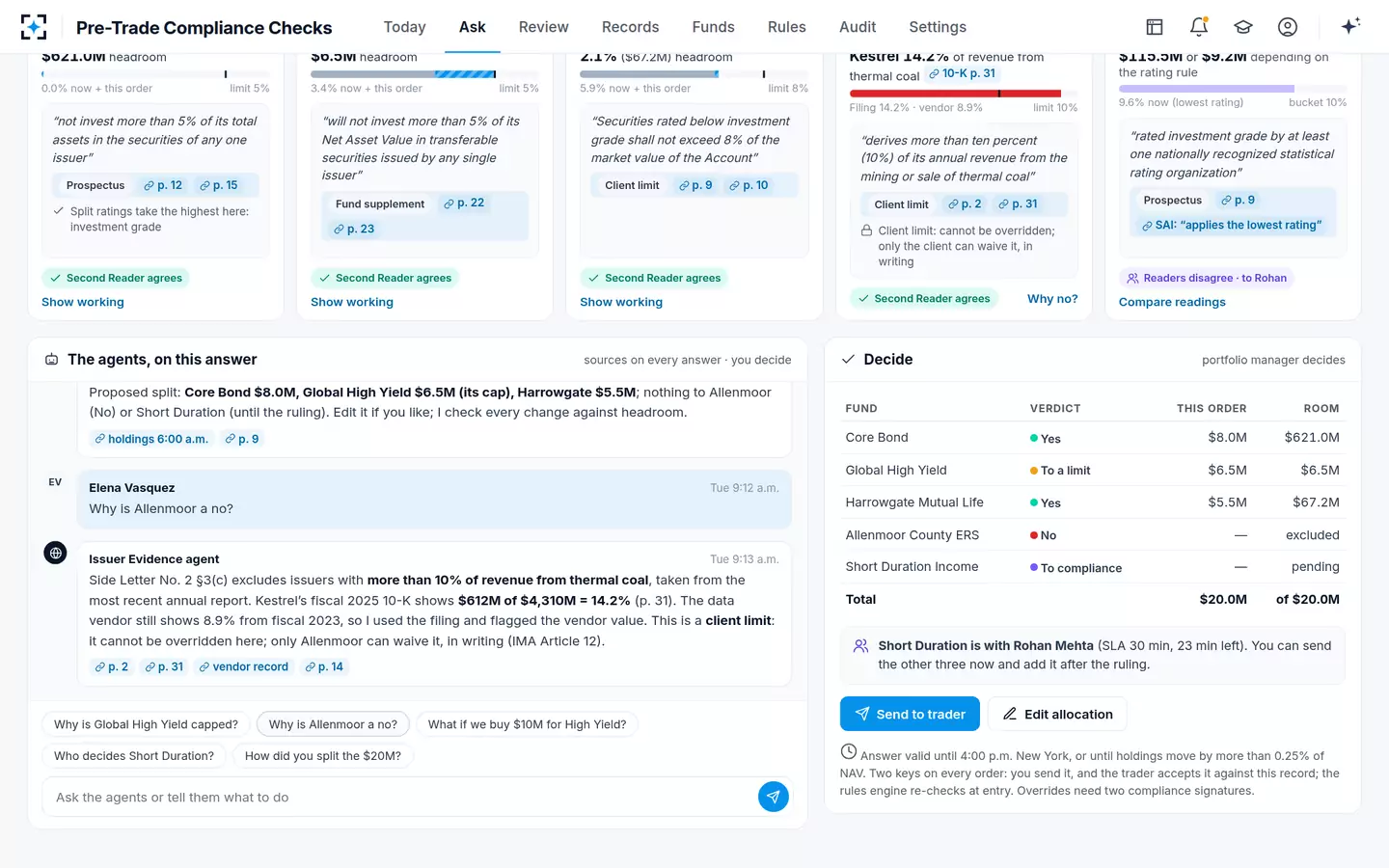
| A pension account and a coal miner | Client side letter, 10% thermal coal revenue | Read the issuer's filing (14.2%), answered no, flagged the vendor's 8.9% | Nobody inside the firm can: only the client can waive, in writing |
| A short-duration fund and a split-rated bond | Prospectus and SAI, read differently | Two readings, the hierarchy and three earlier rulings, laid side by side | The compliance officer, with reason code DH-2: the SAI governs |
| A REIT bond above a single-REIT cap | House rule, 1.00% per REIT | Showed the two limits that pass and the one over by $5.8M; recommended a temporary exception | Compliance officer, then Head of Investment Compliance; not the PM who asked |
| A German mandate's new restrictions | Client guidelines, proposed as coded rules | Extracted 38 restrictions with the German quoted, back-tested each | Two compliance signatures before any rule reaches the engine |
| "What if we buy $10M for High Yield?" | Fund supplement, 5% of NAV per issuer | Answered as a what-if, not saved: over the limit by $3.5M; the most is $6.5M | The PM, who sized the order inside the limit |
The pattern is the design. Where a limit belongs to someone outside the firm, the agents answer and nobody inside overrides. Where documents conflict, a named officer rules with a reason code that becomes precedent for the next identical question. Where the firm's own policy bends, two people who did not ask sign. And where the answer is simply arithmetic, the portfolio manager gets it in seconds and decides the size.
What do regulators expect when firms use AI in compliance?
The same obligations as before, met with the new tools, and supervision of the tools themselves. The SEC's examination division, publishing its priorities for fiscal 2027 on October 23, 2026, wrote that the firms it examines now use what it calls "super intelligence", generative SI tools among them, for work that includes "compliance monitoring and surveillance", and that it is stepping up its work on how those tools shape outcomes and whether firms still meet obligations it calls "technology-neutral" (SEC Division of Examinations, Fiscal Year 2027 Examination Priorities; the Division's words, and where an automated tool's authority should stop).
FINRA made the same point for broker-dealers in June 2024: its rules are intended to be technology neutral and continue to apply when firms use generative AI, with supervision under Rule 3110 and governance that includes model risk management (FINRA Regulatory Notice 24-09). For a pre-trade compliance solution, that translates into concrete properties: versioned agents, models and thresholds, each answer keeping the versions that produced it, and a trail an examiner can follow from question to order.
How is a pre-trade answer recorded?
As one item that holds the whole path: the question, the plan, every clause quoted, the holdings and prices used, both readings, any ruling with its reason code, and the order it was attached to. In the solution each step is written to a hash-chained audit trail, kept seven years, and the answer travels to the order management system as the order's compliance note. Corrections are new versions; a signed answer is never edited.
The pre-trade compliance tool beside the order management system covers how that answer reaches the order and the trader, and what the order system keeps doing on its own.
Ask the agents, and every reply cites its source
Where Pre-Trade Compliance Checks fits, and where it does not
Pre-Trade Compliance Checks is for the questions a rules engine cannot answer, before the order, across many funds with different documents. It is not an order management system, it does not replace the rules engine, which keeps blocking what it holds at order entry, and it does not replace post-trade monitoring, which still has to catch what prices do overnight. It proposes new coded rules when a question surfaces a clause the engine lacks, but a rule reaches the engine only after two compliance signatures.
It also has honest limits. A scanned agreement it cannot read goes to compliance as unreadable. A filing that does not split the revenue an exclusion needs goes to compliance. A question below the confidence floor goes to compliance. In the sample firm's morning, 4 of 64 questions were with compliance; the share will differ by firm and by how well its documents are kept, and a pilot on past questions is how to measure it.
Questions to put to any pre-trade compliance solution
- Does every answer quote the clause, with document, section and page?
If not, compliance cannot check it and an examiner cannot follow it.
- Is there an independent second reading, and what happens when they disagree?
The only acceptable answer is: a person rules.
- Which limits can be overridden, and by whom?
House limits only, with two keys, and never by the requester.
- Where do holdings and prices come from, and how old can they be?
Headroom from last night's batch misses today's fills and moves.
- What happens when the data is missing or the document unreadable?
It must go to a person, never default to yes.
- How does a new clause become a coded rule?
Proposed, back-tested, signed twice, then synced; not typed in by whoever found it.
- Can you show the versions behind an old answer?
Agents, models, thresholds and documents as they were on the day.
The line between what agents answer and what people decide is not a feature to be traded against speed; it is what makes a fast answer usable. To see it on the sample funds, from question to ruling to order, start from Pre-Trade Compliance Checks, and for the passive side of the same problem, see passive breaches of investment limits.
Questions people ask
What is the difference between a pre-trade compliance solution and an OMS compliance module?
An OMS compliance module tests orders against coded rules at entry. A pre-trade compliance solution of the kind described here answers the questions the coded rules do not cover, from the documents themselves, before the order, and hands its answer to the order system, which still re-checks at entry.
Can a portfolio manager override a pre-trade compliance warning?
A portfolio manager can request an override of a house limit, with a reason code, a note, an end date and evidence; a compliance officer and the Head of Investment Compliance approve it, and the requester never can. Client, prospectus and regulatory limits cannot be overridden at all.
Do regulators allow AI to be used for compliance checks?
Yes, under existing obligations. The SEC's fiscal 2027 priorities note firms using "generative SI tools" (the SEC's term, short for super intelligence) for compliance monitoring and say it will examine whether they still meet "technology-neutral obligations"; ESMA lists comparing internal policies with legal requirements as a compliance use and puts oversight on the management body.
What happens when two readings of a fund's documents disagree?
The question goes to a compliance officer with both readings, the firm's document hierarchy and any earlier rulings on the same point. Neither reading counts until the officer rules with a reason code; the portfolio manager can send the other funds meanwhile.
How long should an override approval take?
Long enough for two people to look at the evidence, short enough not to miss the market. The solution's default targets are 60 minutes for an override and 30 for a disagreement, after which the item goes to the Head of Investment Compliance; firms set their own.