The 1940 Act diversification test, usually called the 75-5-10 rule, is the definition of a "diversified" fund in section 5(b)(1) of the Investment Company Act: at least 75% of the fund's total assets must be cash and cash items, government securities, securities of other investment companies, and other securities limited, for any one issuer, to 5% of the fund's total assets and 10% of that issuer's outstanding voting securities. The other 25% is free of the test. Because section 5(c) protects a fund from market drift but not from its own purchases, the test effectively runs at every acquisition, which means the question a pre-trade check must answer is not "is the fund diversified?" but "how many dollars of this issuer can it still buy?". Botminds' Pre-Trade Compliance Checks answers that question per fund before the order, from the morning's holdings and the clause that sets the limit.
The worked figures below use an invented fund, Wrenfield Core Equity Fund, built to show the arithmetic; the product examples use the solution's sample data, on fictional funds. The law is quoted from the statute.
The 75-5-10 rule in four numbers
75%
of total assets must sit in the diversified basket
5%
of total assets: the most any one issuer can count for inside the basket
10%
of an issuer's outstanding voting securities: the most the fund may own and still count it
25%
of total assets left free of the test, where larger positions have to sit
What is the 75-5-10 rule in the 1940 Act?
The 75-5-10 rule is the statutory definition a fund must meet to call itself diversified. The text is a single sentence:
"At least 75 per centum of the value of its total assets is represented by cash and cash items (including receivables), Government securities, securities of other investment companies, and other securities for the purposes of this calculation limited in respect of any one issuer to an amount not greater in value than 5 per centum of the value of the total assets of such management company and to not more than 10 per centum of the outstanding voting securities of such issuer."
Investment Company Act of 1940, section 5(b)(1)
Three details in that sentence decide most pre-trade answers. The base is total assets, not net assets, so a fund that borrows or holds large receivables measures against a bigger number than its NAV. "Government securities" has its own definition, securities "issued or guaranteed as to principal or interest by the United States" or by a US government instrumentality (section 2(a)(16)), so a German or Japanese government bond is an ordinary issuer, capped at 5% inside the basket. And the 10% test is on voting securities, which means it matters for equity positions and, in practice, not for bonds, which carry no votes.
A fund that does not meet the definition is a "non-diversified company", which section 5(b)(2) defines simply as "any management company other than a diversified company". Non-diversified funds are not unregulated: they still face the tax diversification test, any industry concentration policy in their registration statement, and every limit in their own prospectus.
How the 75-5-10 test is calculated, worked to dollars
To calculate the test, value every position as a share of total assets, put cash, government securities and fund shares in the basket, add every other issuer whose position is within 5% of total assets and 10% of its votes, and check that the basket reaches 75%. Anything that does not qualify sits in the 25% bucket. The pre-trade question is then how much of a given issuer the fund can buy before either the basket falls below 75% or the issuer breaks one of its caps.
Wrenfield Core Equity Fund: the diversification test, step by step
| Step | Calculation | Result |
|---|---|---|
| 1. Total assets | Securities, cash and receivables at this morning's prices | $2,400.0M |
| 2. The 25% bucket | 25% × $2,400.0M | $600.0M |
| 3. Positions over 5% of total assets | Halberd Rail 7.1% ($170.4M) + Corriander Health 6.2% ($148.8M) + Bellmoor Insurance 5.8% ($139.2M) | $458.4M (19.1%) |
| 4. Room left in the bucket | $600.0M − $458.4M | $141.6M (5.9%) |
| 5. Basket today | $2,400.0M − $458.4M | $1,941.6M (80.9%) — passes |
| 6. Proposed order | Buy $60.0M of Ostlund Software, now 4.0% ($96.0M), paid from cash | Ostlund would be $156.0M (6.5%) |
| 7. Test after the order | Ostlund leaves the basket: bucket $458.4M + $156.0M = $614.4M (25.6%) | Fails by $14.4M |
| 8. The most Ostlund can take | Whole Ostlund position must fit the bucket's $141.6M: $141.6M − $96.0M | $45.6M |
The answer surprises people who think of the rule as "no more than 5% per issuer". The simple 5% cap would allow $24.0M of Ostlund (from 4.0% to 5.0%). The bucket allows $45.6M, because the fund still has room among its large positions. But the order as drafted, $60.0M, fails, and it fails not on Ostlund alone but on the fund as a whole: the three positions already over 5% have used most of the 25%.
That is why the useful output of a pre-trade diversification check is a number. "No" tells the portfolio manager nothing about the size that would work. "Yes, up to $45.6M" lets her cut the order once rather than three times, and shows compliance exactly which positions consumed the room.
Headroom is shared: every issuer under 5% competes for the same $45.6M of bucket
Whole position or only the excess? Two readings of the basket
Two readings of the statute change these numbers, and a fund's procedures should say which one they use. The cautious reading, used above, takes any issuer over 5% wholly out of the basket. The statute's words, other securities "limited in respect of any one issuer to an amount not greater in value than 5 per centum", also leave room for counting the first 5% of a larger position inside the basket and only the excess outside. On that reading the same fund has only 4.1% of total assets outside the basket and several times more room. A pre-trade check that does not know which reading the fund's compliance procedures adopt will give one of two answers to the same order.
Is the diversification test applied at purchase or every day?
At purchase. Section 5(c) says a diversified fund "shall not lose its status as a diversified company because of any subsequent discrepancy between the value of its various investments and the requirements of said paragraph, so long as any such discrepancy existing immediately after its acquisition of any security or other property is neither wholly nor partly the result of such acquisition" (15 U.S.C. 80a-5(c)). Prices can carry a fund out of compliance without consequence; a purchase that leaves it out of compliance cannot.
The practical result is a rule a rules engine can state and a portfolio manager can feel. If Halberd Rail rises from 4.8% to 7.1% because its shares rallied, nothing is wrong. If the fund then buys more Halberd Rail, or buys anything else that pushes the basket under 75% while the drift is still there, the discrepancy is now partly the result of an acquisition. A passive breach of investment limits becomes an active one through the next order, which is why the next order has to be checked against today's prices, not last month's.
Two 75% tests are not the same test: the 1940 Act and the tax code
1940 Act, section 5(b)(1): 75% of total assets in cash, government securities, other funds and qualifying issuers.
Internal Revenue Code, section 851(b)(3): "at least 50 percent of the value of its total assets" in the same kinds of assets, issuer-limited the same way.
1940 Act, section 5(b)(1): 5% of total assets and 10% of voting securities, inside the basket.
Internal Revenue Code, section 851(b)(3): 5% and 10% inside the 50%; and "not more than 25 percent" of total assets in any one issuer, outside government securities and other RICs.
1940 Act, section 5(b)(1): In effect at each acquisition (section 5(c)).
Internal Revenue Code, section 851(b)(3): "at the close of each quarter of the taxable year", with a 30-day window to fix an acquisition-caused failure.
1940 Act, section 5(b)(1): The fund operates as non-diversified without the shareholder vote section 13(a)(1) requires.
Internal Revenue Code, section 851(b)(3): The fund risks its status as a regulated investment company, and with it pass-through tax treatment.
The tax test catches funds that think non-diversified means unconstrained. A non-diversified fund that wants to stay a regulated investment company still needs half its assets in the issuer-limited basket at each quarter end and no single non-government issuer above 25%. A pre-trade check for a non-diversified fund therefore still computes headroom; it simply computes it against different numbers.
What is a fundamental investment restriction, and can a fund change its diversification status?
A fundamental investment restriction is a policy that can only be changed by a vote of the fund's shareholders, and diversification is one of them, in one direction. Section 13(a)(1) of the Act says no registered fund shall, unless authorised by a majority of its outstanding voting securities, "change its subclassification as defined in section 80a–5(a)(1) and (2) of this title or its subclassification from a diversified to a nondiversified company" (15 U.S.C. 80a-13(a)(1)). A diversified fund cannot become non-diversified by trading its way there; the statute names only that direction.
The same section protects a fund's industry concentration policy and any other policy its registration statement says can only change by shareholder vote. That is why the prospectus or SAI, not the coded rule in the order system, is the governing text: if the two disagree, the coded rule is wrong. A pre-trade answer that quotes the clause it relied on lets anyone see which text it used.
The case that shows how the test breaks: a put option, then a 53.90% position
The SEC's 2021 order against Upright Financial Corp. is the clearest public example of a diversified fund that stopped being one through its own acquisitions. From July 2017 through June 2020, the order found, the adviser and its portfolio manager "made investments for UPUPX that were inconsistent with (i) UPUPX's classification as a diversified investment company, and (ii) UPUPX's fundamental policy with respect to industry concentration" (SEC Release No. 33-11010, November 24, 2021).
The acquisitions did not arrive as buy tickets. The fund wrote put options, and when they were exercised it had to buy the shares: "on August 18, 2017, following the exercise of put options that UPUPX wrote on July 10, 2017 and July 27, 2017, UPUPX purchased $10,997,000 of the securities of a single pharmaceuticals issuer, which amounted to 53.90% of UPUPX's total assets." The fund then ran a proxy vote in August 2018 to change its classification; the order found the proxy statement was not filed in preliminary form as required and "omitted to state that UPUPX had been operating as a non-diversified company prior to the date of the proxy vote." The settled order, which also covered miscalculated NAVs, censured both respondents and required disgorgement of $390,704.92 plus interest from the adviser and a $90,000 civil penalty.
The pre-trade lesson is about when the check runs. A written put is a promise to acquire at the counterparty's choice. A diversification check that runs only on purchase orders sees nothing until assignment, when the acquisition is no longer optional. The check belongs at the moment the option is written, sized as if it were exercised, which is the same logic the SEC wrote into Rule 12d3-1 for options on securities-related issuers.
What else binds a diversified fund before the order?
Diversification is one of several limits a US fund tests on the same purchase, and it is rarely the tightest. Rule 22e-4 bars acquiring any illiquid investment when the fund would be over 15% of net assets in illiquid investments immediately afterwards, a limit measured on net assets rather than total assets. Section 13(a)(3) protects the fund's industry concentration policy as recited in its registration statement; in the Upright order the policy at issue barred investing "more than 25% of its total assets in securities of companies principally engaged in any one industry", and the same purchases that broke diversification broke it.
Then come the issuer-specific rules. A bank, broker or asset manager may bring in the securities-related issuer test of Rule 12d3-1, with its own 5%-of-total-assets cap that, unlike the 75-5-10 test, has no 25% bucket. Another fund's shares bring in the 3-5-10 limits of section 12(d)(1). A pre-trade answer for a diversified fund is the smallest headroom across all of these, and the clause that set it.
Diversified vs non-diversified mutual fund: what changes in the pre-trade check
For a diversified fund the check computes the basket and the bucket; for a non-diversified fund it computes the tax test and the fund's own limits. In both cases the binding limit is often not the statute at all but the prospectus, which can be stricter. A fund may promise never to put more than 5% of total assets in any one issuer, with no 25% bucket, and that promise binds it as tightly as the law.
A fund's own 5% limit, answered in dollars before the order
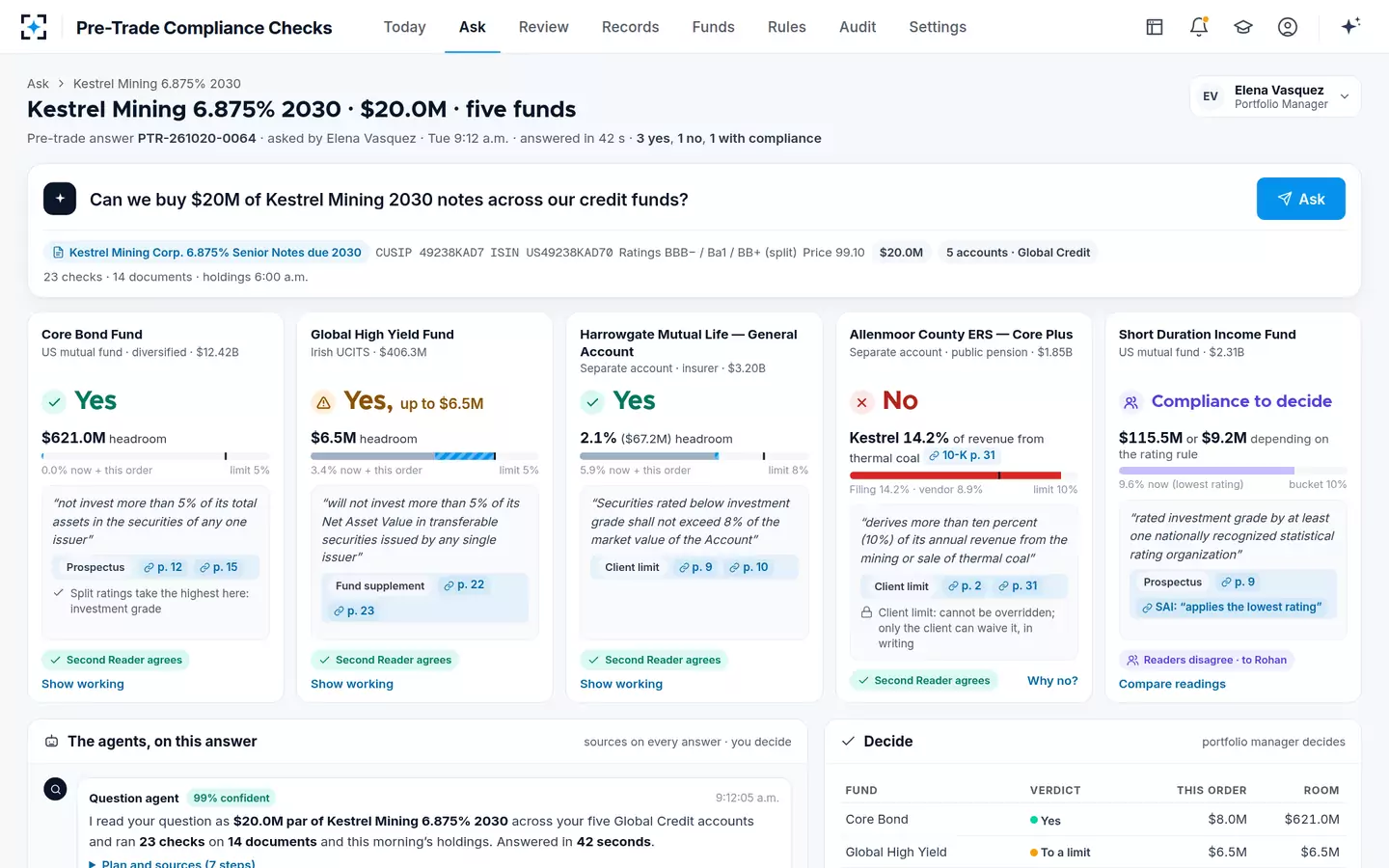
In the solution's sample run, the Core Bond Fund, $12.42 billion of total assets, holds none of the issuer, so its headroom under its own 5% policy is $621.0 million, and the answer is yes. The same order for a fund that already held the issuer, or whose 25% bucket was full, would have produced a dollar figure instead, with the holdings and the clause behind it.
Restrictions like these are a choice funds make, and research finds they need not cost returns. In a study of US domestic equity funds from 1994 to 2000, Almazan, Brown, Carlson and Chapman found that restrictions appear more often where direct monitoring of the manager is harder, and "no evidence that low- and high-constraint funds produce different risk-adjusted returns" (working-paper version of their 2004 Journal of Financial Economics article). The cost of a restriction is operational: someone has to test it before every order.
What a 75-5-10 pre-trade check has to get right
- Measure against total assets, at current prices
Not net assets, and not yesterday's close if the market has moved.
- Classify government securities by the statute
Only US government and instrumentality securities; foreign sovereigns are ordinary issuers.
- Aggregate by issuer, not by security
Every bond, share and note of the same issuer adds up toward the 5%.
- Hold shares outstanding for the 10% test
Voting securities only; the denominator changes with buybacks and issuance.
- Include today's fills and open orders
Two desks buying the same issuer use the same headroom.
- Size written options as if exercised
An assigned put is an acquisition the fund did not choose the timing of.
- Know which reading of the basket the procedures use
Whole position outside, or only the excess over 5%: the answer differs.
- Quote the fund's own limit if it is stricter
The prospectus binds as tightly as the statute and is changed only by vote if fundamental.
The 75-5-10 test is one of three US numeric limits a pre-trade check computes most often, alongside the 15% illiquid cap in Rule 22e-4 and the securities-related issuer test in Rule 12d3-1. For funds sold in Europe, UCITS investment restrictions set a different single-issuer arithmetic on a different base. The solution page, Pre-Trade Compliance Checks, shows the same order answered for a US fund and a UCITS side by side.
Questions people ask
What is an example of the 75-5-10 rule?
A $2.4 billion fund with three positions of 7.1%, 6.2% and 5.8% has used 19.1% of its 25% bucket. It can add $45.6 million of a fourth issuer now at 4.0% before the bucket is full, not the $24.0 million a simple 5% cap suggests, and a $60.0 million order fails.
Does the 10% voting securities limit apply to bonds?
The 10% limit in section 5(b)(1) is on "outstanding voting securities", and ordinary bonds carry no votes. For a bond position the binding piece is the 5%-of-total-assets cap, which counts every security of the issuer together.
Do government bonds count toward the 5% issuer limit?
US government securities do not: they sit in the basket without an issuer cap. Section 2(a)(16) limits "Government security" to securities issued or guaranteed by the United States or its instrumentalities, so foreign government bonds are treated as any other issuer.
Can a non-diversified fund put everything in one stock?
Not if it wants to stay a regulated investment company for tax purposes. Section 851(b)(3) of the Internal Revenue Code caps any single non-government issuer at 25% of total assets at each quarter end and requires half the fund to sit in an issuer-limited basket.
What happens if a diversified fund breaks the test through a purchase?
It is operating as non-diversified without the shareholder vote section 13(a)(1) requires. In the SEC's 2021 Upright order, purchases after put exercises reached 53.90% of total assets in one issuer, and the settled order censured the adviser and its principal and imposed a $90,000 civil penalty alongside disgorgement.