UCITS investment restrictions are the spread and holding limits that EU Directive 2009/65/EC, and the FCA's COLL sourcebook in the UK, impose on every UCITS fund: no more than 5% of assets in securities of one issuer, raised to 10% provided the holdings above 5% add up to no more than 40%; no more than 20% with any one body across securities, deposits and derivatives exposure; and no more than 10% of a single issuer's debt or non-voting shares. Set beside the 1940 Act's 75-5-10 diversification test, the arithmetic differs in shape, base and timing, so the same issuer weight can pass one rulebook and fail the other. Botminds' Pre-Trade Compliance Checks starts every answer by establishing which rulebook and which fund documents govern each fund the order may go into, then computes headroom against the right numbers.
The portfolios below are invented to show the arithmetic; the product examples use the solution's sample data, on fictional funds. Rule text is quoted from the Directive as published on legislation.gov.uk, from the FCA Handbook and from the US Code.
UCITS and the 1940 Act: the limits that decide a single-issuer order
| Limit | UCITS (Directive Art. 52, 56; UK COLL 5.2) | 1940 Act diversified fund (§5(b)(1)) |
|---|---|---|
| Single issuer, ordinary case | 5% of assets; up to 10% for holdings that together stay within 40% | 5% of total assets, but only inside the 75% basket |
| Largest permitted single position | 10% (35% for government issuers; 25% for qualifying covered bonds) | No cap from §5(b)(1) inside the 25% bucket; the tax test caps one issuer at 25% at quarter end |
| Aggregate of large positions | Positions above 5% may total no more than 40% | Positions outside the basket may total no more than 25% of total assets |
| One body across instruments | 20% across securities, deposits and OTC derivative exposure | No equivalent combined limit |
| Share of the issuer | 10% of its non-voting shares, debt securities or money market instruments; no significant influence through votes | 10% of its outstanding voting securities, inside the basket |
| Base | The fund's assets; in the UK, the net value of scheme property after borrowings (COLL 5.2.5R) | Total assets |
| When a market move breaks it | EU: remedy through the fund's sales as a priority; UK: within six months of discovery | No loss of status from market drift (§5(c)); purchases are what count |
What are the UCITS investment restrictions?
The core of the UCITS restrictions is Article 52 of the Directive, the spread rule. Its first paragraph says a UCITS "shall invest no more than: (a) 5 % of its assets in transferable securities or money market instruments issued by the same body; or (b) 20 % of its assets in deposits made with the same body", and caps counterparty exposure in an OTC derivative at 10% of assets for a credit institution and 5% in other cases (Directive 2009/65/EC, Article 52(1)).
"Member States may raise the 5 % limit laid down in the first subparagraph of paragraph 1 to a maximum of 10 %. If they do so, however, the total value of the transferable securities and the money market instruments held by the UCITS in the issuing bodies in each of which it invests more than 5 % of its assets shall not exceed 40 % of the value of its assets."
Directive 2009/65/EC, Article 52(2)
The same paragraph adds the combined limit: a UCITS "shall not combine, where this would lead to investment of more than 20 % of its assets in a single body", its securities of that body, its deposits with it and its OTC derivative exposure to it. Article 56 then limits how much of an issuer a UCITS may own, whatever the weight in the fund: "10 % of the non-voting shares", "10 % of the debt securities" and "10 % of the money market instruments of a single issuing body", and 25% of the units of another fund (Article 56(2)).
For a bond fund the last limit is the one most often forgotten. A UCITS may be well inside its 10% weight in an issuer and still be unable to buy, because it already owns a tenth of that issuer's outstanding debt. The Directive lets the 10% debt and money-market limits "be disregarded at the time of acquisition" only when the gross amount in issue "cannot be calculated", which makes outstanding amounts a data item the pre-trade check must hold.
UCITS 5/10/40 rule explained, with an example
The 5/10/40 rule works in two steps. First, every issuer is capped at 10% of the fund. Second, add up every issuer weighted above 5%; that total may not exceed 40%. A fund can therefore hold four issuers at 10% and nothing else above 5%, or eight at 5% and nothing above, but not five at 9%.
Luxembourg's supervisor published a worked example in its December 2024 FAQ. After a purchase of Equity A at 9% of net assets, a fund held Equity A at 9%, B and C at 8% each, and D and E at 9% each, and "the sum of the securities with positions greater than 5% of TNA equals 43%", a breach of the 40% limit (CSSF FAQ on Circular 24/856, Q3). The CSSF's answer also shows how much judgement a cure involves: the fund "does not necessarily have to sell the securities that caused the non-compliance", and in the example it sold the excess on Equity B instead.
The UK rule is the same arithmetic in its own words: "The limit of 5% in (4) is raised to 10% in respect of up to 40% in value of the scheme property. Covered bonds need not be taken into account for the purpose of applying the limit of 40%" (FCA COLL 5.2.11R(5)). Under COLL 5.2.4R, the fund's own instrument may restrict further, which is how a UCITS ends up with a 5% issuer limit and no 10% tier at all.
How is 5/10/40 different from 75-5-10? Three portfolios, two answers
The two tests are differently shaped, not stronger and weaker versions of one idea. The 1940 Act lets a diversified fund hold one very large position inside its 25% bucket and nothing else large; UCITS forbids any single position over 10% but lets several 10% positions add up to 40%. The three portfolios below each pass one rulebook and fail the other, or depend on how a US fund reads its own test.
Three portfolios tested against both rulebooks
| Portfolio | Positions above 5% of the fund | UCITS 5/10/40 | 1940 Act 75-5-10 |
|---|---|---|---|
| A. One big conviction | One issuer at 18%; every other issuer under 5% | Fails: 18% is above the 10% ceiling | Passes: 18% sits in the 25% bucket |
| B. Four large positions | Four issuers at 9.5% each (38%) | Passes: each under 10%, total under 40% | Fails if a large position counts wholly outside the basket (38% > 25%); passes if only the excess over 5% does (18%) |
| C. The CSSF example | 9%, 8%, 8%, 9%, 9% (43%) | Fails: 43% is above 40% | Fails or passes on the same two readings (43% or 18% outside the basket) |
Portfolio B is where cross-border managers get caught. A UCITS version of a US strategy can legitimately run four 9.5% positions; the US mutual fund running the same model may not be able to, depending on how the 1940 Act diversification test is read in its compliance procedures. A pre-trade answer for "both versions of the strategy" is therefore two answers, computed differently.
The base matters as much as the shape. The UK rule measures "the net value" of scheme property "after deducting any outstanding borrowings" (COLL 5.2.5R); the 1940 Act measures total assets. A fund with $1,100 million of assets and $100 million borrowed holds a $105 million position at 9.5% of total assets but 10.5% of net value: inside the US arithmetic, over the UCITS ceiling.
Which UCITS limits are breached most often?
In the first year of Luxembourg's new breach regime, the single-body 10% and 20% limits were broken far more often than the 40% aggregate. Of 1,393 notified breaches of investment rules in 2025, 565 concerned UCITS diversification, holding and borrowing limits, and the largest group within them was Article 43(1) of Luxembourg's 2010 Law, the national text of the Directive's 10% and 20% limits (CSSF Feedback Report, 2026).
UCITS limits behind the breaches notified in Luxembourg in 2025
The 20% limit per body is a favourite for a reason the CSSF spelled out in its FAQ: cash. A bond maturing into a deposit, a sale settling a day before a purchase, a redemption paid later than the securities sold to meet it, all push deposits with one bank over 20% without anyone buying anything. The supervisor treats these as active breaches because they were predictable, which puts them on the pre-trade side of the line.
What happens when a UCITS passes a limit because of market moves?
The EU and the UK both treat a market-driven breach as passive, but give it different clocks. The Directive requires a UCITS to make the remedy a priority of its sales, with no fixed deadline (Article 57(2)); the UK sets a maximum of six months from discovery for most limits under COLL 6.6.14R; Luxembourg's circular asks for correction within a reasonable period, in the investors' interest. The passive breach of investment limits, and why the next order turns it active, has its own guide.
The US has no UCITS-style rule to compare. Section 5(c) simply says market drift does not cost a fund its diversified status, and the test bites again only at the next acquisition. For a manager running both vehicles, that means a UCITS over 10% after a rally has a clock to cure, while the US twin has no breach at all, until its next purchase.
Do UK UCITS follow the same rules after Brexit?
Mostly yes, with the numbers carried over and the text now maintained by the FCA. COLL 5.2.11R still carries the 5%, 10%/40%, 20% deposit, 20% combined and counterparty limits, and states that companies in the same group "for the purposes of consolidated accounts" are "regarded as a single body". The FCA's version dated 28 September 2026 also includes lines the Directive's Article 52, as it stood when the UK left the EU, does not contain, such as a 10% limit on "transferable securities that are cryptoasset exchange traded notes" (COLL 5.2.11R(9A)).
The practical point for a pre-trade check is version control. A UK UCITS and an Irish or Luxembourg UCITS running the same strategy are now governed by two maintained texts that can drift apart, and each fund's prospectus adds its own limits on top. A check that holds "the UCITS rules" as one coded list will eventually test one of them against the other's text.
A UCITS issuer limit worked from the fund's own supplement
Which rule wins when a fund is subject to more than one?
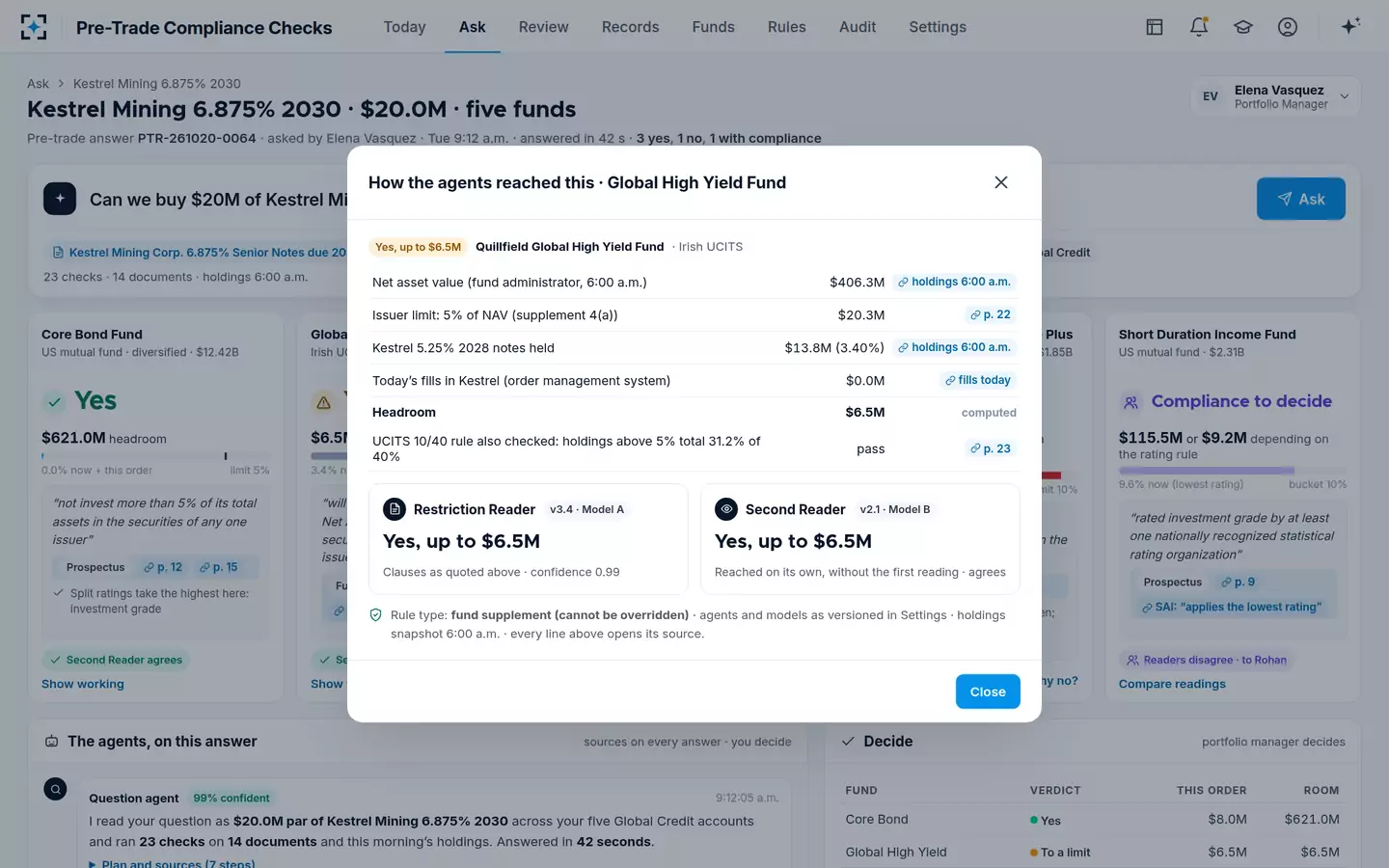
Each fund has one regulatory rulebook, its home regime, plus its own documents, and the strictest applicable limit wins. In the sample run of the solution, an Irish UCITS high-yield fund had the UCITS 10% tier available but a 5%-of-NAV issuer limit in its own supplement; the agents applied the 5%, found $13.8 million of the issuer already held against a $20.3 million limit, and answered "yes, up to $6.5 million". The 10/40 aggregate was still checked, at 31.2% of 40%, because a stricter single-issuer limit does not remove the aggregate one.
Where "both" means two vehicles running one strategy, there is no winner: there are two funds and two answers. The order that a portfolio manager thinks of as one trade becomes, for compliance, one check per vehicle, each against its own rulebook, base and documents. That is the shape of the solution's answer: one tile per fund, each with the clause that decided it. Under the solution's default settings, which a firm can change, the hierarchy for a UCITS puts the UCITS rules first, then the prospectus and supplement, with the stricter text governing.
A mandate's restrictions read in German, quoted under the English
Fund names: the 80% test on both sides of the Atlantic
A newer family of limits sits beside the spread rules: the fund's name. ESMA's guidelines say funds using sustainability-related terms in their names should "meet an 80% threshold linked to the proportion of investments used to meet environmental or social characteristic or sustainable investment objectives" and "exclude investments in companies referred to in Article 12(1)(a) to (g) of CDR (EU) 2020/1818", the Paris-aligned benchmark exclusions (ESMA34-472-440, Final Report, 14 May 2024). In the US, the amended Names Rule requires an 80% investment policy and applies from 11 June 2026 for fund groups with net assets of $1 billion or more and from 11 December 2026 for smaller groups; only its Form N-PORT reporting moved to 2027 and 2028.
For pre-trade compliance, a name test behaves like an aggregate limit: each purchase outside the named focus uses up some of the 20% that is not required to match it, and each purchase in the focus restores it. The same headroom logic applies, against a different numerator.
Before computing UCITS headroom, settle these
- Which regime governs this fund
EU Directive as implemented in the home state, or the UK's COLL 5.2. They are maintained separately now.
- Which base
Net value of scheme property after borrowings in the UK; the fund's assets under the Directive; never total assets by habit.
- Which group is one body
Issuers in the same consolidated group count as a single body for the 20% limit.
- Outstanding amounts for Article 56
10% of an issuer's debt or non-voting shares needs the amount in issue, not the fund's weight.
- Deposits and derivatives with the same body
The 20% combined limit adds cash and OTC exposure to securities; settlement timing moves it.
- The fund's own stricter limits
Supplement and prospectus limits apply on top; COLL 5.2.4R lets the instrument restrict further.
- Launch period
Spread rules do not apply for six months after authorisation in the UK, provided the fund aims at a prudent spread of risk (COLL 5.2.3R).
A manager that answers these seven questions once per fund, writes the answers down, and computes headroom from current holdings has done most of the hard work of cross-border pre-trade compliance. The rest is keeping the answers current as documents change. Pre-Trade Compliance Checks shows a UCITS and four US and separate-account funds answered side by side for one order.
Questions people ask
What is the UCITS 5/10/40 rule?
A UCITS may invest up to 5% of its assets in one issuer's securities, raised to 10% for issuers whose holdings, taken together with every other holding above 5%, total no more than 40% of the fund. It comes from Article 52(2) of Directive 2009/65/EC and COLL 5.2.11R(5) in the UK.
What are UCITS issuer concentration limits beyond 5/10/40?
No more than 20% of assets in deposits with one body, 20% in any combination of securities, deposits and OTC exposure to one body, and 10% (credit institutions) or 5% (others) of OTC counterparty exposure. Article 56 adds limits on the share of an issuer owned: 10% of its debt, non-voting shares or money market instruments.
Can a UCITS hold more than 10% in government bonds of one issuer?
Yes. Article 52(3) lets member states raise the 5% limit to 35% for securities issued or guaranteed by a member state, its local authorities, a third country or a public international body of which member states are members.
Do UCITS limits apply from the first day a fund launches?
The Directive lets member states allow recently authorised UCITS to derogate from the spread rules for six months, while observing risk spreading. The UK applies the spread rules six months after authorisation or the start of the initial offer, provided the fund aims at a prudent spread of risk (COLL 5.2.3R).
Is a UCITS breach caused by cash settlement active or passive?
Usually active. The CSSF's FAQ treats a deposit above 20% caused by a settlement-date mismatch or a bond maturing as active, because the cash flow was "predictable/avoidable"; it accepts passive status only in justified exceptional cases the fund can document.