A pre-trade compliance tool, in the sense used here, is the layer that answers restriction questions before an order reaches the order management system: may this fund buy this security, and how much, given every document that binds it. That is a different job from the restriction tools some brokers offer advisers, which block securities already named on a list, account by account; a fund's tool has to work the list out from the prospectus, the SAI and each client's guidelines. It should sit beside the OMS's compliance rules engine rather than replace it. The engine is good at what it holds, coded limits tested in milliseconds at order entry; what it lacks is everything nobody coded, the side-letter exclusion, the SAI's split-rating policy, the new client's guidelines. Botminds' Pre-Trade Compliance Checks is designed for that division of labour: its agents answer from the documents, send the answer to the order system as the order's compliance note, let the engine re-check every fund at entry, and propose a coded rule whenever a question surfaces a clause the engine lacks, which reaches the engine only after two compliance signatures.
The examples use the solution's sample data, on fictional funds and people; the regulatory texts are quoted from the SEC's rules and examination findings and from Luxembourg's CSSF.
Pre-Trade Compliance Checks beside the order management system
A person decides
Portfolio managerAsks before the order: can these funds take this security, and how much?
Agent
Pre-trade answerReads the documents, computes headroom from 6:00 a.m. holdings plus today's fills, quotes the deciding clause per fund, reads twice.
Never: Never sends an order
A person decides
Portfolio manager sendsThe order goes to the OMS with the written answer attached as its compliance note.
Agent
OMS rules engineRe-checks every fund at entry against the limits it holds and blocks a hard-limit breach.
A person decides
Trader acceptsChecks the order against the answer and accepts it as the second key; cannot change a verdict.
Agent
Rule DrafterWhen a question found a clause the engine lacks, proposes the coded rule and back-tests it on today's holdings.
Never: Never writes to the engine without two signatures
A person decides
Two compliance keysA compliance officer and the Head of Investment Compliance approve; the rule syncs to the engine.
Does a pre-trade compliance tool replace the OMS rules engine?
No, and it should not try. The rules engine sits in the order path, tests every order at entry in milliseconds, and blocks hard limits without anyone asking. Moving that job elsewhere would add latency and a new point of failure to every order. What the engine cannot do is read: it tests only what someone has turned into a rule, and every limit that lives only in prose, or changed since it was coded, passes through it untested.
Luxembourg's supervisor named the second failure precisely. Among the root causes of ESG-related breaches notified to it in 2025 were "issues in internal controls or system settings, which were not updated after changes were made to the UCI documentation or which were not adequate, and thus resulted in the incorrect application of limitations" (CSSF Feedback Report on Circular 24/856, 2026). A tool beside the engine closes that gap from two sides: it answers from the current document today, and it proposes the change to the engine so the next order is caught at entry too.
What a pre-trade compliance tool connects to
Six systems, each for one input, and none of them replaced. The tool reads documents, holdings, prices, issuer data and lists, and it writes two things back: an answer to the order and, after approval, a coded rule to the engine.
The systems Pre-Trade Compliance Checks works with, and what flows each way
| System | What the tool reads | What it writes back |
|---|---|---|
| Order management system | Today's fills and open orders | The written answer as the order's compliance note |
| Compliance rules engine | The coded rules, to know what is already covered | New coded rules, only after two compliance signatures; synced every 15 minutes |
| Portfolio accounting and fund administrator | Holdings for every account at 6:00 a.m.; UCITS net asset values | Nothing; late feeds are flagged |
| Document management | Prospectuses, SAIs, supplements, IMAs, IPSs and side letters, in their original languages and versions | Nothing; every quote links back to its page |
| Security master, ratings and ESG data | Identifiers, ratings from three agencies, revenue mix, controversies | Flags to the data owner when a filing contradicts a vendor value |
| Exclusion and restricted lists | Client side letters, house policy, OFAC and EU sanctions lists, the firm restricted list | Nothing; restricted-list reasons stay visible to compliance only |
The holdings feed is the connection that decides whether answers are right. Headroom computed from last night's positions without today's fills is how two desks breach the same limit on the same morning. In the solution's design, holdings are never older than one business day, fills come from the OMS during the day, and an answer expires at 4:00 p.m. New York or when holdings move by more than 0.25% of NAV, design targets a firm can change.
How does a pre-trade answer attach to an order?
As the order's compliance note, sent with the order into the OMS, so that the order and the reason it was allowed are one item. US recordkeeping rules already require the order side. An adviser must keep a memorandum of every order it gives, with its terms, the person who recommended the trade and the person who placed it (Rule 204-2(a)(3)), for five years from the end of the fiscal year, the first two in an appropriate office (the adviser recordkeeping rule, record by record). A fund must keep "A record of each brokerage order given by or in behalf of the investment company", executed or not (Rule 31a-1(b)(5)), for six years under Rule 31a-2(a)(2).
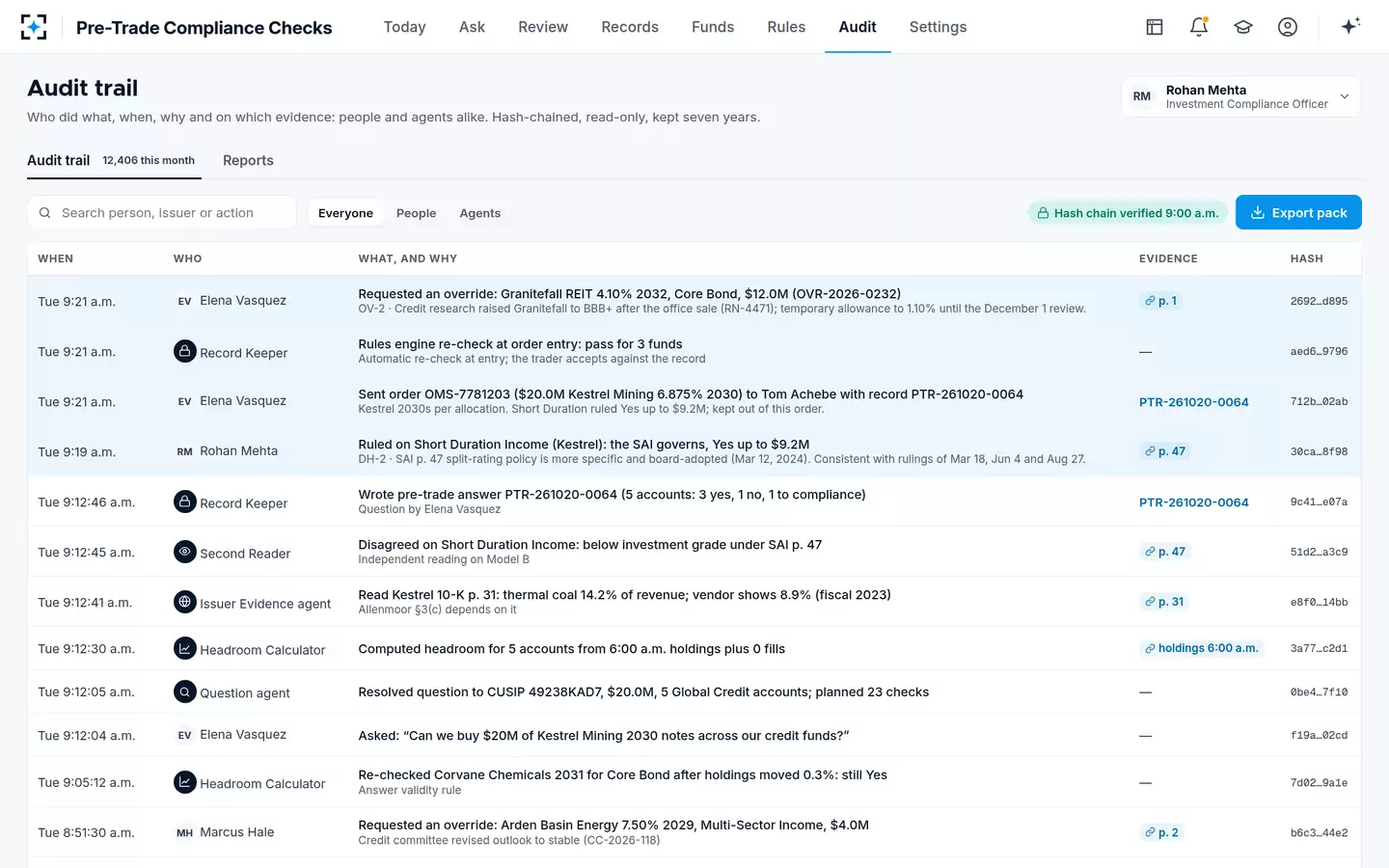
Neither rule requires the compliance answer itself, which is exactly why it goes missing. Attaching it to the order costs nothing at the moment of sending and saves a search at the moment of examination. In the solution, each answer is kept on a hash-chained trail for seven years, a design choice longer than either rule's period for order records.
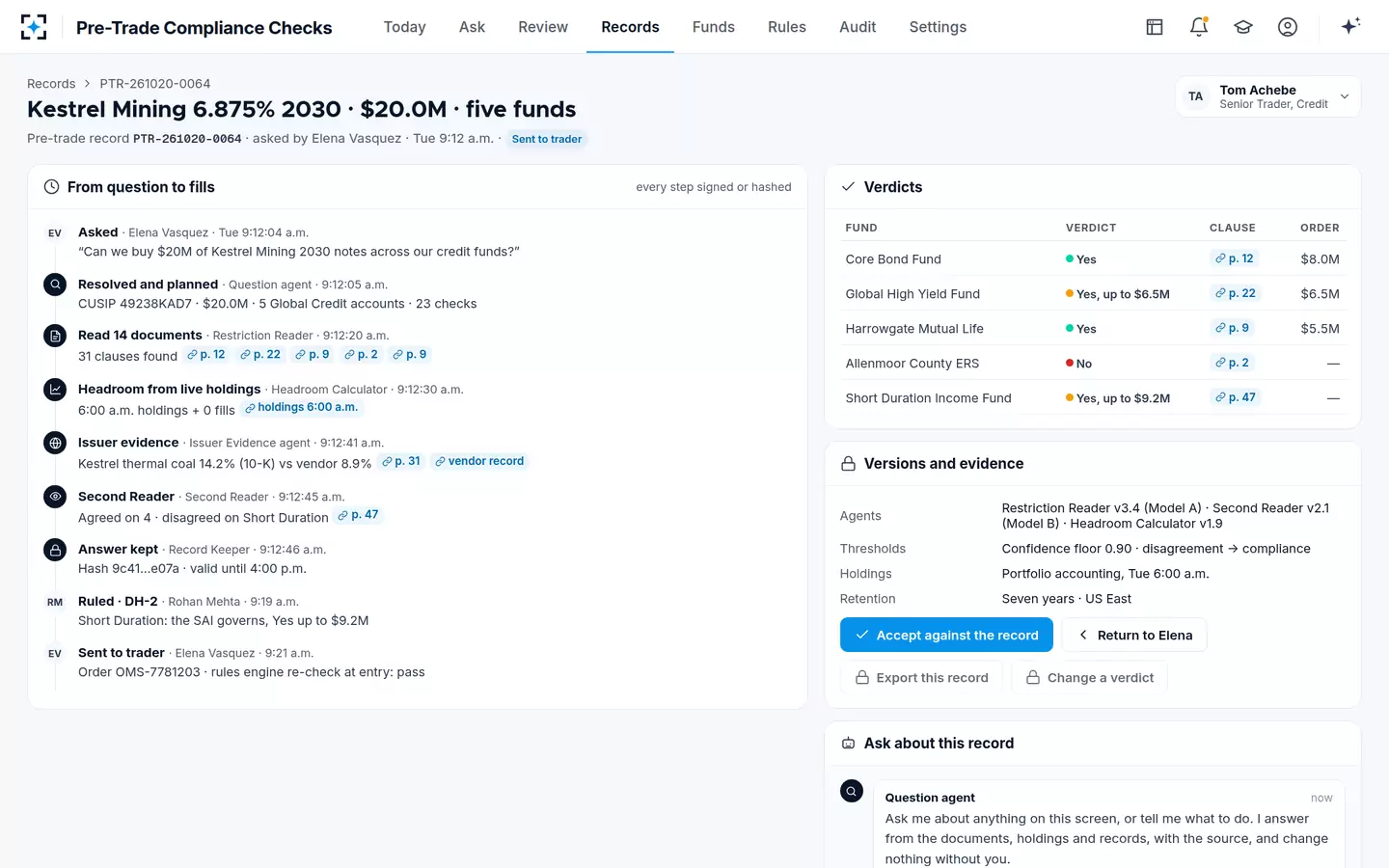
From question to order on one screen, accepted by the trader as the second key
Running both: what each layer catches that the other does not
Two layers catch different mistakes, and the overlap is deliberate. The tool catches the order that should never be placed because of a clause the engine does not hold. The engine catches the order that drifted from its answer: a size typed wrong, an allocation changed after the answer, a second desk's order filling first. In the sample firm, a what-if of $10 million for the UCITS high-yield fund was answered as over its 5% issuer limit by $3.5 million, and the answer noted that the engine would also block it at entry as a hard limit; the order went out at $6.5 million.
Where the two layers cover the same limit, the engine's block stands and the tool's answer explains it. Where only the tool covers it, the answer travels with the order and the Rule Drafter proposes closing the gap. Over time the share of questions only the tool can answer should fall, which is the clearest sign the arrangement is working.
What happens when a new clause isn't coded?
The question still gets answered from the document, and the clause becomes a proposed rule. In the sample firm, the rules engine held 11,860 restrictions for 412 funds and accounts; every question that surfaces a clause outside that set is a gap the engine would have passed. The solution's Rule Drafter writes the proposed rule, back-tests it on today's holdings to show which accounts would fail it now, and sends it to compliance with the clause quoted.
One sample week of keeping the rules engine in step with the documents
2,936
documents read for 412 funds and accounts
11,860
restrictions coded in the rules engine
212
restrictions checked by both readers this week
3days
target for reviewing a proposed new rule, then to the Head of Investment Compliance
The back-test is what makes approval safe. A new rule that would put three accounts in breach today is either wrong or describes a breach nobody has noticed, and both are worth knowing before the rule blocks orders. In the sample data, a German pension mandate's 38 restrictions were read in the original German, 36 agreed by both readers and two sent for a ruling, each with a proposed rule and a back-test.
Who approves a new coded rule?
Two people in compliance, and never the system that proposed it. In Pre-Trade Compliance Checks a new or changed coded rule needs a compliance officer and the Head of Investment Compliance, with the evidence and the first key in front of the second approver; nothing changes in production without both. The same two-key rule applies to the solution's own settings: thresholds, the document hierarchy and who may do what are versioned, and a change goes live only when a second administrator approves it.
Examiners look for exactly this kind of control over the rules themselves. The SEC's 2020 observations on advisers' compliance programs listed, among portfolio-management weaknesses, "Compliance with regulatory and client investment restrictions" and "Adherence with investment advisory agreements" (SEC OCIE, Observations: Investment Adviser Compliance Programs, November 19, 2020). A rule set changed by whoever noticed a problem, without review, is not a control.
Every answer, ruling, rule and order on a trail the examiner can follow
What documents are needed to start?
The documents that bind the funds, the firm's own rules about them, and a sample of past questions to test against. The last item matters most: a tool that cannot answer last quarter's real questions as well as your compliance officers did will not answer next quarter's.
What a firm brings to go live beside its OMS
- Fund documents
Prospectuses, SAIs, UCITS supplements, board-adopted policies, in their current and recent versions.
- Client documents
Investment management agreements, guidelines, investment policy statements and side letters, in their original languages.
- The compliance manual
House limits, override rules and reason codes, the firm's own policy.
- A written document hierarchy
Which document governs when two conflict, per type of vehicle. Without it, every conflict is a ruling.
- Feeds
Holdings from portfolio accounting and the fund administrator; fills from the OMS; security master, ratings and ESG data; exclusion and restricted lists.
- The coded rules
An export from the rules engine, so the tool knows what is already covered and proposes only what is missing.
- A sample of past restriction questions
With the answers compliance gave, to measure agreement before the first live order.
How long does go-live take?
It depends on the number of funds and documents and on how much of the firm's policy is already written down, and an honest plan sets exit criteria before dates. Botminds builds the solution from the firm's requirements and documents, walks the firm through it on its own mandates first, and takes it live once its quality checks have passed. The sequence below is the shape, with what must be true to move on.
Going live beside the OMS: four phases, each with its exit test
| Phase | What happens | Exit test |
|---|---|---|
| 1. Read | Fund and client documents loaded; restrictions extracted with quotes and classified as regulatory, prospectus, client or house | Compliance agrees the extracted restrictions for a sample of funds |
| 2. Compare | Extracted restrictions compared with the coded rules; gaps proposed as new rules and back-tested | Every gap either approved with two keys or explained |
| 3. Replay | Past restriction questions answered and compared with the answers compliance gave | Agreement on the sample, and every difference explained |
| 4. Live, beside the engine | Answers attached to orders as compliance notes; the engine re-checks at entry; exceptions to compliance | Review times, share of questions needing a person and answers attached to orders, tracked monthly |
Phase 3 is where a buyer learns most, and where the cost per question stops being an estimate. It also shows something a demonstration cannot: which of the firm's documents are ambiguous enough that two careful readers disagree. Those are the clauses worth fixing in the documents themselves.
What examiners will look at once it is live
The same things they look at now, with a better file. The SEC said in 2003 that an adviser's compliance policies should address, among other things, "Portfolio management processes, including allocation of investment opportunities among clients and consistency of portfolios with clients' investment objectives, disclosures by the adviser, and applicable regulatory restrictions" (Compliance Programs of Investment Companies and Investment Advisers, 68 FR 74714, December 24, 2003). For fiscal 2027, its examiners will focus on fund "portfolio management practices and whether related disclosures align with stated investment strategies, fund filings, and marketing materials" (SEC Division of Examinations, Fiscal Year 2027 Examination Priorities).
A tool beside the OMS changes what the firm can show. Instead of a rules engine's log and an inbox, it can show each order with the question that preceded it, the clauses read, the headroom computed, the ruling if there was one, and the engine's re-check at entry. To see that path on the sample funds, start from Pre-Trade Compliance Checks; the difference between pre-trade and post-trade compliance explains what the overnight run still has to catch.
Questions people ask
Can a pre-trade compliance tool work with any order management system?
From the OMS side it needs three things: today's fills and open orders, a way to attach a compliance note to an order, and an export of the engine's coded rules. Because the tool answers before the order rather than inside the order path, it adds no step to order entry itself.
Does the OMS still block orders once the tool is live?
Yes. The rules engine keeps re-checking every fund at order entry against the limits it holds and blocks hard-limit breaches. The tool's answer travels with the order; it does not switch the engine off or bypass it.
How do new rules get into the rules engine?
The tool proposes them when a question surfaces a clause the engine lacks, back-tests them on current holdings, and sends them to compliance. A compliance officer and the Head of Investment Compliance must both approve before a rule syncs to the engine.
Where is the pre-trade answer kept?
With the order, as its compliance note, and on the solution's hash-chained trail for seven years. SEC rules already require order memoranda for five years for advisers (Rule 204-2) and order records for six years for funds (Rules 31a-1 and 31a-2); the answer sits beside them.
Is a broker's pre-trade restriction tool enough for a fund?
Not on its own. A broker's tool blocks the securities someone has already listed for an account, which suits a restricted list or a client's named exclusions. A fund's limits are mostly calculations and readings, such as headroom under 75-5-10, an issuer's revenue share or a split rating under the SAI, and those have to be worked out from the documents before any list exists.
What if the tool and the rules engine disagree?
The engine's block at order entry stands, and the difference goes to compliance. Usually it means the coded rule and the current document have drifted apart, which is exactly the gap the CSSF found behind some of the breaches notified to it in 2025.