AI stock alerts are notifications produced by software that reads news, filings and market data about stocks and decides which items deserve a person's attention. The consumer versions send price and keyword alerts, or "signals" to buy and sell. The professional version, for an investment firm, uses AI agents to read every notice on every holding in its own language, merge repeats, score each event against the firm's own investment theses and positions, and hand it to the analyst who covers the stock. What separates a tool a firm can defend from one it cannot is where the agents' authority ends. In the Bank of England and FCA's 2026 survey of UK financial firms, no more than 9% expected agents to execute trades or to change limits, thresholds and controls, even counting a year of planned deployment. Botminds' Portfolio Alerts is built on that line: seven agents read, merge, score, challenge and route every event, and a named analyst acknowledges, a portfolio manager decides, and a second approver releases any order.
Even including planned deployment over the next 12 months, no more than 9% of respondents expected agents to: approve or decline customer outcomes; execute trades or place orders; initiate, execute or block payments; or change limits, thresholds and controls.
Bank of England and Financial Conduct Authority, Artificial intelligence in UK financial services 2026, published October 26, 2026
How do AI stock alerts work?
An institutional AI alerting system is a chain of narrow steps, each done by an agent with fixed limits, ending with a person. The chain matters more than the model: a capable model that can skip a step, or act at the end of the chain, is the risk a firm is buying.
One event through the seven agents in Portfolio Alerts, and the people who decide
Agent
WatchersOne per source family: SEC filings, Asian exchanges, European notices, rating actions, wires, local press, licensed broker research. Read each item in its own language as it publishes, match the issuer, translate, extract every figure with its anchor.
Never: reads an unlicensed source, an expert call or private data
Agent
DeduperMerges every report of the same event into one alert anchored on the earliest exchange or regulator source; flags any report that disagrees with the filing.
Never: drops a report
Agent
Materiality agentScores 0–100: event type 30, thesis fit 30, position 25, surprise 15, naming the pillar touched and quoting the passage that proves it.
Never: scores a restricted issuer or edits a thesis
Agent
ChallengerArgues against the alert: price and volume since publication, earlier press, the company's responses, consensus, market hours.
Never: dismisses an alert; changes severity only with a recorded reason
Agent
Router and note drafterFinds the covering analyst, sets the deadline, copies the PMs who hold it, respects quiet hours; drafts a cited note.
Never: acknowledges or decides for a person, or sends anything outside the firm
A person decides
Analyst, then portfolio managerThe analyst acknowledges with a note and pillar marks, or marks it not material with a reason. The PM decides, with a reason code.
A person decides
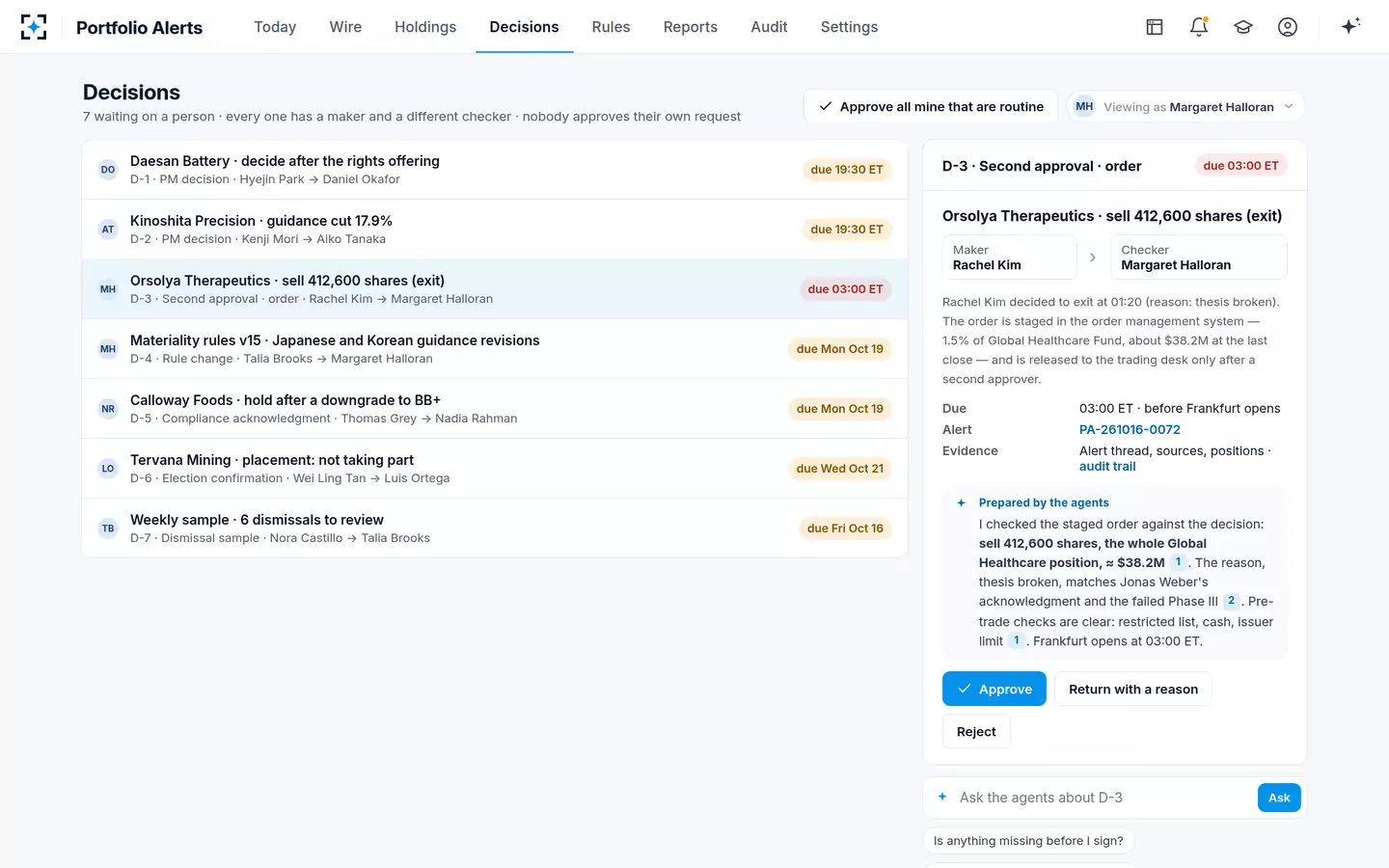
Second approverReleases any order the decision stages, after the agents' pre-trade checks; nobody approves their own request.
Can AI trade on news?
Technically, yes; it is a choice a firm makes. Few UK firms are making it. The Bank of England and FCA survey, with 196 responses, sorted agents in production by autonomy: decision support, in which agents recommend and people decide and carry out the action; constrained execution within predefined limits; conditional autonomy with human approval for certain actions; and broad autonomy. Only 2% of respondents reported agents with broad autonomy, and no more than 9% expected agents to execute trades or place orders even counting a year of plans (Bank of England and FCA, 2026).
For news-driven trading the argument against autonomy is specific. A news alert is a reading of a text, often a translation, matched to an issuer by a probability. Each of those can be wrong in a way a person would catch in seconds: the wrong share class, a figure off by a factor of a thousand, a rumour already denied. In Portfolio Alerts the agents never trade or change a position. A portfolio manager's decision may stage an order in the order management system, and it goes to the trading desk only after the head of investment risk approves it.
Every decision waiting on a person in Portfolio Alerts, each with a maker and a different checker
Who acknowledges an AI alert?
A named person, never the system. Acknowledgment is the moment a firm can show that a human read the alert, formed a view and took responsibility for what happened next. If an agent can acknowledge, that record is empty. In Portfolio Alerts the Router assigns every routed alert to the covering analyst from the coverage map and the follow-the-sun rota, with a deadline by severity: 20 minutes for Critical, a design target, and 60 for High. The analyst has three choices: acknowledge with a note and pillar marks, mark it not material with a reason code, or reassign it to a colleague, with the deadline carried over.
Missed deadlines escalate to people, not to automation. A missed Critical deadline pages the lead portfolio manager, then the head of research 20 minutes later; a missed High deadline notifies the portfolio manager. Dismissals are sampled weekly by research operations, so "not material" is a judgment someone else can check.
What should AI not decide in a portfolio?
Anything that changes the firm's exposure, its obligations or its own controls. The table below is the authority line as Portfolio Alerts draws it. It is one firm's configuration, but most of the rows follow from the regulators' statements quoted further down.
The authority line in Portfolio Alerts: what agents may do, and what only people may
| Step | Agents may | Only a person may |
|---|---|---|
| Reading sources | Read licensed sources, translate, extract figures with anchors | License a new source; add it to the feeds |
| Matching an issuer | Match at 0.90 confidence or above | Resolve any match below 0.90 |
| Restricted issuers | Withhold the alert from everyone outside Compliance | See the details (Compliance only) |
| Scoring | Score under the live rules version, citing the pillar and passage | Change the weights, the alert line or the page line |
| Severity | Raise or lower it, with a recorded reason | Dismiss an alert as not material, with a reason code |
| Ownership | Route to the covering analyst and copy PMs | Acknowledge; reassign |
| The thesis | Draft a cited note and suggest pillar marks | Edit and send the note; set the pillar marks |
| The position | Run pre-trade checks on a staged order | Decide; stage the order; approve it as a different person |
| Corporate actions | Compute the cost of taking up rights | Elect; confirm the election with the custodian |
| The rules | Replay 90 days to show what a change would add or drop | Propose a change; approve it as a different person |
What regulators expect: people decide, firms stay accountable
No securities regulator has issued a rule specific to AI alerting, and none needs to for the old rules to apply. The SEC's Division of Examinations, in its fiscal 2027 priorities published October 23, 2026, notes that registrants now use what it calls super intelligence (SI) across research, portfolio management and compliance surveillance, and says the Division is "intensifying its efforts to understand how the technologies influence outcomes and whether firms continue to comply with existing, technology-neutral obligations" (SEC, Fiscal Year 2027 Examination Priorities). Exam priorities are staff statements, not rules.
There is no pending SEC AI rule for advisers either. The Commission's 2023 proposal on conflicts in the use of predictive data analytics was withdrawn on June 12, 2025, with other proposals; the notice says the Commission "does not intend to issue final rules with respect to these proposals" (Federal Register, June 17, 2025). The obligations that bite are the existing ones: an adviser's written policies to prevent misuse of material nonpublic information under Advisers Act Section 204A (15 U.S.C. 80b-4a), and its books and records under Rule 204-2.
Europe's regulator puts the accountability point plainly. ESMA warned in 2024 that "both the service providers and clients might over-rely on AI for decision-making, neglecting the importance of human judgment", and said it "expects firms to implement comprehensive testing and monitoring systems" for AI, in proportion to the risk (ESMA, public statement, May 2024). FINRA's 2026 oversight report lists agent-specific risks, including one that bears directly on restricted issuers: "Agents operating on sensitive data may unintentionally store, explore, disclose or misuse sensitive or proprietary information" (FINRA, 2026 Annual Regulatory Oversight Report).
One gap is worth knowing. The US banking agencies' revised model risk guidance of April 17, 2026, SR 26-2, leaves generative and agentic AI models out of its scope altogether, on the ground that they are new and changing fast (Federal Reserve, SR 26-2 attachment). It is bank guidance, not an asset-management rule, but it means the most widely copied template for testing models leaves agents to each firm's own governance. A firm buying AI alerts has to write that governance itself.
Can an AI alert be wrong?
Yes, in at least four ways, and a buyer should ask how each is caught. The issuer match can be wrong, for example a subsidiary taken for its parent. The translation can be wrong, especially for numbers and units. The score can be wrong, because the thesis on file is out of date. And the alert can be stale, a repeat of news the market already had.
Portfolio Alerts catches each with a different control. Below 0.90 issuer-match confidence, 0.85 translation confidence or 0.95 figure-match confidence, the item goes to a person instead of being alerted. Every figure is set beside the original-language source with its item or page anchor. The Challenger checks the price, earlier press and the company's responses before an alert is called a surprise. And the analyst who owns the alert can mark it not material with a reason, which research operations samples. The point is not that the agents are never wrong; it is that a wrong alert is visible, owned and corrected, not acted on.
How do you audit AI alerts?
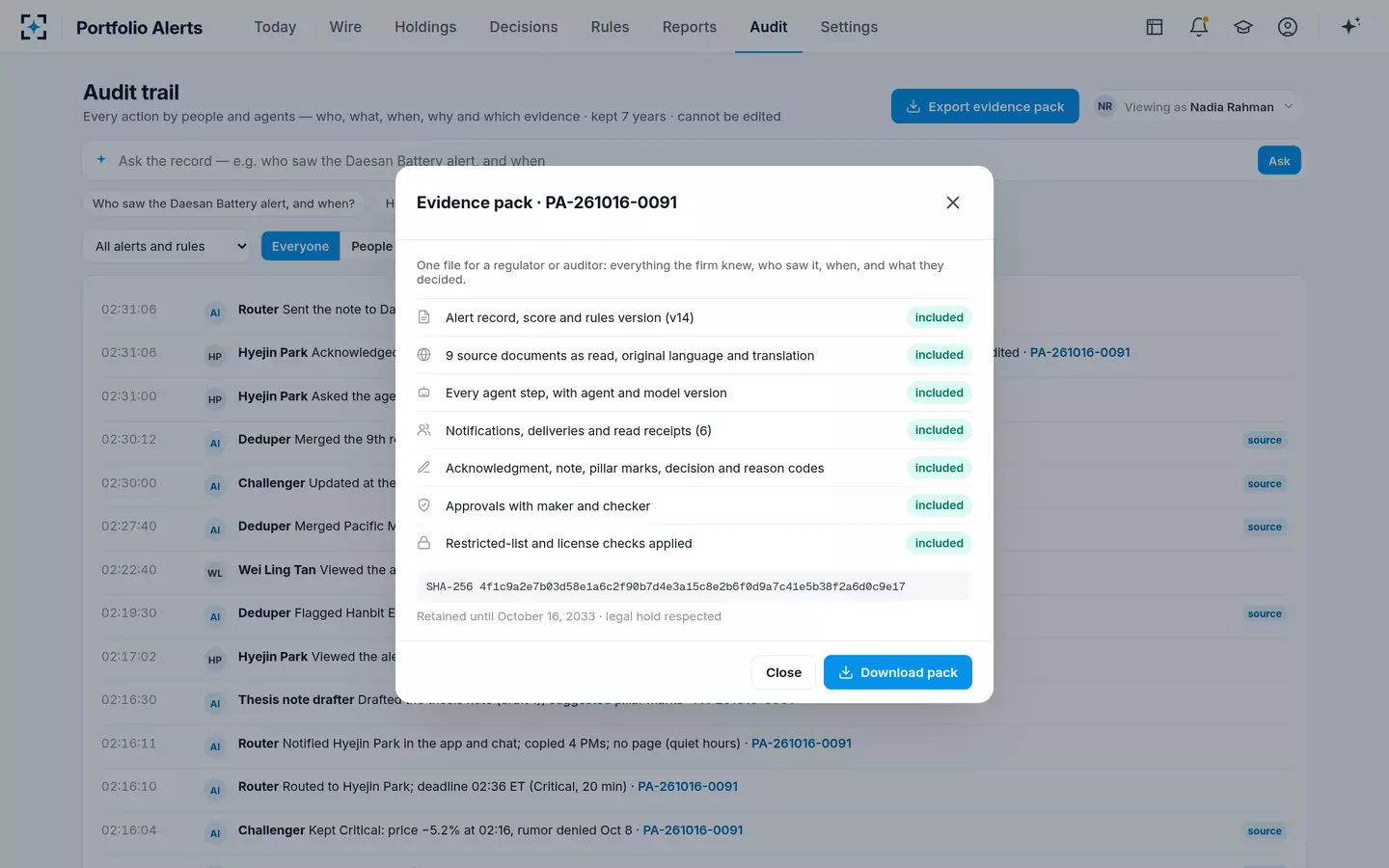
By keeping, for each alert, what a reviewer would need to reconstruct it: the sources as read, every agent step with its version, who was notified and when, who opened it, what they decided and why. The SEC's books-and-records rule requires advisers to keep written communications about any recommendation or advice, given or only proposed, and to keep electronic records safe from loss, alteration or destruction (17 CFR 275.204-2; the rule is applied to research in investment adviser recordkeeping requirements).
One evidence file per alert in Portfolio Alerts, for a regulator or an auditor
AI stock alert apps and institutional portfolio alerts are different products
Many searches for "AI stock alerts" are looking for trading signals for a personal account. That is a different product, and a firm evaluating tools should not compare the two on features.
Consumer AI stock alerts and institutional portfolio alerts
Consumer AI stock alert apps: A ticker on a watchlist, and its price.
Institutional portfolio alerts: An event on a holding, scored against a written thesis and the position in every fund.
Consumer AI stock alert apps: Price feeds and English-language news.
Institutional portfolio alerts: Licensed exchange, regulator, wire, local press and broker sources, in each source's own language.
Consumer AI stock alert apps: A notification, sometimes a buy or sell signal.
Institutional portfolio alerts: An owned alert with a deadline, a cited draft note and an escalation path.
Consumer AI stock alert apps: Whoever receives it.
Institutional portfolio alerts: A named analyst acknowledges; a portfolio manager decides; a second approver releases orders.
Consumer AI stock alert apps: A message history.
Institutional portfolio alerts: An evidence file per alert, kept for the firm's retention period.
Buying AI stock alerts: questions for any vendor
Every vendor, including us, will say its alerts are accurate. These questions test the authority line instead, and the answers are easy to check in a demonstration.
Twelve questions for an AI alerting vendor
- Can any agent place, stage or approve an order?
The answer you want is no, and the second approver is a different person.
- Can any agent acknowledge or dismiss an alert?
If yes, your record of who knew is empty.
- Who can change a threshold, and what do they see first?
Look for maker-checker and a replay of what the change would have caught.
- What happens below the confidence threshold?
Items should go to a person, not be guessed.
- Is every figure cited to its source passage?
Ask to open one citation in the original language.
- How are restricted issuers handled?
Alerts should reach Compliance only, and the list should sync often.
- Which sources, and under whose licence?
Unlicensed content and expert calls should be impossible, not discouraged.
- Does it merge repeats into one event?
Ask for the items-read to events ratio on a real day.
- Is there an agent that argues against the alert?
Ask what it checks and whether it can dismiss.
- What is kept, for how long, and can it be edited?
Sources, steps, versions, receipts, decisions; sealed; your retention period.
- How is a model or agent update tested?
Ask for the replay and who approved the change.
- Where does the data live?
Region by office, and what leaves the firm (the right answer is nothing).
Where Portfolio Alerts fits, and where it does not
It fits a buy-side research team that owns stocks across several funds, keeps a coverage map and written theses, holds companies that publish first in other languages, and must answer "who knew, and when?" after an overnight move. It brings its value from the thesis and the ownership: an alert scored against the pillar it breaks, owned by the analyst who covers it.
It is not a trading-signal service and does not trade; firms that want automated execution on news should look elsewhere. A firm whose theses are not written down will get less from the thesis-fit score, which is 30 of the 100 points, until they are. And it reads only the sources the firm is licensed to read, so its coverage is the firm's own. How to test it, or any monitoring tool, before buying is set out in testing portfolio monitoring tools by replay, and one alert followed end to end is in the rights offering, minute by minute. To see the authority line on your own holdings, start from Portfolio Alerts.
Questions people ask
What are the best AI stock alerts for an investment firm?
The ones that keep authority with people and can prove it: alerts routed to a named owner with a deadline, every figure cited, no agent able to acknowledge, dismiss or trade, rule changes approved by someone other than the proposer, and an evidence file per alert. Accuracy matters, but a wrong alert that is owned and visible does far less harm than an autonomous one.
Do regulators allow AI in investment research?
Yes; the obligations are technology-neutral. The SEC's 2027 exam priorities say it will look at how firms' use of what it calls super intelligence affects outcomes and compliance with existing obligations. ESMA expects testing and monitoring in proportion to risk and warns against over-reliance; the SEC withdrew its predictive data analytics proposal in June 2025.
Can an AI agent change alert thresholds on its own?
It should not, and few firms plan it: no more than 9% of firms in the Bank of England and FCA's 2026 survey expected agents to change limits, thresholds and controls. In Portfolio Alerts, agents replay a proposed change over 90 days, and a different person must approve it.
How do AI alerts handle restricted issuers?
In Portfolio Alerts, the restricted list syncs from Compliance every five minutes; analysts see such an alert only as "Restricted issuer", and only Compliance sees the details. The Materiality agent never scores a restricted issuer. FINRA lists data sensitivity among the risks of AI agents.
What does "human in the loop" mean for stock alerts?
That every consequential step has a named person who must act: acknowledging the alert, deciding on the position, approving the order, and approving any change to the rules. In the Bank of England and FCA survey's terms, it is decision support: the agents recommend, and people decide and carry out the action.