Stock news alerts tell you that something has been published about a stock you follow, and for an individual investor a free price or headline alert is often enough. For an investment firm the question is different: what does it cost when news about a holding reaches the person who must act on it late, or not at all? The research answer is that delay is costly mainly when attention is short. Institutional attention, measured from professionals' news reading, "responds more quickly to major news events" and "facilitates permanent price adjustment", and the well-known drifts after earnings and recommendation changes are concentrated where institutions "fail to pay sufficient attention" (Ben-Rephael, Da and Israelsen, Review of Financial Studies, 2017). A late alert costs a holder the part of the move that comes after it could have acted, plus the decisions that have deadlines, plus the ability to show who knew and when. Botminds' Portfolio Alerts is built to shrink each of those: it reads every source on every holding in its own language as it publishes and puts the event in front of the covering analyst, with a deadline, in minutes.
What the research says about slow reactions to news
15%
weaker immediate price response to earnings announced on a Friday
70%
larger delayed response to those Friday announcements
8%
lower trading volume around Friday announcements
13min
from a Korean notice to the first English newswire, in one sample event
How fast are stock news alerts?
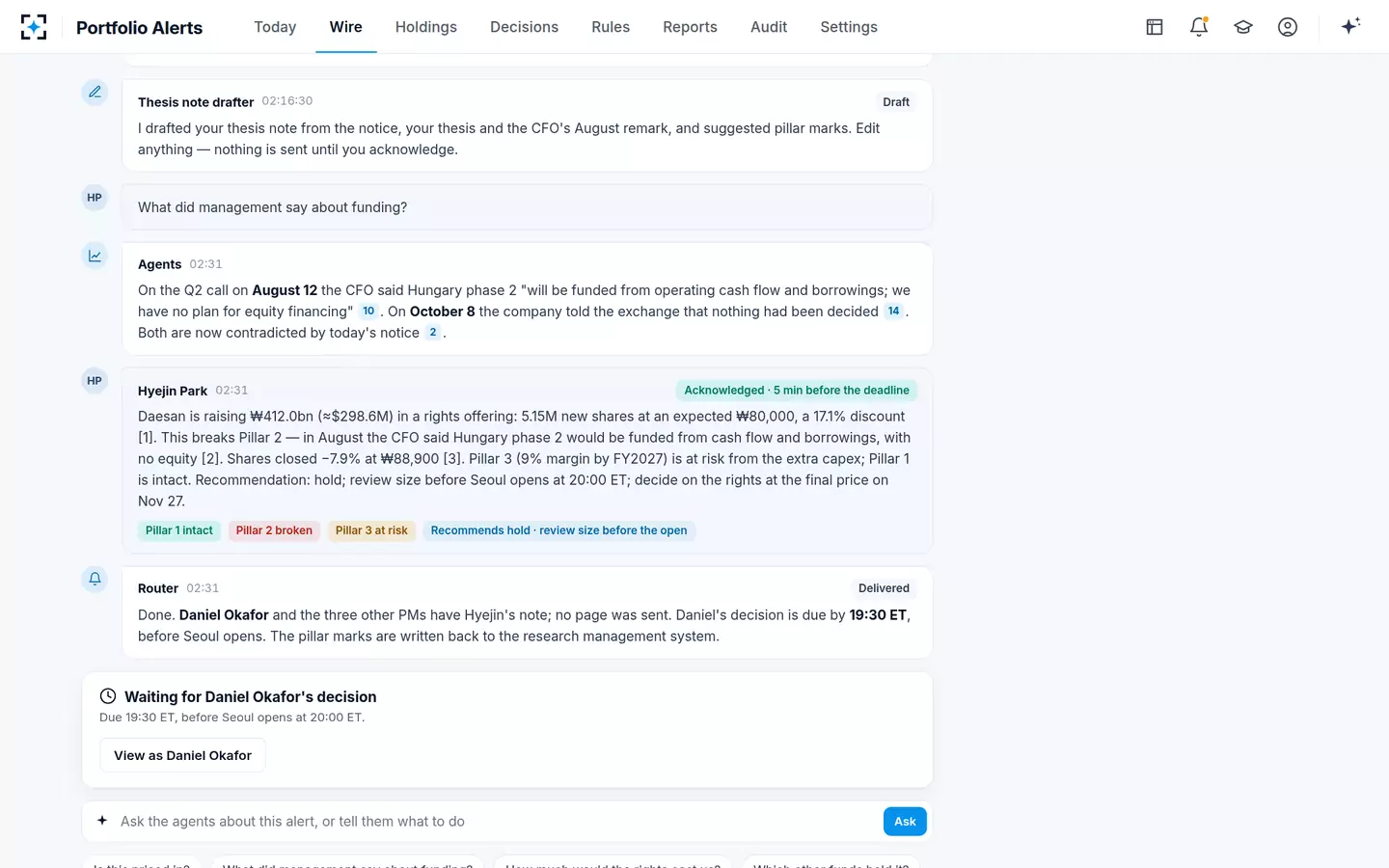
As fast as their slowest link, and the slowest link is rarely the alert itself. For a US filing, the SEC's submissions API typically shows a disseminated filing within a second; the wait is in the rule, since most Form 8-K events may be reported up to four business days later. For a company that publishes first in another language, the wait is the English. In the sample in Portfolio Alerts, a Korean rights offering was read by the agents 33 seconds after filing and the first English newswire arrived 13 minutes after the notice; over 30 days of sample data, the first local-language source led the first English report by a median of 38 minutes on non-US issuers.
Then comes the human link. An alert that lands in an inbox at 2 a.m. New York time is fast and useless if the person it reached is asleep and the person who covers the stock, awake in Singapore, never received it. The useful speed is time to an owner who acts, which is why EDGAR alerts on their own, however quick, solve only the first link.
One overnight notice: when each party could know
Do stocks react slowly to news?
Often, yes, and most when attention is scarce. DellaVigna and Pollet compared earnings announced on Fridays, when investors are less attentive, with those on other weekdays: Friday announcements drew a 15% smaller immediate response and a 70% larger delayed one, with 8% less trading volume (Journal of Finance, 2009). Hirshleifer, Lim and Teoh found the same pattern on crowded days: the more other firms announce on the same day, the weaker the immediate reaction to each surprise and the stronger the drift afterwards (Journal of Finance, 2009).
The reverse also happens. Tetlock found that prices respond less to stale news but still respond, and that a stock's return on a stale-news day tends to reverse over the following week (Review of Financial Studies, 2011). Prices under-react to real news that arrives when nobody is looking, and over-react to repeats of old news. A stock news alert that is fast but cannot tell new from old adds to the second problem; why nine reports of one event should be one alert deals with it.
What is post-earnings announcement drift, and why does it matter for alerts?
Post-earnings announcement drift is the tendency of a stock's price to keep moving in the direction of an earnings surprise for days or weeks after the announcement, instead of adjusting at once. DellaVigna and Pollet conclude that their Friday findings "support explanations of post‐earnings announcement drift based on underreaction to information caused by limited attention". Ben-Rephael, Da and Israelsen locate the drift more precisely: "the well documented price drifts following both earnings announcements and analyst recommendation changes are driven by announcements where institutional investors fail to pay sufficient attention" (Review of Financial Studies, 2017).
For a fund manager that is the economic case for an alert, stated as research. When professional attention arrives quickly, prices adjust and stay adjusted. When it does not, the price takes days to get there, and a holder who was not paying attention spends those days on the wrong side of the move. An alert's job is to make sure that, for the firm's own holdings, the firm is on the attentive side.
What is a missed news alert worth? A method you can run
No regulator or independent study publishes a dollar value for a minute of alert speed, and a vendor's figure should be treated with care. The value can be estimated for your own book, though, as the sum of what a timely alert lets the firm do, minus what it costs the analysts to receive it. The method below uses the sample position for illustration.
The value of a timely alert on one position, as a sum
The move still to come
position × further move after you could act
Only the move after the first chance to act counts. In the sample the shares fell 7.9% on the day, starting a minute after the notice, so the alert could not save that; it could prepare a decision before the next session.
Sample: about $201.6M at the close, so each further 1% is about $2.0M
Decisions with deadlines
value of the elections and orders the event forces
Corporate actions, covenant or mandate limits, and trades that must happen before an open.
Sample: rights worth about $7.9M to take up, election due to the custodian by December 7
The record
who knew, when, and what they decided
The firm's ability to answer a board, a client or an examiner after a holding gaps down.
Rule 204-2 records; Section 204A policies
Analyst load
alerts per analyst × minutes each, false alarms included
The cost side: every alert that should have waited for a digest takes time from one that should not.
Measured in replays before thresholds change
Two cautions apply. The first term is easy to overstate: much of a move happens before any person could reasonably act, and an honest estimate uses only the part after the alert reached its owner. And the terms are not additive across all alerts. Most alerts on a portfolio change nothing; the value sits in the handful each quarter that change a decision, which is why the misses, not the averages, are what a firm should measure. Testing a monitoring tool by replaying last quarter shows how to find them.
How fast is fast enough? Deadlines that follow the next decision
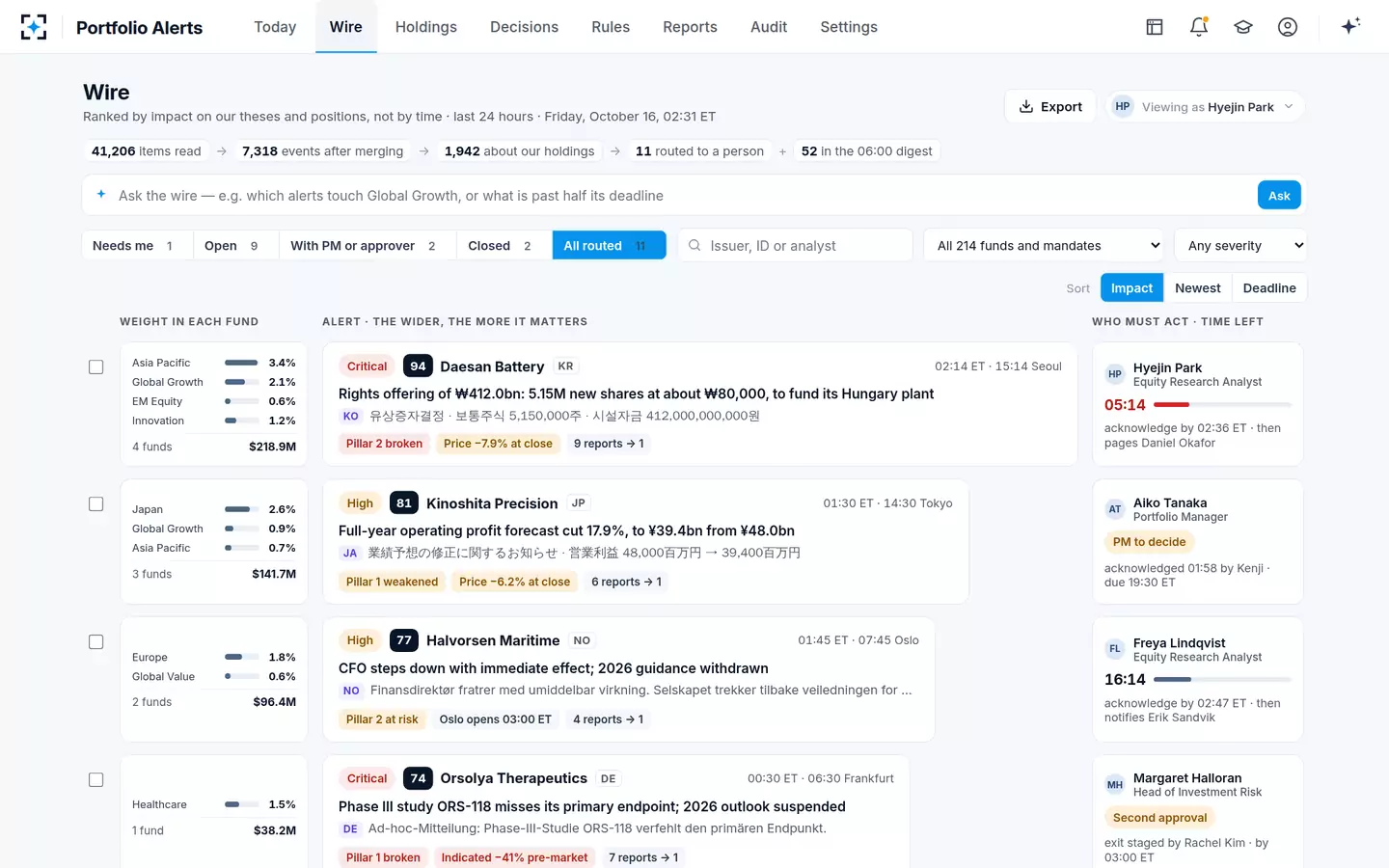
Fast enough means before the next point at which the firm could act differently, and that point is set by the market, not the clock. In the sample, a German notice published at 06:30 Frankfurt time left the firm until 03:00 New York time, before Frankfurt opened, to approve an exit; a Korean notice filed at 15:14 on a Friday in Seoul left a weekend, after the market had already traded on it for the 16 minutes before the close. A single response time for every alert either wakes people for events that could wait or lets urgent ones sit.
That is why Portfolio Alerts sets deadlines by severity and lets the escalation, not the alert, cross time zones. In the fictional sample, a Critical alert has 20 minutes to be acknowledged, a design target, before the lead portfolio manager is paged; a High alert has 60 minutes before the manager is notified; a Medium alert waits until 10:00 local the next business morning; and events below the alert line wait in the 06:00 digest. The portfolio manager's own decision then has a due time set before the next open: in the rights offering, 19:30 New York time, ahead of Seoul's next session. The analyst's 17 minutes matter because they put a cited note in front of the decision-maker long before trading resumes.
Who knew, and when? The other cost of a late alert
When a holding gaps down overnight, the first question from a chief investment officer, a board or a client is who knew, and when. If the answer is scattered across inboxes, the firm cannot give it. That has a regulatory side. Advisers must keep written communications relating to any recommendation or advice (17 CFR 275.204-2(a)(7)) and must maintain and enforce written policies reasonably designed to prevent the misuse of material nonpublic information (15 U.S.C. 80b-4a).
The SEC's examination staff, in a 2022 risk alert, described deficiencies under Section 204A and the code of ethics rule as among those it observed most often, and, on alternative data, found advisers that could not show, by documentation, that their policies had been consistently carried out (SEC Division of Examinations, risk alert, April 26, 2022). A staff risk alert is not a rule, but it says what examiners ask for. An alert system that records who received each alert, who opened it and when, and what was decided, produces that documentation as a by-product.
The analyst's acknowledged note on the record in Portfolio Alerts, five minutes inside the deadline
Free stock news alerts and institutional portfolio alerts
Free alerts are good at telling one person that a headline exists. They are not built for the questions a firm has to answer, and for many readers that is fine.
When a free headline alert is enough, and when it is not
Free or retail stock news alerts: A personal watchlist of a few names, mostly US-listed, read in English.
Institutional portfolio alerts: Hundreds of holdings across funds, many publishing first in other languages.
Free or retail stock news alerts: The headline in the feed.
Institutional portfolio alerts: The first source, usually the home-market notice or filing.
Free or retail stock news alerts: One notice per article.
Institutional portfolio alerts: One alert per event, with every report merged and listed.
Free or retail stock news alerts: Keyword or ticker match.
Institutional portfolio alerts: Scored against the thesis and the position in every fund.
Free or retail stock news alerts: Whoever set the alert.
Institutional portfolio alerts: The covering analyst, with a deadline and escalation.
Free or retail stock news alerts: None to speak of.
Institutional portfolio alerts: Who knew, when, and what they decided, kept for the retention period.
What are the best stock news alerts for an investment team? Five tests
The best alerts for a team are the ones that pass these tests on the team's own holdings. None of them is about the interface.
Five tests for stock news alerts at an investment firm
- Lead time from the first source
Measure from the home-market notice, not from the English wire. In the sample, the gap was 13 minutes on one event and a median of 38 over 30 days for non-US issuers.
- One alert per event
Items read against events after merging; repeats should update an alert, not create one.
- Relevance to the thesis
Ask which pillar an alert touches; if the tool cannot say, the analyst must.
- An owner and a deadline
Every routed alert has a named person and an escalation if they miss it.
- A record you could show
Sources as read, receipts, decisions and reasons, for each alert.
Where Portfolio Alerts pays back, and where it does not
The method above says where the value sits: large positions, holdings that publish first in other languages or out of the firm's hours, events with deadlines such as corporate actions, and firms that must be able to say who knew and when. A global manager with funds in several time zones and holdings in Seoul, Tokyo, Frankfurt and Oslo has all four; the wire in the sample shows notices from all of those markets in a single night.
It pays back least for a concentrated US-only portfolio followed by a small team in one time zone, where the SEC's own feeds and a good newswire may be enough; and it does not replace the analyst's judgment, which is the part of the chain the solution is designed to protect. To estimate the value on your own book, the replay is the place to start; to see it on your own holdings, start from Portfolio Alerts.
One night's wire in Portfolio Alerts, ranked by impact, with the time left on each alert
Questions people ask
Are free stock news alerts good enough for an investment firm?
For awareness of US headlines on a short list, often yes. They fall short on holdings that publish first in other languages, on repeats, on relevance to a thesis, and on the record of who knew and when. Those gaps matter most for large positions and events with deadlines.
How quickly do stock prices react to news?
It depends on attention. Major news that professionals notice is absorbed quickly, while news released on Fridays or on crowded days draws a weaker immediate reaction and more drift later. Ben-Rephael, Da and Israelsen found that the drifts after earnings and recommendation changes come from announcements institutions did not attend to.
Can a news alert prevent a loss?
Rarely the first move: in the sample event the shares began falling one minute after the notice, before anyone in New York could act. What a timely alert protects is the next decision: the position before the following session, elections with deadlines, and the record of who knew.
Why do news alerts arrive late for foreign stocks?
Because many alert services follow English sources, and foreign companies publish first at home. In the fictional sample in Portfolio Alerts, the first English newswire on a Korean rights offering came 13 minutes after the Korean notice, and over 30 days the median gap for non-US issuers was 38 minutes.
What should an alert record keep?
The sources as read, who was notified and when, who opened the alert, the note, the decision and its reason. US advisers must keep written communications relating to recommendations and advice under Rule 204-2 and maintain policies on material nonpublic information under Section 204A.