A rights offering is a share issue in which a company gives its existing shareholders the right to buy new shares in proportion to their holdings, usually at a price below the market, within a set period. FINRA's investor guide puts it simply: "A rights offering occurs when a company issues "rights" to existing shareholders", and "Companies generally offer rights when they need to raise money" (FINRA). For a fund that owns the stock, a rights offering is two decisions at once: what the raise says about the investment case, and what to do with the rights themselves, take them up, sell them or let them lapse. When the notice is filed in another language, in the middle of the night, the hard part is getting both decisions in front of the right people before the market trades again. This guide follows one such event through Botminds' Portfolio Alerts, minute by minute, on the solution's fictional sample data.
The firm, the people, the funds, the issuer and every newspaper, wire and broker in the story are invented: Quillfield Capital is a fictional global asset manager, and Daesan Battery a fictional KOSPI-listed battery maker. The rules and research cited are real.
One rights offering, by the numbers
33s
from the Korean exchange notice to the agents reading it
13min
before the first English newswire on the same event
9→1
reports merged into one alert, one wrong figure flagged
17min
from the notice to the analyst's acknowledged note
What is a rights offering?
In a rights offering, each shareholder receives a right for each share held, and a set number of rights buys a new share at the subscription price. The company announces a record date (who gets the rights), a subscription period (when they can be exercised) and a price, which is usually below the market so that holders take it up. Rights are often transferable, so a holder who does not want to invest more can sell them; FINRA's guide notes the expiration is generally one to three months after the announcement.
In the sample, the notice set out each of those terms in numbered items: 5,150,000 new shares, 4.35% of the 118.4 million outstanding; an expected price of ₩80,000, 17.1% below the prior close of ₩96,500, with the final price to be set on November 27; 0.0435 new shares for each share held on the November 4 record date; subscription on December 8 and 9 and payment on December 15. The proceeds, ₩412.0 billion, were to fund a second phase of a plant in Hungary (₩298.0 billion) and a cathode line in Ulsan (₩114.0 billion). Unsubscribed shares were to be offered to the public.
Is a rights offering good or bad for shareholders?
Mechanically, it is close to neutral for a shareholder who takes up or sells the rights; it is costly for one who does neither. The discount is paid to existing holders in proportion, so a holder who exercises keeps the same share of the company, and one who sells the rights receives their value in cash. A holder who lets them lapse is diluted. Economists add a twist: Burkart and Zhong show that when some shareholders lack the cash to subscribe, "rights offerings lead to more dilution of their stakes and lower payoffs, despite the income from selling these rights" (Review of Corporate Finance Studies, 2023).
The bigger effect is usually informational. A company raising equity is telling the market something about its funding, and sometimes, as in the sample, contradicting something it said before. The covering analyst's thesis on Daesan Battery had a pillar that read: capacity growth funded from operating cash flow, no equity raise before 2028. On the August 12 earnings call, the chief financial officer had said the Hungary expansion "will be funded from operating cash flow and borrowings; we have no plan for equity financing." The rights offering broke that pillar the moment it was filed.
What happens to the stock price in a rights offering?
The arithmetic effect of the discount is usually small; the market's reaction to the news can be much larger. The standard way to see the arithmetic is the theoretical ex-rights price: the value of the old shares at the market price plus the cash from the new shares, divided by the new share count. In the sample that is (118.4 million × ₩96,500 + 5.15 million × ₩80,000) ÷ 123.55 million, about ₩95,800, less than 1% below the prior close.
The shares actually closed at ₩88,900, down 7.9%, falling from one minute after the notice. Most of that fall is not the discount; it is the market repricing the company's funding and the management's word. The notice also came on a Friday afternoon in Seoul. DellaVigna and Pollet found that earnings announced on Fridays get a 15% weaker immediate response and a 70% larger delayed one (Journal of Finance, 2009), a reminder that the first close is not necessarily the whole reaction. What a late alert costs a portfolio takes up that question.
The rights arithmetic on the sample holding
| Measure | Calculation | Result |
|---|---|---|
| Shares held across four funds | Asia Pacific Equity, Global Growth, Emerging Markets Equity, Global Innovation | 3,130,000 · 2.64% of the company |
| New shares the rights buy | 3,130,000 × 0.0435 | 136,155 |
| Cost to take up, expected price | 136,155 × ₩80,000 | ₩10.89 billion, about $7.9 million at ₩1,380 |
| Stake if rights are taken up | 3,266,155 ÷ 123,550,000 | 2.64%, unchanged |
| Stake if rights lapse | 3,130,000 ÷ 123,550,000 | 2.53% |
| Theoretical ex-rights price | (118.4M × ₩96,500 + 5.15M × ₩80,000) ÷ 123.55M | about ₩95,800, −0.7% |
| Actual close on the day | ₩96,500 to ₩88,900 | −7.9%, about $17 million on the position |
02:14 ET: the notice, read in Korean 33 seconds after filing
At 15:14:07 in Seoul, 02:14:07 in New York and 14:14 in Singapore, Daesan Battery filed 「유상증자결정」, a decision on a paid-in capital increase, on the Korean exchange. The Korea exchange watcher in Portfolio Alerts read it 33 seconds later, matched it to the company's ISIN with 0.99 confidence, and extracted every figure with its item number. The same report on DART, the regulator's disclosure system, had appeared at 02:14:31, and it matched figure for figure.
At that point there was no English version. Korea's rules on English disclosure have just tightened: from May 2026, the largest KOSPI companies must in principle file the English version on the same day as the Korean one, and newly covered companies within three days (FSC Korea, January 28, 2026; the rule's stages are set out in ad hoc disclosure rules by market). Same day is not same minute. For the first 12 minutes every source was in Korean; the first English text was a licensed broker's flash note at 02:26, and the first English newswire followed at 02:27.
The first 17 minutes: Korean sources first, the agents early, the analyst in charge
- Korean only: notice, DART, three local reports02:14–02:26
- English: broker note, then wiresfrom 02:26
- Read, score, challenge, route3 min
- Merge later reportsmerging
- Not yet routed
- Analyst reads, asks, editsanalyst
02:14 to 02:30: nine reports and one wrong figure
Over the next 16 minutes nine reports of the event arrived: the exchange notice, the regulator's filing, three Korean local press reports, a licensed broker's flash note, two English newswires and the company's own investor-relations page. The Deduper merged them into one alert anchored on the exchange notice. One local daily, five minutes after the notice, put the raise at ₩410 billion; the filing said ₩412.0 billion. The filing won, and the article was flagged, not deleted.
The alert in Portfolio Alerts as the agents' conversation: the notice read, nine reports merged
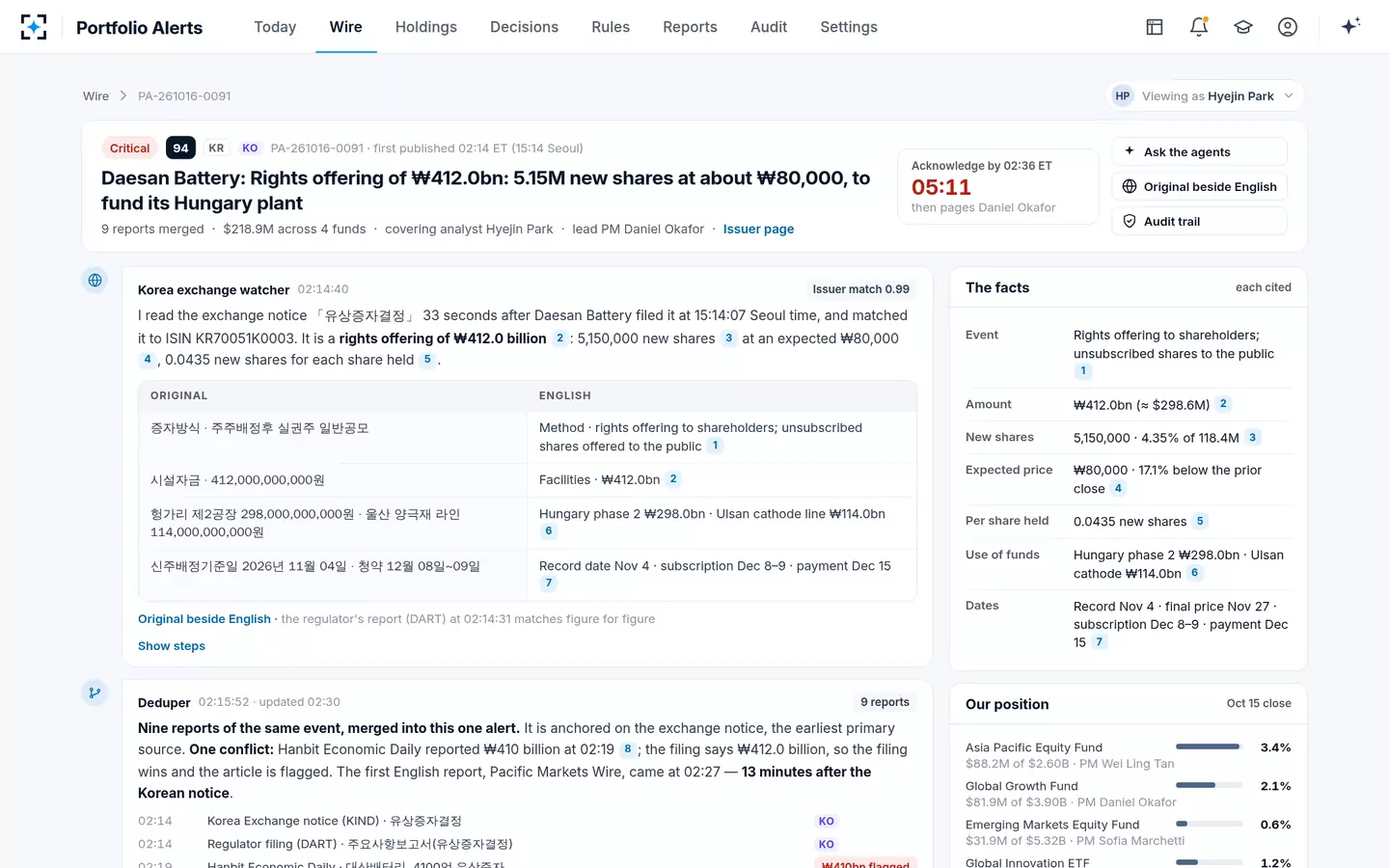
02:15: why the event scored 94
The Materiality agent scored the event against the analyst's thesis and the position in every fund, under version 14 of the firm's rules: event type 27 of 30 (a rights offering or placement), thesis fit 30 of 30 (Pillar 2 directly contradicted, with the CFO's August remark quoted), position 22 of 25 ($218.9 million across four funds, the largest weight 3.4% of the Asia Pacific Equity Fund) and surprise 15 of 15. At 94 it cleared both the alert line of 60 and the page line of 85, so it was Critical.
02:16: the agent that tried to downgrade it
Before the alert reached a person, a separate agent, the Challenger, argued against it. It checked the price, which had fallen from ₩96,500 to ₩88,900 at the 15:30 close, starting one minute after the notice. It found that a local paper had reported a possible raise on October 7, and that on October 8 the company had told the exchange that nothing had been decided. Its verdict: keep Critical. Priced in, partly; already known, no; market, closed. The Challenger may change severity with a stated reason; it may never dismiss an alert.
The Challenger's verdict, the Router's deadline and the escalation plan
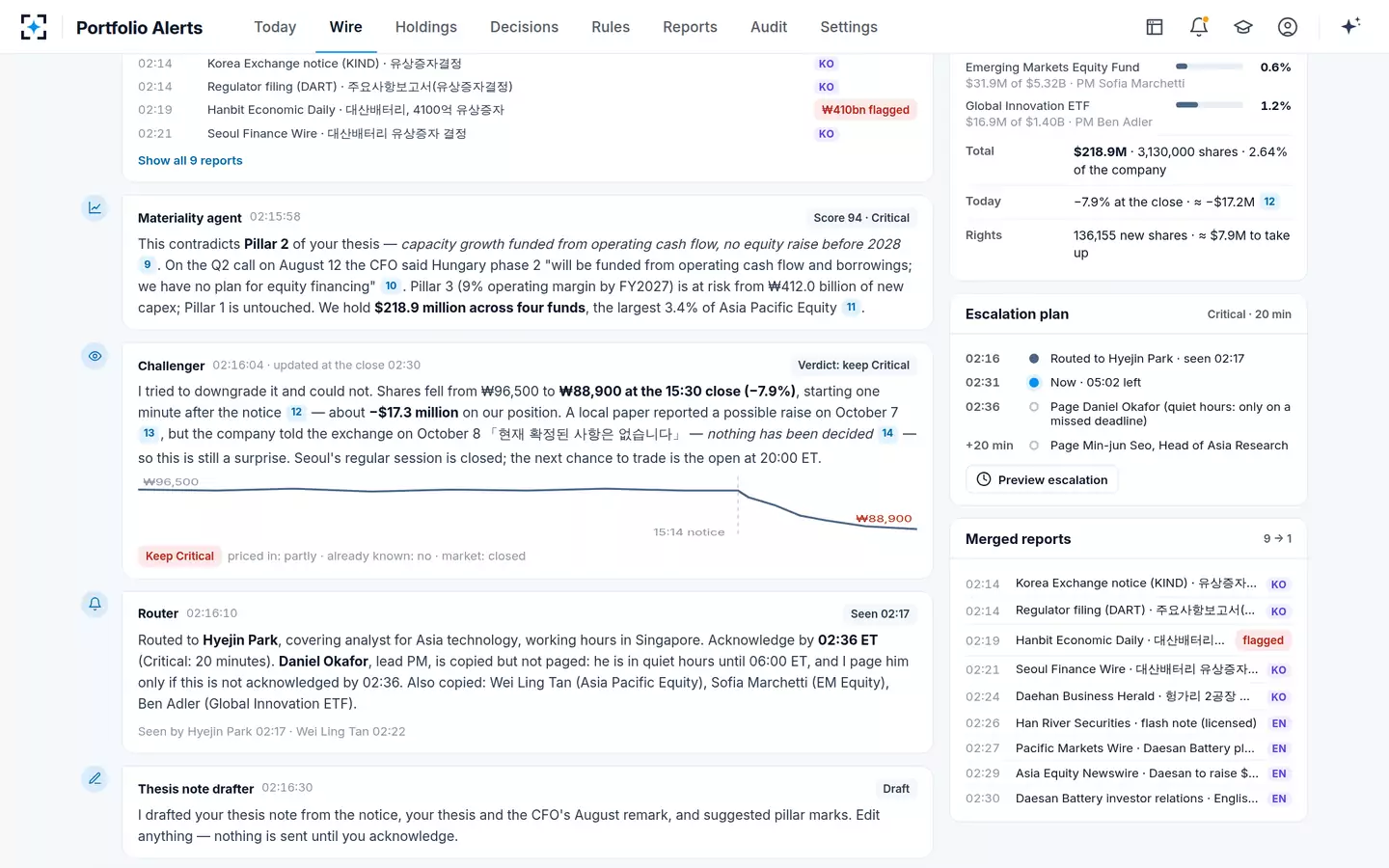
The Router then sent the alert to the covering analyst, Hyejin Park, in Singapore, with a 20-minute deadline, 02:36 ET; 20 minutes for a Critical alert is a design target of the solution. The lead portfolio manager, Daniel Okafor, and the managers of the three other funds that hold the stock were copied. Okafor was in quiet hours until 06:00 in New York, so he was not paged; he would be only if the deadline passed.
02:17 to 02:31: the analyst asks, edits and acknowledges
Hyejin opened the alert at 02:17. Before writing anything she asked the agents on the alert what management had said about funding. The answer came back with numbered citations: the CFO's August remark, and the company's October 8 statement to the exchange that nothing had been decided, both now contradicted by the notice. A drafted thesis note was waiting, written by an agent from the notice, her thesis and the CFO's remark, with three citations and suggested pillar marks: Pillar 1 intact, Pillar 2 broken, Pillar 3 at risk.
She edited it and acknowledged at 02:31, five minutes inside the deadline. The note recommended holding, reviewing the position size before Seoul's next open, and deciding on the rights once the final price was set on November 27. The Router told the four portfolio managers, sent no page, and wrote the pillar marks back to the research management system. The agents never acknowledge or decide for a person; the note went out because she sent it.
How do you find Korean company disclosures?
Korean listed companies' disclosures appear in two places at once: the exchange's notices and DART, the electronic disclosure system run by the Financial Supervisory Service, which it describes as allowing companies "to submit disclosures online, where it becomes immediately available to investors and other users" (FSS, About DART). DART has an English site, an open API since 2013 and RSS since 2015, according to its own history page. English versions of the exchange's disclosures appear there too, on the FSC's timetable above.
For a fund manager outside Korea, the practical choice is between reading the Korean source directly, with a check that every figure carries through translation, or waiting for English. In the sample, waiting would have meant 13 minutes for the first English newswire, and that was a summary, not the notice. How each market's official feed is joined to holdings is covered in regulatory news services, DART and EDGAR.
Who decides what to do with a rights issue?
The portfolio manager decides, and operations confirms. In the sample, Daniel Okafor opened the same alert with Hyejin's note on top and chose a position, hold, trim by a quarter, exit all four funds or add on weakness, and a course for the rights: decide at the final price, take up, or sell the rights when they trade. A reason code was required. Taking up would mean 136,155 new shares, about $7.9 million at the expected price.
The portfolio manager's decision in Portfolio Alerts: the position, the rights and a reason code
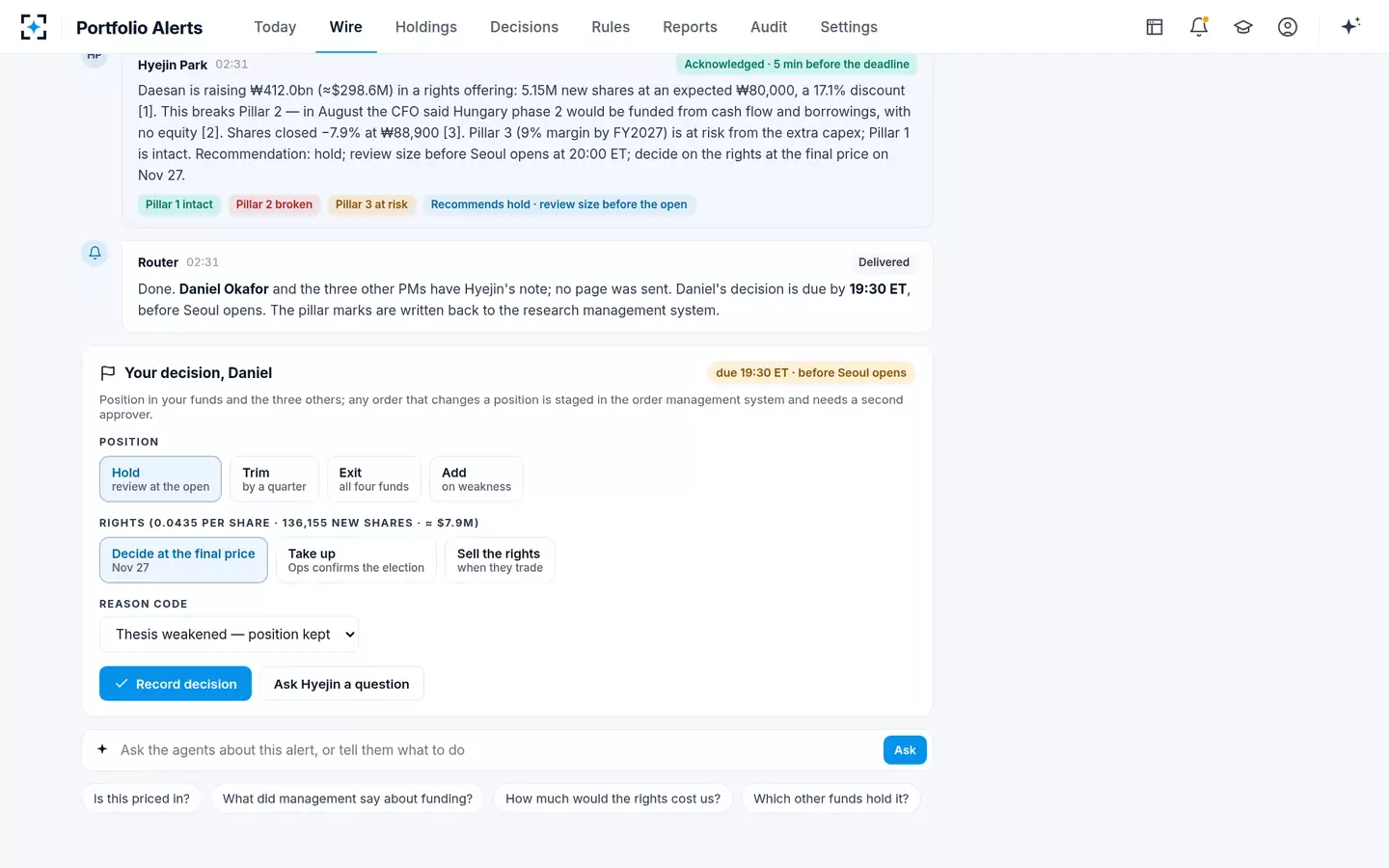
Two controls follow the decision. A rights election goes to investment operations, which confirms it with the custodian; in the sample the custodian needed the election by December 7. Any order that changes a position is staged in the order management system and released to the trading desk only after the head of investment risk approves it. Nobody approves their own request. Why the agents stop where they do is the subject of what AI stock alerts may decide.
What the record shows afterwards
After a holding gaps down, the first question from a chief investment officer or a board is "who knew, and when?". In the sample, the record answers it in one file: the nine sources as read, in Korean and English; every agent step with its version; who was notified at 02:16:11 and who opened the alert, Hyejin at 02:17:02 and a second portfolio manager at 02:22:40; the note, the pillar marks, the decision and the reason codes; and the restricted-list checks. The file is sealed with a SHA-256 hash and kept for seven years, a setting; under the SEC's books-and-records rule for advisers, most records are kept for five (17 CFR 275.204-2(e)(1)). To see an event like this followed on your own holdings, start from Portfolio Alerts.
Questions people ask
What is the difference between a rights offering and a public offering?
A rights offering offers the new shares first to existing shareholders, in proportion to their holdings, usually at a discount; a public offering sells them to new and existing investors through underwriters. Burkart and Zhong's model finds rights offerings achieve the full-information outcome when no shareholder is short of cash, but dilute shareholders who cannot subscribe.
What happens if you do not exercise your rights?
If the rights are transferable you can sell them; if you neither sell nor exercise, they lapse and your stake is diluted. In the sample, a holder of 2.64% of the company would fall to about 2.53% if its rights lapsed. FINRA notes that companies announce an expiration date by which shareholders must buy in.
Why do share prices fall when a rights offering is announced?
Partly the discount, which mechanically lowers the value per share, but in the sample that effect was under 1% while the shares fell 7.9%. The rest is information: what the raise says about the company's funding and its earlier promises. Here the company had said in August it had no plan for equity financing.
What is DART in Korea?
DART (Data Analysis, Retrieval and Transfer System) is the electronic disclosure system run by Korea's Financial Supervisory Service. Companies file disclosures online and they become immediately available to investors; it has an English site, an open API and RSS feeds.
How long do shareholders have to decide on a rights offering?
It depends on the offer. FINRA's guide says expiration is generally one to three months after the announcement. In the sample, the notice came on October 16, the record date was November 4, the final price was set on November 27, and subscription ran on December 8 and 9.
Who should get an alert about a rights offering in a fund?
The analyst who covers the stock, with a deadline, and the portfolio managers of every fund that holds it, copied. Investment operations needs the election deadline, and anyone placing an order needs a second approver. In the sample, one alert reached all of them, with one owner.