Stale news is a news story whose content was already public, usually a rewrite, reprint or recombination of earlier reports or of the company's own filing. Paul Tetlock, who gave the term its research definition, measured a story's staleness as "its textual similarity to the previous ten stories about the same firm", and found that prices respond less to stale news but still respond, and that the move partly reverses the following week (Review of Financial Studies, 2011). For anyone monitoring a portfolio, stale news has a second cost: every repeat becomes another alert. A keyword alert on a company sends one notice per article, so one event reported nine times arrives as nine alerts, some with different numbers. Botminds' Portfolio Alerts merges every report of the same event into one alert anchored on the earliest exchange or regulator source, flags any article whose figures disagree with the filing, and keeps every merged report listed.
Old news, real price moves
10
previous stories a new one is compared with to measure its staleness
$12→$85
a biotech stock's Friday close and Monday open, on a reprinted discovery
5+months
since the same discovery had first been reported
17M
news articles in a study of how markets treat recombined old news
What is stale news?
In finance research, stale news is news that adds little or nothing to what the market already knew. Tetlock's measure is mechanical, which is what makes it useful: compare a new story's text with the ten stories before it about the same firm, and the more it overlaps, the staler it is. A wire story that rewrites a company's press release, a local newspaper that reports the same filing an hour later, and a weekend feature that retells a quarter-old result all score as stale.
Stale does not mean worthless. A later story may add a quote, a context or a mistake, and the mistake matters as much as the quote. But for the question a portfolio manager asks first, "what happened, and is it new?", most reports of an event are copies of one source, and the source is usually a filing or an exchange notice.
Do stock prices react to old news?
Yes, and the research is consistent on how. Tetlock found that "firms' stock returns are less responsive to stale news", yet "a firm's return on the day of stale news negatively predicts its return in the following week", and that individual investors trade more aggressively when news is stale (Tetlock, 2011). Prices move on the repeat and then give part of it back.
The best-known case is extreme. A Sunday newspaper article on a potential cancer drug sent EntreMed's stock "from 12.063 at the Friday close, to open at 85 and close near 52 on Monday", and it stayed above 30 for three weeks, although the breakthrough "already had been reported ... in the journal Nature, and in various popular newspapers (including the Times) more than five months earlier" (Huberman and Regev, Journal of Finance, 2001). The authors' conclusion: "enthusiastic public attention induced a permanent rise in share prices, even though no genuinely new information had been presented."
For a holder, both findings point the same way. A repeat that moves the price is still worth knowing about, because the move is real money on the position. But it should be known as a repeat, linked to the original, so nobody mistakes the second report for a second event.
Recombined news is the hard case
The stories that fool professionals are not reprints but recombinations: articles that stitch together pieces from several earlier sources so the whole reads as new. Fedyk and Hodson ran an experiment on finance professionals and showed that "even sophisticated investors have difficulty identifying old information that recombines content from multiple sources." Across 17 million articles from a professional news terminal, "recombination of old information prompts larger price moves and subsequent reversals than direct reprints" (Journal of Financial Economics, 2023).
They add a finding that matters for anyone building a filter. While markets' reactions to old information in general have declined over time, "differential reactions to recombinations increase." A filter that catches exact duplicates by text similarity catches the easy case and passes the hard one. Recognising a recombination needs the event itself as the unit: what happened, to which issuer, with which figures, first published where.
Why do I get duplicate news alerts?
Because most alerting matches articles, not events. A keyword or company alert fires once for every article that mentions the name: the exchange notice, the regulator's copy, each local newspaper, each wire, each broker flash note and the company's own investor-relations page. The tool has no idea they are the same event; it only knows they match the rule.
In the fictional sample run in Portfolio Alerts, one Korean rights offering produced nine reports in 16 minutes, in two languages. Across the whole portfolio, the agents read 41,206 items in 24 hours, and after merging, those were 7,318 distinct events. Without merging, the analyst who covers the stock would have had nine alerts for one decision, and so might every portfolio manager who holds it.
One rights offering, nine reports in 16 minutes
Which source is first for company news?
Usually the company's own regulatory publication: the exchange notice, the regulator's filing system or the regulatory information service the market requires. Disclosure rules push it there. Under the UK Market Abuse Regulation, an issuer must publish inside information in a way the public can reach fast and assess completely, and must keep it on its website for at least five years (UK MAR, Article 17(1); the clocks behind that duty are in ad hoc disclosure rules by market). The FCA requires regulated information to be communicated to the media "in unedited full text", unless the full text is on its national storage mechanism and the announcement says so (FCA Handbook, DTR 6.3.5).
Those rules make the regulatory copy the anchor in two senses. It is first, or tied for first, and it is complete: a newswire may summarise, a local paper may round, but the notice carries the company's own figures. Where the company's home market is not English-speaking, it is also in the home language. In the sample, the first English newswire came 13 minutes after the Korean notice. The rules by market, and how fast each one says a company must publish, are set out in ad hoc disclosure by market.
Article alerts and event alerts, on the same rights offering
One alert per article: Nine notices in 16 minutes, two of them in a language the reader may not read.
One alert per event: One alert at the first source, updated as the other eight reports arrive and are merged.
One alert per article: Whichever article the reader opens first: ₩410 billion in one paper, ₩412.0 billion in the notice.
One alert per event: The filing's figure, with the paper that disagrees flagged against it.
One alert per article: Every article looks new; a recombination looks newest of all.
One alert per event: The event is checked against earlier reports and the company's responses before it is called a surprise.
One alert per article: Everyone who set an alert on the name, each separately.
One alert per event: The covering analyst, with a deadline; portfolio managers who hold it are copied once.
One alert per article: Nine emails in nine inboxes.
One alert per event: One record with all nine reports listed, none dropped.
Should press reports or filings win when they differ?
Filings win. A company's own regulatory disclosure is the statement it is legally responsible for, and it is the text the rules require to be complete and unedited. A newspaper's figure is a report of that statement. When they disagree, the useful output is not a vote between sources but a flag: this article says X, the filing says Y.
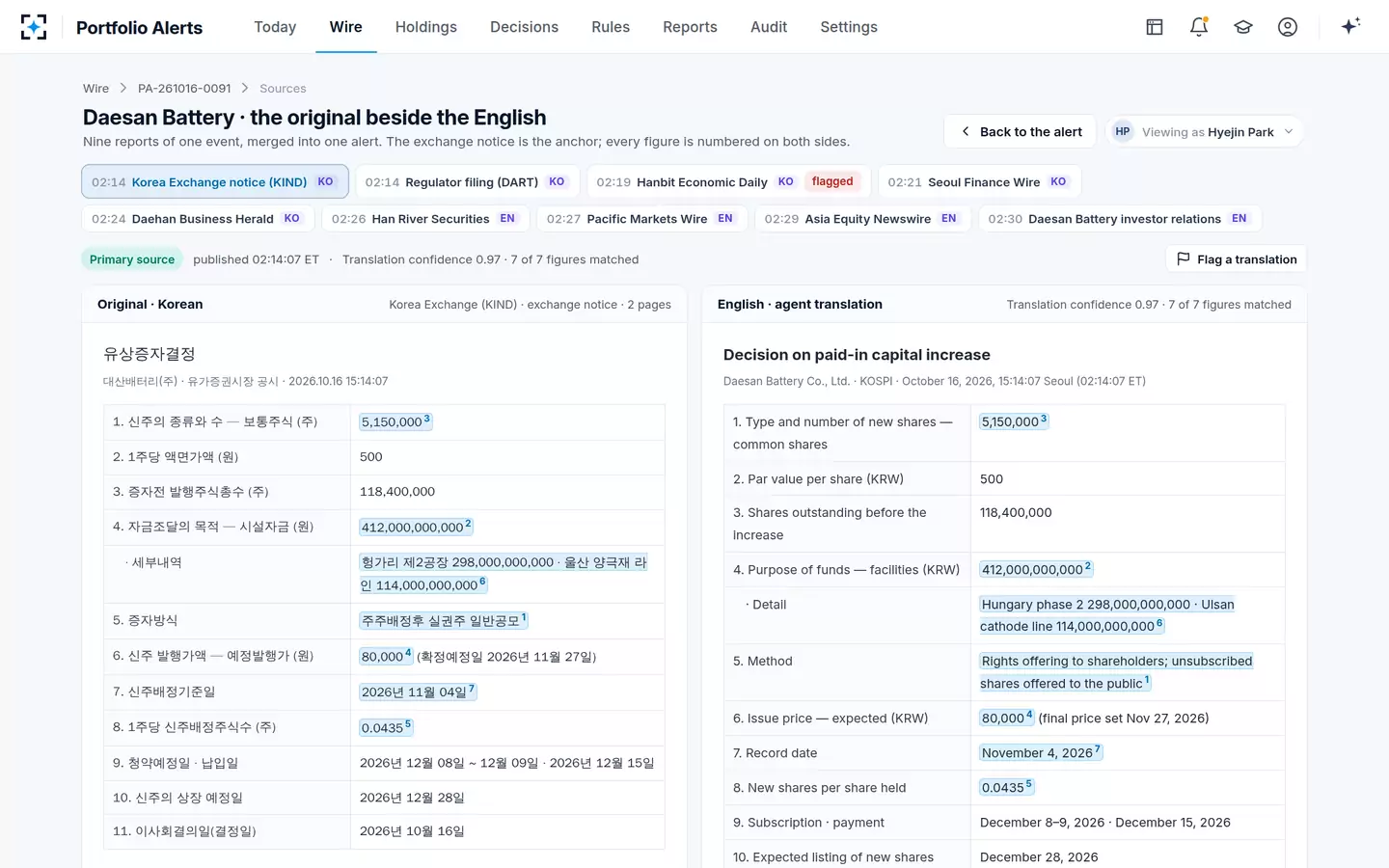
In the sample, a Korean daily reported the rights offering at ₩410 billion five minutes after the notice; the exchange notice and the regulator's filing both said ₩412.0 billion. The Deduper anchored the alert on the notice, flagged the article, and kept it in the list of merged reports, so the analyst could see what the market had been told and by whom. That matters later: if a portfolio manager traded on the wrong figure, the record shows where it came from.
The original notice beside the English in Portfolio Alerts, every figure numbered on both sides
How do you deduplicate news into events?
Deduplicating news well takes four decisions, and text similarity is only the first. The checks below are how we would test any tool, including ours.
Six tests of a news-deduplication method
- Match on the event, not the words
Same issuer, same event type, same key figures and dates; a translation and a rewrite share almost no words.
- Anchor on the earliest primary source
The exchange notice or regulator filing, not the first article to arrive in your feed.
- Compare every figure with the anchor
Amount, share count, price and dates; flag any report that disagrees.
- Never drop a merged report
Keep each one listed with its time and source, so a reader can see what the market was told.
- Check whether the event itself is new
Look for earlier press and the company's own responses; a denied rumour is part of the story.
- Measure the merge rate
Items read against events after merging; a sudden change means a source or a rule has changed.
Is the news new? The check that follows the merge
Merging answers "how many reports"; it does not answer "did we already know this". In Portfolio Alerts a separate agent, the Challenger, argues against every alert: it checks price and volume since publication, earlier press, the company's own responses, consensus and market hours, and keeps, upgrades or downgrades the alert with a stated reason. It can change severity, but it cannot dismiss an alert.
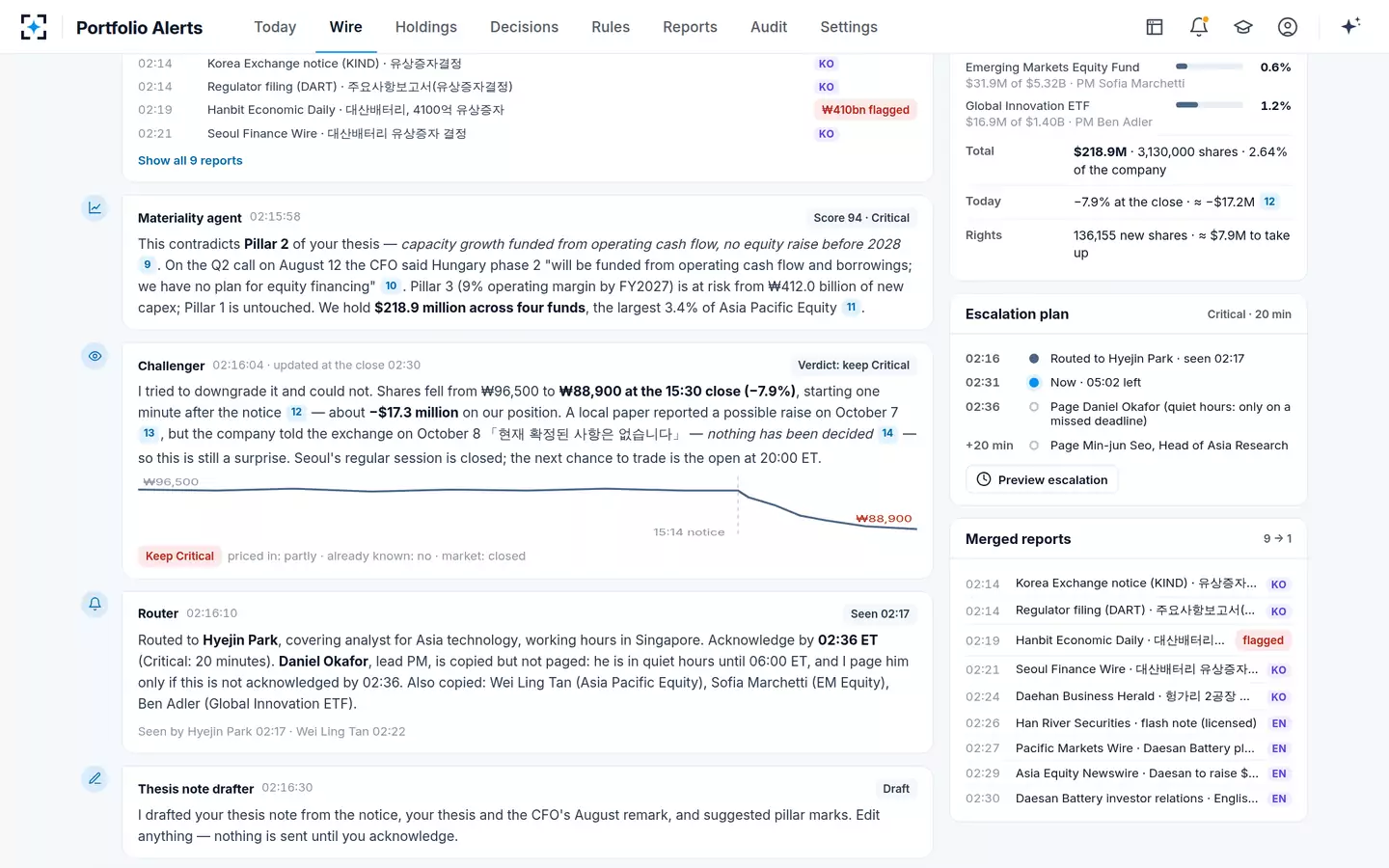
In the sample, a local paper had reported a possible capital raise on October 7, and the company told the exchange on October 8 that nothing had been decided. The Challenger found both and still kept the alert Critical, because the company's denial meant the October 16 notice was a genuine surprise. That is exactly the judgment stale-news research says investors get wrong in both directions: overreacting to repeats, and dismissing real news as a repeat.
In Portfolio Alerts the Challenger checks the price and the earlier rumour before a person sees the alert
What merging must never do
A merge that hides information is worse than nine alerts. Three failures are common in practice. A merge can swallow a second event: a rights offering and, the same afternoon, a chief financial officer's resignation are two events about one issuer. It can drop the outlier article, which is often the one a client or a portfolio manager actually read. And it can pick the wrong anchor, such as a wire story that arrived first in the feed because the exchange notice was in a language the system did not read.
In Portfolio Alerts the Deduper's limits are written as rules: filings win over press, and it never drops a report; every merged report stays listed. Where the issuer match or the translation is below its confidence threshold (0.90 for the issuer, 0.85 for translation, 0.95 for figures in the sample settings), the item goes to a person for review instead of being merged by guesswork. What happens after the merge, scoring and routing to a named analyst with a deadline, is the subject of what AI stock alerts may decide, and what stays human. To see one event, one alert on your own holdings, start from Portfolio Alerts.
Questions people ask
What is the difference between stale news and fake news?
Stale news is accurate but not new: it repeats or recombines information already public. Fake news is false. Both can move prices, but stale news is the everyday problem for a monitoring team, because it is legitimate reporting that looks like a fresh event.
How is news staleness measured?
In Tetlock's 2011 study, a story's staleness is its textual similarity to the previous ten stories about the same firm. Fedyk and Hodson later showed that text similarity misses recombinations that stitch together several older sources, which is why matching on the event and its figures catches more.
Why do stocks move on old news?
Mainly attention. Huberman and Regev's EntreMed case showed a five-month-old discovery driving a stock from about $12 to $85 at the open once a widely read newspaper ran it. Tetlock found the moves on stale news partly reverse the following week, more so where individual investors trade most.
Should alerts be sent for every news article about a holding?
No: one alert per event, updated as further reports arrive. In the fictional sample in Portfolio Alerts, 41,206 items in a day became 7,318 events, and only 11 were routed to a person, with 52 more held for the morning digest.
What happens when a newspaper and the filing disagree?
The filing is the record and wins; the article should be flagged, not deleted. Keeping the disagreeing article in the record shows later what the market was told and by whom, which matters if anyone traded on the wrong figure.