Alert fatigue is the desensitisation that sets in when people receive more alerts than they can meaningfully act on, so that they ignore or mishandle the important ones along with the noise. The US Agency for Healthcare Research and Quality describes it as how busy workers "become desensitized to safety alerts, and as a result ignore or fail to respond appropriately to such warnings" (AHRQ PSNet). The term comes from hospitals, but the mechanism is the same on an investment desk. An equity analyst who covers dozens of stocks across several funds, with a news or terminal alert on each name, gets every mention of every name in every time zone, and spends the day deciding which ones to ignore. Botminds' Portfolio Alerts is built against that: it merges every report of one event into one alert, scores it against the analyst's own thesis and the firm's positions, and routes only what clears a line to a named person with a deadline, holding the rest for a morning digest.
What medicine has measured about alerts
49–96%
of drug safety alerts overridden by clinicians, across 17 studies
30%
lower likelihood of accepting a reminder for each additional reminder per patient visit
1 in 4
drug alerts were repeats for the same patient within the same year
187
monitor warnings per patient per day in one hospital's intensive care beds
What is alert fatigue?
Alert fatigue is a failure of the alerting system, not of the person. The AHRQ primer puts the cause in two parts: "the sheer number of alerts", and the fact that "the vast majority of alerts generated by CPOE systems (and other health care technologies) are clinically inconsequential". The consequence is that people "ignore both the bothersome, clinically meaningless alarms and the critical alerts that warn of impending serious patient harm" (AHRQ PSNet).
Translate the nouns and the sentence describes a research team. Most mentions of a holding are inconsequential to the case for owning it. An analyst who receives all of them learns to skim, and the skim does not slow down for the one notice that breaks the thesis. Overrides are not irrational: the review of drug-alert studies found that "alert overriding may often be justified" (van der Sijs et al., 2006). The problem is that the system makes the analyst do the triage, every time, by hand.
How many alerts is too many?
There is no fixed number, but the evidence says that the count of alerts matters less than how many of them are repeats and how complex the work around them is. Ancker and colleagues studied 112 primary care clinicians from 2010 to 2013 and found that "alert acceptance was associated with work complexity and repeated alerts, but not with the amount of work" (Ancker et al., 2017).
The sizes are large. "Likelihood of reminder acceptance dropped by 30% for each additional reminder received per encounter, and by 10% for each five percentage point increase in proportion of repeated reminders." On average, a quarter of drug alerts and a third of clinical reminders were repeats for the same patient within the same year. The authors' conclusion is the lesson for any alerting system: "Reducing within-patient repeats may be a promising target for reducing alert overrides and alert fatigue."
The investment equivalent of a within-patient repeat is the same event about the same holding, reported again by a second paper, a wire, a broker and the company itself. In the fictional sample in Portfolio Alerts, one Korean rights offering arrived as nine reports in 16 minutes; across the portfolio, 41,206 items in a day were 7,318 events after merging. Why nine reports of one event should be one alert covers the merge in detail.
An analyst's 24 hours, across three time zones
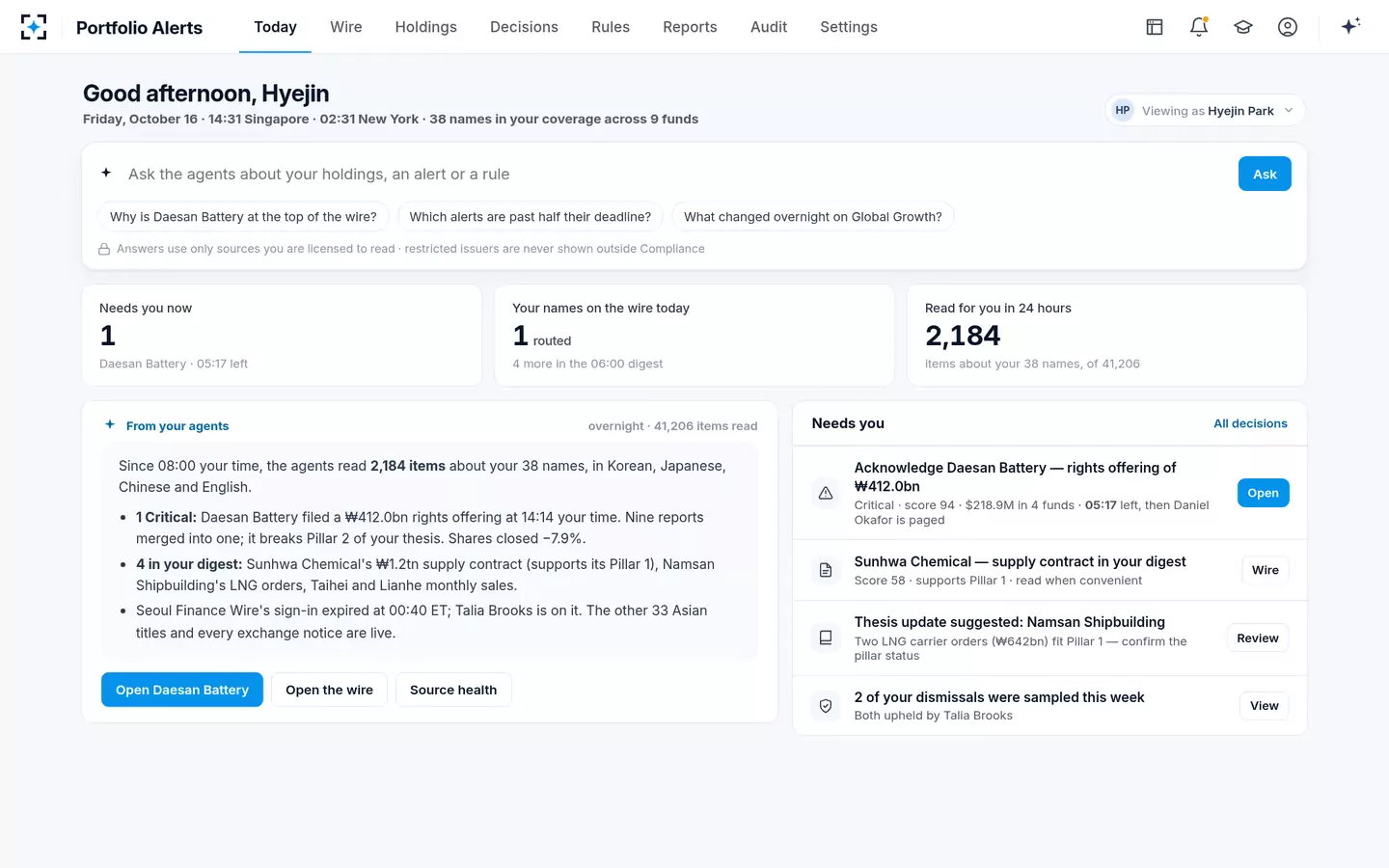
Take the sample analyst in Portfolio Alerts: Hyejin Park, a fictional equity research analyst for Asia technology at the fictional Quillfield Capital, based in Singapore and covering 38 names across 9 funds. Between 08:00 her time, which is 20:00 the evening before in New York, and mid-afternoon, the agents read 2,184 items about her names, in Korean, Japanese, Chinese and English. One of them, filed at 14:14 her time, is a Critical alert: a rights offering by a company whose thesis rests on funding growth without new equity.
The portfolio manager who leads on that stock is in New York, where it is 02:14. His quiet hours run from 22:00 to 06:00 local, so the Router copies him without paging him. He will be woken only if Hyejin does not acknowledge within the Critical deadline of 20 minutes. The firm runs a follow-the-sun rota, Singapore to London to New York, so the people who are awake own what happens in their hours.
At 02:14 in New York, only New York is in quiet hours
- Outside quiet hours00–10 ET
- Quiet hours10–18 ET
- Outside quiet hours18–24 ET
- Quiet
- Outside quiet hours01–17 ET
- Quiet hours17–24 ET
- Quiet hours00–06 ET
- Outside quiet hours06–22 ET
- Quiet
Without an owner and a deadline, the same night looks different. The notice reaches every person with an alert on the name: the analyst, the four portfolio managers whose funds hold it, perhaps a risk manager. Each would get nine reports. Nobody is sure who has read the Korean notice, and the portfolio manager who wakes at 06:00 to nine headlines has no note on what they mean for what he owns. The question the chief investment officer will ask after a holding gaps down, "who knew, and when?", has no single answer.
Where the analyst's time goes on one overnight event
Alert fatigue is usually described in alerts, but the cost is in minutes. On one material event at a non-US holding, most of the analyst's time by hand goes to work that is mechanical: finding out the notice exists, reconciling every report of it, and checking the local-language filing against the English. Our estimate below puts that share at about half; with the agents doing it, the largest share becomes the part only the analyst can do, writing the note on what it means.
On one overnight Critical event, time moves from chasing the news to judging it
By hand · 123 minutes
- Learn of it, find the position, check the price · 35%
- Reconcile every report · 24.4%
- Check the original · 16.3%
- Write the note · 24.4%
With the agents · 18 minutes
- Learn of it, find the position, check the price · 22.2%
- Reconcile every report · 16.7%
- Check the original · 16.7%
- Write the note · 44.4%
What attention research says about crowded hours
Investors' attention is finite, and research on markets shows what happens when it is stretched. Hirshleifer, Lim and Teoh found that when many firms announce earnings on the same day, the immediate price and volume response to each surprise is much weaker and the later drift much stronger, which is what their "investor distraction hypothesis" predicts: that extraneous news inhibits reactions to relevant news (Journal of Finance, 2009). Crowded hours are where news is under-read.
Analysts ration attention too. In a study of sell-side analysts, Harford, Jiang, Wang and Xie found that analysts forecast more often and more accurately for the companies that matter most within their own coverage (Review of Financial Studies, 2019; what that means for the cost of a covered name is in AI earnings report analysis, cost per name). A buy-side analyst with 38 names does the same thing, consciously or not. An alerting system decides which names get attention at 2 a.m.; it should decide on the thesis and the size of the position, not on how many articles a name generated.
How do you reduce alert fatigue? Merge, tier, own
The medical literature's remedies transfer almost directly. AHRQ's primer lists remedies that include tailoring alerts to the patient's own characteristics and this one: "Tier alerts according to severity", presenting warnings differently so the consequential ones stand out (AHRQ PSNet). Ancker's study points at repeats. Together they give three rules: merge repeats, tier by severity against the specific case, and give each alert that survives an owner who must answer it.
In Portfolio Alerts those rules are settings and fixed limits, shown here as configured in the fictional sample. The Deduper merges every report of one event into one alert and never drops a report. The Materiality agent scores each event from 0 to 100 against the covering analyst's own thesis pillars and the position in every fund, the equivalent of tailoring to the patient. Below a score of 60 the event goes to the 06:00 digest, scored and logged; above it, the Router assigns it to the covering analyst with a deadline by severity: 20 minutes for Critical, a design target, 60 minutes for High, and 10:00 local the next business morning for Medium. A second line, at 85, marks the scores at which a missed deadline can page the lead portfolio manager.
The analyst's home screen in Portfolio Alerts: one thing needs her, four wait for the digest
Who should get an alert overnight? Rotas and quiet hours
Overnight, the alert should go to whoever is awake and qualified, and only escalate into someone's night when a deadline is missed. That needs three things written down: a coverage map that says who covers each name, a rota that says who covers for whom when they are out or asleep, and quiet hours that say when a person may be woken.
In the sample, the rota runs Singapore to London to New York, and each analyst names delegates for when she is out; Hyejin's are two colleagues in order. Quiet hours are 22:00 to 06:00 local, and the only thing that breaks through them is a missed Critical deadline. Individuals can opt in for more: one portfolio manager in the sample receives every Critical alert at any hour. A Medium alert raised overnight simply waits for the morning. Each of those is a setting, and changing one requires a second person to approve it after a replay, as testing a monitoring tool by replaying last quarter explains.
The people around one alert
Alert fatigue is usually described from the recipient's chair, but an alert touches five roles, and each one feels the noise differently. The figure below is drawn from the solution's fictional sample.
Five people who carry one overnight alert in Portfolio Alerts, before and after
Today
Korean and Japanese filings land in her afternoon among every mention of every name, and the PM may read the news on an English wire before she has read the notice.
With agents
Opens one alert per event with the original beside the English, the pillar it touches and a drafted note, and acknowledges in her own words before the deadline.
Still theirs: the judgment: acknowledge, mark not material with a reason, or reassign.
Today
Asleep when Seoul trades, and wakes to nine headlines on one event with no note on what it means for what he owns.
With agents
Is paged only if the analyst misses a Critical deadline, then decides before the next open from her note.
Still theirs: the decision, with a reason code.
Today
Has to prove who knew what, and when, after a holding gaps down.
With agents
Sees every alert in every fund and releases any alert-driven order as second approver.
Still theirs: the second signature.
Today
Changes thresholds with no way to show what a change would have caught.
With agents
Proposes rule changes with a 90-day replay attached, approved by someone else.
Still theirs: the feeds, the coverage map and the rota.
Today
Rebuilds who saw an alert, and when, from inboxes.
With agents
Is the only one who sees alerts on restricted issuers, and exports one evidence file per alert.
Still theirs: the restricted list.
What to measure so fatigue does not creep back
Alert fatigue returns quietly: a new source, a lowered threshold or a busy quarter adds alerts a few at a time. The measures below catch it early. Most are counts any alerting system can produce.
Seven measures of alert load for a research team
- Alerts routed per analyst per week
The headline load; in the sample, a proposed rule change was judged partly on adding 0.2 alerts per analyst per week.
- Items read against events after merging
A falling ratio means repeats are getting through.
- Repeat alerts per event
Ancker's measure: the share of alerts that repeat an earlier one.
- Time to acknowledge, by severity
Rising times are the first sign people have stopped trusting the alerts.
- Missed deadlines and pages sent
Every page into someone's night should be explainable.
- Dismissals, sampled and reviewed
In the sample, research operations samples dismissals weekly; both of one analyst's sampled dismissals were upheld.
- Events that moved prices but never alerted
The misses: the only measure that shows when the system is too quiet.
Each of these numbers depends on the rest of the chain working: an alert that reaches the wrong person is not fatigue but a routing failure. How agents and people divide that chain, who scores, who routes, who acknowledges and who decides, is covered in AI stock alerts: what agents may decide. To see your analysts' alert load on your own holdings, start from Portfolio Alerts.
Questions people ask
What causes alert fatigue?
Too many alerts that do not matter, and especially repeats. Ancker and colleagues found acceptance fell with the number of reminders per encounter and with the share of repeats, but not with workload as such. AHRQ adds that most alerts in health systems are inconsequential, so people learn to ignore them all.
Is alert fatigue only a healthcare problem?
No. The research comes mostly from hospitals because that is where it was first measured, but the mechanism, desensitisation from volume and repeats, applies to security operations and investment research alike. AHRQ's primer contrasts health care with aviation, where cockpit alerts are designed to show only highly consequential warnings.
How many stocks does an equity analyst cover?
No regulator or independent study publishes a standard figure for buy-side analysts; it varies by firm and strategy. The fictional analyst in the Portfolio Alerts sample covers 38 names across 9 funds. The US Bureau of Labor Statistics counted 443,100 financial analyst jobs in 2025, with a median pay of $103,570.
What is a follow-the-sun rota?
A schedule that hands ownership of alerts from one office to the next as the working day moves around the world, for example Singapore, then London, then New York. It means the person who receives an overnight alert is awake and qualified, and nobody is woken unless a deadline is missed.
What are quiet hours for alerts?
A period, such as 22:00 to 06:00 local time, during which a person is not interrupted. In the Portfolio Alerts sample, only a missed Critical deadline breaks through, and a Medium alert raised overnight waits for 10:00 the next business morning.