A regulatory news service is the channel a listed company must use to publish regulated announcements, such as results, inside information and changes in major holdings, so that the whole market receives them at once. In the UK the formal term is regulatory information service (RIS), and the FCA's rules require that it be a primary information provider (PIP) the FCA has approved; RNS, the London Stock Exchange's service, is one of six on the FCA's current list (FCA, Regulatory Disclosures). Other markets use other channels: an exchange's notice system and the regulator's DART in Korea, EDGAR in the United States, and, in the EU, providers that disseminate Europe-wide, with a single EU access point due to open to the public by July 2027. For an investment team with holdings in several markets, each feed is the source of record for its own companies, and the work is joining them all to the firm's holdings, coverage map and research system so that every announcement lands with an owner. That is what Botminds' Portfolio Alerts does: its watchers read each official feed in its own language, and the rest of the chain matches, merges, scores and routes.
The official channels, by their regulators' own account
6
FCA-approved primary information providers on the list updated March 3, 2026
Jul 2027
when the EU's single access point is to open to the public
2015
year Korea's DART added RSS; its open API dates from 2013
<1second
typical delay before a disseminated filing appears in EDGAR's submissions API
What is a regulatory news service?
It is a service authorised to carry regulated information from issuers to the market. In the UK the obligation is in the FCA's Disclosure Guidance and Transparency Rules: an issuer "must entrust a RIS with the disclosure of regulated information to the public" and make sure the RIS meets minimum standards (FCA Handbook, DTR 6.3.3). The FCA's own summary: "the DTRs require issuers to use a regulatory information service (RIS) which, under the UK regime, must be a PIP", with PIPs governed by DTR 8 (FCA, Regulatory Disclosures).
The standards are what make an RIS a reliable source for an alerting system. Regulated information must be disseminated "to as wide a public as possible, and as close to simultaneously as possible in the United Kingdom" (DTR 6.3.4), sent to the media in "unedited full text" unless the full text is on the FCA's National Storage Mechanism (DTR 6.3.5), and transmitted in a way that "provides certainty as to the source" (DTR 6.3.6). On the FCA's list, RNS is the service name of the London Stock Exchange's PIP.
What a regulatory announcement carries that matching needs
The fields that let an announcement be matched to a holding without guessing are often prescribed. In its current form, in force since November 3, 2025, DTR 6.3.7 requires regulated information sent to an RIS to identify clearly the issuer, the subject matter, "the time and date of the communication", "the legal entity identifier (LEI) of the issuer concerned", any related issuer and its LEI, and "the headline information that is relevant to the regulated information" (DTR 6.3.7). In Germany an ad hoc notice must carry a fixed header and the ISINs of the issuer's listed instruments (BaFin, Issuer Guidelines). EDGAR identifies every filer by a Central Index Key and every filing by form type.
Official feeds by market, and the identifiers each gives an alerting system
| Market | Official channel | What identifies the issuer and the event | What to watch for |
|---|---|---|---|
| UK | A regulatory information service, which must be an FCA-approved PIP; the National Storage Mechanism for storage | LEI of the issuer and any related issuer; headline information; time and date of communication | Third-country information that may matter to UK investors must also go out this way (DTR 6.3.10) |
| Germany and EU | Service providers that disseminate Europe-wide; notification to BaFin before publication; ESAP from July 2027 | A fixed Article 17 header, a subject keyword and the ISINs of listed instruments | Delay notifications go to BaFin after publication; they are not part of the announcement |
| Korea | The exchange's notice system and DART, run by the Financial Supervisory Service | The filing in Korean, with numbered items; English versions follow under FSC rules | From May 2026, English on the same day for the largest issuers, within three days for newly covered ones |
| United States | EDGAR; press releases often first | Central Index Key; form type; 8-K item numbers | Foreign private issuers furnish 6-Ks after publishing at home |
How do you get exchange announcements in each market?
From the channel each market's rules point to, under a licence where one is needed. In the UK that means one or more PIPs, or the National Storage Mechanism, which the FCA calls "our official way of storing regulated information, as required under the Transparency Directive". In Germany, BaFin notes that an ad hoc disclosure is "deemed to have been disseminated Europe-wide when it is published via one of the providers that offer this service" (BaFin). In the United States, EDGAR's APIs need no key at all. In Korea, a disclosure filed on DART is public as soon as it is filed, on the Financial Supervisory Service's own account of the system (FSS, About DART).
The EU is building a single point of access. ESMA describes the European Single Access Point as "a two-tier system": information is collected from reporting entities by a collection body, such as a national authority or an officially appointed mechanism, and then submitted to the ESMA-run portal. Collection started in July 2026 under the Transparency Directive, the Prospectus Regulation and the Short-selling Regulation; public access is due by July 2027, with a second phase from January 2028 (ESMA, ESAP; ESMA, first phase). ESMA's aim is that information will be "centrally accessible in one single place, searchable based on common criteria"; for speed, an alerting system will still read the dissemination channels.
What is DART?
DART, the Data Analysis, Retrieval and Transfer System, is Korea's electronic disclosure system, run by the Financial Supervisory Service. It began in April 1999 with annual, semi-annual and audit reports, became the channel for all listed companies' disclosures in 2000, and stopped accepting paper filings in January 2001, according to its own history. An English DART followed in 2007, an open API in 2013, RSS in 2015 and Open DART in 2020 (FSS, About DART).
For a foreign investor DART's limit is language, and that is changing. Korea's Financial Services Commission approved rules in January 2026 extending mandatory English disclosure to all KOSPI companies with assets of KRW2 trillion or more from May 2026, and requiring the largest, KRW10 trillion or more, to file the English on the same day as the Korean, as a rule (FSC Korea; the clocks market by market are in ad hoc disclosure rules by market). Until the English arrives, the Korean filing is the record. In the sample event followed in the rights offering, minute by minute, the regulator's DART copy appeared 24 seconds after the exchange notice and matched it figure for figure.
How do you connect news feeds to holdings?
Through the identifiers, the positions and the people, in that order. An announcement is matched to an issuer by its identifiers; the issuer is matched to positions in every fund from the order management system; the positions are matched to the analyst who covers them from the coverage map; and the alert lands with that analyst, with the portfolio managers who hold the stock copied. Each link has a failure mode, and each failure should go to a person, not be guessed.
From official feeds to an owned alert in Portfolio Alerts, and back into the research system
Agent
Watchers, one per source familyRead each feed in its own language as it publishes, from licensed sources only; extract the event and every figure with its item or page anchor.
Never: read an expert call or private data
Agent
Issuer matchMatch by ISIN, CUSIP, LEI or local code to intraday holdings in every fund.
Never: guess: below 0.90 confidence the item goes to review
Agent
Restricted-list checkCompare with the restricted list, synced from Compliance every five minutes; restricted issuers reach Compliance only.
Agent
Merge, score, challenge, routeOne alert per event; scored against the thesis pillars from the research system; routed to the covering analyst from the coverage map and rota.
Never: send anything outside the firm
A person decides
Covering analystAcknowledges with a note and pillar marks; the marks are written back to the research management system.
A person decides
Portfolio manager and operationsThe PM decides; any order is staged in the order management system for a second approver; corporate-action elections are confirmed with the custodian by investment operations.
Can alerts go into the research management system?
They should, because the research system is where the thesis lives, and an alert that changes a thesis without changing the record of it leaves two versions of the truth. In Portfolio Alerts the research management system supplies the coverage map, the thesis pillars and the notes, and receives the result: when the analyst acknowledges, the Router writes the pillar marks back to the research management system. The analyst's note stays on the alert, with its citations.
The same principle applies to every system the alerts touch. The order management system supplies intraday holdings and the restricted list and receives staged orders, never released ones. Portfolio accounting supplies official positions and net asset values each night. The market data vendor supplies prices, volumes and consensus; the custodian supplies corporate-action notices and receives elections; email, chat and pager carry the notifications, digests and escalation pages. Nothing is replaced; each system stays the source of record for what it already holds.
Source health in Portfolio Alerts: one licensed source down overnight, the rest live
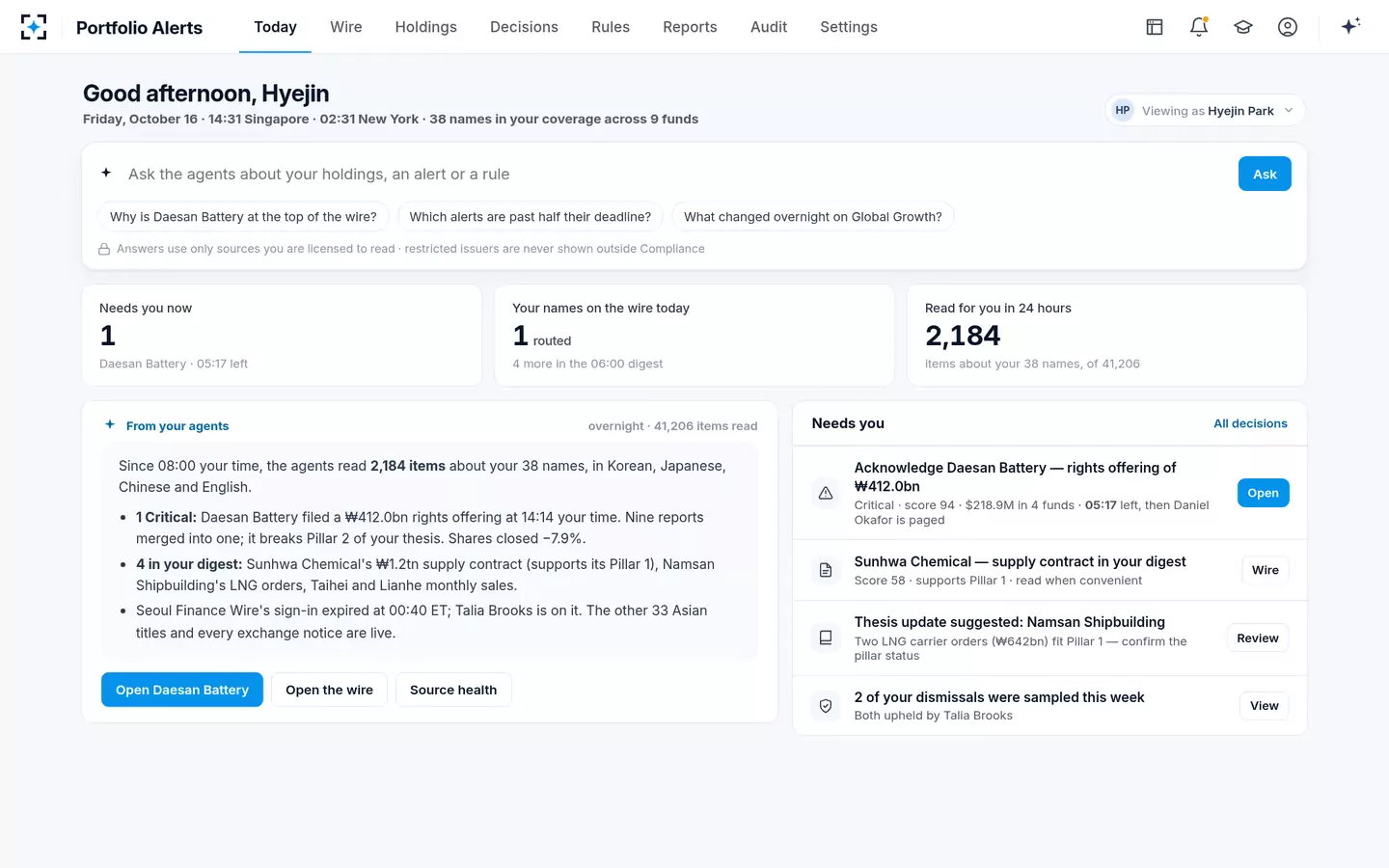
Integrate, don't replace: what stays the source of record
Each market's official channel stays the source of record for its announcements, and an alerting system should never stand in for it. When a press report and a filing disagree, the filing wins. When a translation is uncertain, the original is shown beside it. When a feed fails, the system should say so, as the summary above does, rather than present silence as calm. UK MAR asks issuers to publish inside information so that the public can reach it fast and assess it completely and correctly (UK MAR, Article 17(1)); an alerting system serves that aim when it carries the issuer's words through intact, and works against it when it summarises them away.
Integration also means respecting the licences. Many news and exchange feeds are licensed products, and broker research is licensed by the firm. In Portfolio Alerts the watchers read only sources the firm is licensed to read, answers to analysts' questions use only sources the asker is licensed to read, and data stay in the region of the office that uses them: US data in a US region, London staff in the UK, Asia staff in Singapore, in the sample's settings.
A go-live checklist for research operations
Connecting official feeds is a research operations project as much as a technology one. The checks below are the ones that decide whether alerts are trusted in the first month.
Nine checks before official feeds go live as alerts
- List every channel your holdings publish through
By market: RIS providers, exchange notice systems, DART, EDGAR, national storage mechanisms.
- Confirm each licence
Who may read what, and whether agents may read it on the firm's behalf.
- Map identifiers to holdings
ISIN, CUSIP, LEI, CIK and local codes to positions; decide what happens below the match threshold.
- Load the coverage map and rota
Every holding has a covering analyst and delegates; every office has quiet hours.
- Connect the restricted list
Synced often enough that a newly restricted issuer never reaches an analyst.
- Write pillar marks back
Agree which fields the alerts may update in the research system, and which they may not.
- Monitor source health
An expired login or a silent feed is an incident, with an owner.
- Replay a past event end to end
Same score, owner and deadline as it would have had live.
- Agree who changes rules
Research operations proposes; someone else approves after a replay.
Before going live, the same feeds can be tested on a closed quarter, as testing portfolio monitoring tools by replay describes. To see your holdings' official feeds joined into one stream, start from Portfolio Alerts.
Questions people ask
Is RNS the same as a regulatory information service?
RNS is one of them. Regulatory information service is the FCA's term for the channel issuers must use to publish regulated information, and under the UK regime it must be an FCA-approved primary information provider. RNS, the London Stock Exchange's service, is one of six on the FCA's list as updated on March 3, 2026.
What is a primary information provider?
A firm the FCA has approved to disseminate regulated information on issuers' behalf, governed by DTR 8, which covers approval criteria and secure, timely dissemination. The FCA keeps the list on its regulatory disclosures page and updates it when details change.
What is the European Single Access Point?
An EU portal, run by ESMA, that will give free central access to companies' public financial and sustainability information. Collection from national bodies began in July 2026, public access is due by July 2027, and further phases follow from January 2028. It is built for finding and searching filings in one place; real-time alerting still reads the dissemination channels.
How do you get announcements from Korean companies?
From the exchange's notices and from DART, the Financial Supervisory Service's electronic disclosure system, which offers an English site, an open API and RSS. English versions of many disclosures follow under FSC rules, on the same day for the largest KOSPI companies from May 2026.
Should an alerting system replace a firm's news terminal?
No. Terminals, newswires and the official feeds stay the sources; an alerting system reads them, joins them to holdings and owners, and keeps the record. Each connected system remains the source of record for what it holds, from positions in the order management system to theses in the research system.