Ad hoc disclosure means a listed company's obligation to publish inside information, news likely to move its share price, as soon as it arises, rather than waiting for the next scheduled report. The term comes from European practice: Germany calls the announcement an Ad-hoc-Mitteilung, and the duty sits in Article 17 of the Market Abuse Regulation (MAR), which requires an issuer to inform the public "as soon as possible". Every major market has an equivalent, but the clocks differ, from Hong Kong's "as soon as reasonably practicable" to the four business days of a US Form 8-K, and so do the language and the place the notice first appears. For an investment team holding stocks in several markets, those differences decide when news exists and who sees it first. Botminds' Portfolio Alerts reads each market's notices in their own language as they publish and sets each alert's deadline by severity and by when that market next trades.
Four markets, four clocks
ASAP
EU and UK issuers under MAR Article 17, with a conditional right to delay
307B
Hong Kong's rule, in the SFO: disclose "as soon as reasonably practicable"
4business days
for most Form 8-K events in the United States
Same day
English from Korea's largest KOSPI companies, in principle, from May 2026
What is ad hoc disclosure?
Ad hoc disclosure is publication triggered by an event rather than by the calendar. Annual and quarterly reports are periodic: the date is known in advance. An ad hoc announcement is made because something happened, a profit warning, a failed trial, a capital increase or a chief executive's departure, and the rule requires the market to hear it promptly and all at once.
Germany's financial regulator, BaFin, uses the phrase as the name of the duty itself: "Under Article 17(1) of the MAR, issuers are subject to the ad hoc disclosure obligation." It also governs the format. Under German rules each notice needs "a clearly highlighted header: 'Disclosure of inside information under Article 17 of Regulation (EU) No 596/2014'", a keyword that works as a subject line, the ISINs of the issuer's listed securities, the trading venues, the date the underlying circumstances arose, and an explanation of why the information would be likely to move the price where that is not obvious (BaFin, Issuer Guidelines).
What a German ad hoc announcement must contain
| Element | What the rule asks for | Why it helps whoever reads it |
|---|---|---|
| Header | "Disclosure of inside information under Article 17 of Regulation (EU) No 596/2014", clearly highlighted | Separates an ad hoc notice from marketing and routine news |
| Keyword | A subject line that summarises the main content; several if several items are disclosed together | Tells a reader, or a classifier, what kind of event this is |
| Identifiers | ISINs of the listed shares and certain other listed instruments | Lets the notice be matched to a holding without guessing from the name |
| Venue | The exchange and trading segment of the listing | Shows which market will trade on it next |
| Date | When the underlying circumstances arose, updated if they changed during a delay | Shows how long the issuer held the information |
| Price relevance | Why the information is likely to have a significant price effect, unless obvious | States the issuer's own view of materiality |
| Capital increases | Nature, volume, pre-emptive rights or their exclusion, issue price and expected proceeds | Gives a holder the terms needed to decide on rights |
What is inside information under MAR?
Inside information is what triggers the duty, and MAR defines it in three parts. It is "information of a precise nature, which has not been made public, relating, directly or indirectly, to one or more issuers or to one or more financial instruments, and which, if it were made public, would be likely to have a significant effect on the prices of those financial instruments" (UK MAR, Article 7(1)(a)).
The test for "significant effect" is a reasonable-investor test: information a reasonable investor "would be likely to use as part of the basis of his or her investment decisions" (Article 7(4)). And "precise" reaches further than many readers expect. Under Article 7(2), in a protracted process such as a negotiation, the intermediate steps "may be deemed to be precise information", so an issuer may have inside information well before a deal is signed. That is why ad hoc announcements sometimes report a step, an approach or a board decision, rather than a completed event.
How quickly must a company disclose inside information?
Under MAR, as soon as possible, unless the issuer chooses to delay under strict conditions. The issuer must publish "in a manner which enables fast access and complete, correct and timely assessment of the information by the public" and may not combine the disclosure with marketing (UK MAR, Article 17(1)). In Germany the issuer must also send the notice to BaFin and the trading venues before it is published, and since July 2, 2025 that notification can be made electronically (BaFin, ad hoc disclosure notifications).
The right to delay is the part that most affects an investor's information. Under Article 17(4) an issuer "may, on its own responsibility, delay disclosure" only if three conditions all hold: immediate disclosure is likely to prejudice its legitimate interests, the delay "is not likely to mislead the public", and the issuer can keep the information confidential. When it does publish, it must tell the regulator that it delayed. And if confidentiality is lost, including when "a rumour explicitly relates to inside information" and is accurate enough to show the leak, it must disclose "as soon as possible" (Article 17(7)).
Delay under MAR, read from the holder's side
What the rule lets the issuer do: Hold inside information back, on its own responsibility, if disclosure would prejudice its legitimate interests, delay would not mislead, and confidentiality holds.
What a holder should infer: The date in the notice can be well before the publication date; the gap is how long the issuer knew.
What the rule lets the issuer do: Delay disclosure of the intermediate steps of a process that occurs in stages, under the same conditions.
What a holder should infer: A deal or financing can be announced complete, with its earlier steps disclosed only afterwards.
What the rule lets the issuer do: Must disclose as soon as possible once confidentiality is lost, including through an accurate rumour.
What a holder should infer: A press rumour followed by a notice is a leak being closed; a rumour followed by a denial is not.
What the rule lets the issuer do: Must inform the regulator of the delay immediately after disclosure, and explain it on request.
What a holder should infer: There is a record of the delay; the reasons are not usually published.
Hong Kong: "as soon as reasonably practicable", and the holding announcement
Hong Kong writes the duty into statute. Section 307B(1) of the Securities and Futures Ordinance says a listed corporation "must, as soon as reasonably practicable after any inside information has come to its knowledge, disclose the information to the public", unless one of the statutory safe harbours applies. The Securities and Futures Commission's guidelines explain what that phrase means in practice.
"As soon as reasonably practicable" means that the corporation should immediately take all steps that are necessary in the circumstances to disclose the information to the public.
Securities and Futures Commission, Guidelines on Disclosure of Inside Information, June 2012
The guidelines list those steps as "ascertaining sufficient details, internal assessment of the matter and its likely impact, seeking professional advice where required and verification of the facts". Where a company needs time, it should consider a "holding announcement" that "details as much of the subject matter as possible" and says why a fuller one cannot be made yet. Where confidentiality has been lost and no announcement is possible, the company should consider a trading suspension, and a suspension "in no way lessens the obligations" to disclose (SFC, Guidelines on Disclosure of Inside Information). For a monitoring team, that means a Hong Kong holding announcement is an event in its own right, and a suspension without one is a signal to look harder.
Is there ad hoc disclosure in the US?
Not in the European sense. US rules do not impose one general duty to publish all inside information as soon as possible; instead Form 8-K lists specific events, from a material agreement to an auditor's change, and most must be reported within four business days of the event (SEC, Form 8-K; the items one by one are in Form 8-K items, read as a holder). Separately, Regulation FD governs selective disclosure: if an issuer tells covered persons, including an investment adviser, material nonpublic information, it must publish it simultaneously when the disclosure is intentional, and promptly when it is not (17 CFR part 243).
The practical difference is in timing. A European issuer's notice usually is the first publication. A US company often publishes a press release first and files the 8-K within the four days. And a foreign company listed in the US furnishes a Form 6-K only after it has published at home (SEC, Form 6-K). Item by item, the US events are mapped to a holder's thesis in Form 8-K items, read as a holder.
Do Korean companies publish disclosures in English?
Increasingly, and on a timetable that has just shortened. Korea's Financial Services Commission approved rules on January 28, 2026 that extend mandatory English disclosure "to all KOSPI-listed companies with assets worth KRW2 trillion or more from May 2026", taking the number of companies covered from 111 to 265. The largest, with assets of KRW10 trillion or more, "will need to submit English disclosures on the same day of filing their Korean disclosures with the KRX in principle"; companies newly brought in must do so "within three days" (FSC Korea, January 28, 2026).
The scope widened too: English is now required for all disclosure items in the exchange's rules, "including material information in its entirety (55 items)". A third stage, covering 848 KOSPI companies, is to be sought from March 2027 rather than May 2028. Even under the new rules, same day is not same minute: for the hours between a Korean notice and its English version, the Korean text is the only source. In the sample event in Portfolio Alerts, the first English newswire on a Korean rights offering arrived 13 minutes after the notice; the rights offering, minute by minute follows it from there.
Ad hoc disclosure by market: the rule, the clock and the first source
| Market | The rule | The clock | Where it appears first |
|---|---|---|---|
| UK | UK MAR Article 17, inside information | As soon as possible; conditional delay under 17(4) | A regulatory information service, then the FCA's storage mechanism |
| Germany and the EU | MAR Article 17, with national rules such as section 26 WpHG | As soon as possible; BaFin and venues notified before publication | A provider that disseminates Europe-wide; the issuer's website |
| Hong Kong | SFO section 307B | As soon as reasonably practicable; holding announcement if needed | The exchange's electronic publication system, which the SFC expects issuers to use |
| Korea | Exchange disclosure rules; English under FSC rules from May 2026 | Korean notice first; English same day for the largest issuers, within three days for newly covered ones | The exchange notice and DART, in Korean |
| United States | Form 8-K items; Regulation FD | Four business days for most items; FD simultaneous or prompt | Often a press release, then EDGAR |
Why deadlines in Portfolio Alerts follow the market, not the clock on the wall
A deadline on an alert only means something against the next chance to act. A German ad hoc notice published before Frankfurt opens leaves minutes; a Korean notice filed during New York's night leaves hours until Seoul trades again, but the market in Seoul may already have reacted. A Norwegian announcement made before Oslo opens sits between the two.
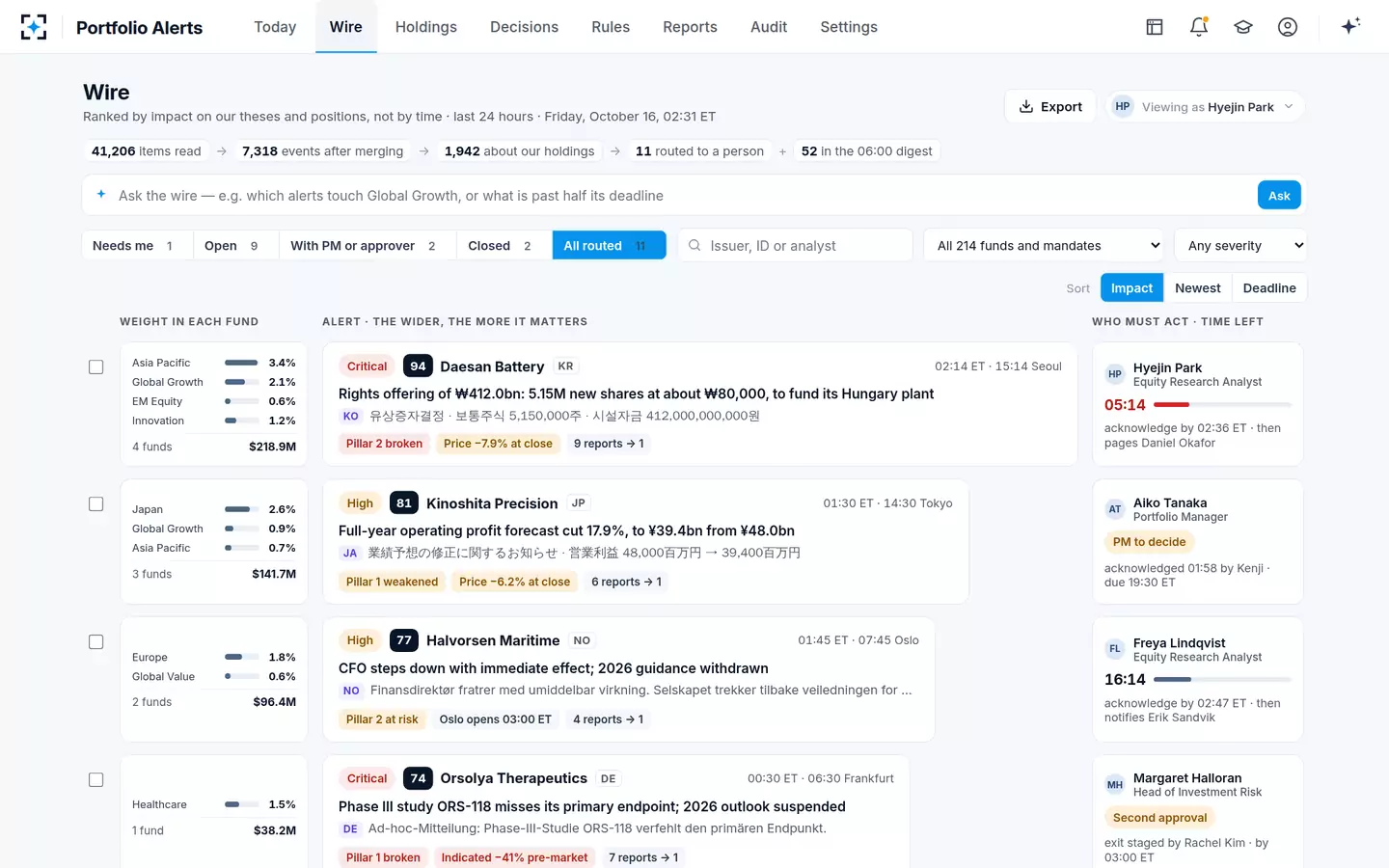
That is how Portfolio Alerts is configured in its fictional sample. A Critical alert must be acknowledged within 20 minutes, a design target, or the lead portfolio manager is paged; a High alert has 60 minutes; a Medium alert waits until 10:00 local the next business morning and is held during quiet hours. The analyst's note records when the market next opens, and a portfolio manager's decision is due before it.
Notices from Seoul, Tokyo, Oslo and Frankfurt on one wire in Portfolio Alerts, each with its local time
What a monitoring team should take from the differences
Three practical rules follow. First, read the home market's notice, in its language, as the primary source; a translation or a wire is a report of it. Second, read the dates inside the notice: under MAR a German or UK issuer states when the circumstances arose, and a long gap means a delay. Third, treat a holding announcement, a trading suspension or a denied rumour as events, because each of them is the issuer telling the market something under the rules.
Portfolio Alerts applies the first two as rules: watchers read every notice in its own language the minute it publishes, extract each figure with its item anchor, and set the original beside the English; any translation below 0.85 confidence goes to a person. The third is the Challenger's job, which checks earlier press and the company's responses before an alert is called a surprise. Joining the official feeds in each market into one stream is covered in regulatory news services, DART and EDGAR. To see your holdings' home-market notices on one wire, start from Portfolio Alerts.
Questions people ask
What does ad hoc mean in finance?
It means event-driven, as opposed to scheduled. An ad hoc announcement is published because something price-sensitive happened, not because a reporting date arrived. Under MAR the trigger is inside information, and the duty is to publish as soon as possible.
Can a company delay disclosure of inside information?
Under MAR Article 17(4), yes, on its own responsibility, if immediate disclosure would prejudice its legitimate interests, the delay would not mislead the public, and it can keep the information confidential. It must tell the regulator about the delay once it publishes, and must publish as soon as possible if confidentiality is lost.
What is a holding announcement?
In Hong Kong, it is a short announcement a listed corporation issues when it needs time to clarify details before a full announcement. The SFC's guidelines say it should detail as much of the subject matter as possible and give reasons why a fuller announcement cannot be made, and the full announcement should follow as soon as reasonably practicable.
What must an ad hoc announcement contain in Germany?
BaFin's guidance requires a highlighted header citing Article 17 of the MAR, a subject keyword, the ISINs of the listed instruments, the trading venues, the date the circumstances arose and, where not obvious, why the information is price-sensitive. For a capital increase it expects the nature, volume, pre-emptive rights, issue price and expected proceeds.
Is Regulation FD the US version of ad hoc disclosure?
Not quite. Regulation FD does not require a company to publish news when it happens; it requires that if a company discloses material nonpublic information to certain market professionals or holders, it publishes it simultaneously, or promptly if the disclosure was unintentional. Event reporting in the US runs through Form 8-K.
Does a trading halt mean a company must disclose?
In Hong Kong, a suspension does not reduce the duty: the SFC's guidelines say it "in no way lessens" the obligation to disclose inside information as soon as reasonably practicable. A suspension without an announcement is a reason for an analyst to look for what the company has not yet said.