The Form 8-K items are the 33 numbered events that oblige a US public company to file a current report with the SEC, from Item 1.01 (a material definitive agreement) to Item 9.01 (financial statements and exhibits), and most must be reported within four business days of the event. For a holder, the item number is the fastest summary of what happened: an Item 4.02 says earlier financial statements can no longer be relied on, an Item 5.02 says an officer or director is leaving or arriving, an Item 2.04 says debt has been accelerated. The hard part is not finding the filing; it is knowing, within minutes, whether the item touches the reason you own the stock. Botminds' Portfolio Alerts reads every 8-K on every holding as it is disseminated, extracts the item and every figure with its page anchor, and scores the event against the covering analyst's own thesis before routing it.
The Form 8-K in four numbers
33
numbered items in nine sections, 27 of them for issuers that are not asset-backed
4business days
to file or furnish after the event, unless the item says otherwise
48hours
after a furnished earnings release, an open call needs no second 8-K
10
items whose late filing alone is not a Rule 10b-5 violation
What are the Form 8-K items? Nine sections, 33 events
The items are grouped by subject into nine sections, and the section number already tells a reader what kind of news it is. Section 1 covers the business and its operations (material agreements, their termination, bankruptcy, mine safety and material cybersecurity incidents). Section 2 covers financial information (acquisitions and disposals, results, new debt, accelerated debt, exit costs and impairments). Section 3 is about the securities and their trading (delisting notices, unregistered share sales, changes to holders' rights). Section 4 covers the accountants, Section 5 governance and management, Section 6 asset-backed securities only, Section 7 Regulation FD, Section 8 other events and Section 9 exhibits.
For an operating company that leaves 27 items, and they are not equal. Some are triggered by a board decision, such as Item 2.06 when the board or an authorized officer concludes that a material impairment charge is required. Some are triggered by a third party, such as Item 3.01 when the exchange sends a delisting notice or Item 4.02(b) when the auditor says its report should no longer be relied on. Two are voluntary channels: Item 7.01 for information a company chooses to disclose under Regulation FD, and Item 8.01, where the form lets a company report any event it "deems of importance to security holders" (SEC, Form 8-K).
That distinction matters for anyone monitoring a portfolio. A required item is a fact the company had no choice about publishing, on a clock it did not set. A voluntary 8.01 is the company choosing its moment and its words, which is useful in its own way but is a different signal.
What triggers an 8-K filing, and when is the deadline?
An 8-K is triggered by the occurrence of any event listed in the form's items, and the default deadline is four business days. The form's own words: "Unless otherwise specified, a report is to be filed or furnished within four business days after occurrence of the event" (General Instruction B.1). If the event falls on a Saturday, Sunday or SEC holiday, the four days begin on the next business day and include it.
"Unless otherwise specified" carries real weight. Item 1.05, the cybersecurity item, runs from a different moment: the report is due "within four business days after the registrant determines that it has experienced a material cybersecurity incident", and that determination must itself be made "without unreasonable delay after discovery of the incident". Item 5.08 runs from the day the company sets an anticipated meeting date. Under Item 5.02(c), a company that intends to announce a new principal officer by press release may wait to file until the day of that announcement. And a Regulation FD disclosure under Item 7.01 follows Regulation FD's own timing, which for an intentional selective disclosure means simultaneously.
The same four-business-day rule, four different deadlines
- EventTue
- Business days 1–3Wed–Fri
- WeekendSat–Sun
- Day 4Mon
- EventSat
- SundaySun
- Business days 1–3Mon–Wed
- Day 4Thu
- Discovery to decision, without unreasonable delaydecide
- Four business days4 days
The practical consequence for a monitoring team is that an 8-K is rarely the first word. A company that signs a material agreement on a Tuesday may announce it that day by press release and file the 8-K as late as the following Monday; the four-day window allows it. The filing is still the record that matters, because it carries the agreement's terms in the company's own words, and it is often where a newswire's summary turns out to be incomplete.
Filed or furnished: why Items 2.02 and 7.01 carry less liability
A report under Item 2.02 (results of operations) or Item 7.01 (Regulation FD) is furnished, not filed, unless the company says otherwise. General Instruction B.2 states that such information "shall not be deemed to be 'filed' for purposes of Section 18 of the Exchange Act or otherwise subject to the liabilities of that section", and that exhibits relating to those items are furnished too unless the company marks them as filed (SEC, Form 8-K).
For a reader, furnished does not mean unimportant: an earnings release under Item 2.02 is often the most price-sensitive document of the quarter. It does mean the company's statutory exposure for that document is narrower than for a filed report. Item 2.02 also has a time rule that shapes the earnings day. A call or webcast that follows a furnished release needs no separate 8-K if it begins within 48 hours of the release and is broadly accessible, among other conditions in Item 2.02(b). What the call itself adds, and how Regulation FD governs what management may say privately, is covered in Regulation FD explained for analysts.
One more instruction is easy to miss. Under B.6, a report under Item 7.01 or 8.01 "will not be deemed an admission as to the materiality of any information in the report that is required to be disclosed solely by Regulation FD". The fact that a company used an 8-K does not, by itself, mean the company considered the news material.
Which 8-K items can break an investment thesis
Any item can matter, but some items change the case for owning a stock far more often than others, because they report a fact the market could not have modelled. The table below is our reading of each common item from a holder's side: what the item actually says, and which part of a typical thesis it tends to touch.
The common Form 8-K items, read as a holder
| Item | What the form requires | What it can mean for the thesis |
|---|---|---|
| 1.01 Material definitive agreement | An agreement not in the ordinary course of business, or a material amendment, with the parties and material terms | A new customer, supplier, licence or financing that moves the growth or funding pillar |
| 1.05 Material cybersecurity incident | Nature, scope, timing and the material or reasonably likely material impact | Operations, liability and, often, guidance; amendments follow when facts become known |
| 2.01 Acquisition or disposition | Completion of a significant acquisition or disposal outside the ordinary course | The business you own has changed shape; check the price paid against the plan you underwrote |
| 2.02 Results of operations | The release disclosing material non-public results for a completed period, furnished | Every pillar with a number in it; compare with your model, not only with consensus |
| 2.03 and 2.04 New or accelerated obligations | A material new direct financial obligation; a triggering event that accelerates or increases one | Balance sheet and liquidity; an acceleration can signal a covenant breach |
| 2.05 and 2.06 Exit costs and impairments | A committed exit or disposal plan with material charges; a board conclusion that a material impairment is required | Management conceding that an asset or plan is worth less than its cost |
| 3.01 Delisting notice | Notice of failure to meet a continued listing rule, or a transfer of listing | Liquidity and, for some mandates, eligibility to hold the stock at all |
| 3.02 Unregistered equity sales | Sales of 1% or more of the class since the last report (5% for smaller reporting companies) | Dilution, and who the new holders are |
| 4.02 Non-reliance | Earlier financial statements should no longer be relied upon because of an error | The numbers your thesis was built on were wrong; usually the most serious item a holder can receive |
| 5.02 Officers and directors | Departures, appointments and compensation of principal officers and directors | Management credibility and continuity; read 5.02(a) disagreements first |
| 7.01 and 8.01 Voluntary | Regulation FD disclosures (furnished) and other events the company deems important | Whatever the company chose to say, on its own timing |
Investors already behave as if some items matter more. In a study of every request made to the SEC's EDGAR servers from 2008 to 2011, Drake, Roulstone and Thornock found EDGAR activity "positively related with corporate events (particularly restatements, earnings announcements, and acquisition announcements)" (Contemporary Accounting Research, 2015). Those three map closely onto Items 4.02, 2.02 and 2.01.
What is 8-K Item 5.02? The officer change that reads like a headline
Item 5.02 reports the departure, election or appointment of directors and certain officers, and their compensation arrangements. It has several paragraphs, and the paragraph matters more than the headline. Item 5.02(a) applies when a director resigns, declines to stand for re-election or is removed for cause "because of a disagreement with the registrant" on its operations, policies or practices; the company must describe the disagreement, give the director a copy of what it files, and file any letter the director sends in reply as an amendment within two business days of receiving it.
Item 5.02(b) is the ordinary departure: the chief executive, president, chief financial officer, principal accounting or operating officer, any named executive officer, or a director retires, resigns or is terminated, and the company discloses "the fact that the event has occurred and the date of the event". Item 5.02(c) covers new principal officers, with their background and the material terms of their arrangements.
For a holder, the reading order is (a) before (b). A 5.02(a) letter from a departing director is one of the few places where a company must publish an insider's own account of a dispute. A 5.02(b) chief financial officer departure with no successor named, filed in the same week as an Item 4.02 or an Item 2.06, is a cluster that should reach the covering analyst as one event, not three separate alerts.
What is 8-K Item 4.02, and why it outranks the rest
Item 4.02 is the non-reliance item: it is filed when the board, a committee or an authorized officer concludes that previously issued financial statements can no longer be relied on because they contain an error, or when the auditor tells the company that its report or interim review should no longer be relied upon. In the first case the company identifies the periods affected and the facts as far as known; in the second it must give the auditor a copy and file the auditor's letter saying whether it agrees. How a restatement differs from a recast, and what each does to a model's history, is in recast financial statements vs restatements.
For an investment thesis that is close to the worst news there is. A thesis is built on reported revenue, margins and cash flow; an Item 4.02 says some of those numbers were wrong, and it rarely says by how much. The form's split between the two cases is useful in practice: a 4.02(b) notice from the auditor, with the auditor's own letter attached, is usually a stronger signal than a company's own 4.02(a) conclusion, because the push came from outside management.
The safe-harbour items: why a late 8-K is still news
For ten items, missing the deadline is not by itself a securities-fraud violation. Rule 13a-11(c) says that no failure to file a report "required solely pursuant to Item 1.01, 1.02, 1.05, 2.03, 2.04, 2.05, 2.06, 4.02(a), 5.02(e), or 6.03 of Form 8-K shall be deemed to be a violation of 15 U.S.C. 78j(b) and § 240.10b-5" (17 CFR 240.13a-11(c)). These are the items that call for judgment: is an agreement material, is an impairment required, is an incident material.
The safe harbour is narrow, and it is not a licence to be late: the reporting duty still stands, and the harbour reaches only a claim under Rule 10b-5 that rests on the failure to file. For a monitoring team, the list is a map of where the company's own judgment sits between the event and the filing. Those are the items most likely to arrive after the market has heard something elsewhere, and so the items where an alert should check the price and the press before it calls the news a surprise.
Foreign issuers file no 8-K: what replaces it
A foreign private issuer does not file Form 8-K at all. Rule 13a-11(b) exempts foreign governments and foreign private issuers that report on Form 6-K, among others, from the 8-K requirement (17 CFR 240.13a-11(b); what that means for their results calls is in foreign private issuer calls). Such an issuer furnishes a Form 6-K, and only after the material is made public at home: the 6-K carries what the company published under its home-country law, filed with its home exchange, or sent to its holders, and it is to be furnished promptly once that has happened (SEC, Form 6-K). For some home-country reports the 6-K may carry an English summary rather than a full translation.
So for a Korean, Japanese or German holding, EDGAR is a second-hand source by design. The first word is the home-market notice, in the home language, under home rules. What ad hoc disclosure means, and how fast each market says to publish sets out those rules market by market, and how earnings calls work for foreign private issuers covers the call side.
How Portfolio Alerts maps an 8-K item to a thesis pillar
In Portfolio Alerts the item number is the first input to a score, not the alert itself. A watcher for US filings reads each 8-K as EDGAR disseminates it, matches the issuer to the holdings by ISIN, CUSIP, LEI or local code, and extracts the item numbers and every figure, each with its page or paragraph anchor. An issuer match below 0.90 confidence goes to a person for review instead of guessing.
The Materiality agent then scores the event from 0 to 100 under the live rules version: event type up to 30 points, fit with the covering analyst's thesis pillars up to 30, the position in every fund up to 25, and surprise up to 15. The event table gives each event type its own weight. The item tells the agent what kind of event it is; the analyst's own thesis tells it whether that event matters for this stock. An Item 5.02(b) departure of a chief financial officer scores very differently for a holding whose thesis rests on a capital-allocation turnaround than for one held as a dividend payer.
Why an event scored 94 in Portfolio Alerts: the event type is one of four parts
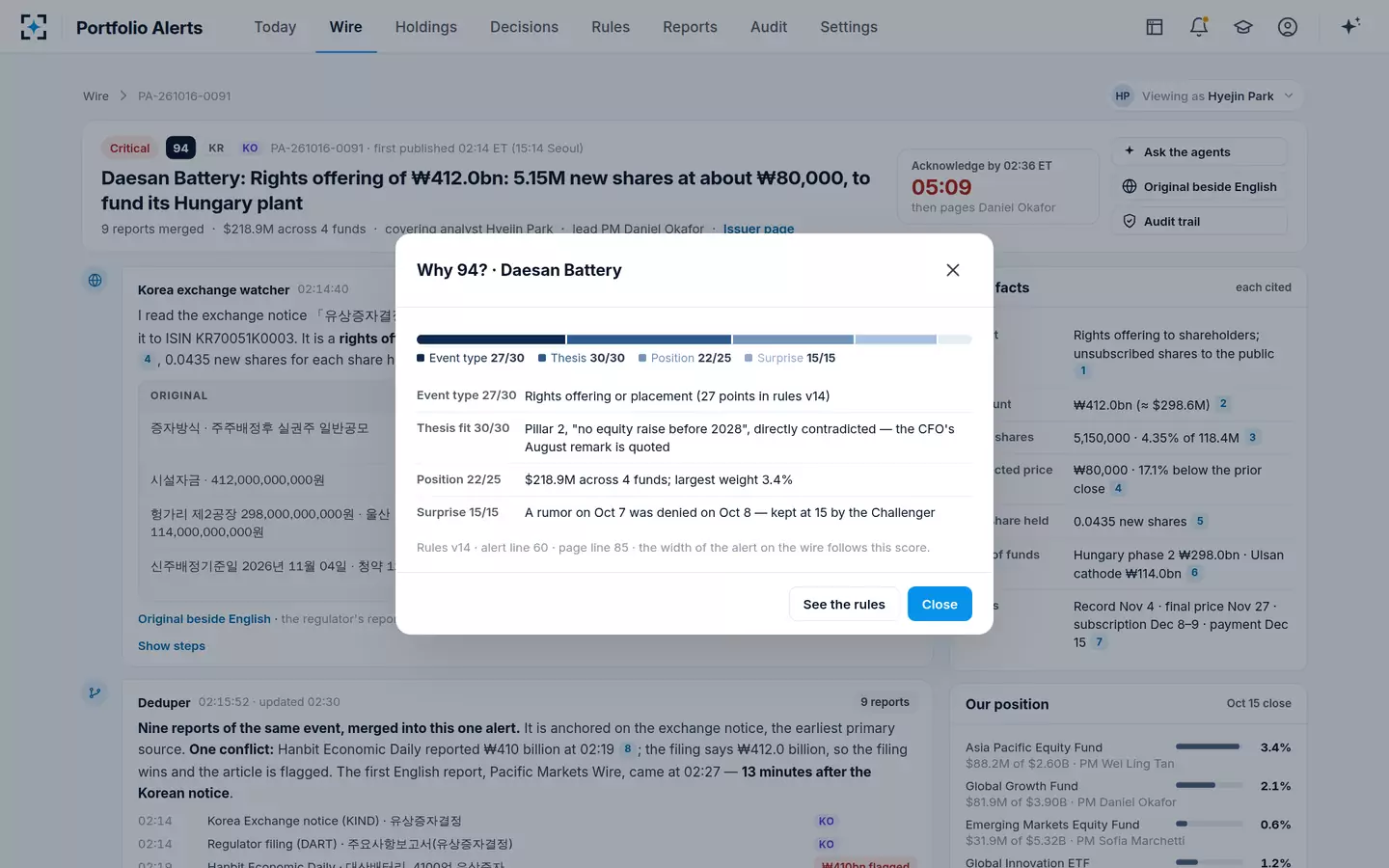
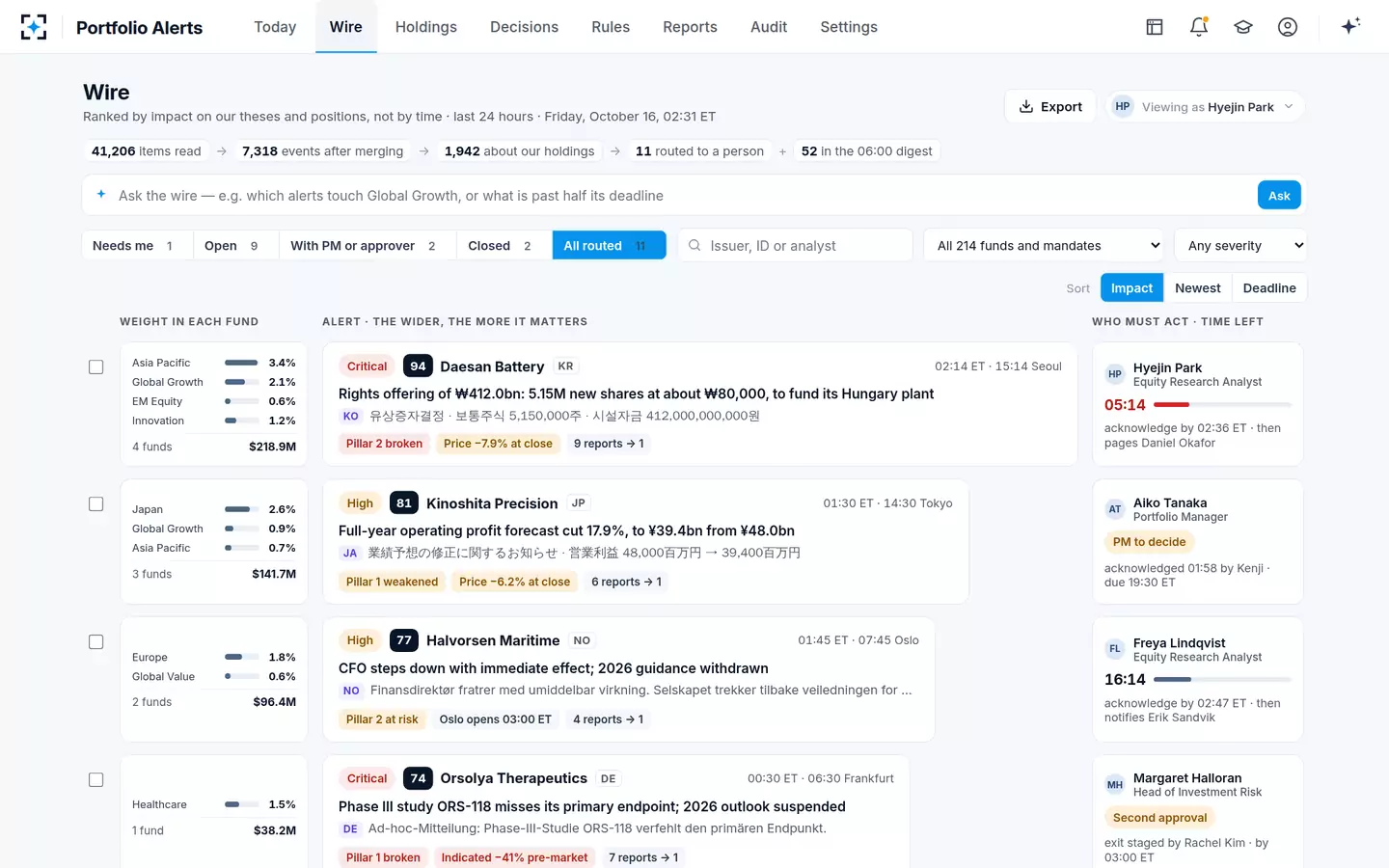
Below the alert line of 60 an event is not discarded; it waits, scored and logged, in the 06:00 digest. Above it the Router hands the alert to the covering analyst with a deadline, 20 minutes for a Critical alert, which is a design target of the solution, and pages the lead portfolio manager if the deadline passes. The analyst acknowledges with a note and pillar marks, or marks the alert not material with a reason; the agents never acknowledge or decide for a person.
The wire, ranked by impact on the thesis rather than by time of filing
A checklist for reading any 8-K in two minutes
Most of an 8-K's value is in a few places, and an experienced reader goes to them in order. The checks below are ours, drawn from the form's own instructions.
Ten checks on any Form 8-K for a stock you own
- Read the item numbers on the cover first
They say what kind of event this is before the prose does; several items in one filing usually belong to one story.
- Find the event date, not the filing date
The four-business-day clock runs from the event; a gap tells you how long the company sat on it.
- Check whether anything is furnished
Items 2.02 and 7.01 and their exhibits are furnished unless the company says they are filed.
- For 4.02, see who concluded
A 4.02(b) auditor notice, with the auditor's letter, is a stronger signal than a 4.02(a) company conclusion.
- For 5.02, look for paragraph (a)
A disagreement and the director's letter outrank a routine departure under (b).
- Read the exhibits, not only the summary
The agreement, the release or the auditor letter usually carries the number the newswire left out.
- Compare figures with the press release
If the release and the filing differ, the filing is the record.
- Look for a promised amendment
Items 1.05, 2.05, 2.06 and 5.02 allow an amendment when facts are not yet known; diary it.
- Check what the price already did
Safe-harbour items often follow earlier news; surprise is not the same as importance.
- Write down which pillar it touches
If you cannot name the pillar, the alert probably belonged in a digest.
The same discipline applies to the feeds that carry 8-Ks. What the SEC's own EDGAR feeds give you, and their limits covers how quickly a filing reaches the public after it is accepted, and why the 5:30 p.m. cut-off decides which day a late filing belongs to. To see an item scored against a thesis on your own holdings, start from Portfolio Alerts.
Questions people ask
How many items are on Form 8-K?
The current form has 33 numbered items across nine sections. Six of them, in Section 6, apply only to asset-backed issuers, so an ordinary operating company works with 27. Item 9.01 is not an event: it is where financial statements and exhibits are attached to a report under another item.
Is the 8-K deadline four business days or four calendar days?
Business days. General Instruction B.1 sets four business days after the event unless an item says otherwise, and if the event falls on a weekend or an SEC holiday, the count starts on the next business day and includes it. An event on a Saturday is therefore due on the Thursday, holidays aside.
What is 8-K Item 2.02?
Item 2.02 reports a public announcement or release disclosing material non-public information about results for a completed quarter or year; the company attaches the release as an exhibit. It is furnished, not filed, unless the company says otherwise. A call that follows within 48 hours, is broadly accessible and meets the item's other conditions needs no separate 8-K.
What is 8-K Item 8.01 used for?
Item 8.01, Other Events, lets a company report any event not called for elsewhere on the form that it deems of importance to security holders, and it may also be used to file information required by Regulation FD. It is optional, so its timing and wording are the company's choice. A report under 7.01 or 8.01 is not, by itself, an admission that the information is material.
Do foreign companies listed in the US file 8-Ks?
Not if they are foreign private issuers reporting on Form 6-K: Rule 13a-11(b) excludes them from the 8-K requirement. They furnish a Form 6-K promptly after the information is made public at home, and some home-country reports may be furnished as an English summary. The home-market notice is therefore the first source for those holdings.
Which 8-K item matters most to investors?
There is no official ranking, but Item 4.02 non-reliance is usually the most serious, because it says the financial statements behind every model were wrong. Research on EDGAR use found investor activity rose most around restatements, earnings announcements and acquisitions. Which item matters most for one holding depends on which pillar of the thesis it touches.