EDGAR alerts are notices that a company has filed with the SEC, and the SEC itself offers two free ways to get them: RSS feeds from EDGAR's company and latest-filings searches, filterable by form type, and the data.sec.gov APIs, whose submissions history the SEC says is updated "with a typical processing delay of less than a second" (SEC, EDGAR APIs). That is fast enough to know about a US filing almost as soon as it is public. It is not enough to run a portfolio on, for three reasons: the SEC sends no email alerts for company filings, nothing in EDGAR knows which filings matter to which of your theses, and a foreign holding's news reaches EDGAR only after it is public at home. Botminds' Portfolio Alerts reads EDGAR as one of its sources, alongside exchange and regulator feeds in each holding's own market, and turns each filing into an owned, scored alert for the covering analyst.
How fast EDGAR moves, by the SEC's own account
<1second
typical delay before a disseminated filing appears in the submissions API
<1minute
typical delay before its XBRL data appears in the XBRL APIs
5:30p.m. ET
after which most filings count as filed the next business day
10per second
the SEC's current maximum request rate for automated access
How do I get SEC filing alerts from EDGAR?
There are three free routes, and each suits a different reader. The first is RSS. EDGAR's company search lets a reader subscribe to the most recent filings of one company, filtered by filing type, and the latest-filings search lets a reader subscribe to all filings or filter by company, CIK or form type, including or excluding ownership filings, according to the SEC's page on its RSS feeds. A reader who follows a dozen names can live on this.
The second is the data.sec.gov APIs. "These APIs do not require any authentication or API keys to access," the SEC says (SEC, EDGAR APIs). Each company's submissions file lists at least a year of its filings, or its most recent 1,000 if that is more, with metadata such as former names, exchanges and tickers. A bulk ZIP of every company's file is republished nightly at about 3:00 a.m. ET. A team that wants to poll a whole portfolio's filings builds on this.
The third is the daily indexes and feed archives, which list every public filing by day. They are complete, but they are rebuilt overnight, so they are for reconciliation, not for alerts: "Indexes incorporating the current business day's filings are updated nightly starting about 10:00 p.m., ET" (SEC, Accessing EDGAR data).
Does EDGAR have email alerts?
Not for company filings. The SEC's page on its RSS feeds lists an email update service for postings outside EDGAR, and says that service is "not available for company filings". A reader who wants an email when a company files has to turn a feed into an email, use a commercial service, or build a small program on the APIs.
That gap is less important than it sounds. For a professional investor the problem is rarely being told that a filing exists; it is being told about the right filing, by the right person's deadline, with what it means for the position. An email per filing on a portfolio of a few hundred names reproduces the problem that alert fatigue in an analyst's 24 hours describes.
How fast does EDGAR publish filings? The hours and the 5:30 p.m. cut-off
EDGAR is fast once a filing is disseminated, but the calendar decides when that happens. Electronic filings may be submitted "each day, except Saturdays, Sundays, and Federal holidays, from 6 a.m. to 10 p.m." Eastern time (17 CFR 232.12(c)). A filing that starts transmitting by 5:30 p.m. is deemed filed that business day; one that starts after 5:30 p.m. is deemed filed the next business day (17 CFR 232.13(a)(2)).
The exceptions are the filings an ownership-watcher cares about most. Forms 3, 4 and 5, Form 144, Schedule 14N and Schedules 13D and 13G, with their amendments, submitted by 10 p.m. are deemed filed the same business day (17 CFR 232.13(a)(4)). The SEC's own description of dissemination follows the same split: "Some filing submissions that begin after 5:30 p.m. ET—or 10:00 p.m. for Ownership forms 3, 4, 5—will be disseminated the next business day" (SEC, Accessing EDGAR data).
So an evening is the busiest time for ownership filings and a dead zone for most others. A company that starts transmitting an 8-K at 6:00 p.m. on its fourth business day has, under the rule, filed it on the fifth, and readers see it the next morning. An alert system that only polls during market hours misses the evening ownership filings; one that polls all night still has nothing to read between 10 p.m. and 6 a.m.
The filing clocks an EDGAR alert inherits
An alert can be no faster than the rule that makes the filing due. Most ownership and event filings run on business-day clocks set in the SEC's rules, and those clocks, not the feed, decide how stale a piece of news is when it first appears on EDGAR.
When the filings people set EDGAR alerts for are due
| Filing | Due | What a holder learns |
|---|---|---|
| Form 4 (insider transactions) | Before the end of the second business day after the transaction | An officer, director or 10% holder bought or sold |
| Schedule 13D (over 5%, active) | Within five business days after crossing 5% | A holder with possible intentions toward the company, and its plans |
| Schedule 13D amendment | Within two business days after a material change, including a material change in the percentage held | The activist added, sold or changed its plans |
| Schedule 13G (qualified institution) | Within 45 days after the end of the calendar quarter in which the duty arose; within five business days after the month-end in which holdings pass 10% | A large passive holder, often weeks after the position was built |
| Form 8-K | Four business days after the event, unless the item says otherwise | One of 33 listed events, from an agreement to an auditor change |
| Form 6-K (foreign private issuers) | Promptly after the information is made public at home | What the company already published in its home market |
Two of these clocks deserve a note. The Form 4 rule is short: "Form 4 must be filed before the end of the second business day following the day on which the subject transaction has been executed" (17 CFR 240.16a-3), and with the 10 p.m. ownership cut-off, a Form 4 often appears in the evening. The Schedule 13D amendment rule is the one activist-watchers live by: a material change, including "any material increase or decrease in the percentage of the class beneficially owned", must be reported "within two business days after the date of such change" (17 CFR 240.13d-2(a)).
What each 8-K item means for a holding, and why Items 4.02 and 5.02 deserve to be read first, is covered in Form 8-K items, read as a holder.
What is the SEC EDGAR API rate limit, and what else does fair access require?
The SEC's current maximum is ten requests a second, and it "reserves the right to limit request rates to preserve fair access for all users" (SEC, Accessing EDGAR data). Automated users are asked to identify themselves in the request header with an organisation name and an administrative contact address, to download only what they need, and to use efficient scripting. The SEC says it does not allow botnets or automated tools to crawl the site outside that policy.
Ten requests a second is plenty for a portfolio if the program is built sensibly: one call per company's submissions file at a reasonable interval, the nightly bulk file to start the day, and the full filing fetched only when the submissions file shows something new. It is not plenty for a program that re-downloads every filing of every company on every pass. Most of the design work in an EDGAR alert system is in not asking for things twice.
Can I track SEC filings for my whole portfolio?
Yes, but the hard part is not the feed; it is matching each filer to what you own. EDGAR identifies filers by the Central Index Key: "CIK numbers remain unique to the filer; they are not recycled" (SEC, Accessing EDGAR data). Portfolio systems usually identify securities by ISIN, CUSIP or ticker. The SEC publishes ticker-to-CIK files, but describes them plainly: "We periodically update these files to provide functionality for EDGAR searches, but do not guarantee accuracy or scope."
Three cases break a naive ticker match. A holding company and its listed subsidiary are separate filers with separate CIKs. The first part of an accession number is the CIK of whoever submitted the filing, which the SEC notes "could be the company or a third-party filer agent", so a program that reads the accession prefix as the company will misfile it. And Section 16 and 13D filings are filed by the insider or the holder, so the issuer appears as the subject, not the filer. A tracking program that matches only the filer's CIK to the portfolio will miss every Form 4 about a stock it owns.
From an EDGAR filing to an owned alert in Portfolio Alerts
Agent
Watcher for US filingsReads each new US filing as EDGAR disseminates it: the form type, every 8-K item and every figure, each with its page anchor.
Never: reads a source the firm is not licensed to read
Agent
Issuer matchMatches the filer, or the subject company of an ownership filing, to holdings by ISIN, CUSIP, LEI or local code.
Never: guesses: a match below 0.90 confidence goes to a person
Agent
Deduper and Materiality agentMerges the filing with the press release and wires about the same event; scores it against the thesis and the position in every fund.
Agent
RouterHands it to the covering analyst with a deadline set by severity, and copies the portfolio managers of every fund that holds the stock.
Never: acknowledges or decides for a person
A person decides
Covering analystReads the filing beside the agents' summary, then acknowledges with a note, or marks it not material with a reason.
What EDGAR cannot see: foreign issuers and the hours before a 6-K
EDGAR is only as early as the filer's obligation to use it. A foreign private issuer files no 8-K; Rule 13a-11(b) excludes it, and it furnishes a Form 6-K "promptly" after the information is public under its home rules (SEC, Form 6-K). For some home-country reports the 6-K may contain an English summary rather than a full translation. Many foreign holdings never file with the SEC at all.
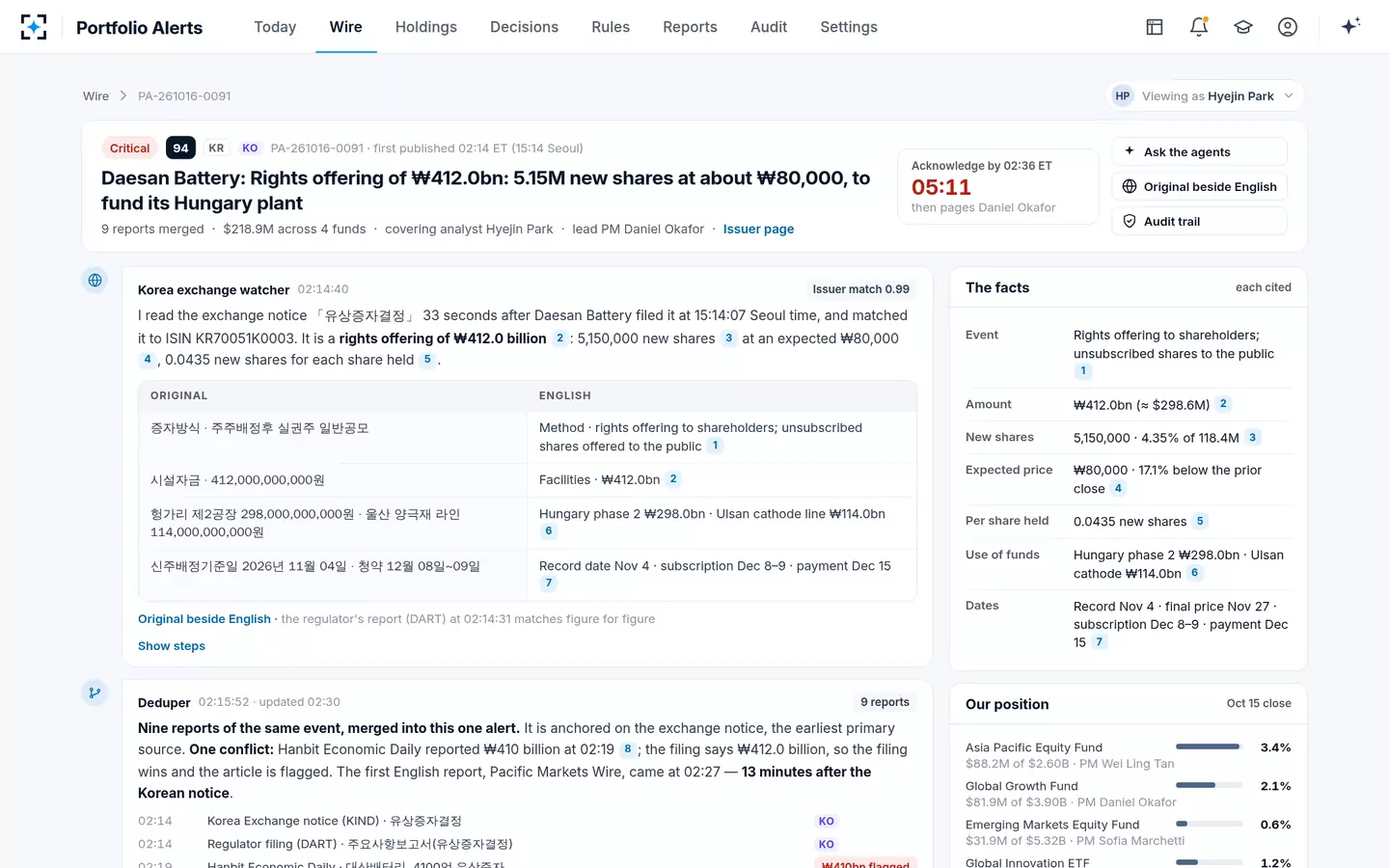
For those holdings the first source is the home market's own system. Korea's is DART, run by the Financial Supervisory Service, where a company's disclosure is public the moment it is filed (FSS, About DART); how one Korean filing reached a holder at 2 a.m. is traced in a rights offering in Seoul, minute by minute. An EDGAR alert on a Korean company, if one comes at all, arrives after the market has traded on the news.
A Korean notice read in Portfolio Alerts 33 seconds after filing, with the regulator's copy checked
Who reads EDGAR, and when?
Most investors use EDGAR rarely, and a few use it constantly. Drake, Roulstone and Thornock, who studied all traffic on EDGAR's servers from 2008 to 2011, found that "the average user employs the database very few times per quarter" and that "a small subset of users employ EDGAR almost daily and access many filings" (Contemporary Accounting Research, 2015). They also found that acquiring information through EDGAR improved how efficiently prices absorbed earnings news.
That split describes the buying decision. A reader who checks a few names a quarter is well served by the SEC's RSS feeds and does not need software. A research team that is responsible for hundreds of holdings, many of them abroad, is the "small subset", and its problem is not access but triage: matching, merging, scoring and assigning each filing among thousands a day.
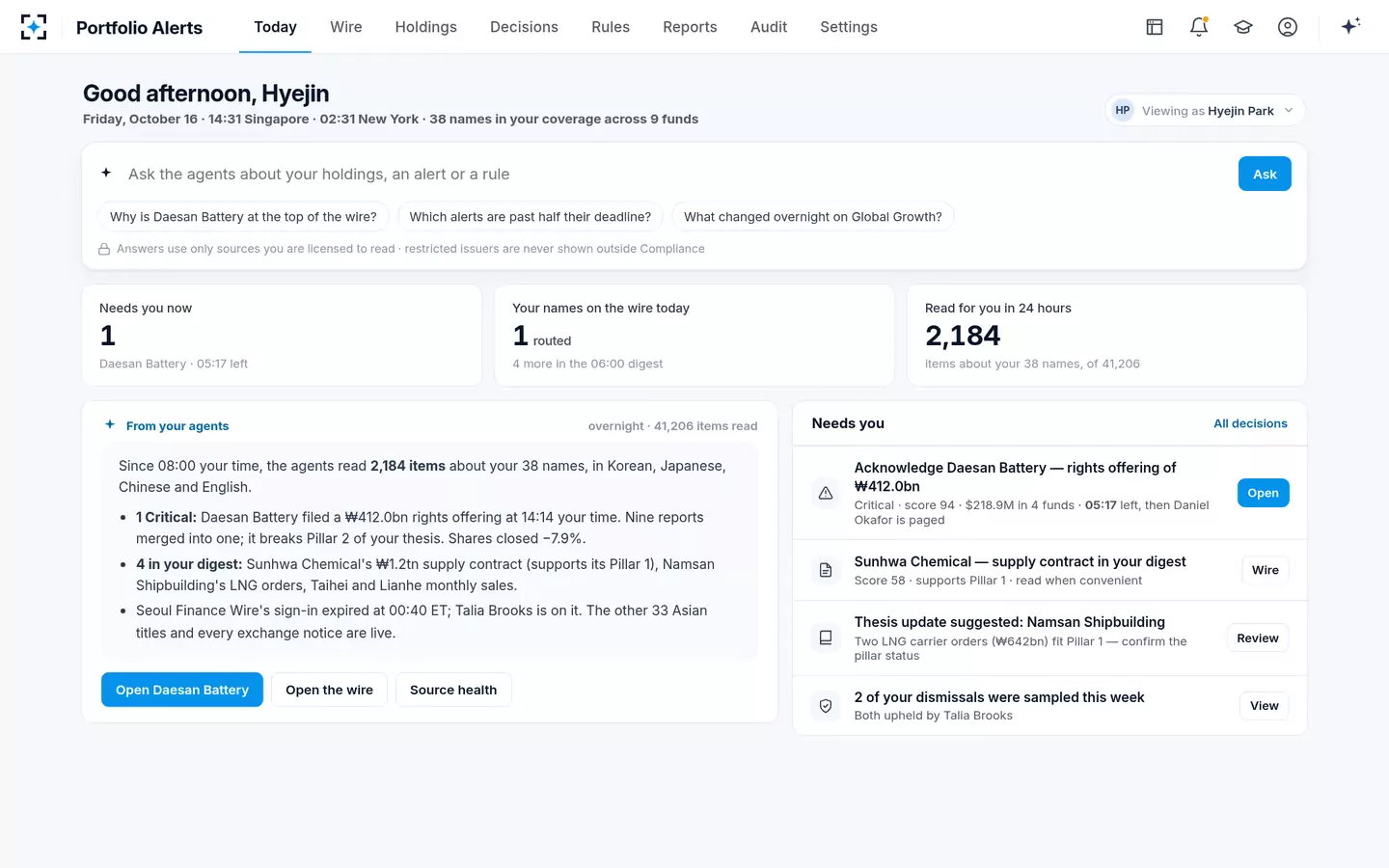
What the analyst sees instead of a feed: what needs her, and what the agents read
Build or buy: a checklist for EDGAR-based alerts
A small program on the SEC's APIs is a reasonable project for a research operations team, and many build one. The checks below are what separates a feed reader from a monitoring system, whoever builds it.
Eight checks for any EDGAR alert system
- Match subjects as well as filers
Forms 3, 4, 5 and Schedules 13D and 13G are filed by the holder; the issuer is the subject.
- Poll through the evening
Ownership filings submitted up to 10 p.m. ET count as same-day; others after 5:30 p.m. roll to the next business day.
- Respect the request limit
Ten requests a second, a declared user agent, and only what is new.
- Reconcile against the nightly index
The API is the fast path; the daily index is the complete one.
- Read item numbers, not only form types
An 8-K Item 4.02 and an 8-K Item 7.01 are not the same alert.
- Merge with the press release
A filing usually follows news already on the wires; one event should be one alert.
- Cover the home market for foreign holdings
A 6-K comes after home-market publication, sometimes only as an English summary.
- Give every alert an owner and a deadline
A feed that nobody owns cannot answer "who knew, and when?"
Merging filings with the press coverage of the same event is a problem in its own right; why nine reports of one event should be one alert explains why repeated news still moves prices. To see EDGAR and home-market sources joined to your own holdings, start from Portfolio Alerts.
Questions people ask
What is the EDGAR RSS feed?
It is a subscription link the SEC offers on EDGAR's searches. From a company search it delivers that company's most recent filings, filterable by filing type; from the latest-filings search it delivers all new filings or those for a company, CIK or form type, with ownership filings included, excluded or alone. The link sits above the results list.
Is there a free API for SEC filings?
Yes. The SEC's data.sec.gov APIs return each filer's submissions history and extracted XBRL financial data as JSON, with no key or authentication. The SEC asks automated users to declare a user agent and stay within ten requests a second, and it republishes a bulk file of all submissions nightly at about 3:00 a.m. ET.
What time does EDGAR stop accepting filings?
EDGAR accepts electronic filings from 6 a.m. to 10 p.m. Eastern time on business days. Most filings that start after 5:30 p.m. are deemed filed the next business day; Forms 3, 4 and 5, Form 144, Schedule 14N and Schedules 13D and 13G submitted by 10 p.m. count as filed that day.
When are Form 4 filings due?
Before the end of the second business day after the transaction is executed, under 17 CFR 240.16a-3. Because ownership forms may be submitted until 10 p.m. ET and still count as filed that day, many appear on EDGAR in the evening.
Why did a company's news appear before its SEC filing?
Because the rules allow it. Most 8-K items are due within four business days of the event, so a press release often comes first. Foreign private issuers furnish a 6-K only after the information is public in their home market, so the home exchange or regulator's system is the earlier source.
Can EDGAR alerts cover non-US holdings?
Only those that file with the SEC, and only after they have published at home. Korean companies publish first through the exchange and DART, which the Financial Supervisory Service says makes disclosures immediately available. A portfolio with foreign holdings needs each market's own source as well as EDGAR.