The denominator effect in private equity is what happens when public markets fall and the private equity allocation rises above its policy range without a single new commitment: the private holdings keep their last reported value while the rest of the fund, the denominator of the percentage, shrinks. It forces a question every investment policy statement should answer in advance: is a breach caused by markets cured by selling fund interests, usually at a discount, or by slowing new commitments until the weight drifts back? Botminds' Investment Policy Statement Monitoring checks every allocation against its band each business day, proves from transactions and price moves whether a breach is active or passive, and proposes only the cures the policy allows, for a person to approve.
The examples use a fictional sample, the $24.71 billion Ridgeline County Employees' Retirement System, as it runs through the solution in October 2026, beside the published policies of two real public plans and the research on what selling fund stakes costs.
How long the policy allows, and how long each pacing plan takes, to bring private equity back under 12%
- Report at the next committee meeting, then return within range, principally by pacing24 months
- Above the 12% ceiling~22 months
- Above the 12% ceiling~25 months
What is the denominator effect in private equity?
The denominator effect is a change in an asset class's share of the portfolio caused by a change in the value of everything else. Private equity is where it bites, for two reasons. Private holdings are valued from fund statements that arrive a quarter or more late, so they do not fall on the day public markets do; and they cannot be sold quickly or cheaply, so a plan cannot simply trim them back to target the way it trims an index fund.
The term is practitioners' shorthand rather than a regulatory one. The closest official language is in plans' own policies, which describe the same thing in longer words. Washington's State Investment Board says ranges "may deviate in the short term as a result of funding schedules, interim market movements, and market impact costs of implementation" (WSIB Policy 2.10.050). The sample IPS calls it an allocation that "exceeds its range because of changes in the value of other assets."
The arithmetic: how a market fall lifts a private allocation
The mechanism is one division, and it is worth doing once by hand. Take a fund of 100 with private equity at 10, its 10% target, and everything else at 90. Public assets fall 20% while the private funds still carry their last statement values. The fund is now 82, and private equity is 12.2% of it, over a 12% ceiling, with no new commitment and no change in the private holdings at all.
One division, three moments: the denominator effect worked on a fund of 100
| Moment | Private equity | Everything else | Fund | Private equity share |
|---|---|---|---|---|
| At target | 10.0 | 90.0 | 100.0 | 10.0% |
| Public assets fall 20%; private values not yet updated | 10.0 | 72.0 | 82.0 | 12.2% |
| Next statements mark private equity down 10% | 9.0 | 72.0 | 81.0 | 11.1% |
| Instead, private equity calls 0.5 and distributes 0.2 | 10.3 | 72.0 | 82.3 | 12.5% |
The third row shows why some plans wait before acting: when private statements catch up and mark down, part of the breach disappears on its own. The fourth shows why waiting is not the whole answer: commitments made in earlier years keep calling capital, and distributions may slow when markets are weak, so the share can keep rising after the public market has stopped falling.
In the sample, the move is visible in a single month. In September 2026, private equity rose 0.6% on the values rolled forward from June, while US equity fell 8.1% and non-US equity 7.4%. Private equity crossed its 12% ceiling on August 31 at 12.1% and stood at 13.4%, $3.15 billion of a $23.48 billion trust, by mid-October.
Why the reported weight lags the market
Private equity weights are always estimates between statements, and the estimate has to be built the same way every day or the breach report means nothing. The usual method is to take the latest net asset value from each fund's capital account statement and roll it forward for capital calls and distributions since that date, with no market adjustment. That is what the sample does: the private markets administrator's third-quarter file was late, so the Holdings agent used June 30 values rolled forward to October 15 and labelled every figure that depends on them.
The roll-forward is also where errors hide. In the sample, the Evidence agent recomputed 13.41% from the custodian file and all 96 fund statements, 25 of them not in English, and found one fund still carried on its March statement rather than June's. A breach declared on a stale statement is a breach someone will later have to retract in front of the committee.
Do you have to sell private equity when over allocation?
Only if the policy requires it, which is why the answer has to be written down in advance. It belongs in the investment policy statement before the market falls, because the people who must decide afterwards are the ones whose pacing plan produced the breach. Two published public-plan policies show the range of answers.
Washington's State Investment Board sets private equity at a 23% target with an 18–28% range, and writes that "Because of appraisal valuation and illiquid market nature of appraised assets, exceeding the maximum policy range allocation will trigger a conscious review by the Board and the appropriate asset class Committee rather than automatic rebalancing." It also says rebalancing "need not occur immediately," and that if private equity is above or below target "due to timing and/or illiquidity," public equity "will be used to offset the imbalance" (WSIB Policy 2.10.050, effective December 18, 2025). The same policy projects private equity at 27% at the end of 2026, stepping down to 23% by 2029: a glide path above target written into the policy itself.
New Jersey's Police and Firemen's Retirement System takes a different approach: a 10% private equity target with an asymmetric range of 4% to 18%. Its chief investment officer may rebalance "between asset classes within their prescribed ranges" without prior approval, but may "Rebalance an asset class beyond the allowed range" only with the general consultant and "with prior approval by the Investment Committee," which "shall bring to the Board’s attention any breach of the Rebalance Guideline Policy" (PFRSNJ Rebalancing Guidelines Policy).
Three ways to cure a passive private equity breach, as Investment Policy Statement Monitoring costs them
What it does: Cut 2027 commitments from $900M to $550M; with distributions of about $610M a year, private equity is back in range by Q2 2028.
What it costs and who must approve: No sale and no transaction cost; the investment officer proposes, the CIO approves. Within the 24 months the policy allows.
What it does: Sell about $330M of fund interests to get under 12% now.
What it costs and who must approve: Estimated cost $26–40M: our estimate, $330M times an assumed 8–12% discount to value. Not required by the policy.
What it does: Raise the ceiling to 14% until the March 2027 policy review.
What it costs and who must approve: No trading cost, but any change to a range needs an amendment adopted by the Board.
How do secondaries price fund stakes? What a cure by sale costs
Selling private equity fund interests to cure a breach usually means selling below net asset value, to buyers who have historically done better than the sellers. A study of secondary transactions built on a leading intermediary's own deal data finds that "Most transactions occur at a discount to net asset value," and that buyers average an annualized public market equivalent (PME) of 1.023 against 0.974 for sellers, "implying that buyers outperform sellers by a market-adjusted five percentage points annually" (Nadauld, Sensoy, Vorkink and Weisbach, NBER Working Paper 22404; published in the Journal of Financial Economics, 2019).
What the buyer of a fund stake gains is roughly what the seller gives up
1.023
average annualized public market equivalent earned by buyers of private equity stakes
0.974
average for the sellers of the same stakes
5pts
a year: buyers’ market-adjusted outperformance over sellers
3pts
for the most common sale, stakes in funds four to nine years old
The same study names who usually sits on the selling side: "sellers are more likely to be traditional private equity investors such as endowments and pension funds," while buyers "tend to be funds-of-funds." A plan that sells to cure a passive breach is paying that liquidity cost to fix a ratio, not a problem with the assets. That is the case for a policy that prefers pacing.
The case is not one-sided. Research on US pension plans' private equity finds that plans earn higher average risk-adjusted performance "mainly due to access to successful PE managers, not superior selection skill," and that "some plans obtain higher PE returns by taking more risk without earning higher, and in some cases earning lower, risk-adjusted returns, broadly consistent with agency problems within plans" (Korteweg, Panageas and Systla, NBER Working Paper 33194; Journal of Financial Economics, 2026). A policy that never forces a sale can also let an allocation grow past what the committee would choose today. The range and the pacing plan both need an owner who reports on them.
Private equity pacing model: curing by commitments instead
A pacing cure works by committing less to new funds while existing funds keep distributing, so that the private allocation shrinks as a share without a sale. The model behind it projects calls, distributions and values for every existing fund and each new vintage; that model is the private markets team's work. What the policy owns is the limit: how long the plan may take, and who must see a plan that takes longer.
The sample IPS writes that limit in §4.4.2: "Where such an allocation exceeds its range because of changes in the value of other assets, Staff is not required to sell interests." The CIO reports the variance at the next committee meeting and presents a plan to return within range "within twenty-four months, principally through the pacing of new commitments." A breach caused by new commitments is different: §4.4.3 asks for a plan within thirty days.
A private markets officer changes the pacing, and the projection is checked against the policy’s 24 months
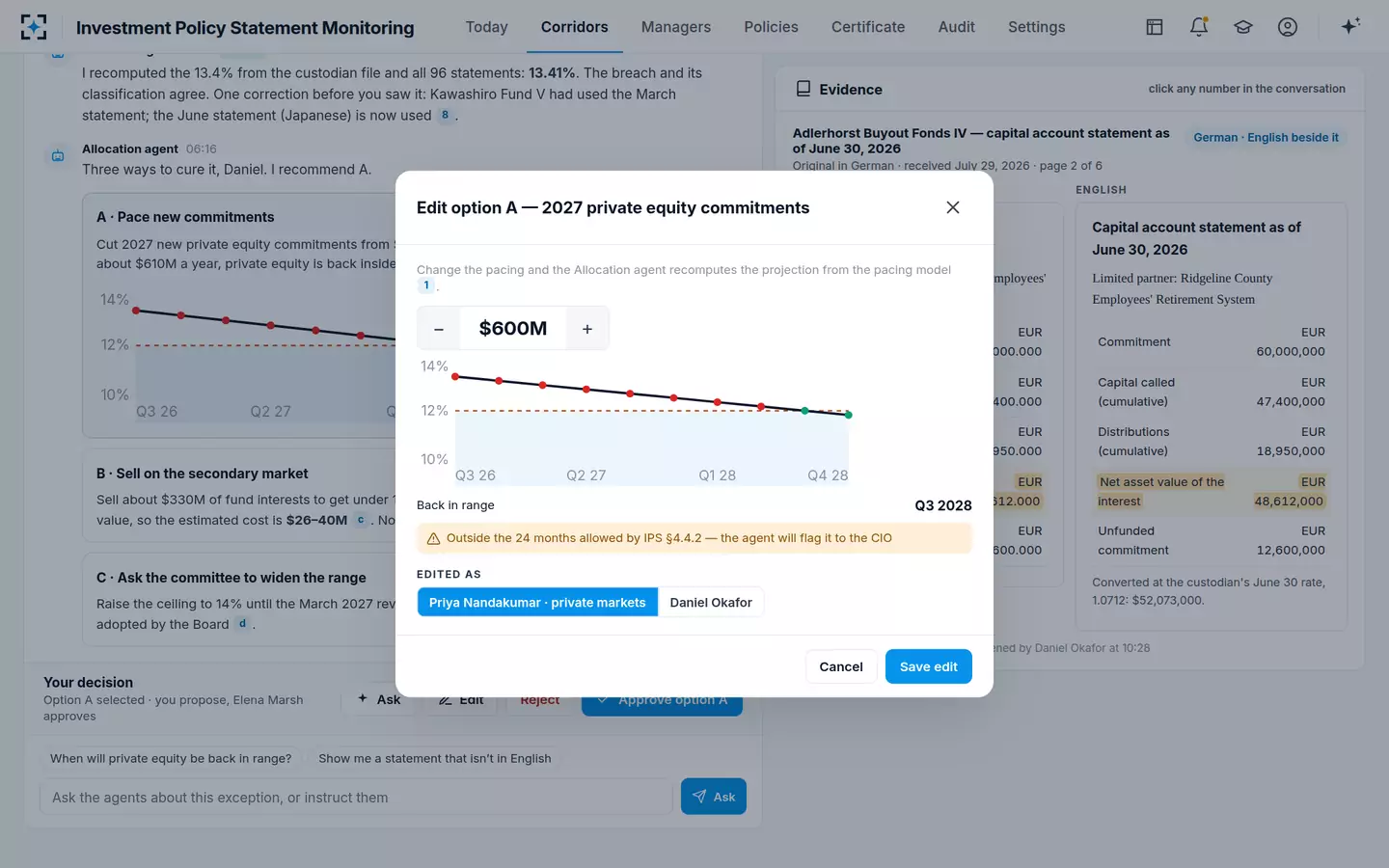
That screen is the whole argument for writing the limit down. Without §4.4.2, a $600 million pacing plan and a $550 million one are both reasonable views; with it, one of them needs the CIO's attention and the other does not, and the difference is visible the moment someone types the number.
What an investment policy statement should say about passive breaches
An IPS handles the denominator effect well when it separates breaches by cause, gives each cause a cure and a clock, and names who may approve a different answer. The Department of Labor's regulation lists the factor every such clause serves: the portfolio's liquidity and current return measured against the plan's expected cash needs (29 CFR 2550.404a-1(b)(2)(ii)(B)). A forced sale at a discount in a falling market is a liquidity decision as much as an allocation one. Registered funds draw the same line between a breach a trade caused and one prices caused, and there regulators set the clock: passive breach of investment limits.
Seven provisions for private markets that go out of range on their own
- Define passive and active
A breach caused by changes in the value of other assets, against one caused by new commitments or purchases, decided from the transaction history.
- Say whether a sale is required
Washington’s policy sends a breach to a board review rather than automatic rebalancing; New Jersey’s needs committee approval to rebalance beyond the range.
- Set the clock
Report at the next committee meeting; a plan to return within a stated number of months; a shorter clock for active breaches.
- Name the cure that is preferred
Pacing of new commitments first, offsetting within public assets second, a sale only on the committee’s decision.
- Fix the valuation basis
Last statement value rolled forward for calls and distributions, and how a late statement is labelled.
- Decide what happens to the range
Who may widen it and for how long, and that a change to a range is a policy amendment, not a staff decision.
- Add a review trigger
An allocation out of range for a set number of days, ninety in the sample, brings the policy itself up for review.
Who approves a widened range or a sale, and on what evidence, belongs in the investment committee charter; the clause itself belongs with the other clauses of the investment policy statement.
One passive breach in Investment Policy Statement Monitoring, from first crossing to cure plan
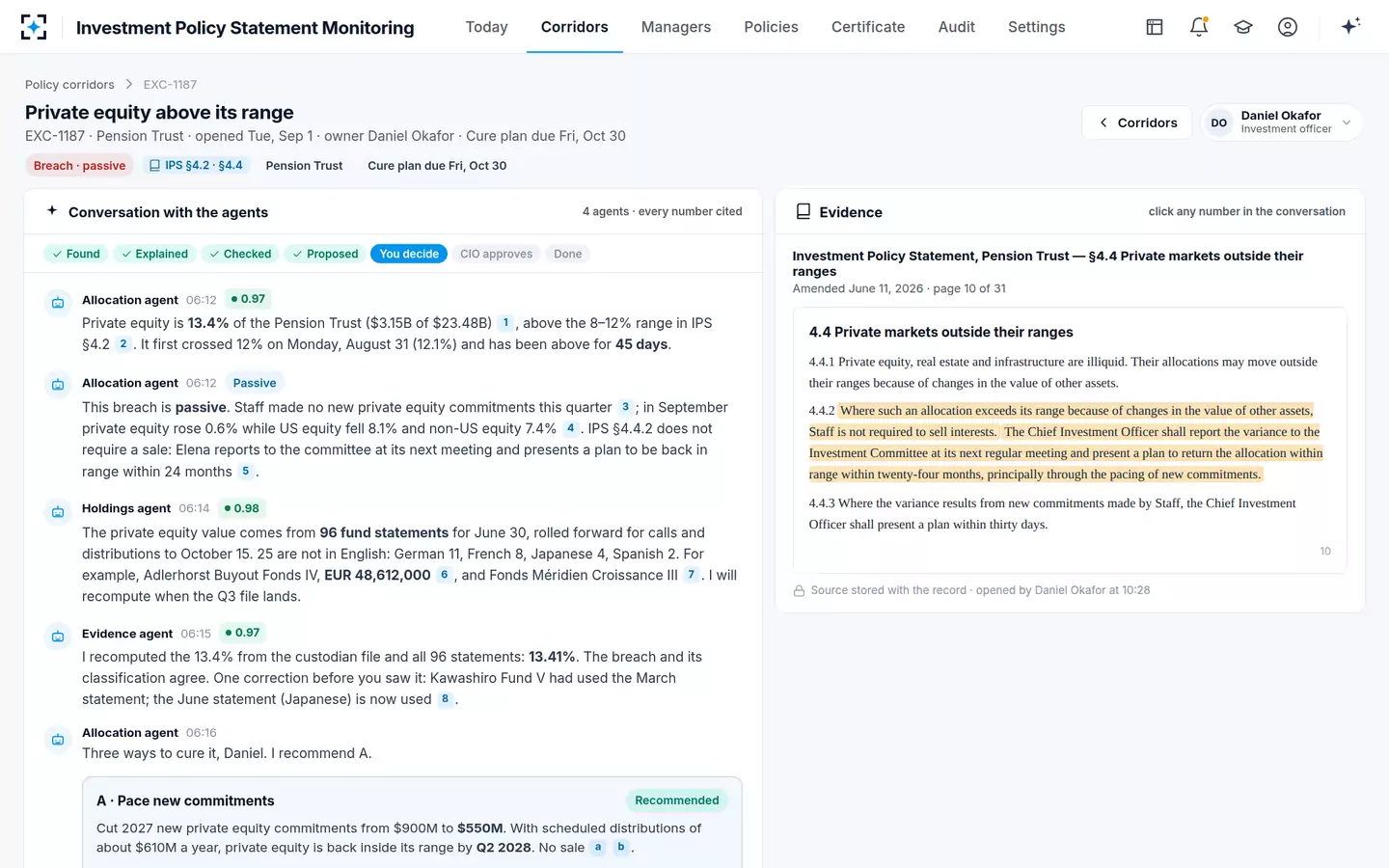
In Investment Policy Statement Monitoring, a passive breach is proved before it is reported. The Allocation agent finds the weight above its ceiling, checks the quarter's transactions for new commitments, compares the private and public moves, and opens the clause that applies. In the sample, staff made no new private equity commitments in the quarter, so the breach is passive and the evidence pane opens IPS §4.4 with the governing sentence highlighted.
A passive breach proved from transactions and price moves, with the policy clause beside it
Then the cures are costed side by side. The secondary sale is shown with its estimated cost so the committee sees what the policy saved it, not hidden because the policy does not require it. The investment officer approves the pacing cure with a reason code, "Passive breach — cured under IPS §4.4," and it goes to the CIO for a second approval.
Three cures, one recommended, beside a fund statement read in German
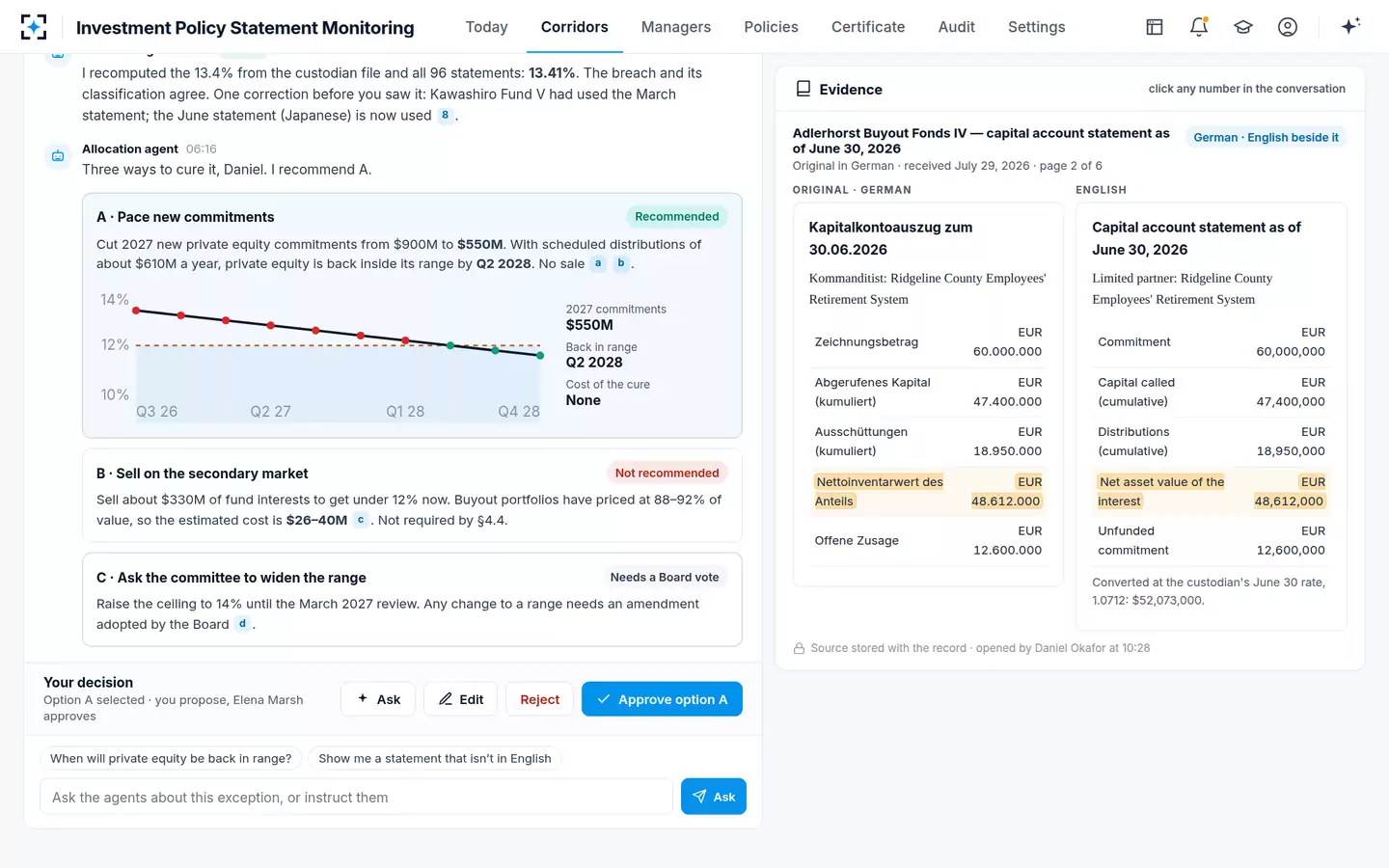
The committee chair, before countersigning the quarterly certificate, can ask why the plan did not sell and get the same three reasons with their sources: the breach came from the fall in public markets, §4.4.2 does not require a sale, and selling would have cost an estimated $26–40 million. To see the cure flow end to end, start from Investment Policy Statement Monitoring.
Questions people ask
What is the denominator effect in simple terms?
It is a change in an asset's share of a portfolio caused by a change in the size of the whole portfolio, not of the asset. When public markets fall, a private equity allocation valued at last quarter's statements becomes a larger share. A 20% fall in public assets lifts a 10% private allocation to about 12.2%.
Does the denominator effect reverse on its own?
Partly. When the next fund statements mark private holdings down, some of the breach disappears; when public markets recover, more of it does. But capital calls on earlier commitments keep adding to the allocation, so a plan that does nothing can stay over its ceiling for a long time. That is why policies pair waiting with a pacing plan and a clock.
How do secondaries price private equity fund stakes?
Mostly below net asset value. In Nadauld, Sensoy, Vorkink and Weisbach's study, most transactions occurred at a discount to NAV and buyers outperformed sellers by about five market-adjusted percentage points a year, about three for stakes in funds four to nine years old. The discount varies with market depth and how much the buyer knows about the fund.
Should we widen the range instead of curing the breach?
Sometimes, as a temporary step, but it is a policy change and should be treated as one. In the sample, widening the ceiling to 14% until the March 2027 review needs a Board vote. Washington's policy takes the other route, a projected glide path above the long-term target written into the policy itself.
What does an IPS say about passive breaches?
A good one says that a breach caused by changes in the value of other assets does not require a sale, sets a time to return within range, names the preferred cure and says who approves an exception. The sample IPS gives 24 months, principally through pacing, with a 30-day plan for breaches caused by new commitments.