A mutual fund watch list, for a 401(k), 457 or pension committee, is not a list of funds someone likes to follow: it is a status defined in the plan's investment policy statement that a fund or manager enters when it trips a named criterion, and leaves only when the committee decides it should be retained, closed or replaced. Good criteria mix numbers (performance against a benchmark, fees against peers, style limits) with events (a manager departure, a change of ownership, a regulatory action), and they let the committee show afterwards why a fund went on, stayed and came off. Botminds' Investment Policy Statement Monitoring evaluates each watch-list criterion in the policy every business day, from holdings, returns, manager letters and filings, drafts the inquiry letter, and leaves every placement and every letter to a person. Choosing the replacement is a different test, set out in how to evaluate a fund manager.
The examples below use a fictional sample, Ridgeline County Employees' Retirement System, as it runs through the solution in October 2026, alongside the published investment policy statement of a real public plan, the Wisconsin Deferred Compensation Program, last revised on September 3, 2026.
On watch in Investment Policy Statement Monitoring: who evaluates, who decides, what is kept
Agent
Evaluate every criterionPerformance, fees, style, people, organization, regulatory and uncured breaches checked against the policy’s own thresholds, each result cited to its source.
Never: puts a fund on watch
Agent
Assemble the caseThe triggers hit, the evidence behind each, and what the policy says happens next, with the clause beside it.
A person decides
Place on watchThe investment officer proposes, the CIO or committee approves; the reason is kept with the decision.
Agent
Draft the inquiry letterQuestions tied to the triggers, a reply date and the guideline paragraphs at issue.
Never: sends a letter
A person decides
Send and review the answerThe CIO approves the letter; the consultant and committee review the reply at the next meeting.
A person decides
Retain, extend, close or replaceOff the list, another period on watch, closed to new money, or a replacement search, each with its reason.
What is a mutual fund watch list? A status your investment policy defines
A watch list is a period of closer review that the policy sets out in advance, so that a committee responds to a struggling fund by procedure rather than by mood. Wisconsin's deferred compensation board writes it as the first of three options when a fund is underperforming: it may "Put the investment option on a formal “watch” list," close it to new elections, or begin to phase it out (Wisconsin Deferred Compensation Program, Investment Policy Statement).
The same paragraph says what watch status means, and it is a useful model: "While an investment option is on a “watch” list, no action will be taken to either close or replace the option." Participants "will be informed of a “watch” decision," and the manager "may be informed, and additional information may be gathered as to why the investment option is underperforming." Watch is a pause with a purpose, not a soft termination.
The legal reason committees keep one is the continuing duty to review. In Tibble v. Edison International the Supreme Court held that a fiduciary must review its investments regularly, with the review's form and timing "contingent on the circumstances" (Tibble, 575 U.S. 523 (2015)). A watch list is how a plan makes "contingent on the circumstances" concrete: it names the circumstances.
What triggers a manager review? The two kinds of watch list criteria
Watch list criteria fall into two groups: thresholds that are computed, and events that are observed. The first group is easy to write down and easy to dispute; the second is where the evidence often arrives first. Wisconsin's policy lists eight reasons, beyond performance, for which the board "may place an investment option under formal watch or terminate an investment option for any reason, including but not limited to the following."
Watch list criteria in one public plan’s policy, and what each needs to be checked
| Criterion in the policy | Kind | What a daily check needs |
|---|---|---|
| Performance must “meet or exceed one or more of established benchmarks”: peer group average, an index, the manager’s own benchmark | Computed | Returns by fund and the three benchmarks, over the policy’s periods |
| Expense ratio no greater than the mean for the peer group; 5-year return at or above the benchmark (selection criteria) | Computed | Fee data and peer group averages, refreshed when prospectuses change |
| “The investment option has changed managers, or such a change appears imminent” | Event | Manager letters, fund filings and news, read as they arrive |
| “a significant change in ownership or control” | Event | Firm filings and announcements |
| “changed its investment mandate or has experienced style drift” | Computed and event | Holdings-based style measures and prospectus changes |
| “substantial portfolio turnover” | Computed | Turnover from holdings or reports, against a stated level |
| “has violated an SEC rule or regulation” | Event | Regulatory releases and the manager’s own disclosures |
| “difficulty in transacting trades, fund transfers or pricing” | Event | Recordkeeper and custodian exception reports |
Read the event rows as a list of evidence sources, not of rules. A manager departure is visible in a letter weeks before it moves returns; a change of control is in a filing. The qualitative criteria are where a committee is most likely to be asked, later, why it did nothing, because the evidence was on someone's desk. The Department of Labor's guidance to plan sponsors lists the same habits for any service provider: reading the reports it sends, checking the fees it charges and asking about its trading, turnover and proxy voting (the Department's monitoring routine, quoted; EBSA, Meeting Your Fiduciary Responsibilities).
Should past returns put a fund on watch?
Past returns should open a question, not settle one, and the research on plan sponsors explains why. Goyal and Wahal studied how 3,400 plan sponsors hired and fired investment managers between 1994 and 2003. Sponsors hired managers after large positive excess returns, and those excess returns did not continue after hiring; managers that sponsors fired went on to earn excess returns that were typically indistinguishable from zero; and in matched pairs of firings and hirings, staying with the fired manager would have left the plan no worse off (Goyal and Wahal, Journal of Finance, 2008).
That finding does not make performance irrelevant. It makes trailing performance a poor trigger on its own, because the committee that fires after three bad years and hires after three good ones is chasing noise at the cost of transition fees. Wisconsin's policy builds the caution in: "The Board recognizes that an investment manager’s performance can move in cycles over time and that investment option performance will not always be superior."
Benchmarks matter too. The Department of Labor's March 2026 proposal on choosing designated investment alternatives would have a fiduciary "determine that each designated investment alternative has a meaningful benchmark and compare the risk-adjusted expected returns, net of fees" to it (91 FR 16088, proposed). That proposal covers selection, not monitoring, and was not final when this guide was written, but it shows where the Department thinks the comparison should start: a benchmark that fits the fund, net of fees, adjusted for risk.
How long should a fund stay on a watch list?
Long enough to answer the question that put it there, and no longer than the policy says. A performance trigger needs enough quarters to tell a cycle from a fault; an event trigger, such as a new lead portfolio manager, needs as long as it takes to see whether the process changed with the person. A policy can set a review at each quarterly meeting and a limit, four quarters for example, after which the committee must either remove the fund from watch or move to the next step.
Wisconsin's policy handles the middle case explicitly: "If improvements have occurred but the investment option is not completely meeting all established criteria and/or there are remaining questions about its performance, the option can be continued on a “watch” list or continue in its closed status." The important part is the decision, made and dated each time, rather than a fund that stays on watch because no one asked.
When to replace a fund in a 401(k): from watch to removal
A fund should be replaced when the review shows it is no longer a prudent option and the committee has a better one, not when it has merely spent a set number of quarters on watch. The Supreme Court put the cost of waiting plainly in Hughes v. Northwestern University: leaving an imprudent investment in the plan beyond a reasonable time is itself a breach (Hughes, 595 U.S. 170 (2022); what that costs a committee).
Removal itself takes time in a participant-directed plan, and the policy should say how much. Wisconsin's begins the phase-out "on the first business day of the 3rd month following the Board’s decision," gives participants "not less than 45 days" to redirect contributions, then another 45 days to move balances, after which money not moved goes to an alternate option the board has chosen. A committee that knows those dates in advance can tell participants, and the auditor, exactly when a decision took effect. The ERISA duty to monitor guide follows what a delay costs.
What records should a committee keep for the watch list?
For each placement, the committee should keep the trigger, the evidence, the decision and the reason, dated, and the same four things each time it reviews the fund until it comes off. The Department of Labor puts the principle in one line: "Prudence focuses on the process for making fiduciary decisions. Therefore, it is wise to document decisions and the basis for those decisions" (EBSA, Meeting Your Fiduciary Responsibilities).
The record that is usually missing is the one for funds that did not go on watch. If a manager's lead portfolio manager left and the committee decided that was no reason for watch status, that decision is worth as much as a placement when the question comes later. A watch list kept only as a list of names cannot show it.
A fund that beats its benchmark and still goes on watch
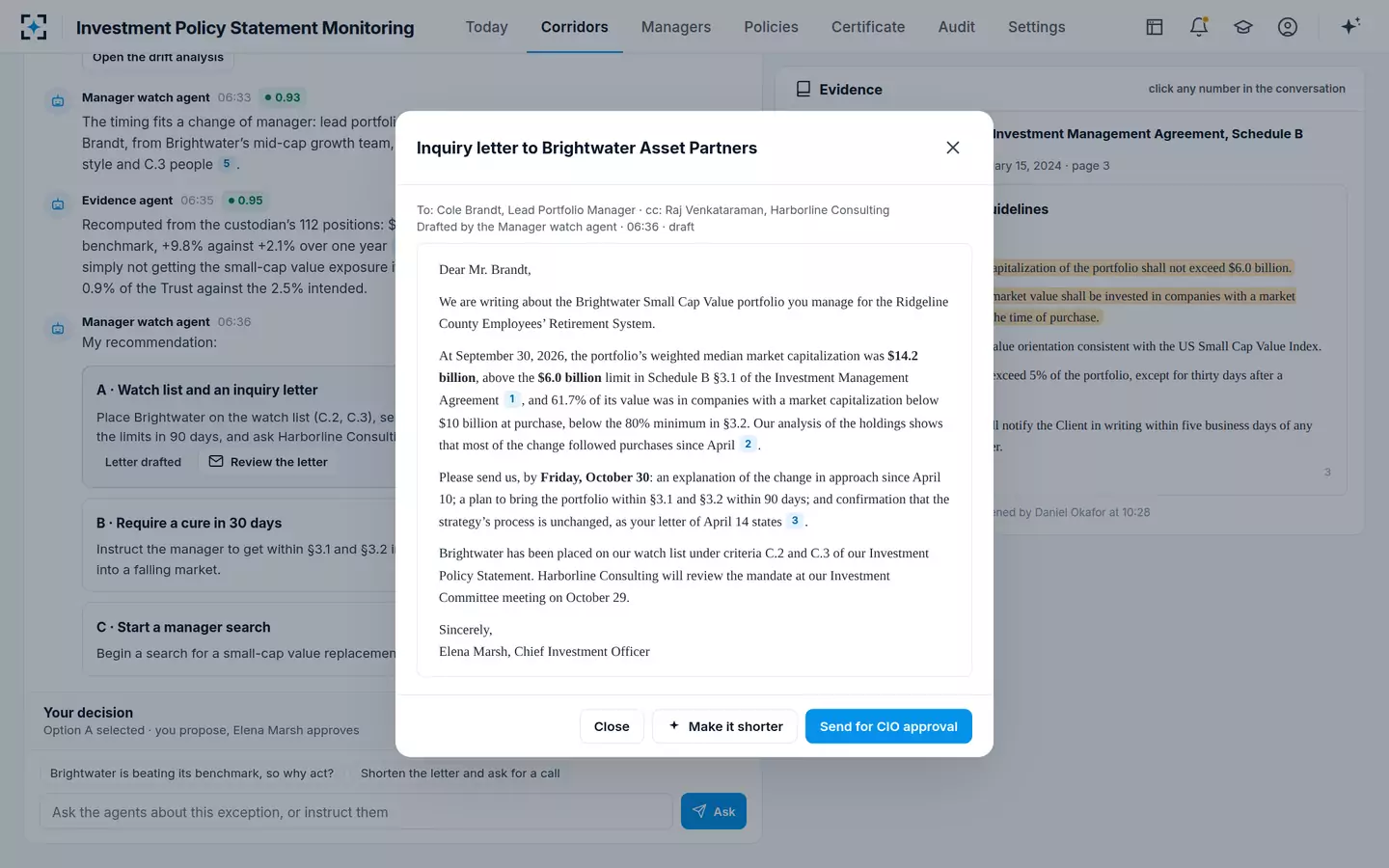
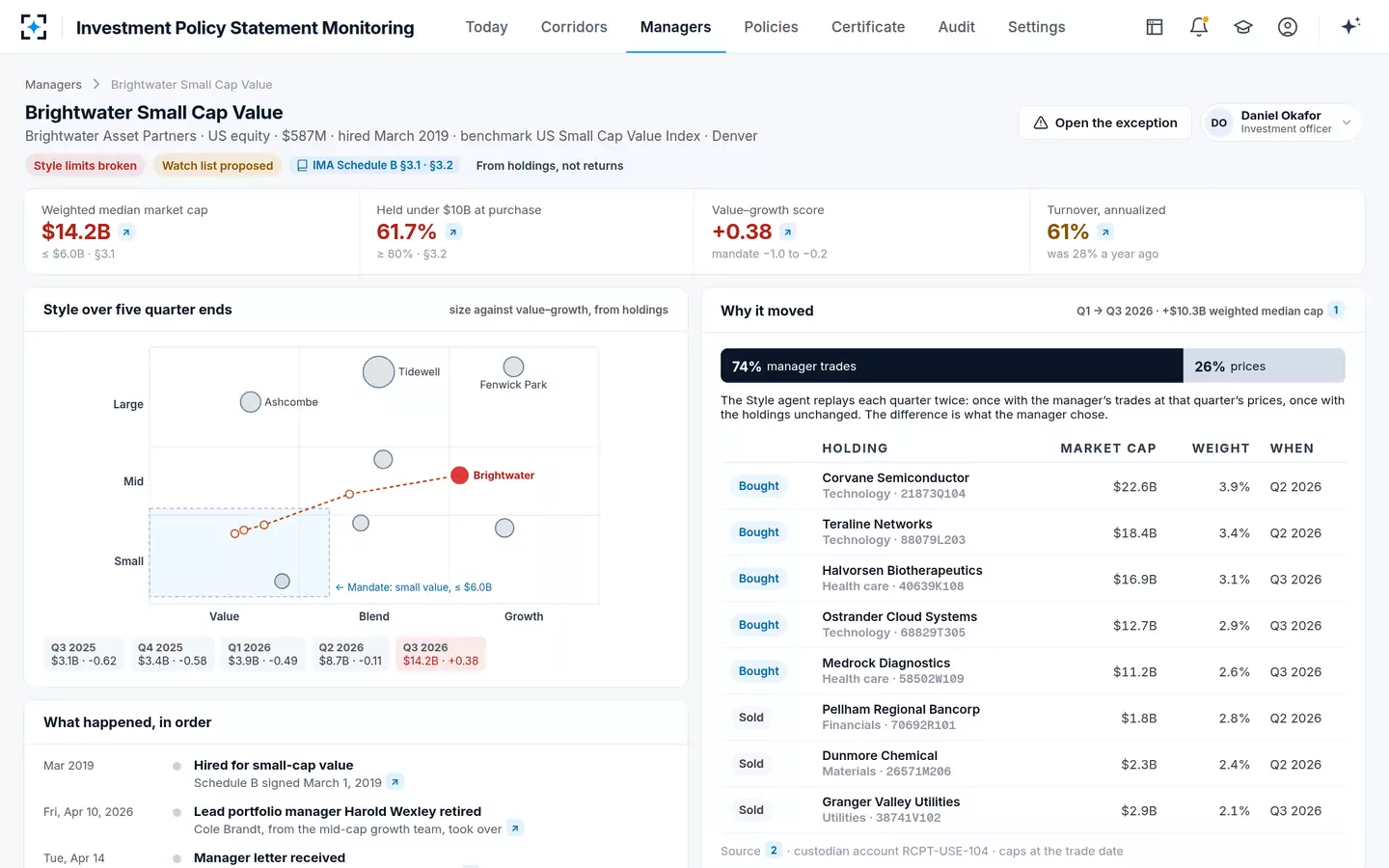
Performance is not the only reason for watch, and the sample shows the case committees find hardest. In the fictional Ridgeline system, Brightwater Small Cap Value was hired in March 2019 for small-cap value. Over one year it returned +9.8% against +2.1% for its benchmark, so a performance screen saw nothing. Its holdings told another story: the weighted median market cap of the portfolio rose from $3.1 billion to $14.2 billion in five quarter ends, against a $6.0 billion limit in its guidelines, after its lead portfolio manager retired in April.
A small-cap value mandate, measured at five quarter ends against its $6.0 billion limit
That one fund trips two of the policy's triggers: style (its guideline limits are broken) and people (the change of lead manager). The Manager watch agent recommends placing it on watch, sending an inquiry letter and asking the general consultant to review the mandate at the October 29 committee meeting. The reason is not that the fund is losing money; it is that the trust is no longer getting the exposure it hired, about 0.9% of the trust in small-cap value against the 2.5% intended. Why returns-based style analysis missed it is a story of its own.
The inquiry letter Investment Policy Statement Monitoring drafts, held for the CIO’s approval
The holdings behind the drift, quarter by quarter, with the people change in the timeline
Watch list criteria a machine can check every day
Most watch-list criteria can be evaluated daily if they are written precisely enough; the vague ones are evaluated by whoever remembers. The checklist below turns the common criteria into wording a person and a monitoring system read the same way. It does not make the decision automatic. It makes the evidence arrive on time.
Writing watch list criteria that can be evaluated every day
- Name the benchmark, the period and the measure
Net of fees, against a named index and a named peer group, over three and five years, with the quarters that count.
- Say how many periods make a trigger
One quarter below the median is noise; a rule such as four of the last six quarters is a decision someone can defend.
- Write style limits as holdings measures
Weighted median market cap, share held below a size at purchase, a value–growth score, each with a number.
- List the events, and where each is seen
Manager departure in letters, ownership change in filings, regulatory action in releases, trading problems in exception reports.
- Make an uncured guideline breach a trigger
A limit broken past the cure window in the manager agreement is a watch-list event, not only a compliance item.
- Set the review cadence and the exit
Reviewed at each meeting; removed, extended, closed or replaced within a stated number of quarters.
- Say who is told
Participants, the manager, the consultant: Wisconsin informs participants of every watch decision.
- Keep the reason for every decision, including “no”
A trigger considered and not acted on is evidence of monitoring too.
To see watch-list criteria evaluated and letters drafted against a policy, start from Investment Policy Statement Monitoring.
Questions people ask
What are typical watchlist criteria for a 401(k) fund?
Wisconsin's public plan is a fair example: performance against an index, a peer group average and the manager's own benchmark, an expense ratio no higher than the peer mean, and eight event triggers such as a manager change, a change in ownership, style drift, high turnover or a regulatory violation. The criteria should be written in the plan's investment policy statement before they are needed.
Can a fund come off the watch list?
Yes, and the policy should say how. Wisconsin's statement lets the board take a fund off watch, and reopen it to new elections if it had been closed, when its performance is "determined to once again be acceptable." The decision and its reason should be kept in the same way as the placement.
Do participants have to be told a fund is on watch?
ERISA's text says nothing about watch lists, so telling participants is a policy choice. Wisconsin's statement says that participants "will be informed of a “watch” decision." Telling participants is a judgement about how much a watch status should influence their choices before the committee has decided anything.
Is a fund watch list required under ERISA?
ERISA does not mention a watch list. It does require fiduciaries to monitor plan investments and remove imprudent ones within a reasonable time, as Tibble (2015) and Hughes (2022) confirmed. A watch list written into the investment policy statement is the usual way a committee shows how it does that.
Should a manager go on watch when its lead portfolio manager leaves?
Many policies make it a trigger, and Wisconsin's lists a change of managers, "or such a change appears imminent," as a reason for formal watch. The point is to examine whether the process left with the person, which returns will not show for some time. In the sample, the style drift showed at the first quarter end after the lead manager changed.