Artificial intelligence in pension funds is useful today in a narrower and more practical place than most headlines suggest: not in picking investments, but in the oversight work around them, reading long policy documents, checking holdings against limits, assembling evidence and drafting reports. A chat assistant can summarise an investment policy statement and answer questions about it. It cannot monitor one, because monitoring means computing every rule against the fund's actual holdings every day, proving the cause of each exception, citing every figure and leaving the decision to a named fiduciary. Botminds' Investment Policy Statement Monitoring uses seven agents that read the policy, check every band and manager daily, recompute each other's figures and draft the certificate; the CIO signs, and no agent trades, sends a letter or approves anything.
Product figures here come from a fictional sample, Ridgeline County Employees' Retirement System, as it runs through the solution in October 2026. Regulators' words are quoted from their published statements, linked where they appear.
“Do we have to sell private equity?”, asked of a chat assistant and of a monitored check
A chat assistant given the IPS: The policy document someone uploaded, possibly not the latest amendment.
A monitored check against holdings: The policy in force, every manager agreement, custodian holdings as of last night and 96 fund statements.
A chat assistant given the IPS: It cannot know; it has no holdings unless someone pastes them in.
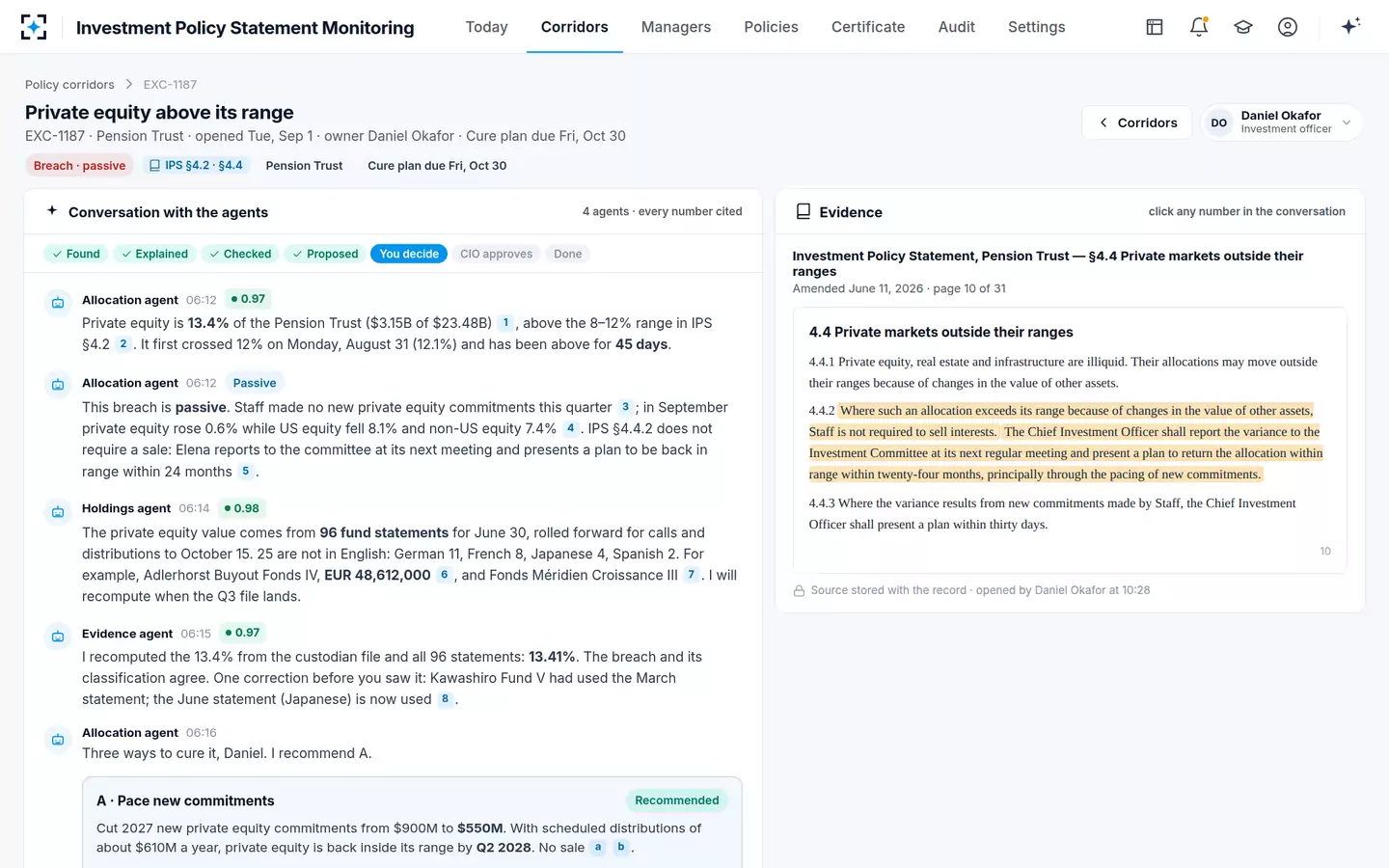
A monitored check against holdings: 13.4% against a 12% ceiling, $3.15 billion of $23.48 billion, recomputed to 13.41% from source.
A chat assistant given the IPS: It can explain what “passive” means; it cannot test it.
A monitored check against holdings: No new commitments this quarter; private equity +0.6% in September while US equity fell 8.1%: passive.
A chat assistant given the IPS: A summary of §4.4, which may be correct, in fluent prose either way.
A monitored check against holdings: No sale required under §4.4.2; report to the committee; plan to return within 24 months; three cures costed.
A chat assistant given the IPS: Possibly to the document; rarely to a page, and never to a holding.
A monitored check against holdings: Every figure opens its source: the clause, the custodian line, the statement page.
A chat assistant given the IPS: Whoever read the answer; nothing unless they save it.
A monitored check against holdings: The investment officer proposes, the CIO approves; reason code and evidence on an append-only trail.
Artificial intelligence in pension funds: where it helps, and where it cannot stand in
AI helps a pension fund most where the work is reading, matching and computing at a volume people cannot sustain daily: hundreds of rules, thousands of positions, statements in several languages, amendments that change one number in a forty-page agreement. It cannot stand in for the judgement ERISA and state pension law put on fiduciaries by name: whether to cure, whether to keep a manager, whether to sign.
The research on AI as an investor is a useful reminder of where the edge is. A 2026 study of AI-driven investing finds it "has grown steadily since the early 2010s and is concentrated among hedge funds," and that "AI hedge funds outperformed non-AI hedge funds in the early years, but this outperformance declined over time, even among early adopters" (Chen, Sialm and Xu, NBER Working Paper 35273, a working paper). For a pension fund, a fading edge in picking securities is a weak reason to adopt AI; an oversight process that checks every limit every day is a strong one.
Can AI monitor investment policy compliance?
Yes, if "AI" means agents that compute checks against holdings and cite their sources, and a person decides; no, if it means a chat model answering from a document. The difference is not the model. It is whether the system has the fund's holdings, reconciles them to the custodian, applies rules that a person approved, proves the cause of each exception and shows its evidence.
European regulators described the legitimate use in 2024. AI "could also be used to support investment advice and portfolio management, by monitoring the overall risk exposure of a client’s portfolio and ensuring the characteristics of the portfolio remain aligned with the client’s profile (in particular risk tolerance and investment objectives)" (ESMA public statement on AI and investment services, May 30, 2024). Replace "client's profile" with "investment policy statement" and that is policy monitoring.
Monitoring, not conversation: a passive breach proved in Investment Policy Statement Monitoring
Why a fluent answer is not a check
A language model's answer reads equally well whether it is right or wrong, and a fiduciary cannot tell the difference without the evidence. ESMA put it bluntly: tools that generate text are known to "hallucinate", producing answers that sound realistic and accurate but are factually wrong (ESMA's warning, and the controls it implies for research), and "In investment advice and portfolio management, hallucinated information can lead to misleading advice that involves unexpected risks or missed opportunities." A footnote in the same statement cites results from May 2023 suggesting one widely used chat model hallucinated in about 19.5% of responses; models have changed since, but the property ESMA describes, confidence without verification, has not.
The deeper limit is not error but absence. A chat assistant asked about a policy breach does not have last night's holdings, the transaction history that proves a breach passive, or the fund statements that value private equity. It can answer only the question it can see, which is what the document says, not whether the fund complies. Monitoring starts where the document stops.
How Investment Policy Statement Monitoring keeps an AI answer honest before anyone reads it
Agent
Load and reconcileHoldings agent loads custodian positions and fund statements and reconciles to the custodian’s total; late data is labelled.
Never: fills a gap silently
Agent
Compute against approved rulesAllocation, Style and Manager watch agents check rules that a person activated, each cited to its clause.
Agent
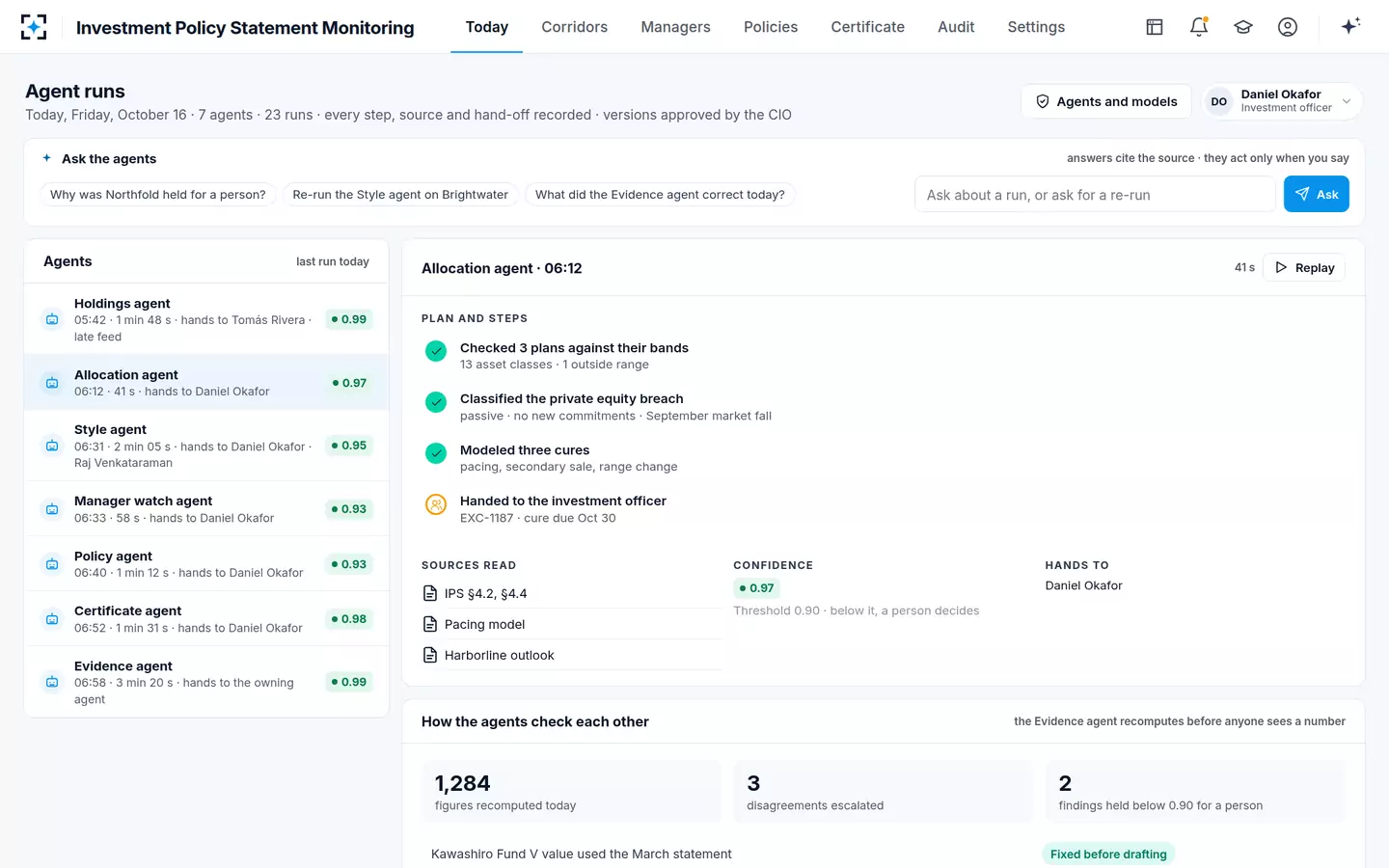
Recompute independentlyEvidence agent recomputes every figure from source and verifies every citation.
Never: changes another agent’s output
Agent
Hold what is uncertainA finding below the 0.90 confidence threshold goes to a person and never into the certificate.
A person decides
DecideThe investment officer approves, edits or rejects with a reason code; the CIO approves second.
A person decides
SignThe CIO signs the certificate; the committee chair can question it, then countersigns.
What do regulators expect from AI governance?
Supervision, records and someone accountable who understands the system. The SEC's Division of Examinations said in October 2026 that the firms it examines are building what it calls "super intelligence" into their businesses, with generative SI tools now used for work from drafting to portfolio management and "compliance monitoring and surveillance", and that it is stepping up its efforts to understand how those tools shape outcomes (SEC Division of Examinations, fiscal 2027 priorities; the Division's full wording, with what else is known about adoption). A year earlier it had said it would assess whether firms have adequate policies and procedures for supervising their use of AI (fiscal 2026 priorities).
Those statements govern SEC registrants, which include registered investment advisers that manage pension money, not the pension funds themselves. ESMA's statement is written for investment firms under MiFID II. Neither binds a public pension board directly. Both describe what a careful board should ask of any AI in its process, and the questions are the same on either side of the Atlantic.
What regulators have put in writing about AI in investment work
2024
ESMA expects a firm’s management body to understand, and oversee, the AI the firm uses
19.5%
of responses hallucinated, in May 2023 results ESMA cites for one widely used chat model
FY2026
SEC examiners assess whether firms have adequate procedures for supervising their AI
FY2027
SEC examiners list “compliance monitoring and surveillance” among firms’ uses of what they call “super intelligence”
Who is accountable for AI output in a fiduciary process?
The same people who were accountable before: the fiduciaries who rely on it. ESMA expects a firm's management body to understand how its AI is applied and used and to oversee it, and warns of "over-reliance": firms and their clients alike may lean on AI so heavily that human judgment drops out of the decision (where a monitoring tool's authority should stop). Nothing in ERISA or state pension law shifts a fiduciary's duty to a tool.
That has a design consequence. If a person remains accountable, the system has to let that person check the output without redoing the work, and it has to stop the AI doing anything the person has not approved. In Investment Policy Statement Monitoring, every agent statement opens its source, every cure, letter, watch-list change and rule change needs a maker and a checker, and the administrator cannot approve exceptions, rules or certificates. The investment committee charter is where a board should write down who approves what, before any AI is in the loop.
Can a committee rely on AI-prepared reports?
It can rely on a report whose every figure it can trace, produced by a process it can describe; it should not rely on one it cannot check. Courts and the Department of Labor judge prudence by process. In its March 2026 proposal the Department quoted the Sixth Circuit that the duty of prudence is "largely a process-based inquiry," and wrote that "prudence is assessed based on a fiduciary's investigation at the time of the investment decision, and not in hindsight based on the investment results" (91 FR 16088, proposed rule, not final). An AI-prepared report helps that showing only if the investigation is visible in it.
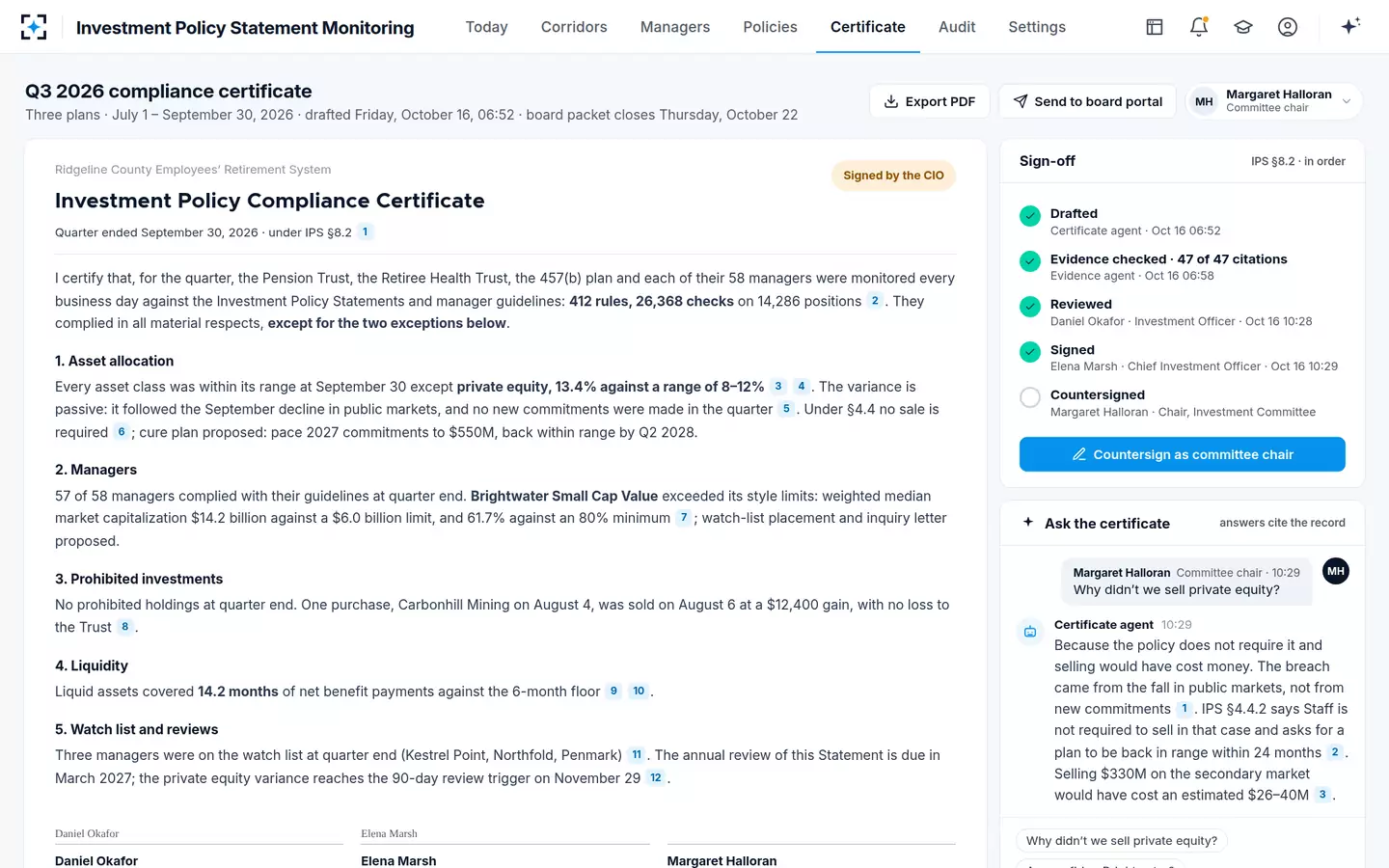
The sample shows what that looks like at the top of the chain. Before countersigning the quarterly certificate, the committee chair asks it in plain words why the plan did not sell private equity, and gets an answer with three citations: the breach came from the fall in public markets, §4.4.2 does not require a sale, and selling $330 million would have cost an estimated $26–40 million. The chair is using AI as a chat interface, but to interrogate checked evidence, not to generate it.
The committee chair asks the certificate a question and gets a cited answer
AI for oversight is a different bet from AI for investing
Pension boards hear about AI mostly as an investment strategy: models that pick stocks, time markets or select managers. That is a bet on an edge that, in the 2026 hedge fund evidence, declined over time. AI for oversight is a different bet: that a fund's own rules, applied every day to its own holdings with every figure checked, will catch breaches and drift sooner and leave better evidence than a quarterly spreadsheet. That bet does not depend on beating anyone.
It also fits the legal duty better. Tibble describes a fiduciary's obligation as a regular review of the investment, its nature and timing set by the circumstances (Tibble v. Edison International, 2015). AI that makes the review continuous and the evidence complete serves that duty directly. The ERISA duty to monitor guide sets out what courts ask for.
Each agent’s plan, sources, confidence and hand-off, open to the person accountable
What to ask before buying AI for a pension fund
Nine questions for any AI that will touch a fiduciary process
- Does it work on our holdings, reconciled to the custodian?
An answer from a document alone cannot tell you whether the fund complies.
- Does every figure open its source?
The clause, the custodian line, the statement page, so a fiduciary can check without redoing the work.
- What happens when it is unsure?
A confidence threshold below which a person decides, and wording it will ask about rather than guess.
- What checks its output?
Independent recomputation before anyone reads a number.
- What can it do on its own?
The right answer for oversight is: nothing that trades, commits, sends, approves or signs.
- Who approves its rules and settings?
A maker and a checker for every rule, threshold and agent version.
- What is kept, and can it be replayed?
Each run’s steps, sources and hand-offs, append-only, and a replay on the same inputs for an auditor.
- Who on our side understands it?
ESMA’s standard for the management body is a fair one for a board: enough understanding to oversee it.
- What does it not do?
An honest vendor will say: not investing, not deciding, not replacing the custodian or the consultant.
A practical next step is to see the checks run on your own policy; the investment monitoring software guide sets out the daily work agents and people split between them. To start, see Investment Policy Statement Monitoring.
Questions people ask
How are pension funds using AI?
The SEC's examiners report, in their October 2026 priorities, that the firms they examine use what the SEC calls "generative SI tools" (SI for super intelligence) for research, drafting, coding, client communications, advisory and portfolio management functions, and compliance monitoring and surveillance. For an asset owner, the most defensible use is oversight: checking holdings against the investment policy and manager guidelines and preparing cited evidence for the people who decide.
Is it safe to upload our investment policy to a chat assistant?
That is a data question for your counsel and security team, and ESMA's statement covers staff use of third-party AI tools with or without management's knowledge. The more important point for monitoring is that an uploaded document gives the assistant no holdings, so it can describe the policy but cannot tell you whether the fund complies.
Can AI decide whether to cure a breach?
It should not. A cure is a fiduciary decision about the fund's liquidity and future commitments. In the sample, the agents prove the private equity breach passive and cost three cures, the investment officer chooses pacing with a reason code, and the CIO approves; no agent can trade or commit.
Does AI change a trustee's fiduciary duties?
No. The duties of prudence and loyalty apply to how trustees use any tool. Regulators expect firms to supervise their AI and keep records of its use; ESMA asks firms' management bodies to understand and oversee it. A trustee who relies on AI output should be able to show what it was based on.
What is the difference between AI for investing and AI for oversight?
AI for investing tries to find returns others miss; 2026 research on hedge funds found that early outperformance faded over time. AI for oversight applies the fund's own rules to its own holdings every day and documents the result. The second does not depend on an edge, and it maps directly onto the duty to review investments regularly.