An investment committee charter is the document that says who may decide what in a fund's investment program: which decisions the board keeps, which it delegates to the investment committee, which the committee hands to the chief investment officer and staff, and what evidence each decision must rest on. The investment policy statement sets the rules; the charter sets the authority to apply and change them. The two fail together when they are vague, because a breach that nobody is clearly allowed to cure is a breach that waits for the next meeting. Botminds' Investment Policy Statement Monitoring checks the policy every business day and routes each exception to the person the charter names, with a second approver for every cure, letter, rule change and settings change, so the chain of authority is enforced rather than remembered.
The examples come from a fictional sample, Ridgeline County Employees' Retirement System, as it runs through the solution in October 2026, alongside the published governance provisions of two real public pension systems and the relevant sections of ERISA.
One passive breach in Investment Policy Statement Monitoring, from the agent that finds it to the chair who countersigns
Agent
Find, classify and citePrivate equity at 13.4% against a 12% ceiling; no new commitments, so passive under IPS §4.4.2; three cures costed.
Never: trades, commits or approves
A person decides
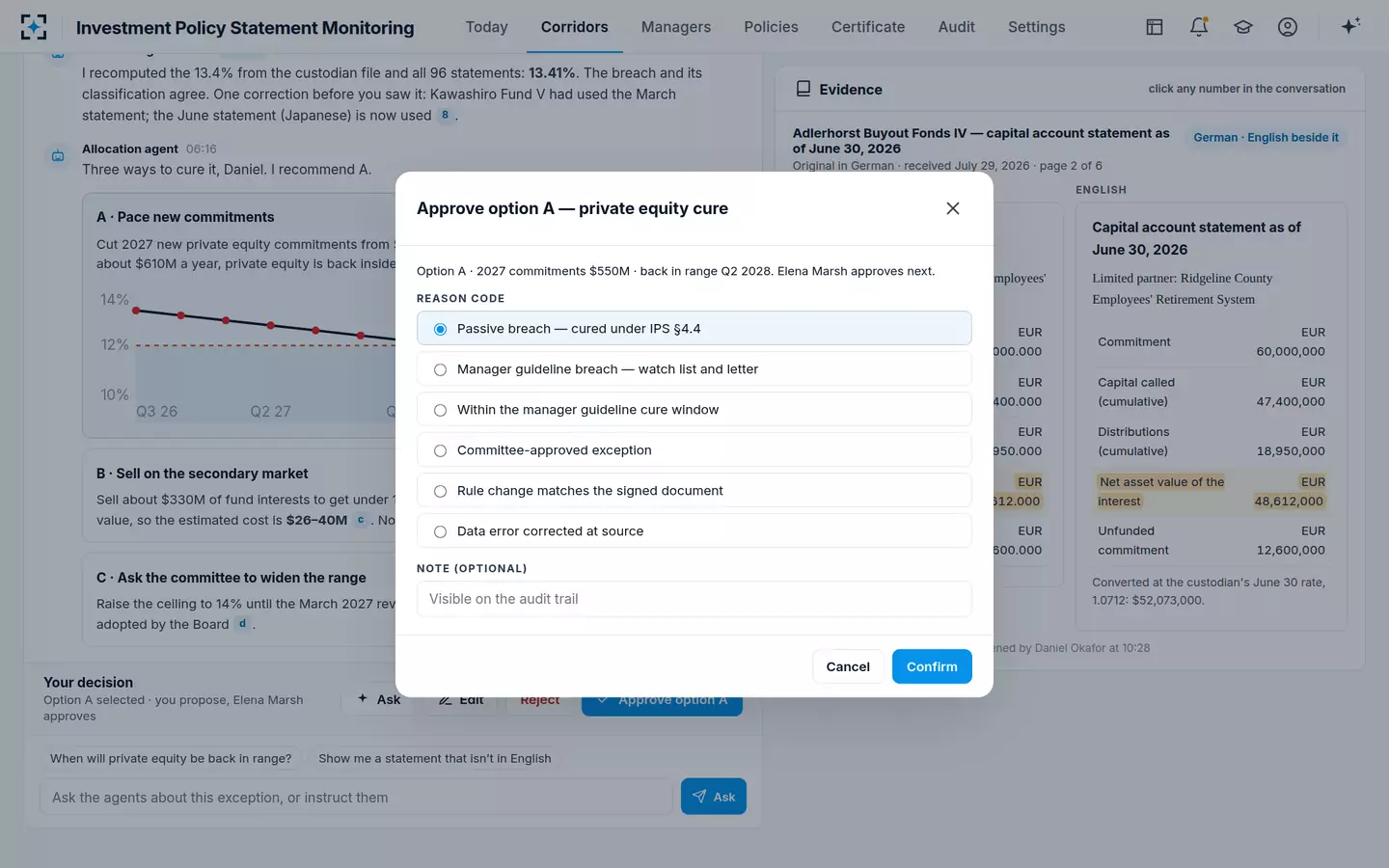
Investment officer proposesChooses the pacing cure and records a reason code: “Passive breach — cured under IPS §4.4.”
A person decides
CIO approvesThe second approval; the person who proposed cannot give it.
Agent
Certificate drafted with every sentence citedThe breach, its cause, the approved cure and the cost avoided, each tied to its source.
Never: signs
A person decides
CIO signs, committee chair countersignsIn the order the IPS sets; the chair can question the certificate before signing.
A person decides
Board decides any range changeWidening the ceiling instead would have needed an amendment adopted by the Board.
What an investment committee charter decides that the IPS does not
The IPS answers "what are the limits?"; the charter answers "who may act when one is reached, and who may move it?" A fund needs both because the questions arrive together. When private equity breaks its ceiling, the IPS says whether a sale is required; the charter says whether the CIO may approve a pacing plan alone, whether the committee must, and whether a wider range needs the board.
For an ERISA plan the statute requires the starting point of that chain. Every plan must be maintained under a written instrument that provides for "one or more named fiduciaries who jointly or severally shall have authority to control and manage the operation and administration of the plan," and must "describe any procedure under the plan for the allocation of responsibilities" and "provide a procedure for amending such plan, and for identifying the persons who have authority to amend the plan" (ERISA §402, 29 U.S.C. §1102). An investment committee charter is usually where those procedures are worked out for investments.
Who carries the policy in a public pension, and what the charter should leave with each
Today
Adopts the IPS and ranges; often learns of a breach from the quarterly book.
With agents
Receives breaches as they happen, through the committee, with the cure already proposed.
Still theirs: Adopting and amending the IPS, ranges and delegations.
Today
Reviews performance and watch-list recommendations from the consultant’s report.
With agents
Reviews exceptions with their clause, cause and evidence; decides beyond-range rebalancing and manager changes.
Still theirs: Manager hiring and termination, watch-list decisions, beyond-range actions.
Today
Signs a quarterly memo built by hand.
With agents
Approves cures, letters, watch-list changes and rule changes proposed by staff; signs a cited certificate.
Still theirs: Second approval on every staff proposal; signing the certificate.
Today
Re-keys ranges and guidelines each quarter and runs breaches by email.
With agents
Opens each exception with its cause and allowed cures, and proposes a decision with a reason code.
Still theirs: Proposing, never approving, the response.
Today
Presents watch-list recommendations from returns-based charts.
With agents
Reviews holdings-based evidence and comments; cannot approve or change anything.
Still theirs: Advice, on the record.
Who approves an IPS amendment?
In public pensions, the board approves the policy and its amendments, and the committee drafts and reviews them; a charter should say so in those words. New Jersey's Police and Firemen's Retirement System puts the chain on the first page of its rebalancing policy: it "has been drafted by PFRSNJ Staff and reviewed and approved by the Investment Committee and approved by a majority of the Board," and "Material deviation from this document is not permitted without explicit written permission, in advance, from the Board" (PFRSNJ Rebalancing Guidelines Policy). The committee "is responsible for drafting, periodically reviewing, and updating these policies as needed."
Washington's State Investment Board draws the same line between levels: the board approves the asset allocation and monitors that allocations stay within their ranges, while "Recommendations for specific investments or investment styles within the asset classes’ allocation is an investment structure decision and will be the responsibility of the appropriate WSIB Committee" (WSIB Policy 2.10.050). The charter should make that boundary explicit, because the commonest governance failure is a staff decision that quietly changed a policy.
A decision matrix for an investment committee charter
| Decision | Proposes | Approves | Evidence kept |
|---|---|---|---|
| Adopt or amend the IPS, including any range | Committee, from staff drafts | Board | Redline, the reason, the vote |
| Rebalance within a range | Staff | CIO | Weights before and after, cost |
| Rebalance beyond a range | CIO with the consultant | Committee, in advance | Breach, cause, alternatives, cost |
| Cure a passive breach by pacing | Investment officer | CIO; reported to the committee | Cause proved, plan, projection, reason code |
| Cure an active breach | Investment officer | CIO, within the policy’s deadline | Trade, limit, cure trade, cost |
| Place a manager on watch, send a letter | Investment officer | CIO | Triggers, evidence, the letter |
| Hire or terminate a manager | CIO with the consultant | Committee | Search or review, fees, transition plan |
| Turn a guideline amendment into rules | Staff reading the document | CIO activates | Document beside each rule, questions asked |
| Sign the quarterly compliance certificate | Drafted from the checks | CIO signs, chair countersigns | Every figure cited to its source |
Can a committee delegate manager selection?
Yes, if the plan's documents allow it and the delegation is prudent, and ERISA builds the route in. A plan may let a named fiduciary appoint investment managers with power to buy and sell plan assets (ERISA §402(c)(3)), and once a qualifying manager is appointed the trustees are not liable for its acts or omissions (ERISA §405(d)(1)). What that appointment moves, and what it leaves with the committee, is the subject of 3(21) vs 3(38) fiduciary services.
The same logic applies inside the fund. ERISA lets the plan instrument provide procedures "for allocating fiduciary responsibilities (other than trustee responsibilities) among named fiduciaries" and for designating others to carry them out. New York's not-for-profit law lets a governing board delegate investment authority "to its committees, officers or employees," provided each delegation can be ended without penalty on no more than 60 days' notice (N-PCL §514; what the statute asks of a nonprofit's policy). A charter that delegates manager selection to the committee, or to an outsourced CIO, is using these provisions.
The duty a committee keeps when it delegates: monitoring the delegate
Delegation moves the decisions; it does not move the duty to watch whoever now makes them. ERISA's relief for an allocated responsibility has an exception written into it: the named fiduciary stays liable where it violated its prudence duty "with respect to such allocation or designation," in "the establishment or implementation of the procedure," or "in continuing the allocation or designation" (ERISA §405(c)(2)). Continuing a delegation is itself a decision, and an unmonitored one is the easiest to attack.
State pension law says the same in fewer words. Texas requires the governing body of a public retirement system to "at frequent intervals monitor the investments made by any investment manager for the system" (Tex. Gov't Code §802.206). The Department of Labor's guidance to plan sponsors makes the same point for any appointed investment manager, and adds a sentence a charter should adopt nearly verbatim: an employer "should document its selection (and monitoring) process, and, when using an internal administrative committee, educate committee members on their roles and responsibilities" (EBSA, Meeting Your Fiduciary Responsibilities).
So the charter should name who monitors each delegate, how often, and on what evidence. "The consultant reports quarterly" is a schedule, not a monitoring procedure. "Staff check every mandate against its guidelines each business day, the CIO approves any response, and the committee receives every exception with its evidence" is one.
Who decides a cure? Passive breaches, active breaches and staff authority
A charter should give staff the authority to cure inside the policy and reserve anything that changes the policy for the committee or board. New Jersey's rebalancing policy is a clean model: the CIO may rebalance "between asset classes within their prescribed ranges" and between managers within an asset class without prior approval, but may "Rebalance an asset class beyond the allowed range" only with the general consultant and "with prior approval by the Investment Committee."
The sample system adds two distinctions worth copying. A passive breach, caused by markets, gets a cure plan within 60 days and may be cured by pacing over up to 24 months; an active breach, caused by a trade, needs a decision within one business day. In both, the investment officer proposes and the CIO approves, and the person who proposed cannot approve. If the cure would change a range, as widening the private equity ceiling to 14% would, it stops being a staff decision and needs a Board vote.
The investment officer approves the cure with a reason code; the CIO approves next
What must investment committee minutes record?
Minutes should record each decision, the alternatives considered, the evidence relied on and the reason, because that is what a reviewer will test, not the outcome. The Department of Labor's guidance puts it as a way to limit liability: "One way fiduciaries can demonstrate that they have carried out their responsibilities properly is by documenting the processes used to carry out their fiduciary responsibilities."
For endowments, New York writes the requirement into statute for spending decisions: the institution must keep a contemporaneous record of how the board weighed each factor the law lists (the spending clause, worked through). A charter can borrow the standard for investment decisions too: a contemporaneous note of what was considered, made when it was decided, not reconstructed for the auditor.
Daily monitoring changes what minutes need to carry. When each exception already holds its clause, cause, alternatives, approver and reason code, the minutes can refer to it rather than retell it, and the committee's time goes to the decisions only it can make. The ERISA duty to monitor guide covers what courts look for in that evidence.
Maker and checker: the person who proposes never approves
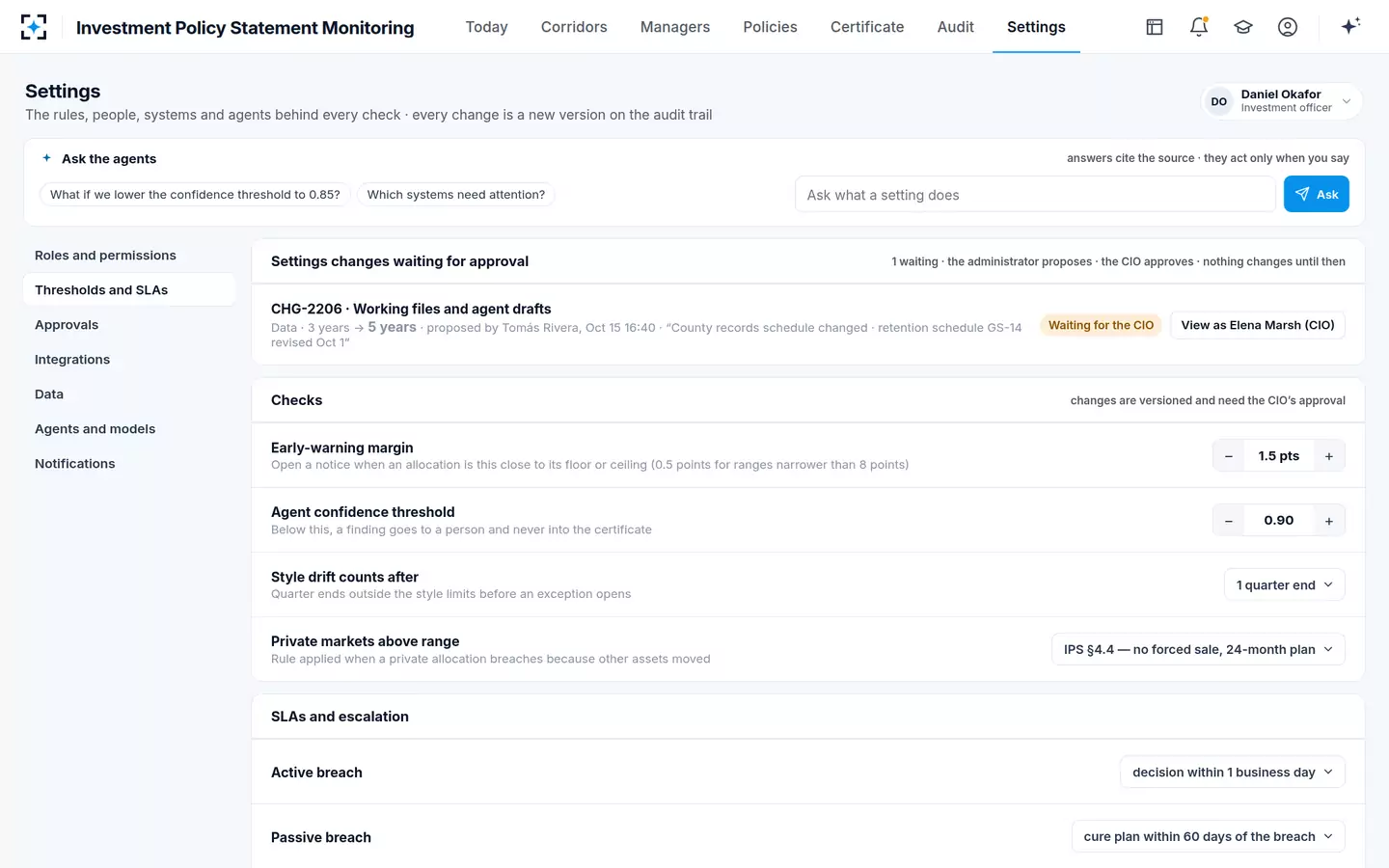
The most useful single rule in a charter is that no one approves their own proposal. It is cheap to state and, on paper, easy to break: the CIO who drafts the cure and signs it, the administrator who changes a threshold and approves the change. Investment Policy Statement Monitoring enforces it in the software. Cure plans, manager letters, watch-list placements, rule changes and settings changes each need a maker and a checker; the administrator cannot approve exceptions, rules or certificates; the consultant and the auditor can comment but cannot change anything.
Thresholds and deadlines are settings in Investment Policy Statement Monitoring, and a change waits for the CIO
Investment committee charter template: what to include
A charter does not need to be long; it needs to answer, for each decision, who proposes, who approves, by when and on what evidence. The checklist below is a template structure, built from ERISA's requirements for plan instruments and the public plans' policies quoted above.
Ten sections for an investment committee charter
- Authority and source
The board resolution or plan provision that creates the committee, and what it may and may not decide.
- Membership and independence
Who sits, who votes, how conflicts are declared, and whether staff and the consultant attend without a vote.
- Decisions reserved to the board
Adopting and amending the IPS and its ranges, and creating or ending delegations.
- Decisions delegated to the committee
Manager hiring and termination, beyond-range rebalancing, watch-list outcomes.
- Decisions delegated to the CIO and staff
Within-range rebalancing, cures inside the IPS, rule activation, letters, each with a second approver.
- Deadlines
Active breach, passive breach cure plan, style exception, escalation when a deadline is missed.
- Monitoring of every delegate
Who checks each manager and outsourced adviser, how often and against which document.
- Evidence and minutes
What each decision must record: alternatives, evidence, reason, approver and date.
- Reporting and certification
What the committee and board receive each quarter, and who signs and countersigns the compliance certificate.
- Education and review
Training for new members on roles and responsibilities, and a date to review the charter itself.
Two more guides cover what the charter governs: passive breaches in private equity, the decision that tests a charter most often, and the clauses of the investment policy statement itself. To see the chain of approvals enforced on a policy, start from Investment Policy Statement Monitoring.
Questions people ask
What is an investment committee charter example?
A public plan example is the governance chapter of New Jersey PFRS's rebalancing policy: the board keeps discretion and approves the policy, the investment committee monitors weights against ranges and reports breaches to the board, and the CIO rebalances within ranges and needs committee approval beyond them. A full charter extends that pattern to manager decisions, watch-list outcomes and certification.
Should the CIO be a voting member of the investment committee?
Charters differ: one design makes the CIO a non-voting adviser so that the committee can approve or reject staff recommendations independently; another gives the CIO a vote on matters outside staff authority. Whatever the choice, the charter should prevent the same person from proposing and approving one decision. In the sample, the CIO approves staff proposals and signs the certificate, and the committee chair countersigns.
How often should an investment committee meet?
At least quarterly, with a way to act between meetings when a breach needs a committee decision. New Jersey PFRS's board receives quarterly updates on weights against targets and ranges, and Washington's board and staff review the asset mix quarterly while staff review it at least monthly. Daily monitoring lets the committee meet on a schedule without waiting for one to learn of a breach.
Who should sign the quarterly investment compliance certificate?
The person accountable for running the program, usually the CIO, with a countersignature from the committee chair. The certificate should state what was checked and cite each figure, so the signers can trace it. In the sample, 412 rules and 26,368 checks on 14,286 positions sit behind one certificate.
Does delegating to an outsourced CIO end the committee's duty?
No. ERISA relieves a named fiduciary of liability for a properly allocated responsibility except where it was imprudent in making, implementing or continuing the allocation. Continuing to use an outsourced manager without monitoring it is the exposure, so the charter should name who monitors the delegate and how.