Pension fund management software covers three different jobs: administration (members, contributions, benefit payments), fund accounting, and investment oversight. The first two are mature categories; the third is where most pension funds still work by hand, re-keying the investment policy statement and every manager's guidelines into a spreadsheet each quarter. Putting daily policy checks in place does not require replacing any system the fund runs. It requires four things to be ready: the investment policy statement, the manager agreements and amendments, a custodian feed that reconciles to the dollar, and the people who will approve exceptions. With those, a pension fund can go live on daily monitoring within a quarter. Botminds' Investment Policy Statement Monitoring is built for that layer: it reads the policy and every guideline into cited rules, checks every mandate against custodian holdings each business day, and drafts the quarterly certificate for the CIO to sign.
Product figures here come from a fictional sample, the $24.71 billion Ridgeline County Employees' Retirement System, as it runs through the solution in October 2026. The plan's durations are Botminds' estimate for a fund of that size, not a commitment or a measured customer result.
Investment Policy Statement Monitoring live within a quarter: two workstreams, thirteen weeks
- IPS, agreements and side letters read into cited ruleswk 1–3
- Rules reviewed and activated; roles and thresholds setwk 4–5
- Parallel run beside last quarter’s manual checkwk 6–10
- Live daily; first certificate drafted and signedwk 11–13
- Custodian, performance and GP statement feeds connectedwk 1–3
- Reconciliation to the custodian, to the dollar, dailywk 4–6
- Reconciliation held through the parallel runwk 7–10
- Live feeds; late files labelled on every figurewk 11–13
Pension fund management software: administration, accounting or policy monitoring?
When a pension fund searches for management software, it is usually buying one of three things, and they do not substitute for each other. Pension administration systems keep member records, collect contributions and pay benefits. Fund accounting and the custodian keep the book of record for the assets. Investment oversight checks those assets against the policy the board adopted: ranges, prohibitions, liquidity, manager guidelines, watch-list triggers.
The third job is the one law makes explicit for public plans. Texas requires every public retirement system to "develop and adopt a written investment policy," keep it for public review and file it, and each change, with the State Pension Review Board, and requires the governing body to monitor its investment managers' investments at frequent intervals (Tex. Gov't Code §§802.202, 802.206; how a charter assigns that duty). Administration software does not do that, and the custodian's reports do not know what the policy says.
What data feeds are needed?
Six sources cover a typical pension's policy monitoring, and only one of them, the custodian, has to be perfect on day one. The others can start partial, as long as every figure that depends on a late or missing source is labelled as such.
The feeds Investment Policy Statement Monitoring needs, and what each one is used for
| Source | What it provides | What depends on it |
|---|---|---|
| Custodian | Daily holdings and transactions for every account | Every allocation, prohibition and guideline check; the reconciliation total |
| Performance measurement system | Returns by composite and manager | Watch-list performance triggers and benchmark comparisons |
| Private markets administrator and GP portals | Quarterly fund values, calls and distributions, often not in English | Private allocations between statements; passive-breach proof |
| Document store | The IPS, investment management agreements, amendments, side letters, manager letters | Every rule and its citation; watch-list people and organization triggers |
| Manager database and market data | Firm and people data; market caps, classifications, ratings | Style measures, credit limits, sector and country rules |
| Board portal and email | Where the certificate, committee papers and letters go | Delivery of what people approved |
The custodial relationship is usually already set by law. Texas requires a system that contracts for investment management to enter "an investment custody account agreement designating a bank, depository trust company, or brokerage firm to serve as custodian for all assets allocated to or generated under the contract," and Florida's statute says a local plan's securities "should be held with a third party" (Fla. Stat. §112.661(10)). The custodian's file is therefore the one independent source of holdings every pension already has.
How long does it take to implement investment policy monitoring?
In Botminds' estimate, about a quarter for a fund with a few dozen external managers and one custodian, if the documents and the custodian feed are available in the first week. The time goes less to software than to two pieces of work only the fund can finish: deciding what ambiguous clauses mean, and agreeing that the reconciled holdings are right. A fund with many custodians, or with guidelines that exist only in email, should expect longer.
The plan above runs two workstreams in parallel because they depend on different people. The policy workstream needs the investment officer and the CIO to answer the questions the reading raises. The data workstream needs operations and the custodian's relationship team. The two meet in week six, when rules and reconciled holdings exist together for the first time.
Weeks 1 to 5: the policy, read into rules and approved
The first weeks turn documents into rules a person has approved. The Policy agent reads the IPS, each investment management agreement and schedule, every amendment and side letter, in the language it is written in, into rules cited to their clauses: ranges, prohibitions, liquidity floors, manager limits and watch-list triggers. Where the wording does not settle a number, it asks.
In the sample, one manager's amendment says non-dollar exposure must be "substantially hedged," a term defined nowhere; the agent offers at least 90%, at least 95%, or asking the manager, and notes that the trust's other core-plus mandate uses 90%. Those questions are the real work of weeks one to five, and each answer makes the policy better as well as the monitoring. No rule runs until the CIO activates it.
How do you reconcile to the custodian? The test that decides go-live
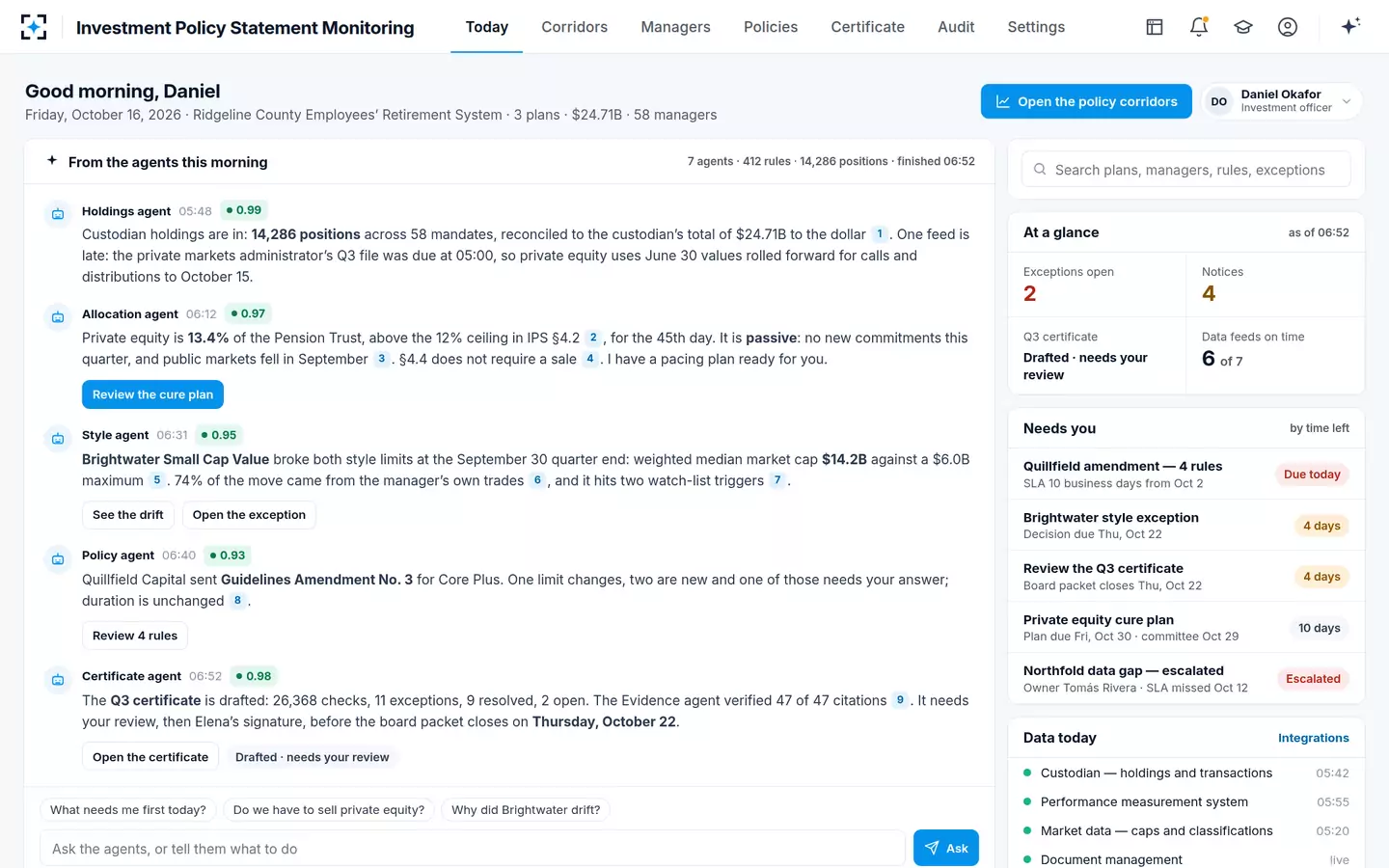
Reconciliation is the go-live test: holdings loaded for monitoring must agree with the custodian's own total, every day, before any check is shown to a person. A breach report built on holdings that do not reconcile is worse than none, because it will be wrong in a way nobody can see. In the sample, the Holdings agent loads 14,286 positions across 58 mandates each morning and reconciles them to the custodian's $24.71 billion to the dollar.
Three things usually break reconciliation in the first weeks: accounts the custodian holds that the policy does not map to a mandate, private funds valued on different statement dates, and cash and pending trades classified differently. Each needs a rule written down: every account maps to one mandate and one plan, every private fund uses its latest statement rolled forward for calls and distributions, and pending trades are counted the same way the custodian counts them. Florida asks local plans' investment policies to provide "for a system of internal controls and operational procedures," reviewed by independent certified public accountants; the reconciliation rule is one of those controls.
Every morning starts with holdings reconciled and late feeds named
Weeks 6 to 10: a parallel run against last quarter's manual check
The parallel run answers the question every CIO will ask before signing: does the system find what we found, and what did we miss? Run the activated rules over the last closed quarter, day by day, and compare the result with the manual check the team actually did. Every difference is either a rule to fix, a data issue to fix, or a breach the manual process did not catch.
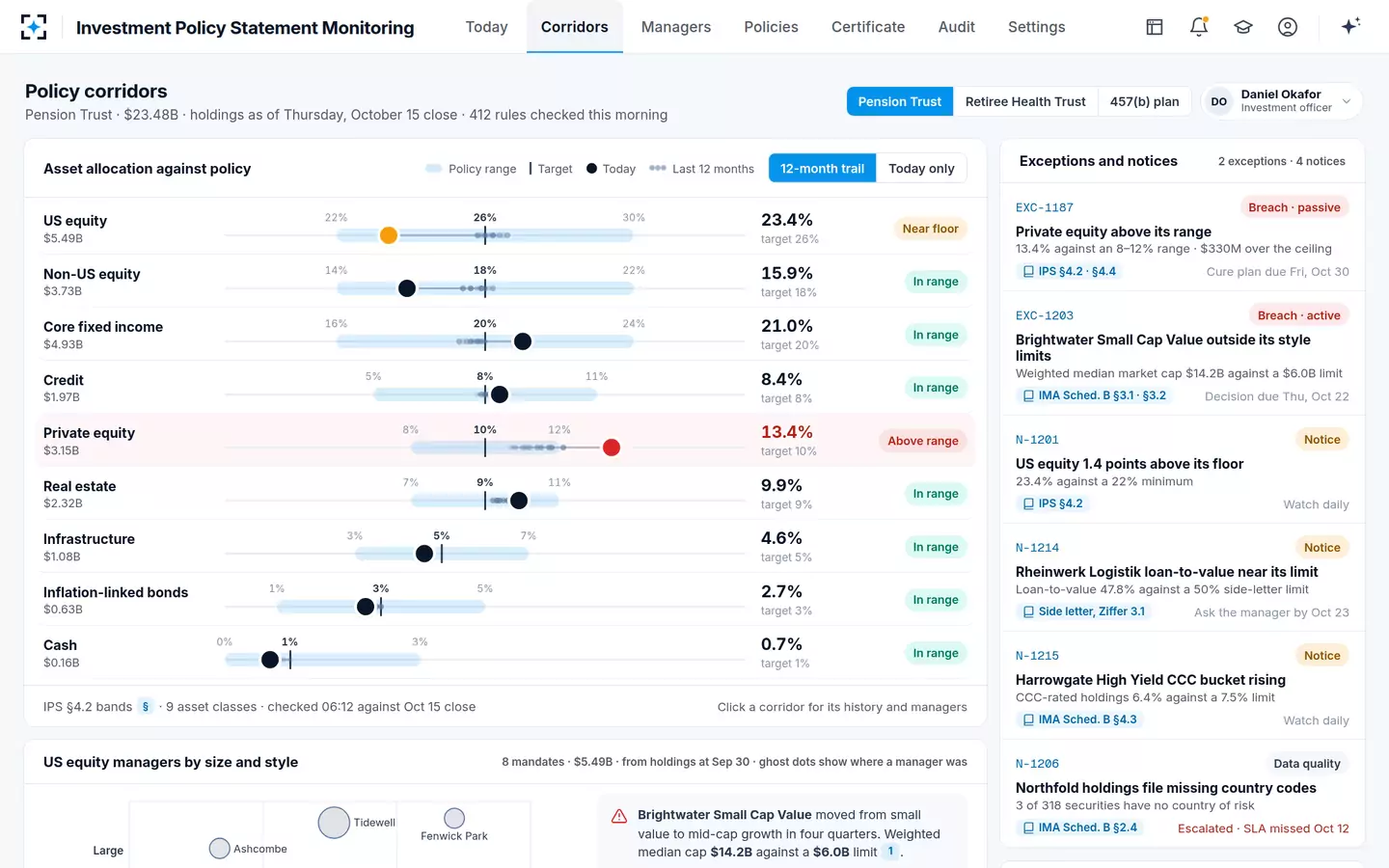
The third kind is the uncomfortable one and the reason to run it. A quarterly check looks at quarter-end holdings; a daily check sees the prohibited stock bought on the fourth of the month and sold on the sixth. The sample certificate records exactly that kind of event: one purchase of a prohibited holding on August 4, sold on August 6, at a gain and with no loss to the trust. A quarter-end check would never have seen it.
The corridors, live: each allocation against its range, every exception cited
Who signs the first certificate?
The CIO, with the committee chair countersigning, the same people who sign the manual memo today; what changes is what they can see. The first certificate should be drafted at the end of the parallel run for the quarter just closed and signed only when every figure in it traces to a holding, a statement or a clause. In the sample, the Certificate agent's Q3 draft carried 412 rules and 26,368 checks, 11 exceptions with 9 resolved and 2 open, and 47 citations, all verified by the Evidence agent before the CIO saw it.
The signing order should be set before go-live, not discovered on the day. The investment officer reviews but cannot sign for the CIO; the CIO signs with an attestation; the chair can question the certificate and then countersigns. Text is frozen after the first signature, and a change restarts the sign-off. The investment committee charter is the right place to write that down.
What state law already asks of the process
Public pensions already owe several of the outputs daily monitoring produces, which makes the business case easier. Texas requires every public retirement system with at least $100 million in assets to have an independent firm evaluate its investment practices "once every three years," including "an analysis of any investment policy or strategic investment plan adopted by the retirement system and the retirement system's compliance with that policy or plan" and "a review of the retirement system's investment manager selection and monitoring process" (Tex. Gov't Code §802.109). A daily, cited record of compliance is the evidence that evaluation asks for.
What public pension law already asks for, in numbers
3years
cycle for an independent evaluation of a Texas system’s investment practices, including compliance with its policy, at $100 million or more in assets
90days
for a Texas system to file a new investment policy, or any change, with the State Pension Review Board
31stday
after filing with the plan sponsor: when a Florida local plan’s investment policy or amendment takes effect
1month
longest interval between staff reviews of the asset allocation at Washington’s State Investment Board
Florida's statute adds two requirements that a monitoring system touches directly: the policy must "provide for appropriate annual or more frequent reporting of investment activities," and for each actuarial valuation the board must check how the fair market value of illiquid investments was determined (Fla. Stat. §112.661(15), (17)). For ERISA plans, the Department of Labor's regulation names the liquidity question the same monitoring answers: the portfolio's liquidity and current return against the plan's expected cash needs (29 CFR 2550.404a-1(b)(2)(ii)(B); where that factor sits in the policy).
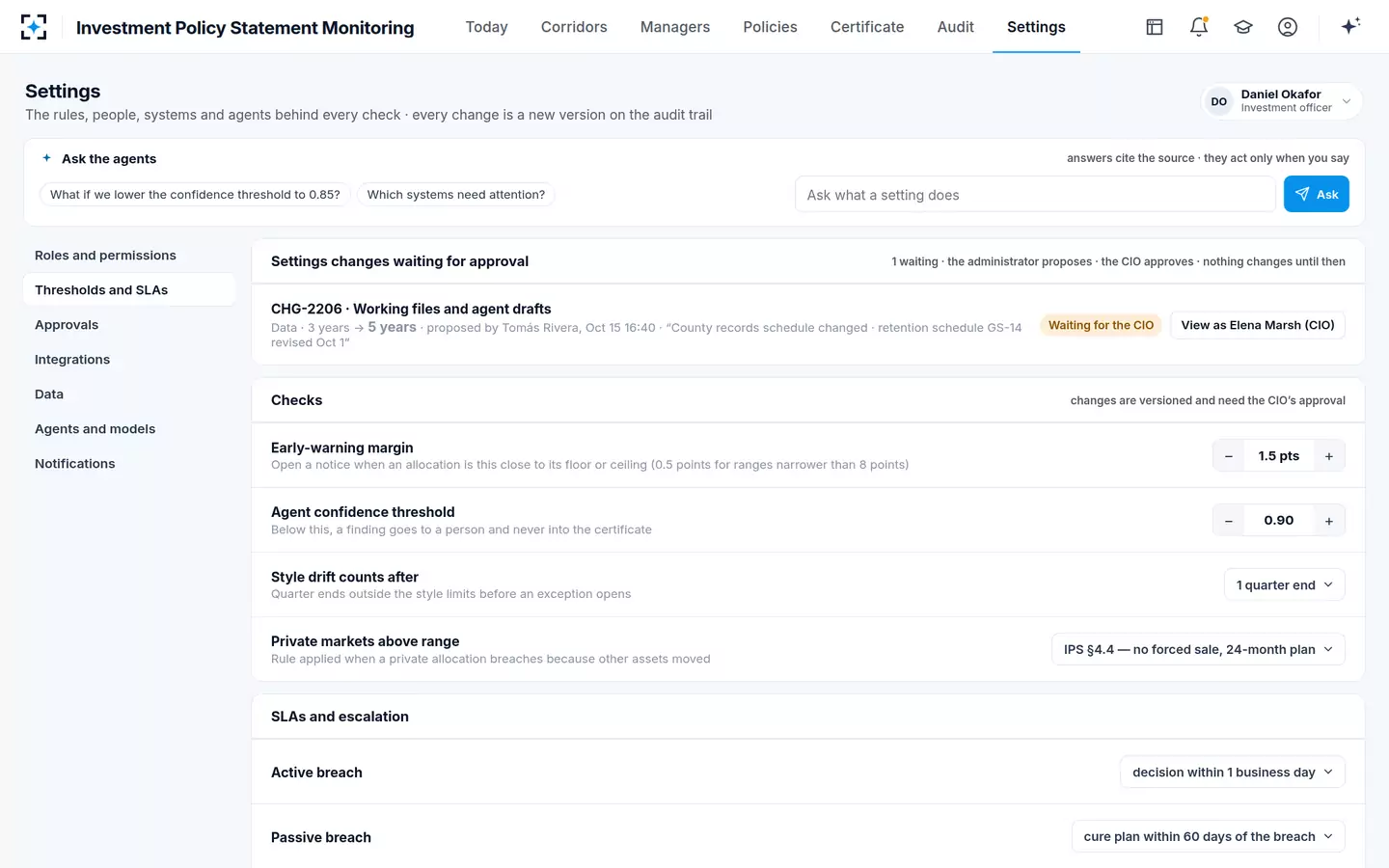
Thresholds and deadlines set once, before go-live, and changed only with a second approval
Go-live checklist for daily investment policy monitoring
Nine things to have in hand before the first live morning
- The current IPS and every manager agreement, with amendments and side letters
The signed versions, so every rule cites a document a reviewer can open.
- Answers to every ambiguity the reading raised
Each recorded with who decided and when; several are policy fixes worth making anyway.
- A custodian feed that reconciles to the dollar
For at least a full month of business days before go-live, with breaks explained.
- A rule for private fund values between statements
Latest statement rolled forward for calls and distributions, with the statement date shown.
- Every account mapped to one mandate and one plan
An unmapped account is the commonest source of a false breach or a missed one.
- Thresholds and deadlines approved
Early-warning margin, confidence threshold, style counting rule, breach deadlines and escalation.
- Roles assigned, with maker and checker
Who proposes, who approves, who signs and countersigns; no one approves their own proposal.
- A parallel run on the last closed quarter, differences explained
Every difference classed as a rule fix, a data fix or a breach the manual check missed.
- The first certificate drafted, traced and signed
Every figure opened to its source by the signer at least once.
A fund that wants to know which checks to run daily, and how to split them between agents and people, will find that in the investment monitoring software guide. To plan a go-live on your own policy, start from Investment Policy Statement Monitoring.
Questions people ask
What is pension fund administration software, and is this it?
Pension administration software manages members, contributions and benefit payments. Investment Policy Statement Monitoring is not that: it checks the investment portfolio against the fund's investment policy and manager guidelines every business day. A pension usually needs both, and the monitoring layer reads from the custodian rather than from the administration system.
What is a pension fund management system expected to report to the board?
At least the allocation against the policy's targets and ranges, compliance with the policy and manager guidelines, and the watch list, quarterly. Some public plans write it into policy: New Jersey PFRS's board receives quarterly updates on weights against targets and ranges, and Florida requires annual or more frequent reporting of investment activities.
Can we go live on one plan first?
Yes, and for a multi-plan system it is often the safer path. Start with the largest trust, where most mandates sit, and add the others once its reconciliation and parallel run are clean. The rules for shared managers carry over; only the plan-level ranges differ.
What happens when the custodian file is late?
The checks run on the latest reconciled holdings, and every figure that depends on the late file is labelled as such. In the sample, the private markets administrator's file was late, so private equity used June 30 values rolled forward, and each figure carried that note. A late feed past its deadline becomes an exception with an owner.
Who has to be involved from the fund?
An investment officer who owns policy compliance, the CIO for approvals, someone from operations who knows the custodian feed, and the private markets team for fund statements. The general consultant can review evidence and comment from the start, but approves nothing.