Investment monitoring software, in the sense an investment officer means it, checks a fund's holdings against its own investment policy statement and manager guidelines every business day: allocation ranges, prohibited holdings, liquidity floors, each manager's limits and the watch-list triggers. It is not a market-news or price-alert tool (those are portfolio monitoring tools of a different kind), and it is not the performance system, though it reads from both. The useful question when buying it is not which checks it automates but how the work divides: which tasks software can compute and cite, and which decisions must stay with a person whose name goes on the record. Botminds' Investment Policy Statement Monitoring gives the computing and citing to seven agents, and every cure, letter, watch-list placement, rule change and signature to people, with a second approver for each.
Figures from the product on this page come from a fictional sample, the $24.71 billion Ridgeline County Employees' Retirement System with 58 managers, as it runs through the solution in October 2026, or are labelled as Botminds' estimates.
Where one investment officer’s quarter goes, by hand and with agents doing the mechanical part
By hand: about 18 working days a quarter
- Re-keying limits and ticking them against holdings · 28%
- Gathering custodian files, GP statements, attestations · 22%
- Style drift and watch-list triggers · 17%
- Exception threads: cause, cure, approvals · 17%
- Writing and signing the certificate · 16%
With the agents: about 2.8 working days a quarter
- Re-keying limits and ticking them against holdings · 11%
- Gathering custodian files, GP statements, attestations · 18%
- Style drift and watch-list triggers · 18%
- Exception threads: cause, cure, approvals · 36%
- Writing and signing the certificate · 17%
Investment monitoring software for an investment policy: what it is, and what it is not
Policy monitoring answers one question every morning: is the fund inside the rules it set for itself? That makes it a different product from three things it is often confused with. Portfolio analytics and performance measurement tell you how the fund did; market and news monitoring tells you what moved; the order management system's pre-trade compliance stops a manager's trade before it happens. Policy monitoring sits after all three, at the asset owner, checking the whole fund and every mandate against the statement the board adopted.
The distinction matters when buying because each category reads different documents. Pre-trade compliance reads a manager's rule set; policy monitoring has to read the asset owner's IPS, every investment management agreement, every amendment and every side letter, often in more than one language, and keep them in step as they change. That is where most of the hand work in the split above sits, and where software either saves time or quietly creates a second, unofficial version of the policy.
What should investment monitoring software check daily?
Everything in the policy that is a number, every business day, against the custodian's holdings as of the prior close. The courts set the expectation in principle: a fiduciary must review its investments regularly, with the nature and timing of the review set by the circumstances (Tibble v. Edison International, 2015; what the duty to monitor asks). Public plans set it in practice; Washington's State Investment Board has staff review the asset allocation at least monthly and report to the board quarterly (WSIB Policy 2.10.050). Daily checking is now cheap enough that the question is why any numeric clause would wait for the month.
The daily checks an IPS implies, and who owns each half
| Check | What the agents compute and cite | What a person decides |
|---|---|---|
| Holdings complete and reconciled | Every position loaded and reconciled to the custodian’s total; late or stale feeds labelled on every figure that uses them | Whether to proceed on a late feed, and who chases it |
| Allocation against ranges | Each asset class against its floor and ceiling, with an early-warning margin; active or passive breach proved from transactions | The cure, within the policy, and its approval |
| Prohibited and authorized investments | Every holding screened against the permit and deny lists, each hit tied to the clause | Whether a hit is a breach or a data error, and the response |
| Liquidity floor | Liquid assets against projected net outflows and capital calls | Whether to raise cash, and from where |
| Manager guideline limits | Size, style, credit, duration and concentration limits per mandate, cited to the agreement | Whether to write to the manager, and what to ask |
| Watch-list triggers | Performance, style, people, organization, regulatory and uncured-breach triggers evaluated | Watch placement, retention or replacement |
| Rules in force | Each new amendment compared with the live rules; ambiguous wording raised as a question | Which reading is right; activating the rule |
The morning summary: what each agent checked before 7 a.m., with a citation on every figure
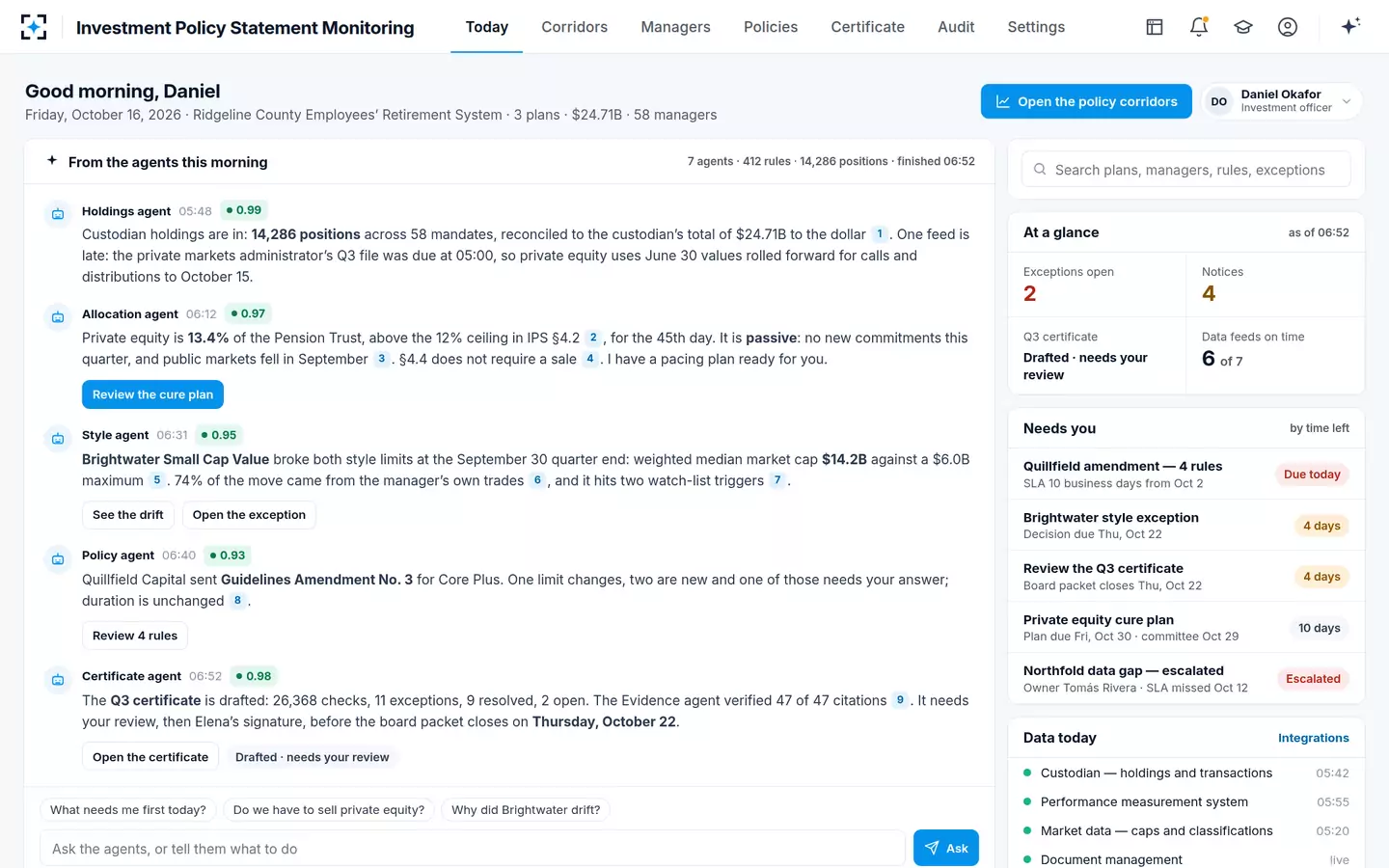
Who does each check: the agents' half and the people's half
The split in the opening figure is the real buying criterion. In Botminds' estimate for one investment officer covering about 60 mandates, the quarter's policy work falls from about 18 working days to about 2.8. Almost all of the saving is in tasks that are mechanical but consequential: re-keying limits, gathering files, ticking holdings against limits. What grows, as a share, is deciding exceptions: a sixth of the work by hand, over a third with the agents. That is the right direction. The software should shrink the time to an informed decision, not the decision.
The division in Investment Policy Statement Monitoring is fixed by role, not by preference. Seven agents read, load, check, measure, evaluate, recompute and draft; none of them trades, commits capital, sends a letter, places a manager on watch, activates a rule or signs. The investment officer approves, edits or rejects each finding with a reason code; the CIO approves cures, letters, watch-list changes and rule changes; the committee chair countersigns the certificate. The investment committee charter is where those lines should be written first.
How are manager guidelines coded?
Manager guidelines should be read into rules from the signed document, with each rule cited to its paragraph and nothing guessed. That sounds obvious, and it is where most monitoring systems are weakest: someone reads an amendment and types a number into a rules engine, and the link between the number and the paper is lost the day the person leaves.
A guideline amendment in Investment Policy Statement Monitoring, beside the rules it becomes
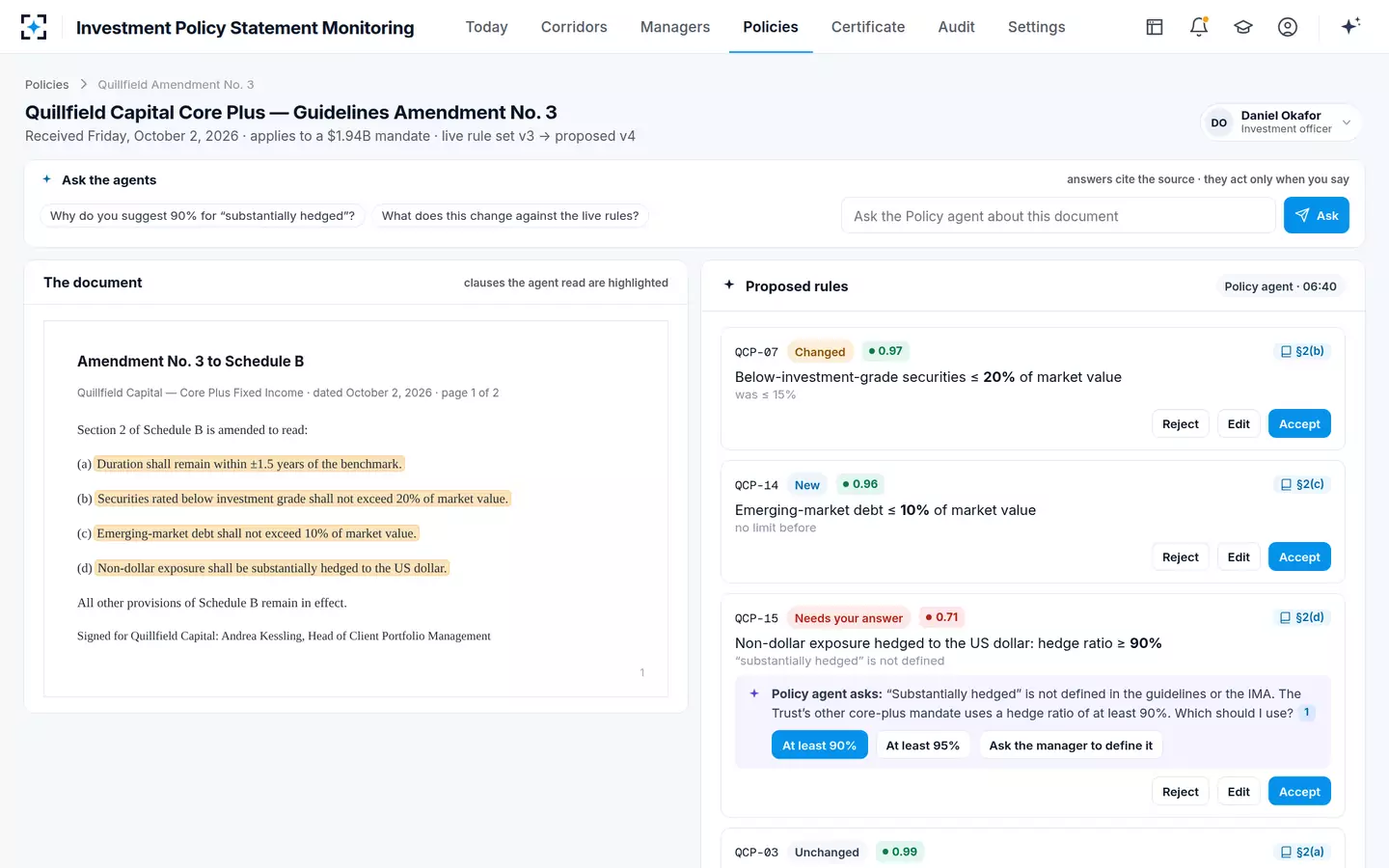
Ask any vendor to show this step on one of your own amendments. A system that can only take rules typed into a form leaves the reading, the riskiest part, to your staff and outside the audit trail. A system that reads the document but does not show the clause beside each rule leaves you trusting its reading. The test is whether a reviewer can open any rule and see the words it came from.
Who decides a cure? Never the software
Software can prove what happened and price what the policy allows; it should not choose. In the sample, private equity sits at 13.4% against a 12% ceiling. The Allocation agent proves the breach is passive, opens the clause that says no sale is required, and costs three cures: pacing 2027 commitments down to $550 million, selling about $330 million of fund interests at an estimated $26–40 million cost, or asking the board to widen the range. The investment officer picks the pacing cure with a reason code; the CIO approves it. The denominator effect guide follows that breach in full.
The reason is not only caution. A cure is a judgement about the fund's future, about liquidity, about the managers' next funds, and the law puts that judgement on fiduciaries by name. Software that "auto-cures" a breach has made a fiduciary decision nobody signed.
Checking the checker: recomputation before anyone reads a number
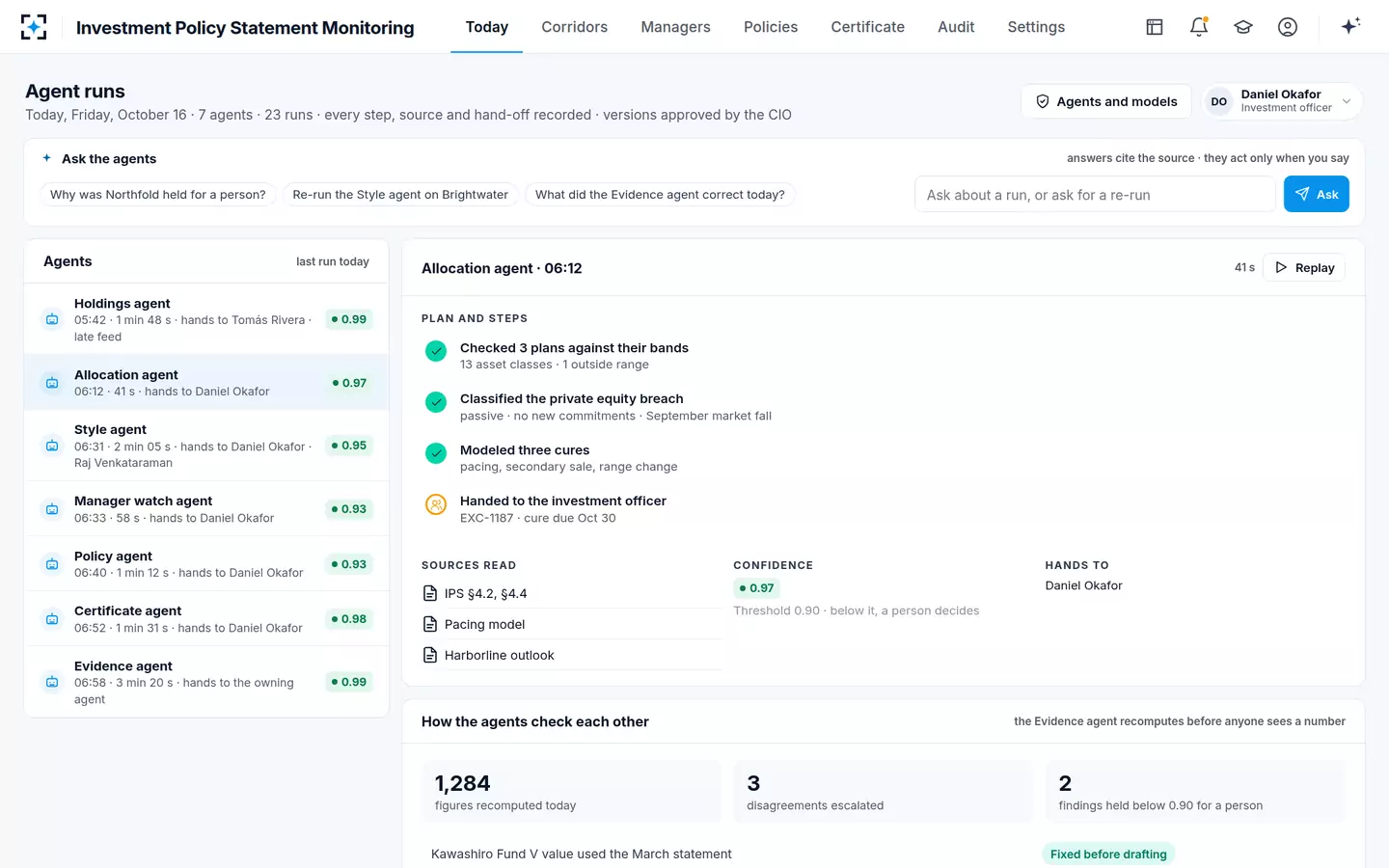
The most important agent in a monitoring system is the one that checks the others. In Investment Policy Statement Monitoring, the Evidence agent recomputes every figure from source and verifies every citation before a person or the certificate sees it. On the sample day it recomputed 1,284 figures, escalated 3 disagreements and held 2 findings below the 0.90 confidence threshold for a person. One correction is visible in the private equity exception: a fund had been carried on its March statement instead of June's, and was fixed before the investment officer saw the number.
One sample morning, checked before anyone read it
1,284
figures recomputed from source by the Evidence agent
3
disagreements between agents escalated to a person
2
findings held below the 0.90 confidence threshold for a person to decide
47of 47
citations in the quarterly certificate verified before the CIO signed
Every run, its sources, its confidence and who it handed to
What regulators expect of automated monitoring
Regulators do not object to automated monitoring; they expect it to be supervised. For SEC-registered advisers, which include any registered outsourced CIO a pension or endowment hires, the Division of Examinations said in its fiscal 2026 priorities that it would assess whether firms have adequate policies and procedures for supervising their use of AI, and that its reviews would also look at how firms use regulatory technology to automate internal processes (SEC Division of Examinations, FY2026 priorities).
The European Securities and Markets Authority described the use case directly in 2024: AI can support portfolio management by watching a portfolio's overall risk and keeping its characteristics in line with the client's profile (ESMA public statement, May 30, 2024; ESMA's words, and what they mean for a pension fund). The same statement puts responsibility for oversight on the firm's management body. For an asset owner the translation is simple: the agents may monitor, but someone accountable must be able to show how, and to override them.
What to ask before buying investment monitoring software
Ask to see your own documents run, not a demonstration portfolio. The checklist below is what we would ask of any vendor, including ourselves; it is weighted toward the parts of policy monitoring that fail quietly.
Ten questions to put to any investment monitoring software
- Will you read our IPS, IMAs, amendments and side letters?
In the languages they are written in, with each rule shown beside its source clause.
- What happens to wording you cannot read with confidence?
It should become a question to a named person, never a guessed number.
- Do you reconcile to the custodian before checking?
To the dollar, daily, with late or stale feeds labelled on every figure that uses them.
- How do you value private funds between statements?
Last statement rolled forward for calls and distributions, with the statement date visible.
- Can you tell an active breach from a passive one?
From transactions and price moves, with the clause that governs each.
- Do you measure style from holdings?
Weighted median cap and value–growth score, with drift split into trades and prices.
- Who can approve what, and can that be switched off?
Maker and checker on cures, letters, rules and settings; no role approves its own proposal.
- What checks your checks?
Independent recomputation of every figure and citation before anyone reads it.
- Can every number in the certificate be traced?
From the sentence to the holding, the statement page or the clause, by the signer.
- What is kept, and for how long?
Who, what, when, why and which evidence, append-only, for the retention period your rules require.
Where Investment Policy Statement Monitoring fits, and where it does not
It fits an asset owner, or an OCIO acting for one, that runs money under a written policy through several external managers and custodians, and wants every numeric clause checked daily with the evidence attached. Pensions, endowments and foundations are the obvious cases; the sample is a public pension with three plans and 58 managers.
It does not replace the systems it reads from. The custodian remains the book of record, the performance system still calculates returns, and a manager's own pre-trade compliance still stops its trades. It does not replace the general consultant's judgement on managers or allocation; it gives the consultant holdings-based evidence and a place to comment. And it does not make decisions. If the goal is a system that rebalances or cures on its own, this is the wrong product, deliberately.
The go-live path, from documents to a first signed certificate, is set out in the pension fund management software guide. To see the checks run on your own policy, start from Investment Policy Statement Monitoring.
Questions people ask
What is the difference between an investment monitoring system and a portfolio monitoring tool?
A portfolio monitoring tool usually watches prices, news and risk for holdings. An investment monitoring system for an asset owner checks the portfolio against its own policy: ranges, prohibitions, liquidity, manager guidelines and watch-list triggers, each tied to the clause it comes from. Many funds need both; they answer different questions.
What does a pension investment monitoring system need to connect to?
The custodian's daily holdings and transactions, the performance measurement system, private markets administrators and GP statements, the document store holding the IPS and agreements, market data for caps and classifications, and the board portal for the certificate. In the sample, six of seven feeds arrived on time, and the late one was labelled on every figure that used it.
Does monitoring software replace the investment consultant?
No. It replaces the hand work of checking limits and assembling evidence, and gives the consultant holdings-based facts to advise on. In the sample, the general consultant reviews the style drift and the trades behind it and comments; it cannot approve or change anything.
Can investment monitoring software check private equity?
It can check the allocation and the cause of any breach, if it values private funds consistently between statements. The sample uses each fund's latest capital account statement rolled forward for calls and distributions, reads statements in five languages, and recomputed a 13.41% weight from 96 statements before reporting it.
How often should investment policy compliance be checked?
Every business day for every numeric clause, because breaches start on a trading day, not a reporting date. Courts describe the duty to review as regular and dependent on circumstances, and public plans like Washington's already ask staff for at least monthly allocation reviews.