An investment policy statement for nonprofits covers everything a pension statement does, objectives, ranges, permitted investments, liquidity, managers and review, and then adds four things a pension never needs: a spending policy, a map of donor-restricted funds, a payout rule if the organization is a private foundation, and an account of what the board delegates and how it watches the delegate. Those additions are where nonprofit boards are most exposed, because the law asks them to show their reasoning, not just their results. Botminds' Investment Policy Statement Monitoring reads the statement into rules cited to their clauses and checks the portfolio against them every business day, whether the fund behind it is a pension, an endowment or a foundation, and drafts the board's quarterly certificate with every figure traced to a holding.
The statutes quoted here are New York's version of the uniform prudent-management act, Article 5-A of the Not-for-Profit Corporation Law, and the federal private-foundation rules. Other states' versions differ in detail, so read your own state's text before you copy a clause.
Six clauses a nonprofit investment policy statement needs that a pension's does not
- A spending policy tied to the investment policy
New York lists “the investment policy of the institution” among the factors a board weighs each time it appropriates from an endowment.
- A record of every appropriation decision
The board must keep “a contemporaneous record” of how it considered each factor, so the policy should say who writes it and where it is kept.
- A map of donor-restricted funds
Which gifts are permanent endowments, which have a spending rate in the gift instrument, and which are board-designated only.
- Grant-driven liquidity
A floor sized to the next twelve to twenty-four months of grants and operating draws, not to benefit payments.
- The payout, for a private foundation
The 5% minimum investment return and the assets it is measured on, valued monthly where market quotations exist.
- Delegation and how it is watched
What an outsourced manager may decide, how the board monitors “performance and compliance,” and the 60-day termination right.
Investment policy statement for nonprofits: what it adds to a pension's
A pension's IPS serves one obligation: benefits promised to members, discounted at an assumed rate. A nonprofit's serves several at once, and they pull in different directions. The endowment must support this year's programs, preserve purchasing power for future ones, honor each donor's terms and, for a private foundation, pay out enough to keep its tax position. Every one of those is a clause the board will be asked to show it followed.
That is why the nonprofit version is not a shorter pension IPS with "grants" in place of "benefits." The allocation and manager clauses look the same; the clauses about spending, restrictions and delegation do not exist in a pension statement at all. The clause-by-clause anatomy of an investment policy statement covers the shared core; this guide covers the rest.
Pension IPS and nonprofit IPS, clause by clause
Defined benefit pension: Benefits set by plan terms, forecast by the actuary.
Endowment or foundation: Grants and operating draws set each year by the board, under a spending policy.
Defined benefit pension: The actuarial assumed rate.
Endowment or foundation: Spending rate plus inflation plus costs, so that purchasing power is preserved.
Defined benefit pension: One trust; assets pooled for all members.
Endowment or foundation: Many gift instruments, some permanent, some with their own spending terms.
Defined benefit pension: None beyond paying benefits when due.
Endowment or foundation: For a private foundation, a 5% minimum investment return under §4942.
Defined benefit pension: ERISA or a state pension code.
Endowment or foundation: The state’s prudent-management act, plus §4944 for private foundations.
Defined benefit pension: Documented process; minutes.
Endowment or foundation: In New York, a contemporaneous record of each appropriation decision.
Does a nonprofit need a written investment policy?
In New York, yes, by statute: "Each institution shall adopt a written investment policy setting forth guidelines on investments and delegation of management and investment functions in accord with the standards of this article" (N-PCL §552(f)). In states whose version of the uniform act has no such sentence, the board still has to show it managed the fund prudently, and a written policy is the usual evidence that it did.
Note what New York's sentence covers. It asks for guidelines on two things, investments and delegation, which is a stronger requirement than most boards' existing documents meet. A statement that sets an allocation but is silent on what the investment committee may decide, or what an outsourced manager may do without asking, does not satisfy the second half.
The numbers a nonprofit investment policy has to live with
7%
a year: spending above this share of a New York endowment’s five-year average value is presumed imprudent
5%
minimum investment return a private foundation must pay out on its non-charitable-use assets
60days
longest notice a New York delegation contract may require before the board can end it without penalty
35,755
nonprofits in the first broad study of endowment returns, covering 2009 to 2018
The eight factors a nonprofit investment policy must weigh
New York's statute lists eight factors the board must consider "if relevant" in managing and investing an institutional fund, and a well-built IPS turns each into a clause rather than leaving it to the minutes (N-PCL §552(e)(1)). They are general economic conditions; the possible effect of inflation or deflation; expected tax consequences; "the role that each investment or course of action plays within the overall investment portfolio of the fund"; expected total return from income and appreciation; other resources of the institution; the needs of the institution and the fund to make distributions and preserve capital; and an asset's special relationship or value to the institution's purposes.
Two rules in the same section shape how the policy is monitored. Decisions about an individual asset "must be made not in isolation but rather in the context of the institutional fund's portfolio of investments as a whole," which is the statutory case for checking allocation bands rather than single holdings. And an institution that chooses not to diversify must "review a decision not to diversify as frequently as circumstances require, but at least annually," a requirement that often lands on a gifted block of founder's stock or a building, and that belongs on the policy's calendar with an owner and a date.
The section also asks the institution to "make a reasonable effort to verify facts relevant to the management and investment of the fund." For a board that relies on its consultant's quarterly book, that is a pointed sentence. A figure the board cannot trace to a holding is a fact nobody verified.
UPMIFA spending policy: the 7% presumption and the contemporaneous record
The spending clause is where nonprofit law is most specific. New York lets an institution appropriate "so much of an endowment fund as the institution determines is prudent," but requires it to weigh eight factors each time, ending with "the investment policy of the institution," and then adds: "For each determination to appropriate for expenditure, the institution shall keep a contemporaneous record describing the consideration that was given by the governing board to each of the factors enumerated in this paragraph" (N-PCL §553(a)).
The statute also draws a line. Spending in any year of "an amount greater than seven percent of the fair market value of an endowment fund," measured on values "determined at least quarterly and averaged over a period of not less than five years," creates "a rebuttable presumption of imprudence." The same subsection is careful to say it does not "create a presumption of prudence" for spending at or below seven percent. A 4% or 5% spending rule is therefore not a safe harbor; it is a rate the board still has to justify.
For monitoring, that means three calculations belong in the policy and in the quarterly report: the trailing average market value on the statute's basis, the year's appropriations as a percentage of it, and the date and location of the contemporaneous record. A spending rule that cannot be recomputed from holdings and board minutes will not survive the first donor complaint.
Private foundation investment policy statement: the 5% payout and jeopardizing investments
A private foundation's statement has a federal floor and a federal standard on top of state law. The floor is the minimum investment return: "5 percent of the excess of" the fair market value of the foundation's assets not used directly in its exempt purpose over related acquisition debt, with securities that have market quotations valued "on a monthly basis" (26 U.S.C. §4942(e)). The IPS's return target and liquidity floor must both clear it.
The standard is the jeopardizing-investment rule. An investment jeopardizes the foundation's exempt purposes if its managers "failed to exercise ordinary business care and prudence, under the facts and circumstances prevailing at the time of making the investment" (26 CFR 53.4944-1(a)(2)). The regulation says that "No category of investments shall be treated as a per se violation," judges each investment "taking into account the foundation's portfolio as a whole," and names methods that "will be closely scrutinized," among them trading on margin, commodity futures, puts, calls and straddles, warrants and selling short.
Two features of that regulation belong in the foundation's IPS. First, the judgement is made "as of the time that the foundation makes the investment and not subsequently on the basis of hindsight," which rewards a policy that records why each scrutinized strategy was approved. Second, the list of scrutinized methods is a ready-made permit list: a foundation that wants to use any of them should name it in the policy, with limits, rather than let a manager decide.
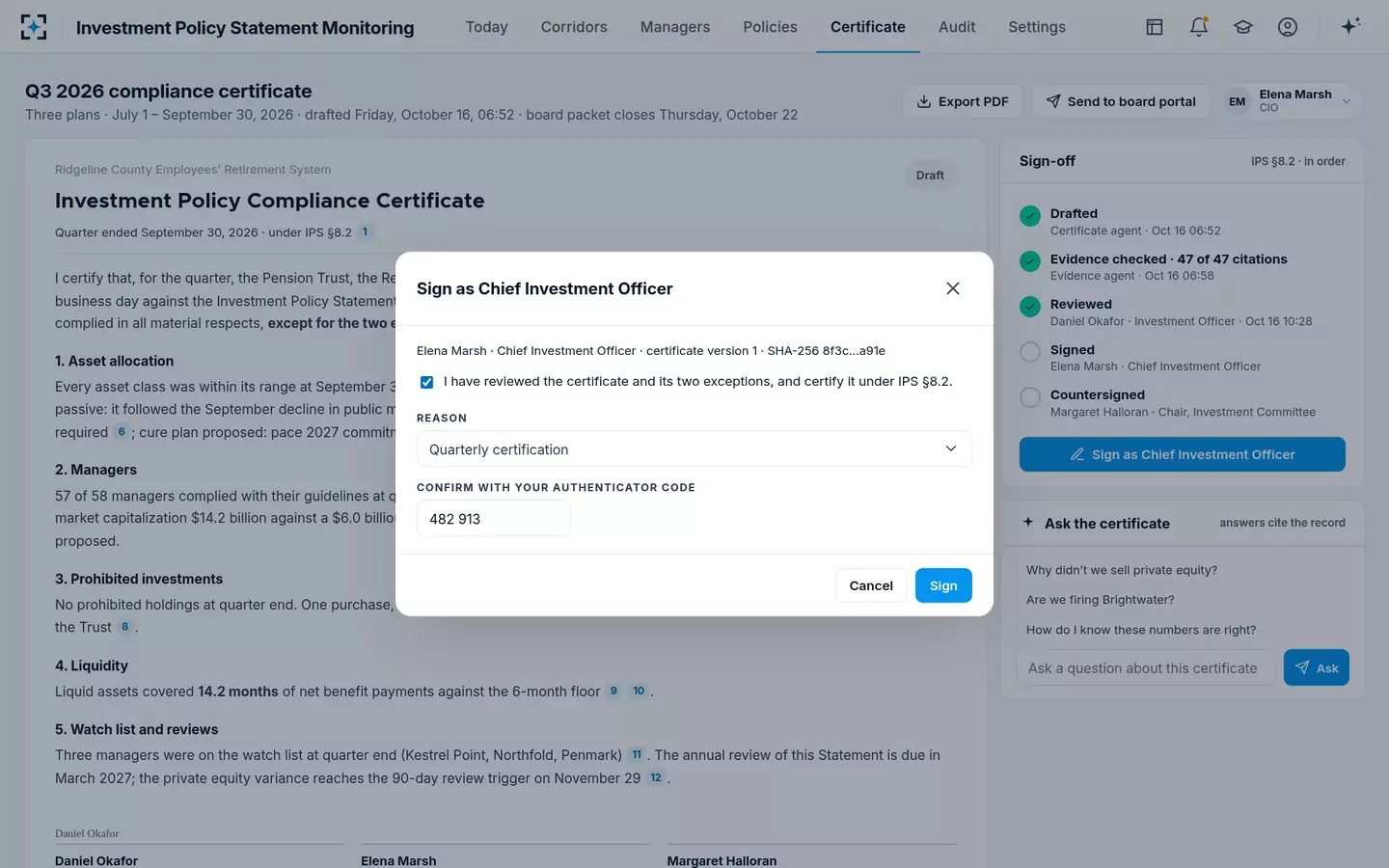
A quarterly certificate from Investment Policy Statement Monitoring that a board chair can question
Donor restrictions: why one endowment is many funds
A pension trust is one pool; an endowment is a set of gift instruments that happen to be invested together. New York allows pooling, "An institution may pool two or more institutional funds for purposes of management and investment," but the restrictions travel with each gift (N-PCL §552(d)). A gift that names a spending rate, or that directs the board to use only "income," limits what the board can appropriate from that fund even when it shares a portfolio with unrestricted money.
The IPS should say how those funds are tracked inside the pool: units or shares per fund, how gains are allocated, and which funds are below their historic dollar value. It should also say which donor terms the investment program itself must honor, such as a gift that excludes a sector. Those are investment restrictions on part of the pool, and they are the ones most easily lost when a manager is replaced.
Which benchmark? Endowments against a simple 60-40 mix
The benchmark clause matters more for nonprofits than most boards assume, because the evidence on endowment returns is uncomfortable. A study that its authors call "the first estimates of investment returns and distribution rates for U.S. non-profit endowments," covering 35,755 organizations from 2009 to 2018, found that they "badly underperform market benchmarks during our sample period": a portfolio long the endowments and short "60-40 mix of U.S. equity and Treasury bond indexes" earned a mean −4.20% a year (Dahiya and Yermack, NBER Working Paper 25323, a working paper revised in April 2021).
Endowments trailed a simple index mix in 2009–2018
The two numbers answer different questions. The −4.20% is what the board would have seen comparing its fund to a passive 60-40 mix over a period that, in the authors' words, "saw a sharp drop followed by a lengthy appreciation in public equity values"; the −0.39% is what remains after adjusting for the fund's actual exposures to global stocks and hedge funds. The authors also report that "Smaller endowments have less negative alphas than larger endowments, but all size classes significantly underperform," and that distribution ratios were "conservative, well below the funds' long-run returns."
The policy lesson is not that endowments should hold 60-40. It is that the IPS should name a simple, investable reference portfolio alongside the policy benchmark, so that the committee sees each year what its active and alternative choices added or cost. That comparison is cheap to compute daily and almost never appears in a board book.
Delegating to an outside manager: what the board still monitors
Many nonprofits hand day-to-day investment to an outsourced chief investment officer or a single discretionary manager. New York permits that, but the board must act with prudence in "selecting, continuing or terminating an agent," in "establishing the scope and terms of the delegation," and in "monitoring the agent's performance and compliance with the scope and terms of the delegation" (N-PCL §554(a)). A board that complies is not liable for the agent's decisions; one that cannot show it monitored has no such protection.
The statute also writes the exit into every contract: each must provide that it "may be terminated by the institution at any time, without penalty, upon not more than sixty days notice," and a contract delegating to the corporation's own committees, officers or employees must carry the same 60-day term (N-PCL §514). The IPS is where "scope and terms" live, so it is also what the board monitors the agent against. Who on the board approves a change to that scope belongs in the investment committee charter.
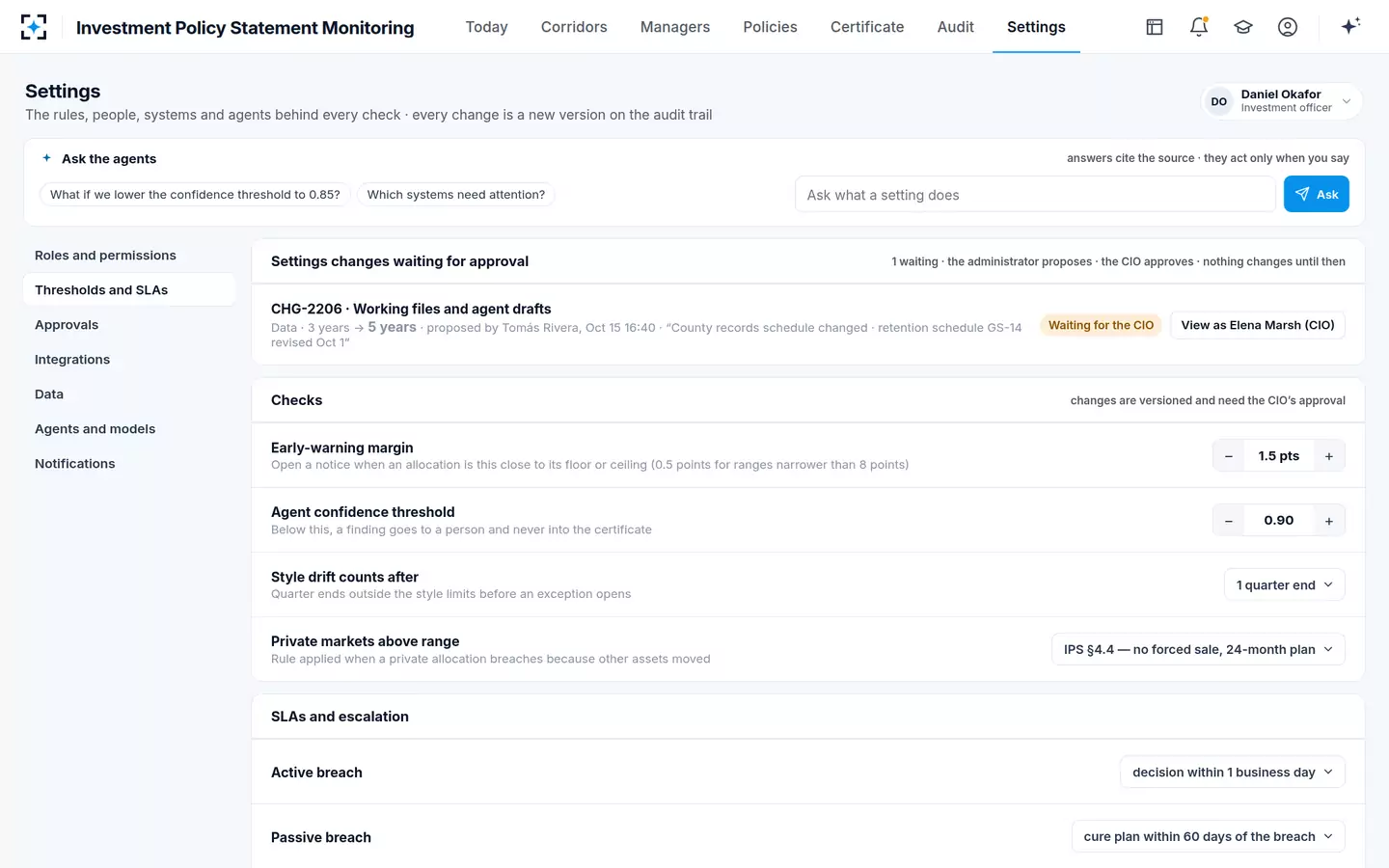
Thresholds and deadlines in Investment Policy Statement Monitoring, changed only with a second approval
How often should a nonprofit review its IPS?
New York sets no fixed cycle for the policy itself, but it sets one inside it: any decision not to diversify must be reviewed "at least annually." Most boards review the whole statement once a year as well, and the useful addition is a set of triggers in between, such as a gift that changes the fund's size or liquidity, a change in spending rate, an allocation out of range for a set number of days, or a new outsourced manager.
The triggers are what daily monitoring makes enforceable. A board that reviews once a year learns in its annual meeting that the private equity sleeve spent two quarters above its ceiling; the denominator effect explains why that happens to endowments more than most. A board whose statement names the trigger is told the week it fires.
To see a policy statement read into rules and checked against holdings, start from Investment Policy Statement Monitoring.
Questions people ask
Is an investment policy statement for charities different from one for a foundation?
The investment clauses are the same; the payout clause is not. A private foundation must meet the 5% minimum investment return under §4942 and the jeopardizing-investment standard under §4944, which a public charity does not. Both are bound by their state's prudent-management act for endowment funds.
Where can I find an investment policy statement template for nonprofits?
The most reliable outline is the statute itself: New York's §552(e)(1) lists the eight factors to address and §552(f) requires guidelines on investments and on delegation. A template that does not have a spending section, a donor-restriction section and a delegation-monitoring section is a pension template with the word changed.
What is UPMIFA compliance?
It means managing, spending from and delegating endowment funds the way the state's version of the uniform act requires: weighing the listed factors, diversifying unless there is a reason not to, and, in New York, keeping a contemporaneous record of each spending decision. New York presumes spending above 7% of the five-year average value imprudent.
Can a nonprofit invest in private equity?
Yes. New York lets an institution "invest in any kind of property or type of investment consistent with this article," and the federal rule for private foundations says no category of investment is a per se violation. The policy should set a range for private assets, a valuation rule and what happens when the allocation goes out of range on its own.
Does a 4% spending rate make spending prudent?
No. New York's statute says the 7% presumption does not "create a presumption of prudence" for lower rates. The board still has to consider the factors in §553(a) each time it appropriates and keep a contemporaneous record of how it did.