The ERISA duty to monitor is a fiduciary's continuing obligation to review the plan's investments at regular intervals and remove imprudent ones within a reasonable time; it exists, the Supreme Court held in 2015, "separate and apart from the trustee's duty to exercise prudence in selecting investments at the outset." Because the duty continues, so does the exposure: a claim that a committee kept an imprudent option is timely if the failure to monitor fell within the six years before suit, however long ago the option was chosen. What not looking costs is therefore measured in years of fees and returns a court can reach, and in the evidence a committee cannot produce. Botminds' Investment Policy Statement Monitoring checks every portfolio and manager against the investment policy statement each business day and keeps, for every exception and every quarter, the evidence of what was checked, what was found and who decided. This guide is not legal advice.
Where this guide uses the product, the figures come from a fictional sample, Ridgeline County Employees' Retirement System, as it runs through the solution in October 2026. The law is quoted from the Supreme Court's opinions, the statute, the regulation and the Federal Register, linked where it appears.
From Tibble to Intel: six moments in eleven years of the duty to monitor
- Tibble decidedMay 2015
- Hughes decidedJan 2022
- DOL duties ruleDec 2022
- Intel: review grantedJan 16, 2026
- DOL menu proposalMar 31, 2026
- Intel argued; pendingOct 6, 2026
What is the duty to monitor under ERISA?
The duty to monitor is part of ERISA's duty of prudence: a fiduciary must act "with the care, skill, prudence, and diligence under the circumstances then prevailing that a prudent man acting in a like capacity and familiar with such matters would use" (29 U.S.C. §1104(a)(1)(B)). That sentence does not use the word "monitor." The Supreme Court found the duty in the trust law ERISA draws on, and the Department of Labor's guidance to employers says that even where participants choose their own investments, "the fiduciary retains the responsibility for selecting and monitoring the investment alternatives that are made available under the plan" (EBSA, Meeting Your Fiduciary Responsibilities).
The duty has two parts that a committee should keep separate in its procedures. One is to review: regularly, with the nature and timing set by circumstances. The other is to act: to remove an investment that the review shows is imprudent, within a reasonable time. A committee that reviews and never acts fails the second part; one that acts only when a consultant raises a problem may fail the first.
Under trust law, a trustee has a continuing duty to monitor trust investments and remove imprudent ones. This continuing duty exists separate and apart from the trustee's duty to exercise prudence in selecting investments at the outset.
Tibble v. Edison International, 575 U.S. 523 (2015)
Tibble v. Edison International (2015): why keeping an option restarts the clock
Tibble decided when the six-year limitations period starts for a fund that was imprudent from the day it was added. ERISA bars a claim filed more than six years after the last act that formed part of the breach (how ERISA's limitation periods run). The lower courts had held that claims over three retail-class funds added in 1999 were too late, because the funds were chosen more than six years before the 2007 suit. The Supreme Court unanimously disagreed: "So long as a plaintiff's claim alleging breach of the continuing duty of prudence occurred within six years of suit, the claim is timely" (Tibble).
The Court leaned on trust treatises to describe what the duty involves. The trustee "cannot assume that if investments are legal and proper for retention at the beginning of the trust, or when purchased, they will remain so indefinitely," and must "systematic[ally] conside[r] all the investments of the trust at regular intervals." It also quoted the Uniform Prudent Investor Act's comment that "[m]anaging embraces monitoring."
Tibble left one question open on purpose: "We express no view on the scope of respondents' fiduciary duty in this case." The Court did not say how often, or how deeply, a committee must look. That gap is why a plan's own investment policy statement and watch-list criteria carry so much weight: they are the committee's written answer to the question the Court did not settle.
Hughes v. Northwestern (2022): a broad menu does not excuse an imprudent option
Hughes extended Tibble to every option on a defined contribution menu. The Seventh Circuit had dismissed claims against Northwestern's plans partly because participants could have chosen the low-cost options also on offer. The Supreme Court vacated that ruling: "Such a categorical rule is inconsistent with the context-specific inquiry that ERISA requires and fails to take into account respondents' duty to monitor all plan investments and remove any imprudent ones" (Hughes, 595 U.S. 170 (2022)).
The holding is short and the practical effect large. "If the fiduciaries fail to remove an imprudent investment from the plan within a reasonable time, they breach their duty." The Department of Labor read it the same way in March 2026: "the Supreme Court unanimously affirmed that ERISA fiduciaries have a continuing obligation to monitor all plan investments--not just a subset" (91 FR 16088). A committee's monitoring has to reach the options nobody uses as well as the popular ones.
ERISA section 404(a)(1)(D): the policy you adopt becomes the standard
Section 404(a)(1)(D) requires fiduciaries to follow the plan's governing documents, so far as they are consistent with ERISA (the clause, and what it does to an adopted policy). For monitoring, that turns an adopted investment policy statement into a second standard. If the statement says the committee reviews each option quarterly against named criteria, a court can ask for the quarterly reviews; if it sets a watch list, the court can ask what was on it.
The Department's current investment-duties regulation shows the Department reading the section that way: it says a pooled-fund manager facing conflicting policy statements must, under §404(a)(1)(D), "reconcile, insofar as possible, the conflicting policies" (29 CFR 2550.404a-1(d)(4)(ii)). That 2022 text was still the regulation in October 2026. The Department's regulatory agenda lists a rewrite of the same section at the proposed-rule stage, but no proposal had appeared in the Federal Register by October 28, 2026 (RIN 1210-AC37).
How often must plan investments be reviewed?
No statute or regulation sets a number. Tibble describes "a regular review" with "the nature and timing of the review contingent on the circumstances," and the Department of Labor's March 2026 proposal refers to "ERISA's well-established duty for fiduciaries to monitor designated investment options at regular intervals after their selection." The public plans quoted in these guides report to their boards quarterly; the stronger answer is a quarterly review plus triggers between meetings, so that a manager departure or a broken guideline does not wait for the calendar.
What the cases make clear is that frequency alone is not the test. A committee that met every quarter but looked only at trailing returns could still miss the fee and share-class issues Tibble and Hughes were about. The review has to cover what can make an option imprudent: cost, share class, manager and process changes, adherence to the mandate, and performance against a fitting benchmark.
What is Anderson v. Intel about?
Anderson v. Intel Corp. Investment Policy Committee asks what a participant must allege to bring an underperformance claim. The question presented is "Whether, for claims predicated on fund underperformance, pleading that an ERISA fiduciary failed to use the requisite “care, skill, prudence, or diligence” under the circumstances and thus breached ERISA’s duty of prudence when investing plan assets requires alleging a “meaningful benchmark.”" (Supreme Court, No. 25-498, question presented).
The Ninth Circuit had dismissed the claim, which concerned Intel's use of hedge funds and private equity inside diversified target date funds; in the Department of Labor's summary, the dismissal "suggested that a fiduciary's inclusion of investments in hedge funds and private equity funds, as part of a diversified target date fund, was not inconsistent with prudence because the plan followed a prudent process." The Court granted review on January 16, 2026 and heard argument on October 6, 2026, with an Assistant to the Solicitor General arguing for the United States as amicus curiae on the respondents' side (docket 25-498). The Court had not decided the case when this guide was written; check the docket for the current status before relying on any reading of it.
The dates a committee should have on its calendar
6years
limitations period for a breach, which Tibble measures from each failure to monitor, not from the selection
Jan 16
2026: the Supreme Court grants certiorari in Anderson v. Intel
Oct 6
2026: argument in Anderson v. Intel; decision pending
Jun 1
2026: comments closed on DOL’s proposal for choosing menu options, which is not final
What the DOL's 2026 proposal changes, and what it leaves alone
The Department of Labor's March 31, 2026 proposal "provides a safe harbor for, a fiduciary's duty of prudence under the Employee Retirement Income Security Act of 1974 (ERISA) in connection with selecting designated investment alternatives." It lists six factors and says that when a fiduciary "objectively, thoroughly, and analytically considers, and makes a determination following the described process" on any of them, "its judgment regarding the factor or factors is presumed to be reasonable and is entitled to significant deference" (91 FR 16088). Comments closed on June 1, 2026; the rule was not final in October 2026.
The proposal is explicit about its limit: it "does not address ERISA's well-established duty for fiduciaries to monitor designated investment options at regular intervals after their selection." The Department said it "anticipates issuing interpretive guidance in the near term" on monitoring, and that it "generally is of the view" that the proposal's factors and processes apply to the ongoing duty. We found no such guidance in the Federal Register by October 28, 2026. For a committee, the signal is still useful: the Department is framing prudence as a documented process, which is exactly what monitoring evidence shows.
What not looking costs: the arithmetic of a missed review
A missed review costs what the imprudent option took from participants for as long as it stayed, measured back from the suit. Tibble's facts are the template: retail share classes kept when cheaper institutional classes of the same funds were available. The arithmetic below is illustrative, not drawn from any case, but it shows why a continuing duty makes delay expensive.
Illustrative: what one unreviewed share class costs over a six-year window
| Step | Calculation | Result |
|---|---|---|
| Assets in the option | Held flat for simplicity | $40,000,000 |
| Extra cost of the retail class | Expense ratio difference against the institutional class | 0.25 points a year |
| Annual excess fees | $40,000,000 × 0.25% | $100,000 |
| Six years, no growth | $100,000 × 6 | $600,000 |
| Six years, with lost growth at 6% | $100,000 × ((1.06⁶ − 1) ÷ 0.06) | about $697,500 |
The bigger cost is often not the fee gap but the absence of evidence. A committee that cannot show what it reviewed, when, and why it kept an option has to defend its process with recollection. The Department's guidance puts the remedy in one line: document the process, because the record is how a fiduciary shows the duty was carried out (what minutes should record). The watch list criteria guide covers how to write the triggers so that the evidence exists.
A certificate from Investment Policy Statement Monitoring whose every sentence traces to a check
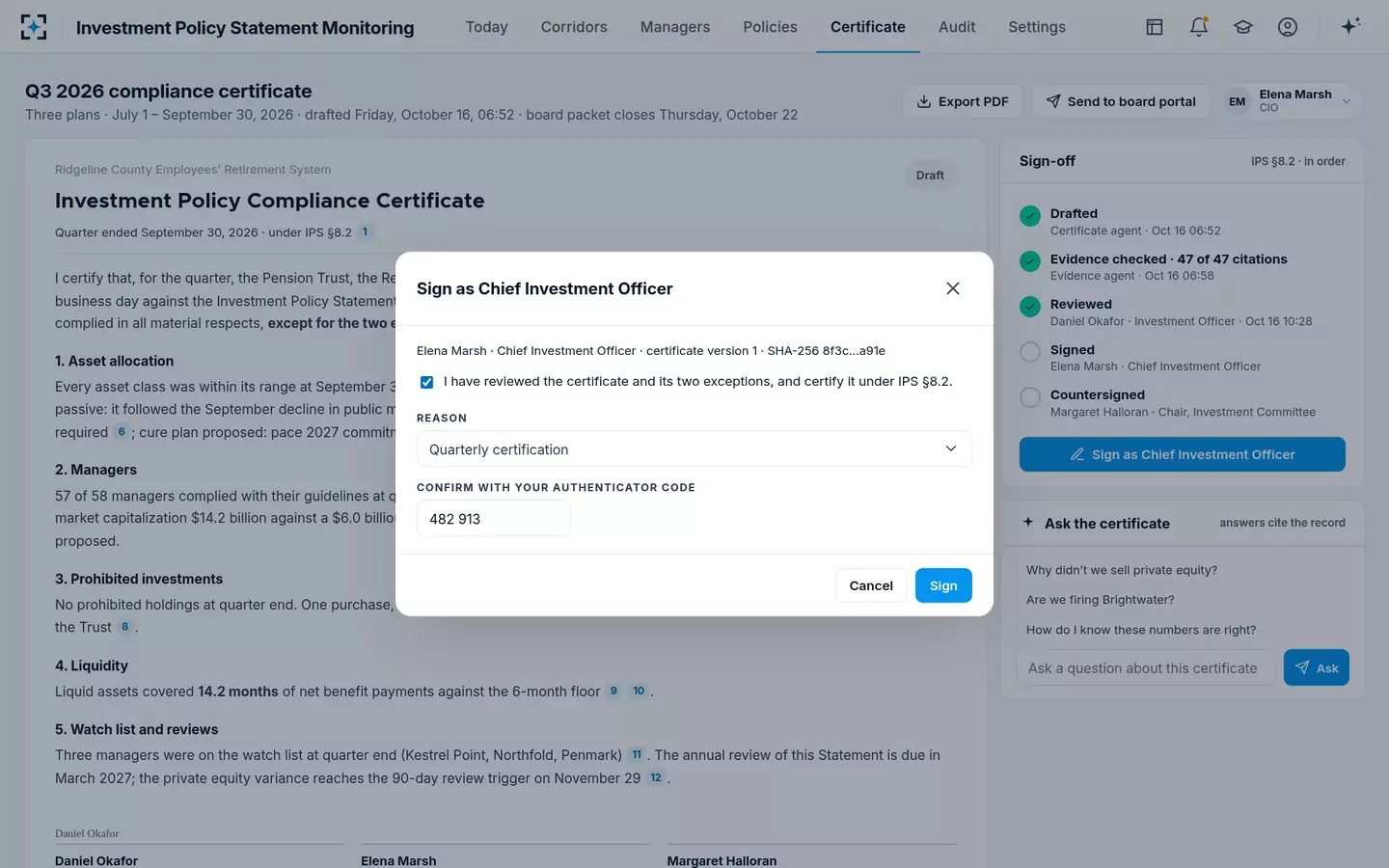
The evidence a committee needs to show it looked
The evidence of monitoring is not a binder of consultant reports; it is a trail from each review to what was found and what was decided. Built daily, it costs little. Built after a demand letter, it cannot be built at all.
Eight pieces of evidence that show a committee monitored
- The criteria, adopted before they were needed
The IPS and watch-list criteria in force on each date, with their versions.
- What was checked, and how often
Each rule, each date, each result, against custodian holdings for that date.
- Every exception with its cause
Breach or trigger, the evidence, and the clause it falls under.
- Every decision with its reason
Retain, watch, cure, replace, and why; including decisions not to act.
- Who proposed and who approved
Different people, named, with dates.
- Fees and share classes reviewed
The options compared and the cheaper class considered, quarter by quarter.
- What the committee received
The certificate and exceptions in each board packet, with every figure traceable.
- Questions asked, and answers given
Committee members’ questions on the evidence, kept with it.
The committee chair questions an Investment Policy Statement Monitoring certificate before countersigning
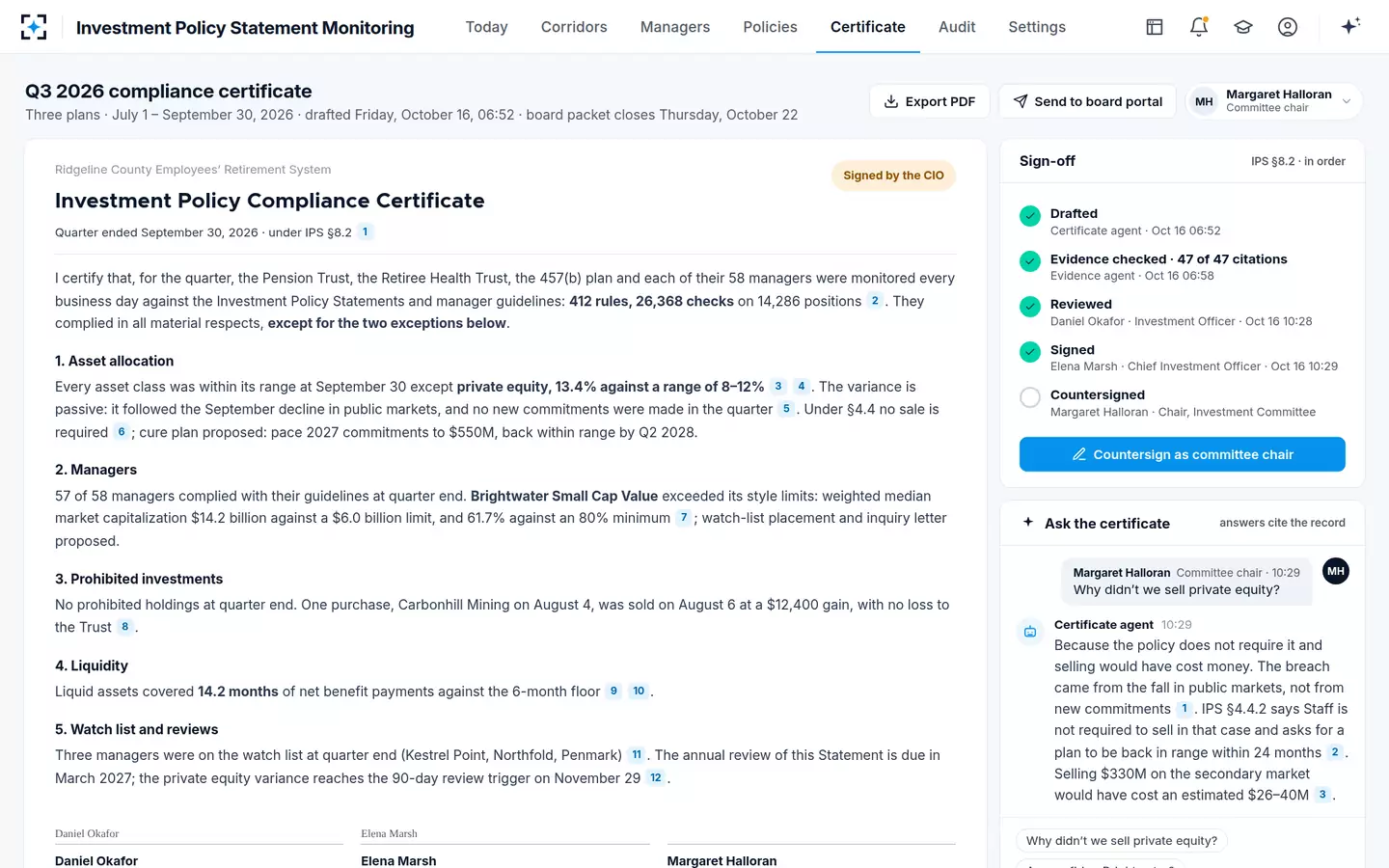
To see a policy checked daily and its evidence kept, start from Investment Policy Statement Monitoring. The investment committee charter guide covers who should approve what.
Questions people ask
What did Tibble v. Edison International decide in 2015?
That ERISA fiduciaries have a continuing duty to monitor plan investments and remove imprudent ones, separate from the duty to choose prudently, so a claim based on a failure to monitor is timely if that failure occurred within six years of suit. The case concerned retail share classes kept when institutional classes were available. The Court did not define how much review is required.
What does ERISA section 404(a)(1)(D) require?
That fiduciaries follow the plan's governing documents, so far as those documents are consistent with ERISA. An adopted investment policy statement is typically read as one of them, so its review cycle and criteria become standards the committee can be measured against.
Does offering a broad menu excuse an imprudent option?
No. In Hughes v. Northwestern University the Supreme Court held that having low-cost options on the menu did not excuse keeping imprudent ones, because fiduciaries must monitor all plan investments and remove any imprudent ones within a reasonable time.
Does the duty to monitor apply to an investment manager the plan appointed?
Yes. Appointing a qualified investment manager relieves trustees of liability for the manager's individual decisions, but the Department of Labor's guidance says the employer must still monitor the manager periodically. The appointing fiduciary's own prudence in continuing the appointment remains open to challenge.
Has the Supreme Court decided Anderson v. Intel?
Not as of October 28, 2026. The Court granted review on January 16, 2026 and heard argument on October 6, 2026 on whether an underperformance claim must allege a "meaningful benchmark." Check the Supreme Court's docket, No. 25-498, for the current status.