There is no ERISA claim statute of limitations for a lawsuit to recover benefits under section 502(a)(1)(B): the statute is silent, so the time limit is usually the one the plan writes for itself, and the Supreme Court held in 2013 that a long-term disability plan's clause requiring suit within three years after proof of loss was due is enforceable, even though that clock ran during the plan's own appeal. For an LTD claim that means a third deadline running beside the plan's decision and appeal deadlines, set in the policy, measured from a date that may be years before the denial, and since 2018 required to be stated as a calendar date in the final denial letter. Botminds' LTD Claim Monitoring builds each claim's dates from the policy and keeps the limitations date on the claim beside the review and appeal dates, so the letter the examiner signs carries the right one.
Where this page uses a claim as an example, it is fictional sample data from the carrier Larkspur Mutual as it runs through the solution. The law is quoted from the Supreme Court's opinion, the US Code and the Department of Labor's claims regulation, linked where it appears; nothing here is legal advice.
Three years from proof of loss: how much is left once the plan has used its own deadlines
- Decision, 45 days + two 30-day extensions105 d
- Claimant's appeal window180 d
- Appeal decision, 45 + 45 days90 d
- Left to sueabout 23½ months
- One clock, running from proof of loss36 months
What is the statute of limitations for an ERISA claim?
For a benefits claim, there is none in the statute. The Supreme Court said so directly in Heimeshoff v. Hartford Life & Accident Insurance Co.:
"ERISA does not, however, specify a statute of limitations for filing suit under §502(a)(1)(B)."
Heimeshoff v. Hartford Life & Accident Ins. Co., 571 U.S. 99 (2013), opinion of the Court
Into that gap goes the plan's own clause, if it has one. The plan in Heimeshoff, Wal-Mart's group long-term disability plan administered by Hartford, required any suit "to be filed within three years after 'proof of loss' is due." A unanimous Court held: "The Plan's limitations provision is enforceable." Where a plan has no clause, the period comes from elsewhere and the answer depends on the court and the state, which is one reason a clear clause, stated plainly to the claimant, serves both sides.
The "six years" people often find in a search is a different rule. ERISA section 413 limits suits for breach of fiduciary duty to the earlier of "six years after (A) the date of the last action which constituted a part of the breach or violation" or "three years after the earliest date on which the plaintiff had actual knowledge of the breach or violation" (29 U.S.C. 1113). It governs fiduciary-breach claims, not an ordinary claim for disability benefits under the plan's terms.
What was Heimeshoff v. Hartford?
Heimeshoff was a 2013 Supreme Court case about when a plan's limitations period may start. Heimeshoff claimed long-term disability benefits under the Wal-Mart plan; after she exhausted the plan's appeal, Hartford issued its final denial. She sued almost three years after that final denial, but more than three years after proof of loss had been due, and the lower courts dismissed the suit as late.
Her argument was that a clock cannot fairly start before the claimant is allowed to sue, since ERISA claimants must exhaust the plan's appeal first. The Court disagreed. A participant's cause of action "does not accrue until the plan issues a final denial", it said, "But it does not follow that a plan and its participants cannot agree to commence the limitations period before that time." The question is whether the period is reasonable, and this one was: "Applicable regulations mean for mainstream claims to be resolved by plans in about one year," and even Heimeshoff's longer review "still left Heimeshoff with approximately one year to file suit."
When does the ERISA limitations period start?
It starts when the plan's clause says it starts, provided the result is reasonable. In Heimeshoff it started when proof of loss was due, which is before the plan has decided anything; other clauses run from the final denial. The Court also held that the clock does not pause during the plan's own appeal unless the plan's terms say so: the limitations period "need not be tolled as a matter of course during internal review", and courts "need not inquire whether state law would toll" it, because "the limitations period is set by contract, not borrowed from state law."
For an LTD desk the consequence is arithmetic. If proof of loss is due shortly after the elimination period and the clause runs three years from that date, every month the plan takes over its decision and appeal is a month off the claimant's time to sue. The Timeline above shows the outer case: a plan using every extension and a claimant using the whole appeal window leaves about two years.
Can an LTD policy shorten the time to sue?
Yes, within reason. Under the rule Heimeshoff applied, a contractual limitations provision is enforced "so long as the limitations period is of reasonable length and there is no controlling statute to the contrary." A clause that left a diligent claimant with almost no time after the final denial would be at risk; three years from proof of loss, under regulations that aim to finish mainstream claims in about a year, was not.
The Court added protections for claimants. "If the administrator's conduct causes a participant to miss the deadline for judicial review, waiver or estoppel may prevent the administrator from invoking the limitations provision as a defense," and equitable tolling may apply where a diligent participant was prevented by extraordinary circumstances. A plan that delays a decision past its own deadlines, or misstates the date, weakens its clause.
Does an appeal stop the limitations clock?
The mandatory internal appeal does not, unless the plan's terms say it does. A voluntary further appeal is different: a plan that offers one beyond the levels the regulation requires must agree "that any statute of limitations or other defense based on timeliness is tolled during the time that any such voluntary appeal is pending" (29 CFR 2560.503-1(c)(3)(ii)). And a plan that fails to follow the disability claims rule strictly can find the claimant treated as having exhausted the appeal, free to sue at once.
The deadlines that run beside one LTD claim
| Deadline | Length | Set by |
|---|---|---|
| Plan's initial disability decision | 45 days, plus up to two 30-day extensions | 29 CFR 2560.503-1(f)(3) |
| Claimant's appeal of an adverse benefit determination | At least 180 days after the notice | 29 CFR 2560.503-1(h) |
| Plan's decision on a disability appeal | 45 days, plus one 45-day extension | 29 CFR 2560.503-1(i) |
| Suit to recover benefits | The plan's clause; three years from proof of loss in Heimeshoff | The plan, if reasonable |
| Suit for breach of fiduciary duty | Six years from the breach, or three years from actual knowledge, if earlier | 29 U.S.C. 1113 |
| Social Security reconsideration or hearing request | 60 days from receipt, receipt presumed five days after the notice | 20 CFR 404.909 and 404.933 |
The calendar date the denial letter must state
For disability claims filed after April 1, 2018, a plan's final denial must tell the claimant when the clock runs out. The regulation requires the statement of the right to sue to "describe any applicable contractual limitations period that applies to the claimant's right to bring such an action, including the calendar date on which the contractual limitations period expires for the claim" (29 CFR 2560.503-1(j)(4)(ii)).
This turns a legal clause into a calculation the plan must get right on every adverse decision on review. To state the date, the plan has to know when proof of loss was due on this claim under this policy, apply the clause's terms, and print the result. A plan that computes it by hand, letter by letter, risks the kind of slip the rule punishes: the regulation treats a failure to "strictly adhere" to its requirements as letting the claimant go to court as if the appeal were finished. A misstated date carries its own risk, because a claimant who relies on it has the waiver and estoppel arguments the Court described.
The review rights in every LTD Claim Monitoring letter, checked before it can be signed
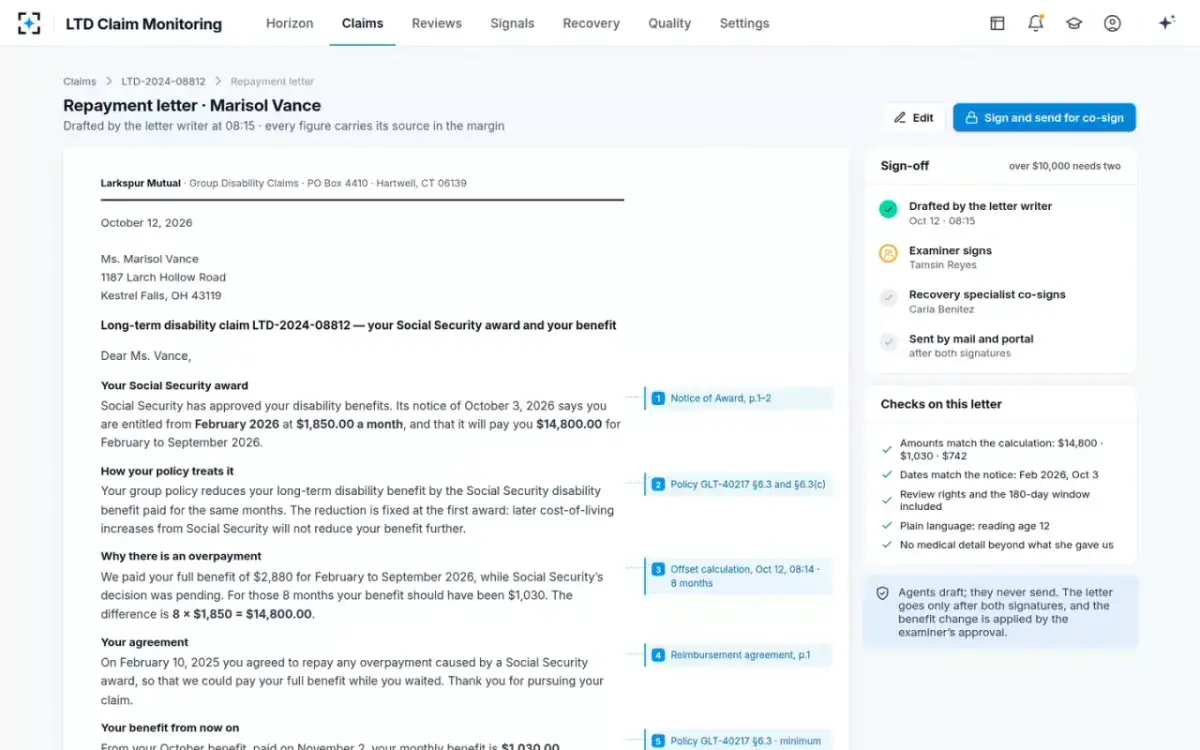
Overpayment claims run on their own clock
When the plan is the one suing, to recover an overpayment, a different set of rules applies, and there is no single ERISA period for it either. What limits a plan most is not a statute but speed: in Montanile v. Board of Trustees (2016) the Supreme Court held that once a participant has spent the money on things that cannot be traced, the plan cannot use ERISA's equitable remedies to reach the participant's other assets. A plan's practical deadline is the day the back pay is spent, as checking an LTD overpayment explains.
For the examiner this makes two clocks worth keeping on every claim with an award: the claimant's, set by the policy and stated in any final denial, and the plan's own, set by how fast it asks. In the sample, a Social Security award read on October 12 had its repayment letter signed and sent by 10:25 that morning, while the back pay was still in the claimant's account.
The quality page in LTD Claim Monitoring: dates kept, notices on time, decisions that answer Social Security
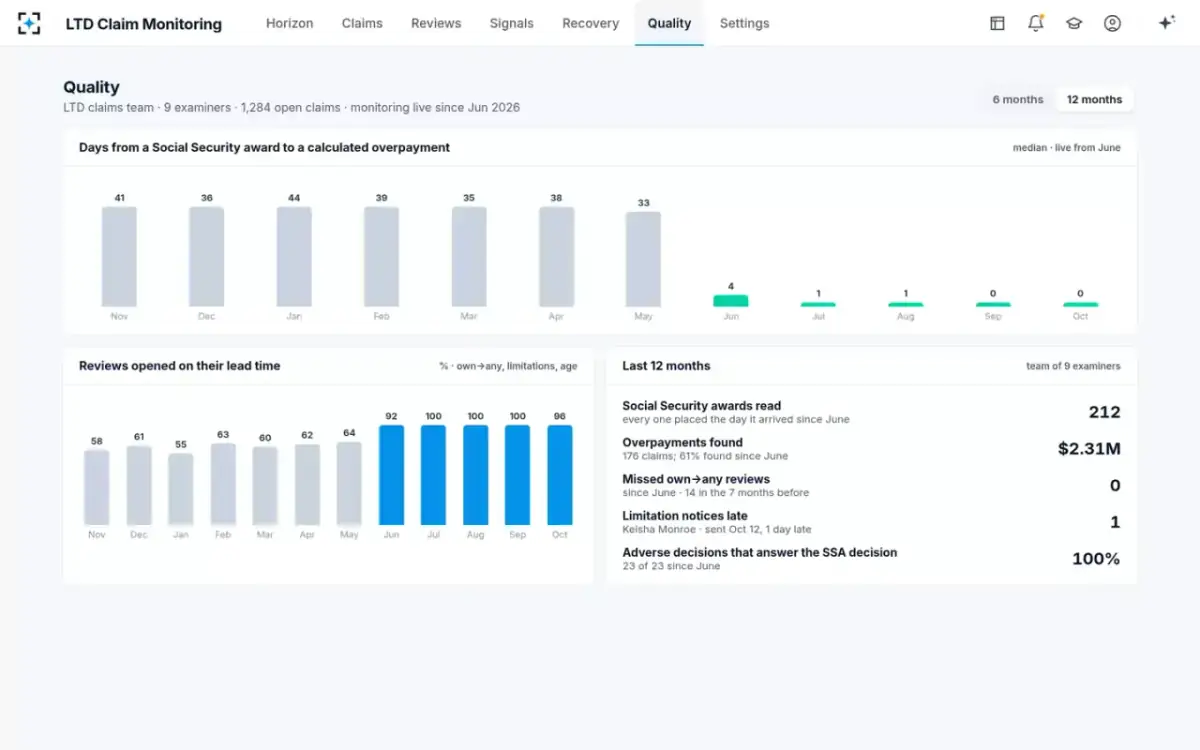
What a monitoring diary must hold
A monitoring diary must hold every date from which a deadline is counted, not only the deadlines themselves, because the deadline changes when its starting date does. LTD Claim Monitoring's plan provisions agent builds the claim's dates from the policy in force at the date of disability; the checklist below is what we would expect any LTD diary to carry.
Dates an LTD claim needs for the limitations clock
- When proof of loss was due under this policy
The usual starting point of a three-years-from-proof-of-loss clause, and easy to lose once the claim is years old.
- The policy's limitations clause, as written
Its length, its starting point and any tolling term, from the policy in force at the date of disability.
- Every adverse decision and the date its notice went out
The 180-day appeal window runs from receipt of the notice.
- Every extension, with its notice
An extension needs notice before the original period ends; an undocumented one is a missed deadline.
- Any voluntary appeal, with its dates
The plan has agreed to toll the limitations period while it is pending.
- The computed limitations date
Stated on the claim, checked by a second person, and printed in the final denial as the regulation requires.
- For overpayments: the award date and the first letter
The plan's own clock, which in practice is set by when the back pay is spent.
The same diary carries the dates that decide whether a decision is needed at all: the end of the own-occupation period and of any limitation, which the review at month 24 covers. Appeals and the decisions behind them belong to Disability Claims Adjudication, whose guide to the ERISA disability appeal process sets out the record they build. To see the dates on sample claims, start from LTD Claim Monitoring.
Questions people ask
How long do I have to sue after an LTD denial?
As long as your plan's limitations clause allows, counted from the date it names, which may be before the denial. For disability claims filed after April 1, 2018, the plan's final denial must state the calendar date your time runs out. If it does not, or you cannot find a clause, ask the plan in writing and take legal advice.
Is the ERISA statute of limitations six years?
Six years is the outer limit for suits for breach of fiduciary duty under 29 U.S.C. 1113, shortened to three years from actual knowledge of the breach. A claim for disability benefits under the plan's terms is not a fiduciary-breach claim, and ERISA sets no period for it; the plan's clause usually governs.
Does filing an appeal extend the time to sue?
The required internal appeal does not, unless the plan says so; the Supreme Court held the clock need not be paused during internal review. A voluntary extra appeal that a plan offers does pause it, because the regulation makes the plan agree to toll the limitations period while that appeal is pending.
What if my plan missed its own deadline?
For disability claims, a plan that fails to follow the claims rule strictly can be treated as having denied the appeal, and the claimant may go to court without waiting. The regulation makes an exception for minor violations, but not where the violation is part of a pattern or practice.
Is there an ERISA lien statute of limitations for overpayments?
ERISA sets no single period for a plan's suit to recover an overpayment; the answer depends on the claim the plan brings and where. In practice the tighter limit is the Supreme Court's rule that a plan cannot reach a participant's general assets once the money has been spent on things that cannot be traced.