The ERISA disability appeal process is the plan's internal review of its own denial of a disability claim. Under the Department of Labor's rule, the claimant has at least 180 days after the denial to appeal. The review is done without deference to the first decision, by someone who neither made it nor reports to the person who did, with a qualified health care professional consulted on medical questions. Any new evidence or new rationale goes to the claimant before the plan decides, and the decision is due within 45 days, extendable once by 45. What happens next is the reason to take it seriously: in court, disability cases are usually decided on the administrative record the plan assembled. Botminds' Disability Claims Adjudication builds that record from the first day: every reading, decision and letter carries the page it rests on, and new evidence before an appeal decision goes to the claimant first.
This guide is written for appeals specialists, claims compliance and in-house counsel at plans and carriers, and is about disability claims only; appeals of medical claims follow related but different rules. Examples come from the solution's sample data, with fictional people and claims. Nothing here is legal advice.
The ERISA appeals process for a disability claim, at its longest
- At least 180 days to file the appeal after the denial notice180 days
- Decide45 days
- Extension, with notice+45
- New evidence or rationale sent to the claimantbefore the decision
What is a full and fair review under ERISA?
It is the review the statute promises: every plan must "afford a reasonable opportunity to any participant whose claim for benefits has been denied for a full and fair review by the appropriate named fiduciary of the decision denying the claim" (29 U.S.C. § 1133). The regulation turns that into specific duties. The claimant may submit "written comments, documents, records, and other information"; is entitled to copies of everything relevant to the claim, free; and the review must take into account everything the claimant submits, "without regard to whether such information was submitted or considered in the initial benefit determination" (29 CFR 2560.503-1(h)(2)).
For disability claims, the regulation adds the group health plan protections and two of its own. The review must not "afford deference to the initial adverse benefit determination" and must be done by a fiduciary "who is neither the individual who made the adverse benefit determination that is the subject of the appeal, nor the subordinate of such individual". Where the denial rests on a medical judgement, the fiduciary must consult "a health care professional who has appropriate training and experience in the field of medicine involved", someone other than the professional consulted on the denial and not that person's subordinate, and the medical or vocational experts whose advice was obtained must be identified whether or not the plan relied on it ((h)(3), applied by (h)(4)).
What the rule requires on a disability appeal, and what the file must show
| Requirement | Where in 29 CFR 2560.503-1 | What the file must show |
|---|---|---|
| At least 180 days to appeal | (h)(3)(i), via (h)(4) | The denial date, the deadline stated in the letter, the date the appeal arrived |
| Copies of relevant documents, free | (h)(2)(iii), (m)(8) | What was requested, what was sent, when |
| Everything the claimant submits is considered | (h)(2)(iv) | Each submission logged and addressed in the decision |
| No deference; a different decision-maker, not a subordinate | (h)(3)(ii) | Who decided the claim, who decided the appeal, and their reporting lines |
| A qualified health care professional on medical questions, not the one consulted before | (h)(3)(iii), (v) | The consultant’s name, field and question; that they were not consulted on the denial |
| Experts identified | (h)(3)(iv) | Every medical or vocational expert consulted, relied on or not |
| New evidence and new rationale to the claimant first | (h)(4)(i)–(ii) | What was new, when it was sent, the claimant’s response |
| Decision within 45 days, one 45-day extension | (i)(3)(i), (i)(1)(i) | Receipt date, any extension notice and its reason |
| Reasons, provisions, discussion of disagreement, limitations date | (j), including (j)(4)(ii) and (j)(6) | The letter, with the calendar date the contractual limitations period expires |
How long do I have to appeal a disability denial?
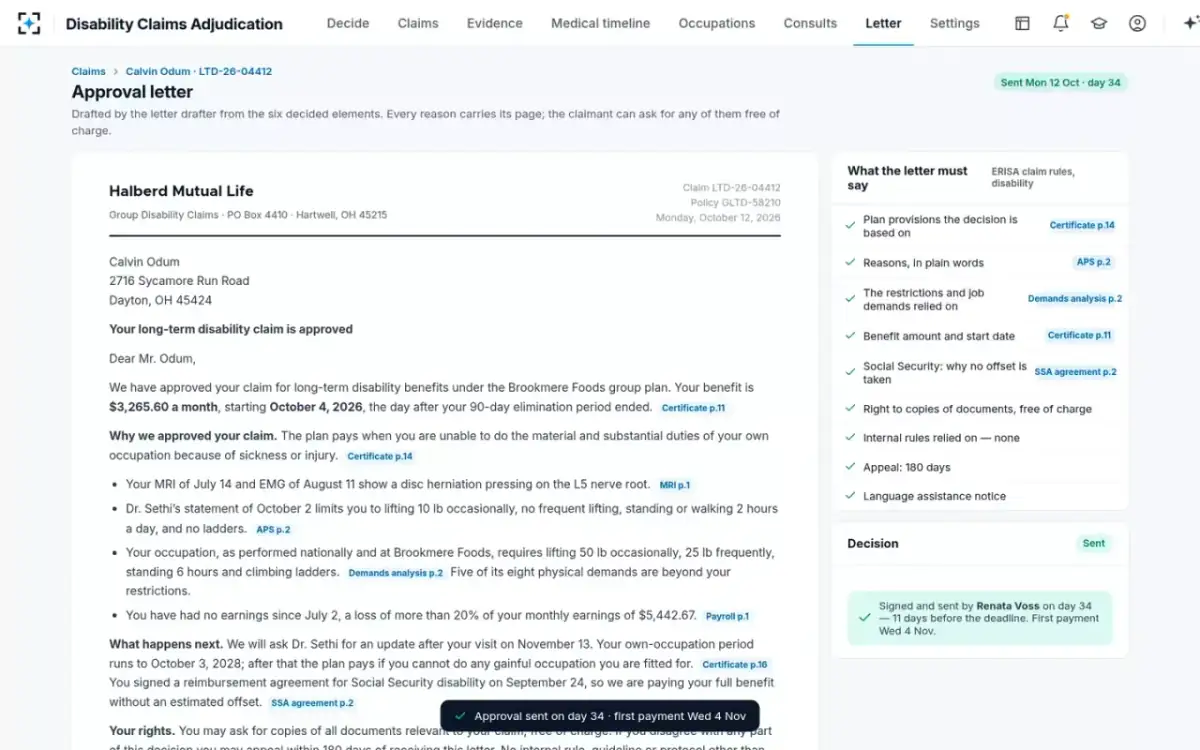
At least 180 days from receiving the denial notice, if the plan is governed by ERISA. The regulation requires plans providing disability benefits to give claimants "at least 180 days following receipt of a notification of an adverse benefit determination within which to appeal" (29 CFR 2560.503-1(h)(3)(i), applied by (h)(4)). The plan may allow longer; the denial letter must describe the review procedures and their time limits. In the sample approval letter, the claimant is told he has 180 days to appeal any part of the decision he disagrees with.
What is the administrative record?
It is the file the plan compiled in deciding the claim and the appeal, and in most ERISA disability suits it is what the court reads. The Department of Labor explained why it rewrote the disability rules around it.
Many federal courts have held that in reviewing a plan administrator's decision for abuse of discretion, the courts are limited to the “administrative record”-- the materials compiled by the administrator in the course of making his or her decision.
Department of Labor, 2016 final rule on disability claims
The Department added that most circuits allow additional evidence even on de novo review "only in limited circumstances", and that "because the claimant may have limited opportunities to supplement the record", the claimant must be given "a full opportunity to develop the record that will serve as the basis for review" (81 FR 92316). The Eighth Circuit's August 2026 decision in Halloran shows the practice: with no grant of discretion in the plan, the district court reviewed the denial "de novo, acting as factfinder on the administrative record" (Halloran, 8th Cir. 2026).
The record a court reads, document by document
A complete record holds the claim from the first form to the final letter, in order, with nothing a later reader has to reconstruct. The list below is the order we would expect a reviewing court, or the claimant's counsel, to want it.
The disability appeal record, document by document
- The plan documents in force
Certificate and plan, with the definition of disability, any discretion clause and the contractual limitations provision.
- The claim as filed
Claimant and employer statements and authorizations, with the date of receipt that started the 45 days.
- Every request and reply
Requests to doctors and the employer, follow-ups, extension notices and the claimant’s responses, dated.
- The medical evidence
Attending physician statements, records, imaging, test results, each with its date and author.
- The job evidence
Job description, demands analysis, employer statement, occupational data relied on, and how conflicts were resolved.
- Consultant and expert reports
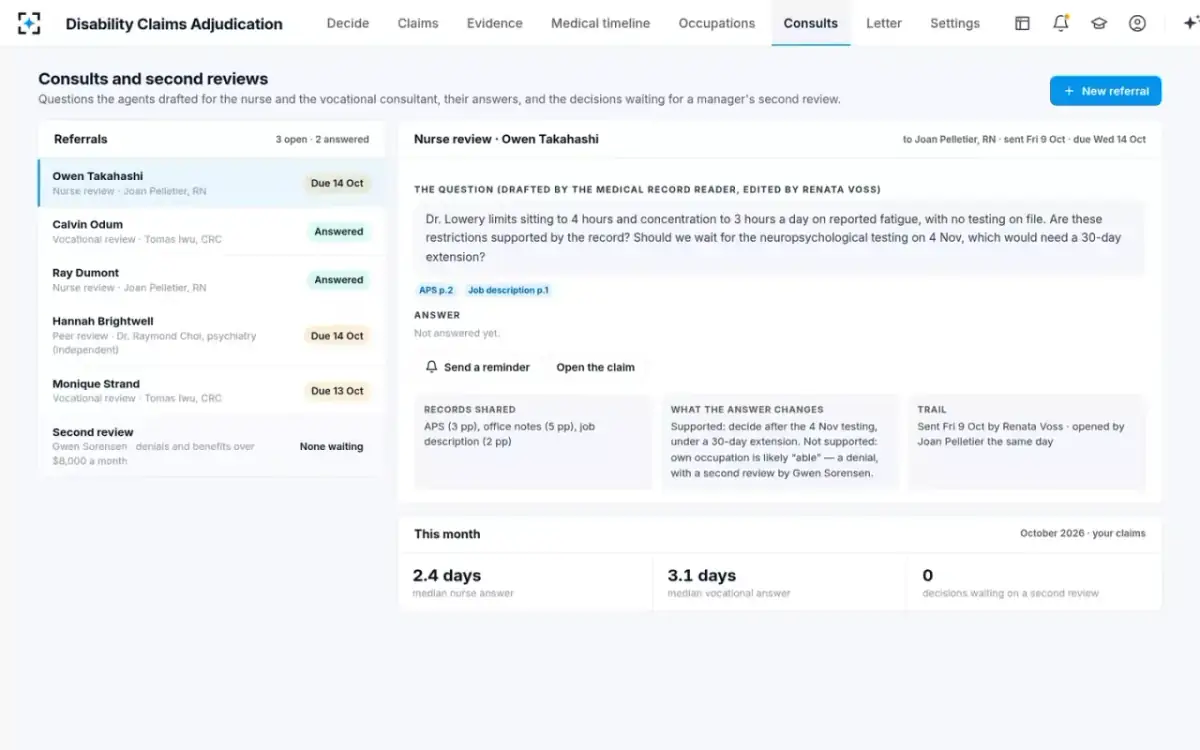
Nurse, physician and vocational reviews, with the question each was asked; all of them, relied on or not.
- Any Social Security decision
If the claimant sent one, and the letter’s discussion of why the plan agreed or disagreed.
- The initial decision and letter
Who decided each element, on which sources; the letter with reasons, provisions and rights.
- The appeal and everything submitted with it
Including audio, video or other electronic evidence, which plans may not refuse.
- New evidence and rationale notices
What was new on appeal, when it was sent to the claimant, and the response.
- The appeal decision and letter
Who decided, without deference; the consultant identified; the limitations period with its calendar date.
Can I submit new evidence on appeal?
Yes, and the plan must consider it. The review must take into account everything the claimant submits, whether or not it was before the first decision-maker. The Department also said plans may not narrow what counts: it "does not believe that plans could refuse to accept evidence submitted in the form of video, audio or other electronic media", and it would not be permissible "to impose courtroom evidentiary standards in determining whether the plan will accept or consider information or materials submitted by a claimant" (81 FR 92316).
The appeal is usually the last chance to add evidence. Because courts often confine themselves to the administrative record, a report or statement that was never given to the plan may never be weighed. For the claimant, that is a reason to file everything relevant within the appeal; for the plan, it is a reason to ask precisely for what is missing, since the rule requires the denial to say what additional material would perfect the claim and why.
What must the plan give the claimant before deciding the appeal?
Anything new. Before a disability appeal can be denied, the plan must give the claimant, free, "any new or additional evidence considered, relied upon, or generated by the plan, insurer, or other person making the benefit determination", and any "new or additional rationale", "as soon as possible and sufficiently in advance" of the decision date "to give the claimant a reasonable opportunity to respond" (29 CFR 2560.503-1(h)(4)). A file review by a new physician consultant is new evidence; a reason the denial letter did not give is a new rationale.
This is where appeals most often run short of time, because a consultant's report written on day 40 leaves no room for a response before day 45. The practical answer is to commission reviews early in the appeal and send them out as they arrive. In the sample solution, new evidence before an appeal decision goes to the claimant first, and the letter states which internal rules, if any, were relied on.
Consults and peer reviews, each with the question and the records shared
How long does an ERISA appeal take?
For a disability claim, a decision is due within a reasonable time and no later than 45 days after the plan receives the appeal; the regulation applies the general 60-day rule with "a period of 45 days" substituted (29 CFR 2560.503-1(i)(3)(i)). If "special circumstances (such as the need to hold a hearing" require more time, the plan may extend once, by up to another 45 days, with a written notice before the first period ends stating the circumstances and the expected decision date. A multiemployer plan whose board meets at least quarterly may instead decide at its next meeting, under a separate timetable. Health plan appeals run on their own clocks, urgent and pre-service among them, and Medicare's on others again; grievance vs appeal starts there.
The appeal decision letter has its own content rules. It must give the specific reasons and provisions, the right to copies of relevant documents, the same discussion of disagreement with treating doctors, plan experts and Social Security as the initial denial, and, for disability plans, a description of any contractual limitations period for a lawsuit together with the calendar date on which it runs out for this claim (29 CFR 2560.503-1(j)(4)(ii)); the ERISA claim statute of limitations quotes the requirement and works the date out. The Supreme Court held in Heimeshoff that such limitations provisions are enforceable; the policy there required suit "within three years after 'proof of loss' is due" (Heimeshoff, 2013).
What happens if the plan misses the appeal deadline?
The claimant can go to court without waiting. On a disability claim, "if the plan fails to strictly adhere to all the requirements of this section", the claimant "is deemed to have exhausted the administrative remedies available under the plan", and the claim "is deemed denied on review without the exercise of discretion by an appropriate fiduciary" (29 CFR 2560.503-1(l)(2)(i)). There is a narrow exception for "de minimis violations that do not cause, and are not likely to cause, prejudice or harm to the claimant", where the plan shows good cause and "an ongoing, good faith exchange of information", but it is unavailable for "a pattern or practice of violations", and the plan must explain itself in writing within 10 days if asked.
The consequence is practical. In Halloran, the claimant argued the insurer had not followed its claims procedures; the court answered that even if it had not, the remedy was de novo review in court, "which is exactly what he got" (Halloran, 8th Cir. 2026). A plan that misses a deadline does not lose the claim by doing so, but it can lose the deferential review its discretion clause was meant to buy.
Which standard of review will a court apply?
De novo, unless the plan grants discretion. The Supreme Court held in Firestone that a denial "must be reviewed under a de novo standard unless the benefit plan expressly gives the plan administrator or fiduciary discretionary authority to determine eligibility for benefits or to construe the plan's terms" (Firestone v. Bruch, 1989). With discretion, courts ask whether the decision was reasonable; the Eighth Circuit put it as "supported by substantial evidence", meaning "more than a scintilla but less than a preponderance" (Darvell, 8th Cir. 2010).
Either way, the record decides. Under Glenn, an insurer that decides and pays claims has a conflict that the court weighs, more heavily where there is a history of biased administration and less where the insurer has acted to reduce bias and promote accuracy (Metropolitan Life v. Glenn, 2008; the Court's passage is quoted in claims adjudication systems examiners trust). Those steps are visible only if the record shows them: who decided, on what, after which reviews. Disability cases are where this matters most.
Long-term disability claims dominated ERISA benefits litigation, 2006–2010
The letter, with appeal rights and a reason tied to every page
How Disability Claims Adjudication builds the record from day one
The appeal record is mostly made before there is an appeal. In the sample solution, every element reading, restriction, job demand and reason in the letter cites the document and page it came from; each human decision is recorded with who made it, when and on which sources; each agent step is on the claim's activity trail; and settings changes are versioned. Every denial and every benefit above the examiner's authority goes to the LTD claims manager before it leaves, and the sample setup assigns appeals to someone who did not decide the claim.
The agents never decide an appeal, never send a letter and never contact a doctor beyond a standard request. What they change is that the file a court will read is assembled as the claim is decided, not reconstructed when the appeal arrives. The same discipline starts with a single restriction, traced in the attending physician statement form guide, and the rules on what software may do are set out in AI in disability insurance claims.
Questions people ask
Do I have to appeal before suing over a disability denial?
The rule is built on internal appeals first: a claimant is "deemed to have exhausted" the plan's remedies, and may sue at once, only where the plan fails to follow the claims procedure strictly. Otherwise, expect to complete the plan's appeal before going to court, and to rely on the record built during it.
Can I get a copy of my claim file for the appeal?
Yes, free of charge. Relevant documents include everything relied on, everything "submitted, considered, or generated" in making the decision even if not relied on, documents showing the plan followed its safeguards, and for disability plans any statement of policy or guidance on the benefit for your diagnosis.
Does the appeal reviewer have to be a doctor?
No, but where the denial rests on a medical judgement the reviewer must consult a health care professional with appropriate training and experience in the relevant field, who was not consulted on the denial and is not that person's subordinate. The plan must identify the medical and vocational experts it consulted.
Can the plan deny my appeal for a new reason?
Only after giving you the new rationale, free, early enough for you to respond before the decision deadline. The same applies to new evidence the plan gathers or generates during the appeal, such as a new file review.
How many appeals can a disability plan require?
The rule allows a plan to provide for one or two appeals, and the 45-day limit applies to each. Any further voluntary level must be described in the final letter, which must also state the right to sue.
When does the time to sue start?
It depends on the policy. Contractual limitations periods are enforceable under Heimeshoff, and the final appeal letter for a disability plan must state the calendar date on which the period expires for the claim.