AI in disability insurance is useful in claims for three jobs: gathering the evidence a short- or long-term disability decision needs, reading it, and drafting the decision letter. It should not make the decision. For employer plans covered by ERISA, the Department of Labor's claims rule requires disability claims to be decided by people chosen and paid without regard to whether they deny, and requires every denial to explain why it disagrees with the claimant's doctors, the plan's own experts and any Social Security award. A model can prepare all of that; the rule leaves the judgement and the signature with a named person. Botminds' Disability Claims Adjudication is built on that split: seven agents gather and read the file and lay the plan's definition out as elements, and the examiner decides each one and signs the letter.
Examples below come from the solution's sample claims at a fictional carrier, Halberd Mutual Life; the people and claims are fictional. The rules are quoted from the eCFR, the Department of Labor's 2016 rulemaking and the Supreme Court.
Seven agents prepare; the examiner decides every element and signs
Agent
Evidence gathererBuilds the checklist each plan and claim type needs, sends standard requests to the doctor, employer and claimant, and chases on day 7 and day 14.
Never: Requests records beyond the signed authorization, or asks the employer about the diagnosis.
Agent
Medical record readerReads statements, notes, imaging and operative reports; builds the timeline and lifts every restriction with its page and author.
Never: Infers a restriction a provider did not write, or diagnoses.
Agent
Job demands analystSets each physical and mental demand of the job from the demands analysis, job description, employer statement and any posting.
Never: Assumes a demand that is not in a document.
Agent
Plan definition readerSplits the certificate’s definition of disability into elements and reads the elimination period, earnings test and exclusions.
Never: Reads past the wording: ambiguity goes to the examiner.
A person decides
Examiner decides each elementConfirms the routine elements against their sources and decides the contested one, on the record, in her name.
Agent
Letter drafterDrafts the approval, denial or extension notice with the plan provisions and every reason cited to its page.
Never: Sends anything.
A person decides
Examiner signs; manager second-reviews denialsEvery denial and every benefit above the examiner’s authority goes to the claims manager before it leaves.
How is AI used in disability insurance claims?
It is used in three different kinds of work, and the design question is which a model should touch. The first is gathering: knowing which documents a given plan and claim type need, requesting them and chasing them. The second is reading: finding the lifting limit on page 2 of a surgeon's statement, the weight on page 2 of a physical demands analysis, the elimination period on page 14 of the certificate. The third is deciding: whether the restrictions rule out the claimant's occupation, which doctor to believe, whether a Social Security award changes the answer.
Gathering and reading are where most of an examiner's week goes (our estimate for a sample LTD desk is in a disability claims examiner's week), and they are work a language model does well when it must cite every page it read. Deciding is where the federal claims rule puts its weight. We found no AI-specific rule for disability claims from the Department of Labor as of 27 October 2026; the existing rule already says enough about who decides and how the decision must be explained.
Can AI deny a disability claim under ERISA?
Nothing in the rule mentions software, but its requirements are written for people and are hard to meet without one. The statute requires a plan to state its specific reasons for a denial and, on appeal, to give the claimant a full and fair review by a named fiduciary (29 U.S.C. § 1133). The regulation adds, for disability claims, that the appeal be decided by a fiduciary who neither made the first decision nor reports to the person who did, without deference to that decision (29 CFR 2560.503-1(h)(3)(ii), applied to disability by (h)(4)). Those duties attach to accountable individuals.
The risk of a model that decides is also practical. If a plan does not follow the rule strictly on a disability claim, the claimant is treated as having exhausted the plan's remedies and can go straight to court, and the claim counts as denied on review with no fiduciary having exercised discretion (29 CFR 2560.503-1(l)(2)); the ERISA appeals process for disability sets out what that costs in court. A denial a person did not really make is the kind of procedural gap that can cost a plan the deferential review its discretion clause was written to earn.
What does the ERISA independence rule mean for AI?
It means the tool must not be tuned, scored or bought on how often it helps deny. The rule says a disability plan "must ensure that all claims and appeals for disability benefits are adjudicated in a manner designed to ensure the independence and impartiality of the persons involved in making the decision", and that decisions on "hiring, compensation, termination, promotion, or other similar matters" for any adjudicator or medical or vocational expert "must not be made based upon the likelihood that the individual will support the denial of benefits" (29 CFR 2560.503-1(b)(7)).
For example, a plan cannot provide bonuses based on the number of denials made by a claims adjudicator. Similarly, a plan cannot contract with a medical expert based on the expert's reputation for outcomes in contested cases, rather than based on the expert's professional qualifications.
Department of Labor, 2016 final rule on disability claims
The rule speaks of persons, not software, but three consequences for AI follow from its words. A model trained or tuned to predict denials, and used to route or recommend, builds outcome into the process the rule says must be impartial. A dashboard that ranks examiners or experts by their denial rate hands managers exactly the measure the rule forbids them to use for pay or promotion. And a tool that chooses which consultant to send a file to should choose by qualification and availability, never by the consultant's past outcomes. The Department also warned against "expert shopping": consulting several experts and denying "based on the view of one expert when advice from other experts who were consulted supported a decision to grant the claim" (81 FR 92316).
What the disability claims rule asks, what an agent may do, what a person must do
| The rule | An agent may | A person must |
|---|---|---|
| Independence and impartiality, (b)(7) | Route by claim type, workload and qualification | Never be hired, paid or promoted on denial rates; choose experts by qualification |
| Specific reasons and plan provisions, (g)(1)(i)–(ii) | Draft each reason with the provision and page it rests on | Decide the reasons and sign the letter |
| Explain disagreement with treating, plan and SSA views, (g)(1)(vii)(A) | List every treating, consulting and SSA view in the file, with its page | Write why the plan disagrees, in the claim’s own terms |
| Internal rules relied on, or a statement that none exist, (g)(1)(vii)(C) | Record which guideline each step used | Confirm what was relied on |
| New evidence or rationale before an appeal denial, (h)(4) | Detect anything new since the first decision and draft the notice | Send it in time for a reasonable response, then weigh the reply |
| Appeal by someone else, not a subordinate, (h)(3)(ii) | Assemble the whole file for the reviewer; never pick the reviewer by outcome | Decide the appeal without deference |
Can AI write a disability claim letter?
It can draft one, and a cited draft is better than one written from memory, but the letter is where an AI shortcut is easiest to see. For a disability denial the rule requires "a discussion of the decision", including "an explanation of the basis for disagreeing with or not following" the views of the claimant's treating health care professionals and vocational evaluators, the plan's own medical or vocational experts "without regard to whether the advice was relied upon", and any Social Security disability decision the claimant sent (29 CFR 2560.503-1(g)(1)(vii)(A)).
The Department was specific about what does not count. It "would not be satisfied merely by stating that the plan or a reviewing physician disagrees with the treating physician", and for Social Security, it "would not be sufficient for the benefit determination merely to include boilerplate text about possible differences in applicable definitions, presumptions, or evidence. A discussion of the actual differences would be necessary" (81 FR 92316). A model trained on past letters will reproduce their boilerplate. A drafting agent is useful only if it is built to do the opposite: put every treating view, every consultant's view and the award on the table with its page, so the examiner has to write the disagreement, not paper over it.
The courts have been weighing this for years. In Glenn, the Supreme Court held that an insurer that both decides and pays has a conflict to be weighed, and noted that the lower court had counted against the insurer its silence on why it found the claimant able to work when Social Security had found her unable to (Metropolitan Life v. Glenn, 2008); the LTD guide to own occupation vs any occupationquotes the passage and follows it to the month-24 review. In Nord, the Court held that plans need not give treating physicians special deference (Black & Decker v. Nord, 2003). Read together with the 2016 rule, a plan may disagree with the doctor and with Social Security, but it must say why.
The routine elements confirmed with their sources; the contested one left to the examiner
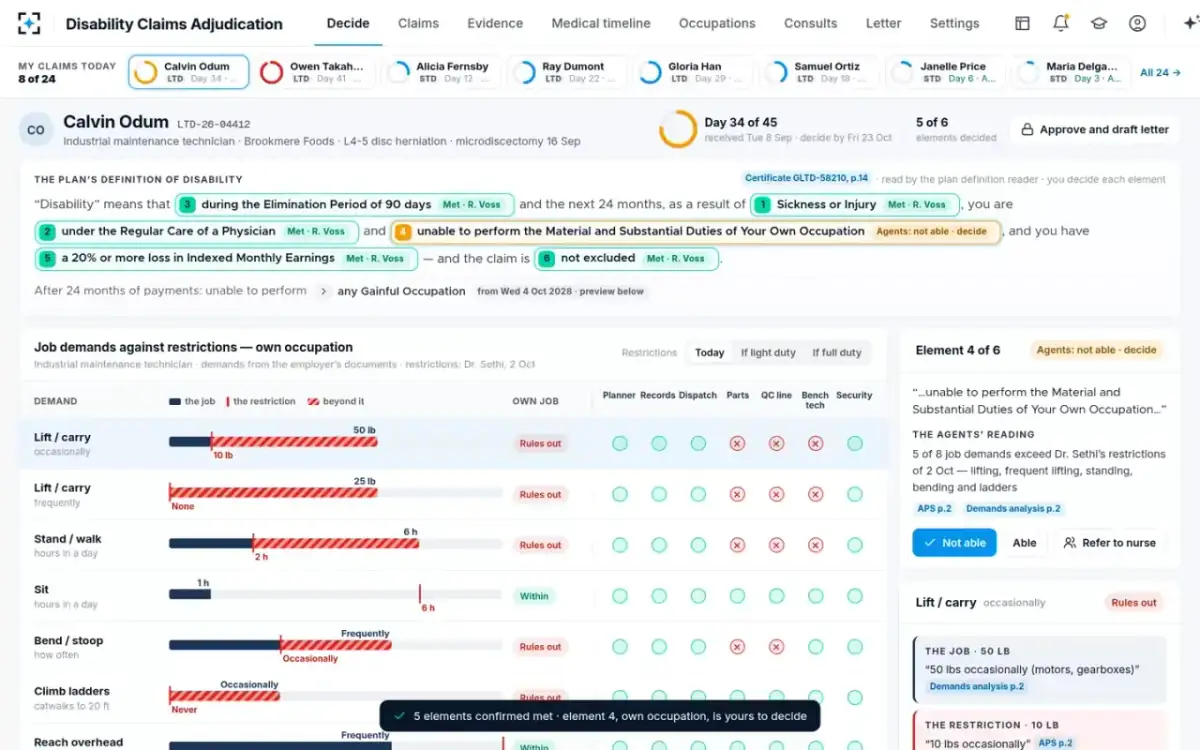
Is the AI's work part of the claim file?
Very probably, and buyers should plan on it. Claimants are entitled, free of charge, to the documents and information relevant to their claim, and the rule defines relevant to take in whatever was submitted, considered or generated while the decision was being made, whether or not the plan relied on it, together with the records that show the plan followed its own safeguards (29 CFR 2560.503-1(m)(8); disability case management software quotes the definition and the systems that must hold it). An agent's summary of the medical record or a draft letter is generated in the course of the determination.
That changes what a tool should keep. Every agent step should be on the claim's trail with its inputs, its output and the pages it cited, and every human decision with who made it, when and on what sources. A file in which the machine's reading and the examiner's decision can be told apart is one a plan can hand to a claimant, and later to a court, without embarrassment. The ERISA appeals process for disability sets out the full file a court reads.
Two ways to put AI on a disability claim, and what each leaves the examiner
AI that scores and routes: A score, such as likelihood of approval or of a long duration, and a queue.
Agents that prepare a cited file: A checklist, a medical timeline, job demands and a draft letter, each line tied to a page.
AI that scores and routes: Whether to trust a number whose reasons are not on the page.
Agents that prepare a cited file: Each element against the pages cited for it.
AI that scores and routes: High if the score is trained on past denials or used to rank people.
Agents that prepare a cited file: Low if the agents are never measured on outcomes and route by qualification.
AI that scores and routes: The score explains nothing a claimant can read.
Agents that prepare a cited file: Every treating, consulting and SSA view is listed, so the disagreement has to be written.
AI that scores and routes: A number that may be hard to explain if requested.
Agents that prepare a cited file: Readings and drafts a claimant can be given, separate from the decision.
What do state insurance regulators expect of AI in claims?
Group disability insurers are also regulated by the states, and the state regulators' standards body has set out expectations. The NAIC model bulletin on insurers' use of AI systems, adopted by the NAIC in December 2023, expects insurers to keep a written program for AI systems that make or support decisions in regulated insurance practices, claim administration and payment among them (NAIC model bulletin). It also reminds insurers that the unfair trade and unfair claims settlement practices laws apply to their actions however those actions were reached, by a person or a model. A bulletin binds only where a state has issued it; the NAIC AI bulletin requirements are set out state by state in our compliance guide.
For a disability claims tool the practical result is the same as under ERISA: an inventory of what each model does, testing that its readings are accurate, and a record showing that a person made each decision. A design in which agents read and draft and people decide is the easiest to put into that program.
Consults and second reviews stay with named people
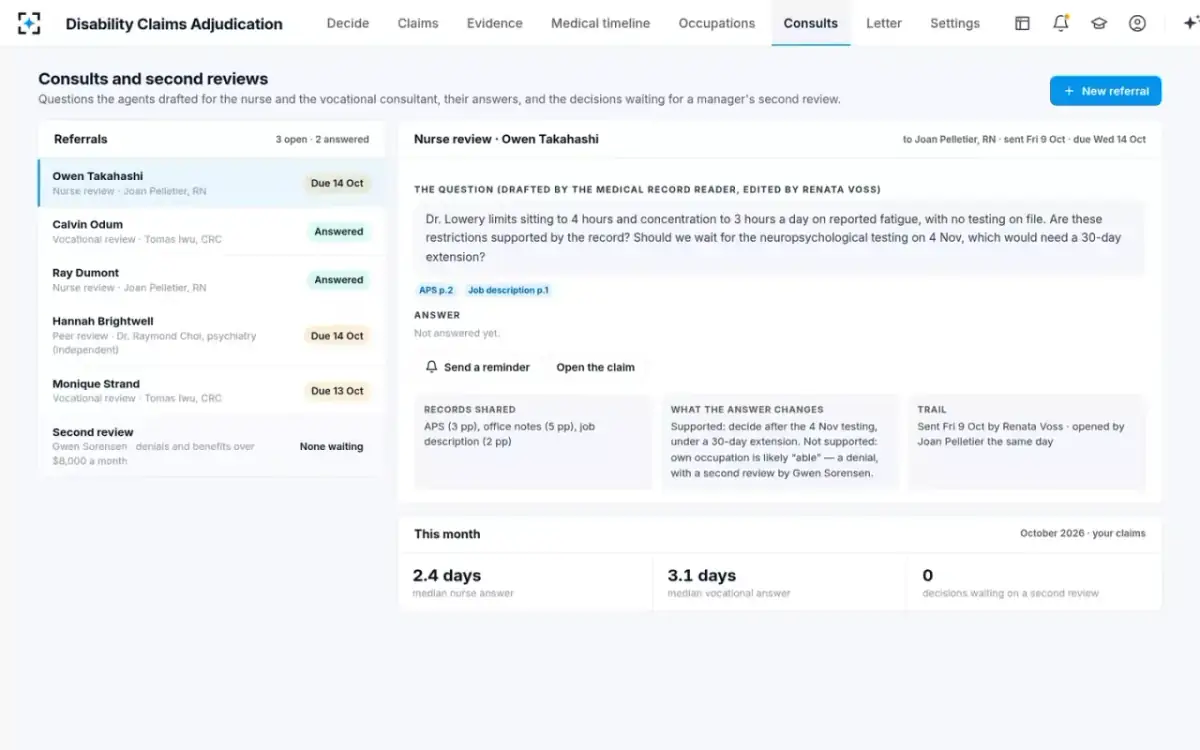
Who signs a disability denial letter?
A person with the authority to decide the claim signs it: usually the examiner, within authority limits the carrier sets, often with a second review for denials and large benefits. On the sample desk every denial and every benefit above $8,000 a month goes to the LTD claims manager before it leaves. On appeal, the rule requires a different decision-maker who is not the first decision-maker's subordinate. None of those roles can be held by software, and a letter drafted by an agent is the examiner's letter once she signs it.
Ten questions to ask any AI disability claims vendor
Ask to see each answer on a closed claim of yours, not on the vendor's sample. A tool that cannot show the page behind a reading, or that cannot tell you what it was measured on, will not survive the first appeal it is part of.
Ten questions to ask before you put AI on disability claims
- Does every reading cite a page?
Each restriction, job demand and plan provision should open the page it came from.
- What does the model decide?
If the answer is anything other than “nothing”, ask who the fiduciary is for that decision.
- What was it trained or tuned to predict?
A target built on past denials or claim durations sits badly with the independence rule.
- Does it rank people by outcome?
Dashboards of examiner or expert denial rates give managers the measure (b)(7) forbids them to use.
- How are consultants chosen?
By qualification and availability, never by past results.
- Does the draft list every view the letter must address?
Treating, vocational, plan experts consulted and any Social Security award, each with its page.
- What does it do with new evidence on appeal?
It should detect anything new since the first decision and draft the notice to the claimant.
- What lands in the claim file?
Agent outputs are likely relevant documents under (m)(8); you should be able to produce them.
- What can it never do?
Send, pay, contact a doctor beyond a standard request, or request records beyond the authorization.
- How is accuracy measured?
Against your examiners’ decisions on closed claims, with every disagreement logged and read.
Where Disability Claims Adjudication fits, and where it does not
Disability Claims Adjudication fits the initial STD or LTD decision: building the file, reading it against the certificate and drafting the letter, on top of the claim system you already run. Every element reading cites a page, the examiner confirms or decides each element, and denials need a second review. The letter's reasons are tied to pages as a design target, which the checklist beside each letter shows.
It does not replace the claim system of record, pay benefits, decide employability (the vocational consultant signs the any-occupation study) or monitor approved claims for Social Security awards and offsets over the years that follow. How to bring a tool like this in without losing your examiners' trust is the subject of claims adjudication systems examiners trust.
Questions people ask
Is AI allowed in ERISA claims decisions?
Nothing in ERISA or the Department of Labor's claims rule forbids software, and we found no AI-specific DOL rule as of 27 October 2026. The existing rule still governs: independent and impartial adjudicators, specific reasons, an explanation of disagreement with treating doctors, plan experts and Social Security, and a different, non-subordinate decision-maker on appeal. A process where AI prepares and people decide fits those requirements most easily.
Does a claimant have a right to see what the AI produced?
Probably. The rule entitles a claimant to everything submitted, considered or generated while the plan was making the benefit decision, whether or not it was relied on. An agent's medical summary or draft letter fits that definition, so plans should keep agent outputs in a form they can produce.
Can AI choose the independent medical reviewer?
It can propose one by specialty, licence and availability. The Department of Labor's own example of a forbidden practice is contracting with a medical expert "based on the expert's reputation for outcomes in contested cases", so a selection model must never use a reviewer's past results.
Does AI make disability decisions faster?
It shortens the reading and drafting, not the waiting. The 45-day clock starts when the claim arrives, and the slowest step is usually a doctor's office answering a request. In the sample claim the file was complete on day 27, after one chase, and the decision took one sitting on day 34.
Does the NAIC AI bulletin apply to disability claims?
Where a state has issued it, the bulletin applies to AI systems that make or support decisions in regulated insurance practices, and it names claim administration and payment among them. It is a model; each state's version governs.
Who is responsible if an AI-drafted letter is wrong?
The plan and the person who signed it. A draft does not become a decision until an examiner adopts it, which is why every reason should open the page it rests on before she does.