Disability case management software, for an insurer or claims administrator, is the set of systems that carries a short- or long-term disability claim from intake to decision and through the months or years of benefits that follow: the claim system of record, document intake, medical records, employer and payroll data, the group policies, and occupational and wage data. The hard part of choosing one is that the evidence for a single decision is spread across all six, and the Department of Labor's clocks run while it is gathered. Botminds' Disability Claims Adjudication does not replace the claim system: its agents read across those systems, gather and read the file, lay the plan's definition out as elements and draft the letter, and the examiner decides.
The map below uses the solution's sample setup at a fictional carrier, Halberd Mutual Life. The rules that set the clocks are quoted from the eCFR; the market figures come from the Department of Labor and the Bureau of Labor Statistics.
Six systems hold the evidence for one disability claim
What is disability case management software?
The phrase is used for two different products, and buyers should say which they mean. On the insurer's or administrator's side, it is the software that manages a disability claim: intake, tasks, requests, the decision, payments, offsets and re-evaluations. On the employer's side, it often means absence and return-to-work tracking for the employer's own people. This guide is about the first: the systems a group STD and LTD claims team works in, and what each must do for one decision to be made on time and defended later.
The federal rule decides what "a disability claim" is for these systems, and the answer is wider than the product line. The Department of Labor wrote that "if the claims adjudicator must make a determination of disability in order to decide a claim, the claim must be treated as a disability claim", whatever the plan calls the benefit (81 FR 92316). A system that keys the 45-day clock off the product code, not off whether disability has to be decided, will put some claims on the wrong clock.
What systems do disability claims teams use?
Six, counting by where the evidence lives rather than by vendor. The claim system holds the claim, its status and the decision of record. Fax, email and portals carry requests and replies. Medical records arrive from doctors' offices as attending physician statements, notes, imaging and operative reports. The employer provides the job description, any physical demands analysis and payroll. Plan administration keeps the group policies and certificates. And occupational and wage data, once the Department of Labor's Dictionary of Occupational Titles, now increasingly the BLS survey that Social Security is adopting to replace it (SSA), supplies the demands of occupations as performed across the economy.
Each system, the evidence it holds, and the rule it serves
| System | Evidence for the decision | The rule or clock it drives | What an agent reads there |
|---|---|---|---|
| Claim system of record | Claim and employer statements, dates, status, the decision | The 45-day clock starts at receipt; extension notices before it ends | Receipt date, claim type, which plan applies |
| Fax, email and portal | Requests, replies, chases, authorizations | Follow-ups (day 7 and 14 on the sample desk); the claimant’s 45 days to answer an extension notice | What was asked of whom, when, and what came back |
| Medical records | APS, office notes, imaging, operative reports | Restrictions and their end dates; re-evaluation diaries | Each restriction with its author, date and page |
| Employer and payroll | Job description, demands analysis, posting, earnings | The occupation test; the earnings test; the benefit | Each job demand with its source; pre-disability earnings |
| Group policies | Certificate definitions, elimination period, offsets, exclusions | Which elements must be met; when own occupation ends | The definition split into elements, with the page |
| Occupation and wage data | Strength levels, demands, regional wages | The any-occupation test and the gainful wage | Occupations that fit the restrictions and pay above the gainful wage |
Can case management software track the 45-day clock?
It can, if it encodes the rule rather than a simple countdown. Four details are where systems go wrong. The period begins when the claim is filed under the plan's reasonable procedures, whether or not everything needed to decide it came with the filing, so the start date is the receipt date, never the date the file was complete. Each 30-day extension needs a notice sent "prior to the expiration" of the current period. The notice must name the open issues and the information that would resolve them, which the disability claims process quotes. And the clock is tolled only when the extension is due to the claimant's failure to provide information, "from the date on which the notification of the extension is sent to the claimant until the date on which the claimant responds" (29 CFR 2560.503-1(f)).
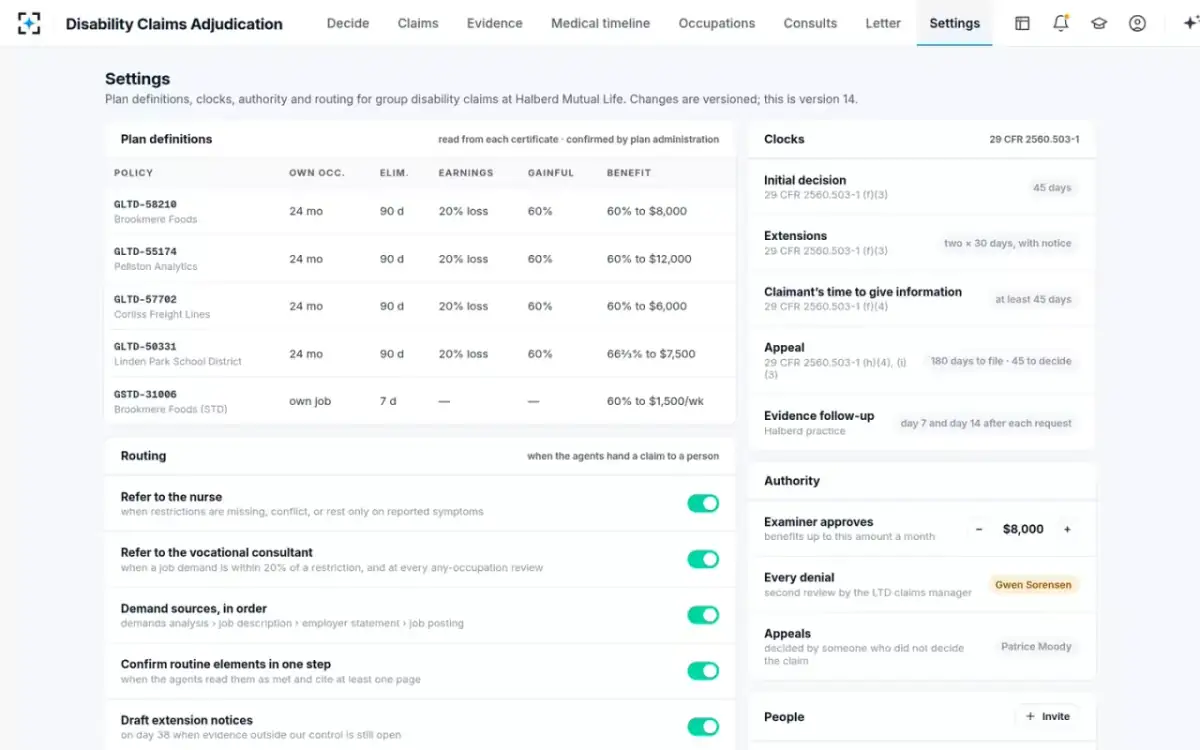
The sample setup drafts an extension notice on day 38 when evidence outside the plan's control is still open, leaving a week for the examiner to review and send it. A countdown that pauses whenever a document is "pending" will mis-state the deadline for every claim waiting on a doctor, because a doctor's delay tolls nothing.
The scale disability case management software serves
39,135
plans reporting temporary disability benefits, covering 40.1 million participants
Form 5500 Schedule A, 2014 data
26,171
plans reporting long-term disability benefits, covering 22.4 million participants
Form 5500 Schedule A, 2014 data
44%
of private industry workers had access to short-term disability plans
BLS, March 2026
37%
had access to long-term disability plans
BLS, March 2026
How do disability claim systems handle documents?
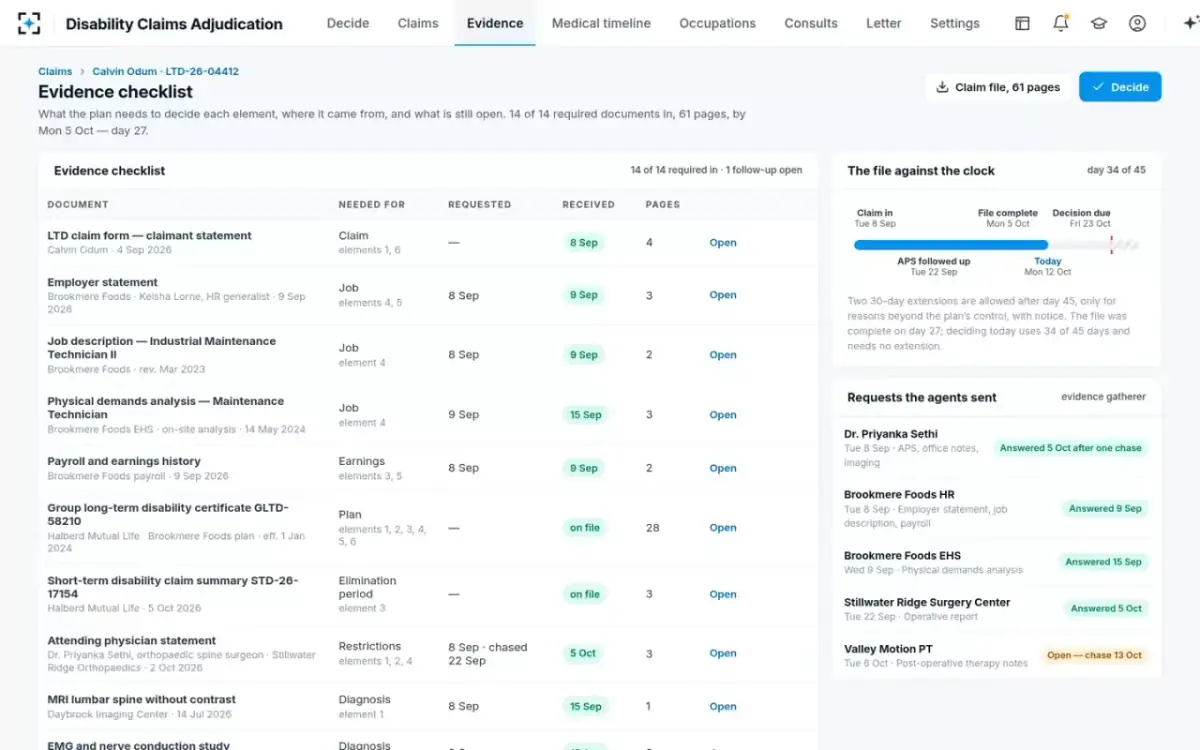
Most file them by type and date, which is the problem: the examiner needs them by element. A 61-page claim file, as in the sample claim, is easy to store and slow to use if the lifting restriction on page 2 of the surgeon's statement has to be found again by every reader. The useful unit is the cited fact: a restriction, a job demand, a plan provision, each pointing to its document and page, each tied to the element it serves.
Two rules shape document handling. Requests to doctors run on the claimant's authorization, which under HIPAA must describe the information, the recipient, the purpose and an expiration date or event (45 CFR 164.508(c)), so the system should know what each authorization allows before anything is requested. And the claimant may obtain, free, every document "submitted, considered, or generated in the course of making the benefit determination" (29 CFR 2560.503-1(m)(8)), so whatever the software generates should be producible.
One document's path through the systems, from fax to decision
Agent
RequestThe evidence gatherer asks Dr. Sethi’s office for the APS, notes and imaging on 8 September, within the signed authorization, and chases on 22 September.
Never: Asks for anything the authorization does not cover.
Agent
Receive and fileThe statement arrives on 5 October and is filed against the elements it serves: sickness or injury, physician care, own occupation.
Agent
ReadThe medical record reader lifts each restriction with its date range and page, and adds it to the medical timeline.
Never: Infers a restriction the doctor did not write.
Agent
MatchThe job demands analyst draws the job’s 50 lb against the 10 lb restriction, citing the demands analysis and the APS.
A person decides
DecideThe examiner checks both pages and decides own occupation: not able, recorded with two sources.
The evidence checklist: every document, the element it serves, and the clock
Where evidence goes missing between systems
Most errors in a disability file are not misreadings of one document; they are facts that sit in one system and never reach the decision made in another. Six recur, and each is a test to run on a vendor's demonstration.
Conflicting job documents. The employer's 2024 physical demands analysis for the sample claimant says 50 pounds occasionally; a 2025 job posting in the employer statement says "lift up to 75 lbs". A system that keeps only the latest document picks the posting; the sample setup ranks sources (demands analysis, then job description, employer statement, posting) and flags the conflict for a person. Restrictions that expire. The surgeon's limits run "until re-evaluation 11/13"; if the end date stays in the medical records system and never reaches the claim system's diary, nobody asks again. The STD claim behind the LTD claim. On the sample plans the STD claim summary is the evidence that the 90-day elimination period was served; it lives in a different claim, often a different product line.
A Social Security reimbursement agreement. Whether the benefit is reduced by an estimated Social Security award depends on a signed agreement that may sit in the correspondence system, not the payment system; the sample claimant signed one on 24 September, so no estimated offset was taken. The claimant's county. Whether a denial needs a language notice depends on where the claimant lives, which is an address field, not a document. Superseded statements. A second attending physician statement can arrive after a first, and a file sorted by type shows two answers without saying which is current. Each of these is caught by tying every fact to its source and date, not by adding another system.
What integrations does disability software need?
Read access to every system that holds evidence, write access to as few as possible. The claim system needs to receive the decision and the letter; the other five only need to be read. The checklist below is what to confirm before a pilot, so that the first weeks are spent on decisions rather than on connections.
Integration questions for disability case management software
- Claim system
Can it read receipt date, claim type and plan, and write back the decision and letter without re-keying?
- Fax and portal
Are inbound documents matched to the right claim automatically, and outbound requests logged with dates?
- Authorizations
Does it know what each signed authorization allows before it requests records?
- Certificates
Are plan definitions read from each certificate and confirmed by plan administration, with the page?
- Employer data
Can it take job descriptions, demands analyses and payroll in the formats employers actually send?
- Occupation and wage data
Which source sets job demands for the any-occupation test, and what year are its wages?
- Claimant’s county
Does it know when a letter needs the language notice? The rule ties it to the claimant’s county.
- The trail
Is every agent step and human decision kept with sources and producible to the claimant?
What is the difference between claims and case management software?
Claims software decides and pays; case management software manages the person and the claim over time. For STD the two are close, because most claims close in weeks. For LTD they separate: after approval, the claim needs re-evaluations as restrictions change, a check at the end of the own-occupation period, and Social Security awards and offsets. The sample claim already carries the next steps: a re-evaluation with the surgeon on 13 November and an own-occupation period that ends on 3 October 2028.
Disability Claims Adjudication is aimed at the decision: the initial STD or LTD claim, built and read against the plan, with an early look at the any-occupation question so the vocational work does not start from scratch two years later. It feeds the case management that follows rather than replacing it.
Plans, clocks and authority as settings, every change versioned
Where Disability Claims Adjudication fits in the stack
It sits between the evidence systems and the claim system of record. It reads the claim system for receipt dates and plan, sends standard requests through fax and portal within the claimant's authorization, reads medical records, employer documents, certificates and occupational data, and writes back a decided set of elements and a signed letter. It never pays, never sends a letter without the examiner's signature and never contacts a doctor beyond a standard request. Its reading of one restriction, from the form to the letter, is traced in the attending physician statement form guide; the trust a team needs before relying on it is the subject of claims adjudication systems examiners trust.
Questions people ask
Do we need to replace our claim system to use agents?
No. The decision of record, payments and correspondence stay in the claim system. Agents need read access to the systems that hold evidence and a way to write back the decided elements and the letter.
Which claims count as disability claims for the 45-day clock?
Any claim where the adjudicator must decide whether the claimant is disabled, whatever the plan calls the benefit, according to the Department of Labor. A benefit that depends on a disability finding made by someone else, such as Social Security, is not treated as a disability claim under the rule.
Does disability case management software need to be HIPAA compliant?
For disability income coverage the carrier is outside HIPAA's definition of a health plan, but the doctors it requests records from are covered entities and release them only under a valid authorization. State insurance privacy and data-security law governs the carrier's own handling.
What data does the any-occupation test need?
The claimant's restrictions, skills from the job file, the plan's gainful wage (60 percent of indexed earnings on the sample plan, $18.84 an hour for the sample claimant) and occupational data on demands and regional wages. In the sample, three of seven occupations that use the claimant's skills stayed open.
How long does it take to connect the systems?
It depends on how many of the six are already reachable. A pilot can start on closed claims exported from the claim system with their documents, before any live connection, which is also the safest way to measure accuracy.