The disability claims process for a group short- or long-term disability plan has seven steps: the claim is filed, the elimination period runs, the evidence is requested and chased, it is read, the job is set against the restrictions, the plan's definition is decided element by element, and the letter goes out. For an ERISA plan the Department of Labor's rule gives the plan 45 days from receipt to send a denial, with two 30-day extensions for matters beyond its control. Almost all of the cost sits in the middle steps, where examiners and nurses read and chase documents. Botminds' Disability Claims Adjudication puts agents on those steps: they gather and read the file and lay the definition out as elements, so the examiner's time goes on the decision.
The prices below use public rates: the Bureau of Labor Statistics' wage and compensation-cost surveys and the Department of Labor's own regulatory impact analysis of the 2016 disability rule. The hours per step are our estimate for an LTD decision on the solution's sample desk, with fictional people and claims; replace them with yours.
The disability claims process: seven steps, who does each, and the clock
| Step | Who does it | What it needs | The clock |
|---|---|---|---|
| 1. The claim is filed | Claimant, employer, treating doctor | Claimant statement, employer statement, authorization to release records | The 45 days start on receipt, complete or not |
| 2. The elimination period runs | Nobody: it is a waiting period | Proof the disability began and continued (90 days on the sample LTD plan, 7 on the STD plan) | Benefits start the day after it ends |
| 3. Evidence is requested and chased | Examiner or agent | Attending physician statement, records, imaging, job description, demands analysis, payroll | Follow-ups on day 7 and 14 on the sample desk |
| 4. The file is read | Examiner; nurse when restrictions are unclear | Every restriction with its author, date and page | Usually the longest working step |
| 5. The job is set against the restrictions | Examiner; vocational consultant when close | Each job demand with amount and frequency | Before the decision |
| 6. The definition is decided | Examiner; second reviewer for denials | Each element of the policy definition, with sources | Denial notice by day 45, or an extension notice before it |
| 7. The letter goes out | Examiner signs | Reasons, plan provisions, rights, appeal time, language notice where required | Appeal: 180 days to file, 45 days to decide |
What are the steps in a disability claim?
The steps are set by the policy and the federal rule together. The policy decides what has to be proved: on the sample LTD certificate, six elements, from sickness or injury and a physician's regular care to the 90-day elimination period, the occupation test, a 20 percent loss of indexed earnings and no exclusion. The rule decides how fast and how openly: the plan must notify a denial "within a reasonable period of time, but not later than 45 days after receipt of the claim" (29 CFR 2560.503-1(f)(3)), and the letter must give specific reasons, cite the plan provisions and, for disability, explain any disagreement with the claimant's doctors, the plan's experts and Social Security.
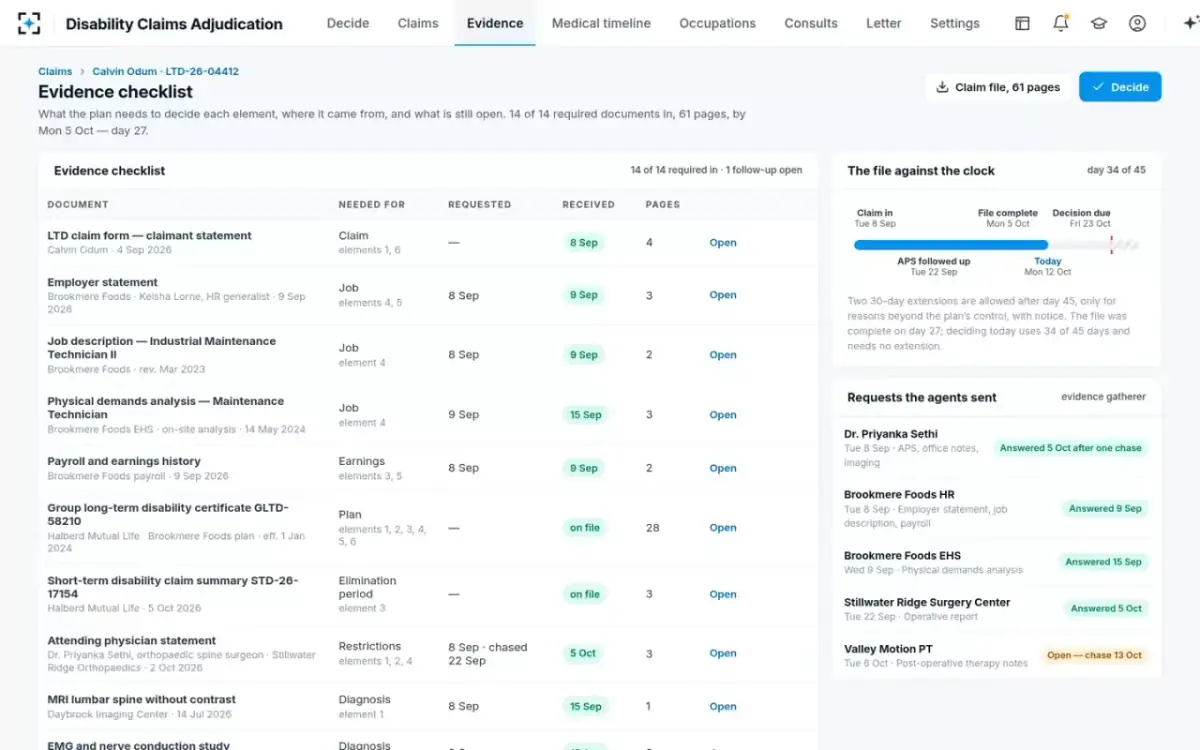
Between the claim and the letter, the work is evidence. The claim form and employer statement arrive first; the attending physician statement, office notes, imaging and operative reports come from doctors' offices; the job description, a physical demands analysis if one exists, and payroll come from the employer; the certificate is the plan's. In the sample claim, 14 documents, 61 pages, came from five parties.
What documents are needed for a disability claim?
For a group LTD claim the examiner typically needs the claimant's statement, the employer's statement with the job title, hours and last day worked, the treating doctor's attending physician statement with restrictions, the medical records behind it, the job description or a physical demands analysis, earnings history, and the group certificate. STD claims need the same core documents with less depth. The attending physician statement form is the one that decides most claims, and the one most often late.
How long does a disability claim take?
The initial decision on an ERISA disability claim must be made within 45 days of receipt if it is a denial, and up to 105 days with both extensions. The extensions are not routine: each requires that the plan "determines that such an extension is necessary due to matters beyond the control of the plan" and tells the claimant before the current period ends, naming "the unresolved issues that prevent a decision on the claim, and the additional information needed to resolve those issues", with at least 45 days for the claimant to provide it (29 CFR 2560.503-1(f)(3)). If the hold-up is something the claimant has not sent, the clock stops from the extension notice until the claimant responds.
The disability claims process against its 45-day clock
- Decide or extend45 days
- 1st extension+30
- 2nd extension+30
- Evidence inday 27
- Decided on day 34+7
What is the elimination period?
The elimination period is the stretch of continuous disability before benefits become payable: 90 days on the sample LTD plan and 7 days on the sample STD plan. It runs from the date the disability began, not from the date the claim is filed, so a claim can be decided before it ends. Calvin Odum, the fictional claimant in the sample, was first seen on 5 July; his 90 days ended on 3 October and his benefit began on 4 October, eight days before his claim was decided.
The length of the period changes behaviour, not just the payout date. A study of about 10,000 policies at one large LTD insurer found that workers were significantly more likely to claim when the benefit replaced more of their pay and when the elimination period was shorter (Autor, Duggan and Gruber, NBER, 2012), which is why LTD rates move with both. The data are from a single insurer, but the direction is what an examiner sees: longer elimination periods screen out short disabilities before they become LTD claims.
How much does it cost to process a disability claim?
No regulator or independent study measures it, so it has to be built. The Department of Labor itself wrote that it "does not have sufficient data on the number of disability claims that are filed or denied" (81 FR 92316), but in costing its 2016 rule it priced several parts of the work, and those prices are a useful floor.
The Department of Labor's own prices for parts of a disability claim (2016)
The examiner is the largest cost, and BLS gives the inputs. The median wage for claims adjusters, examiners and investigators was $78,000 a year in May 2025 (BLS), about $37.50 an hour over 2,080 hours. For full-time private industry workers in June 2026, wages and salaries were 68.5 percent of employers' compensation costs (BLS, Employer Costs for Employee Compensation), which puts the examiner's hour at about $54.74 with benefits. That excludes office space, systems and management.
The cost of one LTD decision, built term by term
Examiner time
7.5 h × $54.74
Our estimate of hours per initial LTD decision on the sample desk; the loaded rate from BLS wage and compensation-cost data.
Claims operations
Nurse review
0.4 × 1 h × $46.02
Assumes 4 in 10 claims need a nurse review of about an hour, at the Department of Labor’s 2016 rate.
Medical review
Vocational review
0.3 × 1.5 h × $54.74
Assumes 3 in 10 LTD claims need a vocational review; priced at the examiner rate for want of a public rate.
Vocational
Physician consult and letter
0.1 × 1 h × $157.80 + $23.19
One claim in ten sent to a physician consultant; preparing and mailing the letter at the Department of Labor’s 2016 figures.
Medical review
Where the cost of one LTD decision goes, by step
Which steps move the cost?
Reading and chasing move it most: on the model, 44 percent of the cost of a decision is the examiner finding, requesting and reading documents, and only 4 percent is the examiner deciding. Two levers follow. The first is to take the finding and reading off the examiner without taking away the check: an agent can lift each restriction with its page, but the examiner still reads the cited pages before she relies on them. The second is to chase earlier and more precisely, because a late attending physician statement costs an extension notice, a second chase and often a second read of a file that has gone cold.
On our estimate, agents that read and cite take the examiner's hours per decision from about 7.5 to about 3.2: reading 2.7 to 0.8, chasing 1.2 to 0.3, job and benefit work 1.0 to 0.3, letter 1.2 to 0.5, calls 1.0 to 0.9, and deciding unchanged at 0.4. Consultants' time does not fall, and should not: nurse and vocational reviews are where judgement is added. That is about $235 less examiner cost per decision on the model. It is an estimate, not a measured result; the way to test it is on your own closed claims, as the adoption plan for claims adjudication systems describes.
Every document the plan needs, against the clock
How are long term disability claims decided?
Element by element. The examiner tests each part of the policy's definition of disability against the evidence and decides whether it is met. In the sample claim, five elements were routine and were confirmed in one step, each with at least one cited page: the MRI for sickness or injury, office notes for physician care, the STD claim summary for the elimination period, payroll for the earnings loss and the certificate for exclusions. The sixth, whether Calvin could do the material and substantial duties of his own occupation, needed judgement: his job required 50 pounds occasionally and his surgeon allowed 10, and five of eight demands exceeded his restrictions.
The decision is then reviewed according to its consequences. On the sample desk the examiner approves benefits up to $8,000 a month on her own authority; every denial and every larger benefit goes to the LTD claims manager. The approval letter states the benefit, $3,265.60 a month from 4 October, the reasons in plain words, the restrictions and demands relied on, why no Social Security offset is taken, the right to copies, 180 days to appeal and the language notice.
The decision letter, every reason tied to its page

The cost of getting the process wrong
The cheapest decision is the one that holds. By the Department of Labor's own account in 2016, long-term disability claims are the largest share of ERISA benefits lawsuits, and its rewrite of the disability claims rules was a response to them (81 FR 92316). And a plan that does not "strictly adhere to all the requirements" of the claims rule on a disability claim loses its internal appeal: the claimant is deemed to have exhausted the plan's remedies and may sue at once (29 CFR 2560.503-1(l)(2)).
Those risks are priced per claim in legal fees and reversals, which no public source totals. What a process can control is whether every decision carries its reasons and their sources. That is the part of the cost model the step "deciding" understates: four percent of the hours, and almost all of the exposure. The ERISA appeals process for disability covers what happens when a decision is challenged.
Questions people ask
How long does a long term disability claim take to process?
Under the ERISA claims rule, a denial must be sent within 45 days of receipt, or up to 105 days if the plan takes both 30-day extensions for matters beyond its control. In the sample claim, the attending physician statement took 27 days to arrive after one chase, and the decision took one sitting a week later.
Do I get paid during the elimination period?
Not from the LTD plan: benefits are payable only after it ends. Where the employer also offers STD, as in the sample, the STD plan pays during those weeks, and its claim summary becomes the evidence that the elimination period was served.
What is the most common reason a disability claim is delayed?
On the sample desk, a missing or incomplete attending physician statement. The doctor's office is outside the plan's control, so a late statement can justify an extension, but the plan must send the notice before day 45 and name exactly what is missing.
How many disability claims are denied?
There is no public count for private plans. In its 2016 cost estimate the Department of Labor assumed LTD denials at Social Security's 75 percent denial rate and said that proxy "may overstate" private-plan denials, because plans often apply a less strict standard than Social Security. Treat any single denial rate you see quoted with care.
Who decides a disability claim?
A claim examiner at the insurer or administrator, within authority limits, with nurse and vocational consultants advising and a manager reviewing denials and large benefits. On appeal, the rule requires a different decision-maker who is not the first one's subordinate.
Can the 45-day clock be paused?
Only for information the claimant has to provide. If the plan extends because the claimant has not sent something, the period is tolled from the extension notice until the claimant responds. Waiting on a doctor or employer does not stop the clock.