Group long term disability rates are calculated as a monthly rate per $100 of covered payroll. The carrier sets a rate for each age band, or one composite rate for the group, from the plan design (the share of earnings replaced, the monthly maximum, the elimination period, the definition of disability) and the group's industry, size and claims history. Each employee's monthly earnings, up to the cap the maximum benefit implies, are divided by 100 and multiplied by the rate for their age. The premium is the sum. Because the inputs are birth dates and earnings, the employee census is half of the price, which is why Botminds' Group Census & RFP Intake Automation checks every birth date and salary on a broker's census before rating applies a single rate.
The arithmetic is public wherever a public employer publishes its rates. The State of Tennessee's 2026 long-term disability chart for its own employees prints the formula and a worked example: an annual salary of $35,000 is covered monthly salary of $2,916.67, or 29.17 hundreds; at the age 45 to 49 rate of $0.22 per $100, the monthly premium is $6.42 (State of Tennessee, 2026 monthly premiums for long-term disability). The rest of this page works through each input, then prices three census errors on the same table.
The long term disability premium, step by step
| Step | Formula | Tennessee’s example | Comes from |
|---|---|---|---|
| 1. Covered monthly earnings | Annual earnings ÷ 12, up to the cap | $35,000 ÷ 12 = $2,916.67 (cap $12,500 at 60%) | Census: salary and pay basis |
| 2. Hundreds of covered payroll | Covered monthly earnings ÷ 100 | 29.17 | Arithmetic |
| 3. Rate per $100 | Rate for the age band and plan design | $0.22 at ages 45 to 49, 60% / 90 days | Census: birth date; rating manual |
| 4. Monthly premium | Hundreds × rate, summed over employees | 29.17 × $0.22 = $6.42 | Rating |
What is a rate per $100 of covered payroll?
It is the price of long term disability cover for each $100 of an employee's monthly earnings that the plan insures. "Covered" is the important word: earnings above the level at which the maximum benefit is reached buy nothing, so they are not rated. Tennessee's chart caps them for its 60% options at "Average monthly earnings (not to exceed $12,500)", which at 60% is a $7,500 maximum benefit; for Option 4, at 63%, the cap is $15,873.02, which works out to a $10,000 maximum.
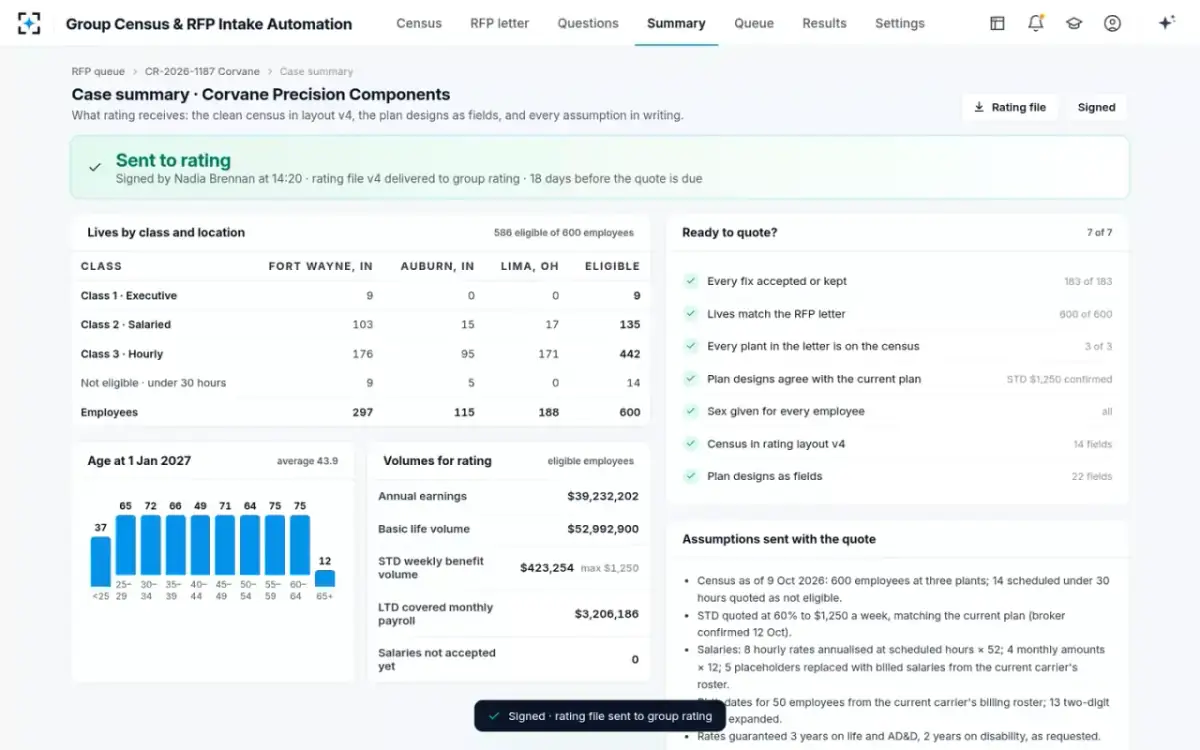
Covered payroll is therefore a census calculation, not a payroll total. In Group Census & RFP Intake Automation's fictional sample case, a 600-employee manufacturer asking for 60% to $10,000 a month, the case summary sent to rating showed annual earnings of $39,232,202 for 586 eligible employees and long-term disability covered monthly payroll of $3,206,186. The second is smaller than one-twelfth of the first because earnings above the cap are not insured. A salary column with hourly rates or $1 placeholders in it makes both numbers wrong.
Why does age affect group LTD rates?
Because the expected cost of disability claims rises with age, until the plan's own end age cuts benefit periods short. Tennessee's 2026 table shows the curve plainly: on its 60% / 90-day option, the rate per $100 is $0.06 under 30, $0.22 at 45 to 49 and $0.42 at 60 to 64, seven times the youngest band. Then it falls, to $0.28 at 65 to 69 and at 70 and over.
Long term disability rates rise sevenfold with age, then fall
The fall after 64 is an age-discrimination rule at work, not a quirk. The EEOC's rule under the Age Discrimination in Employment Act lets a plan contain the cost of older disablements by shortening how long benefits last rather than cutting their level, and it names a pattern that passes: benefits that stop at 65 for disabilities starting at 60 or younger, and five years after disablement for those starting later (29 CFR 1625.10; what to look for in long term disability insurance quotes it and compares schedules). A shorter benefit period is a cheaper one. Every age-banded rate therefore depends on an accurate age at the effective date, and an age is only as good as the birth date on the census.
How does the elimination period change LTD cost?
A longer elimination period, the wait before benefits start, lowers the rate, and a higher replacement percentage raises it. Tennessee's four options isolate both. Moving from a 90-day to a 180-day wait at 60% cuts the age 45 to 49 rate from $0.22 to $0.17, about 23% cheaper; moving from 60% to 63% at 90 days raises it from $0.22 to $0.27.
One plan, four designs: what the design does to the rate
| Option | Benefit / elimination period | Rate at 45–49 | Rate at 60–64 |
|---|---|---|---|
| Option 1 | 60% / 90 days | $0.22 | $0.42 |
| Option 2 | 60% / 180 days | $0.17 | $0.33 |
| Option 3 (offline agencies, employee-paid) | 63% / 90 days | $0.27 | $0.52 |
| Option 4 | 63% / 180 days | $0.21 | $0.41 |
Research on claiming behaviour explains why. A study of one large long-term disability insurer's data by Autor, Duggan and Gruber found that "a higher replacement rate and a shorter waiting time to benefits receipt--also known as the Elimination Period or EP--significantly increase the likelihood that workers claim LTD" (NBER Working Paper 18172, 2012). That is the reason the plan design in the RFP letter matters as much as the census: a letter that says 90 days where the current plan has 180, or $1,000 where it has $1,250, is a different product at a different price.
What else moves an LTD rate: design, offsets, occupation and experience
Beyond age and design, carriers rate the group's industry and occupations, its size and how much weight its own claims history can carry, the definition of disability (how long the own-occupation period lasts before an any-occupation test), limits on mental and nervous or self-reported conditions, and the offsets that reduce benefits when other income starts. Offsets are why bidders ask what else the group's employees are entitled to. On Clark County, Washington's 2023 RFP, a bidder asked: "For LTD offsets, does the group participate in a PERS program? If so, do they also participate in SSDI?" (Clark County RFP 868 questions and answers).
Those are underwriting judgements, and none of them is in the census. What is in the census, ages and covered earnings, is multiplied by every one of them. Long term disability is a thin-premium line: in June 2026, private employers' long-term disability costs averaged $0.05 per hour worked across all private industry workers, against $3.48 for health insurance (BLS, Employer Costs for Employee Compensation, June 2026). On a thin premium, a misstated census is a large share of the margin.
One composite rate, or a rate for every age band?
Both are common, and Tennessee's chart carries both. Employee-paid options are age-banded, so each employee pays for their own age. The employer-paid version of Option 3 for central state government and higher education is a single rate for every age, $0.278 per $100, and its worked example shows the employer premium for the $35,000 employee as $0.278 × 29.17 = $8.11 a month. A composite rate is an average of the banded rates, weighted by the group's covered payroll in each band, so it is just as dependent on the census; the error simply spreads across everyone instead of landing on one row. The arithmetic is worked line by line in age banded rates vs composite rates.
What one wrong census field costs
Price three common census errors on Tennessee's Option 1 rates and its $12,500 cap. This is an illustration on a public rate table, not anyone's quote, and the employees are from the fictional sample census or, for the third, an example built for the arithmetic.
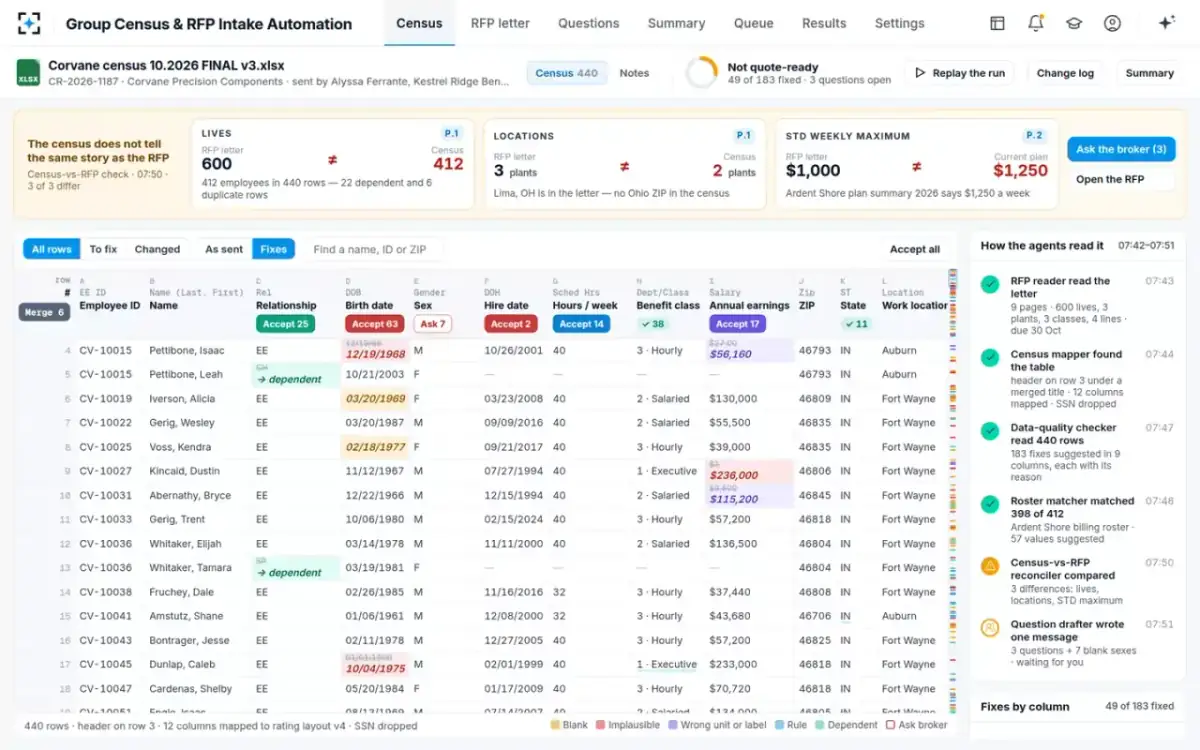
A $1 salary placeholder for an executive. The sample census sent $1 for an executive born in 1967 whose billed salary was $236,000. At 59 on a 1 January 2027 effective date, the rate is $0.32. Covered earnings are capped at $12,500 a month: 125 × $0.32 = $40.00 a month, $480 a year. As sent, the row priced at almost nothing.An hourly rate in the salary column. The sample's $27.00 row, for an hourly employee aged 58, priced on $2.25 a month of covered earnings instead of $4,680: $14.98 a month against less than a cent, about $180 a year. A placeholder birth date. A 42-year-old earning $60,000 has $5,000 of covered monthly earnings: 50 × $0.17 = $8.50 a month. Typed in as 01/01/1900, the same person is 127 and falls in the 70-and-over band at $0.28: $14.00 a month, $66 a year too much.
What three census errors misprice, per employee per year
The amounts look small per row, and that is the trap. The sample census had five $1 placeholders and twelve hourly or monthly amounts in its salary column, and 63 problem birth dates, in a file of 412 employees. None of those rows would fail a format check. How to separate the checks that catch them from the ones that do not is the subject of census data cleaning.
A missing plant changes the mix, not just the count
The largest census error is the one with no cell. In the sample case the broker's file left out a plant of 188 employees, 171 of them hourly. Without it, hourly employees were 68% of the eligible group; with it, 75%. Any rate built on the incomplete file prices a group with a different occupational, age and earnings mix from the one the employer will enrol, and the missing location, if it is priced later, usually comes in at a rate of its own. The reconciler found the gap by comparing the letter's three plants with the two that had ZIP codes on the file.
The census as sent, with every cell that would break the rating
The rate guarantee keeps the error
Group RFPs usually ask for rates guaranteed for a period, and the sample letter asked for two years on disability and three on life. A guaranteed rate that was computed on a misstated census carries the misstatement for the whole guarantee, which is why the bars above double the per-row figures. An underpriced group stays underpriced until renewal; an overpriced one is the quote that loses the case.
An LTD rate is a number per $100 of covered payroll for an age. The census supplies the payroll and the age. Check those two columns and you have checked half the price.
Price the census before you price the case
Rating engines are good at applying a manual to a clean file; they cannot tell a $27.00 salary from a $27,000 one. In Group Census & RFP Intake Automation, the data-quality checker flags every salary below a floor the carrier sets ($10,000 in the sample settings), annualises hourly and monthly pay with the working shown, and offers billed salaries from the current carrier's roster for placeholders. Birth dates get the same treatment. The underwriter accepts the fixes, and rating receives covered payroll, ages at the effective date and every assumption in writing.
The market this matters in is large. The Department of Labor counted, from 2014 Form 5500 Schedule A filings, 26,171 plans providing long-term disability benefits to 22.4 million participants (DOL, Federal Register, December 2016), and in March 2026, 37% of private industry workers had access to long-term disability cover (BLS).
What rating receives: covered payroll and ages, checked
Questions people ask
How are long term disability premiums calculated for one employee?
Take the employee's monthly earnings up to the plan's cap, divide by 100, and multiply by the rate for their age band. On Tennessee's 2026 chart, a $35,000 salary is $2,916.67 a month; 29.17 × $0.22 at ages 45 to 49 gives $6.42 a month. On a composite rate the same arithmetic uses one rate for everyone.
Is LTD premium based on gross salary?
It is based on the plan's definition of earnings, often base salary before deductions, capped at the earnings the maximum benefit insures. Tennessee's 2025 chart defined average monthly earnings as "Base annual salary divided by 12" (State of Tennessee, 2025). Whether bonuses or commissions count depends on the policy's definition, which is why the census should state the pay basis.
Why is LTD cheaper at 65 to 69 than at 60 to 64?
Because benefits for older disablements are paid for a shorter time. The EEOC's ADEA rule accepts benefits ending at 65 for disabilities that start at 60 or younger and five years after disablement for those after 60, so expected benefit periods, and costs, shrink after 64.
What is a typical group LTD rate?
There is no published market average. Public employers' rate sheets show the range for their own plans: Tennessee's 2026 Option 1 runs from $0.06 to $0.42 per $100 by age, and its employer-paid composite is $0.278. Industry, design and claims history move a private employer's rate well outside any one public plan's.
What happens if the census salary is wrong?
Covered payroll is wrong, so the premium is wrong for every month of the rate guarantee, and for life lines the benefit volume is wrong too. A $1 placeholder underprices a capped executive by $480 a year on Tennessee's 2026 Option 1 rates; an hourly rate read as a salary underprices the sample's 58-year-old by about $180. Find the pay basis before rating, from the hours column or a billed salary.
How does a higher benefit percentage change the rate?
It raises it. On Tennessee's 2026 chart, moving from 60% to 63% with the same 90-day wait raises the age 45 to 49 rate from $0.22 to $0.27 per $100, and research on one large insurer's claims found that higher replacement rates raise the likelihood that workers claim.