An employee census template for a group life or disability quote is a spreadsheet with one row per eligible employee and about a dozen columns: an employee ID, date of birth, sex, date of hire, scheduled hours, status on the effective date, class, annual earnings and pay basis, work ZIP, state and location, and current coverage amounts. Dependents go on a separate sheet if dependent life is quoted. What makes a template work is not the column list but knowing, for each column, which payroll or HR record it comes from and which check it must pass before it leaves the employer. Carriers that use Botminds' Group Census & RFP Intake Automation accept any layout, but a census built to the map below needs far fewer questions back.
The map below is for employers and brokers preparing a census, and for carriers' sales-support teams deciding what to ask for. It follows the columns carriers actually request in public RFPs, and it explains the checks with the rules behind them: age bands, earnings definitions, eligibility hours and data protection.
The employee census, field by field: source and check
| Field | Where it comes from | Check before sending |
|---|---|---|
| Employee ID | HR system’s employee number | One row per ID; the same ID the current carrier bills on |
| Date of birth | HR master data | Full date with a four-digit year; no placeholders such as 01/01/1900 |
| Sex | HR master data | No blanks: a blank comes back as a question, not a guess |
| Date of hire | HR master data | Not after the effective date; rehire date if the plan uses it |
| Scheduled hours a week | Payroll schedule or position data | The scheduled figure, not last month’s worked hours |
| Status on the effective date | Leave records, disability claims, payroll status | Active, on leave, on STD or LTD, not eligible |
| Class | Job code or pay grade, mapped to the letter’s classes | Every row in a class the RFP letter defines; a legend for codes |
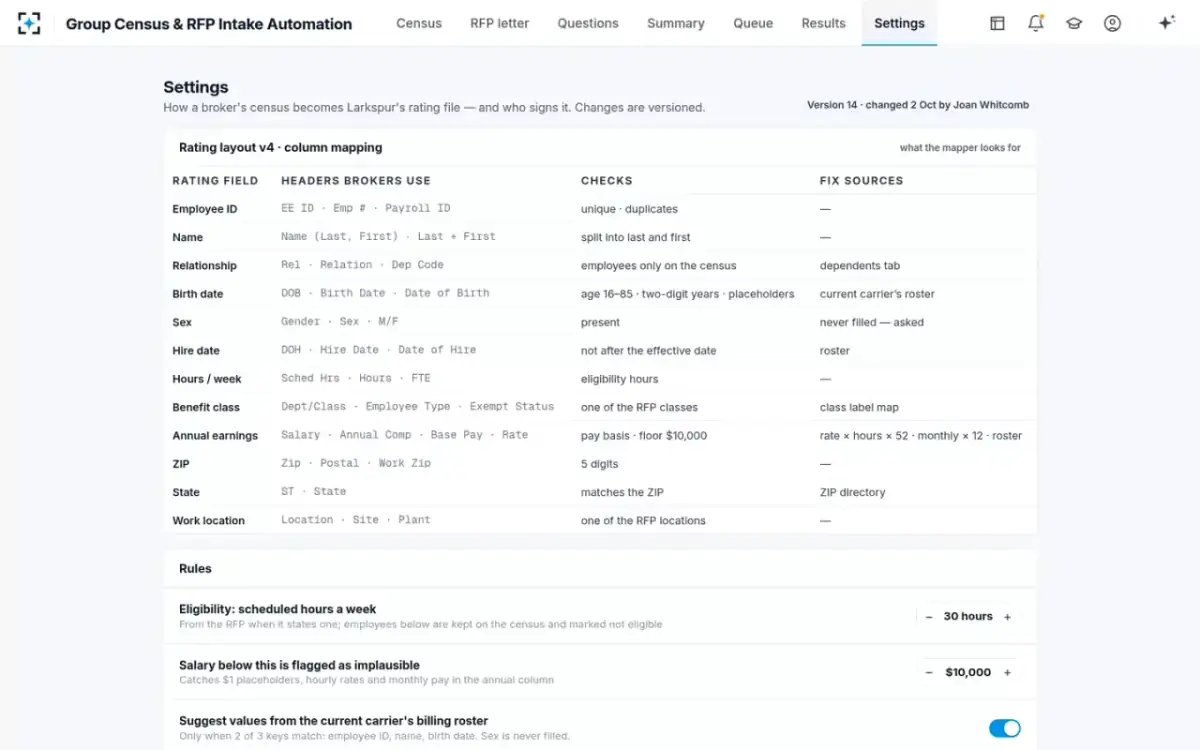
| Annual earnings and pay basis | Payroll: base rate and frequency | One basis; hourly rates annualised at scheduled hours × 52 |
| Work ZIP, state and location | Position or cost-centre data | Every location in the letter appears; state matches ZIP |
| Current coverage amounts | The current carrier’s bill or enrolment file | Per line; matches the plan’s formula, such as 2× earnings |
What should an employee census include?
Every field that sets the price or the eligibility, for every employee the RFP letter describes, and nothing that only identifies a person. Public employers' RFPs, which publish bidders' questions, show the core list. Bidders on the City of Providence's 2024 life insurance RFP asked for "a census file that includes: date of birth, gender, annual salary, active/retired/disabled status, coverage amount (and/or a multiple of salary), date of retirement and descriptions of abbreviations in any of the provided fields" (City of Providence, RFP questions and answers). Add class, hours and location for a multi-class, multi-site employer, and the list is the table above.
Two things are as important as the columns: the census date and the scope. State the date the data was extracted, because a census ages, and confirm that the file covers every location and class in the letter. In Group Census & RFP Intake Automation's fictional sample case, the case summary sent to rating opened with "Census as of 9 Oct 2026: 600 employees at three plants" after the broker supplied a missing plant's file.
Is there a standard employee census template?
Not one that every carrier uses. Each group carrier rates from its own layout, brokers have their own request forms, and employers' payroll systems export in their own formats. What is standard is the content: the same dozen fields recur in every public RFP's questions, under different headers. The practical standard, then, is a column specification like the one below, with a legend for every code and a stated basis for every amount.
Employee census template for Excel, column by column
CV-10015Stable employer ID; never an SSN12/19/1968Full date, four-digit yearMAs held by the employer; never left blank10/26/2001Full date40NumberActiveActive, leave, STD, LTD, not eligible3One of the classes the RFP letter defines56,160Annual amount on the plan’s earnings basisHourly 27.00Salary, hourly with rate, or commission46793Five digitsINTwo letters, matching the ZIPAuburnOne of the locations the letter names50,000Per line, where cover exists todayWhat earnings should go on a disability census?
The earnings the policy insures, on one stated basis: often base annual salary before deductions, with bonuses, overtime and commissions in or out as the plan's definition says. Disability premiums are priced per $100 of covered monthly earnings, so the earnings column is half the price. Tennessee's state long-term disability chart defined the figure plainly for 2025: average monthly earnings are "Base annual salary divided by 12" (State of Tennessee, 2025 long-term disability premiums), capped at $12,500 a month for its 60% options in 2026 as in 2025 (2026 chart). For life cover the basis can be rounded: Indiana's basic life was billed on "(Annual salary rounded up to the nearest $1,000 / 1,000) X bi-weekly rate" (Indiana RFP 19-112).
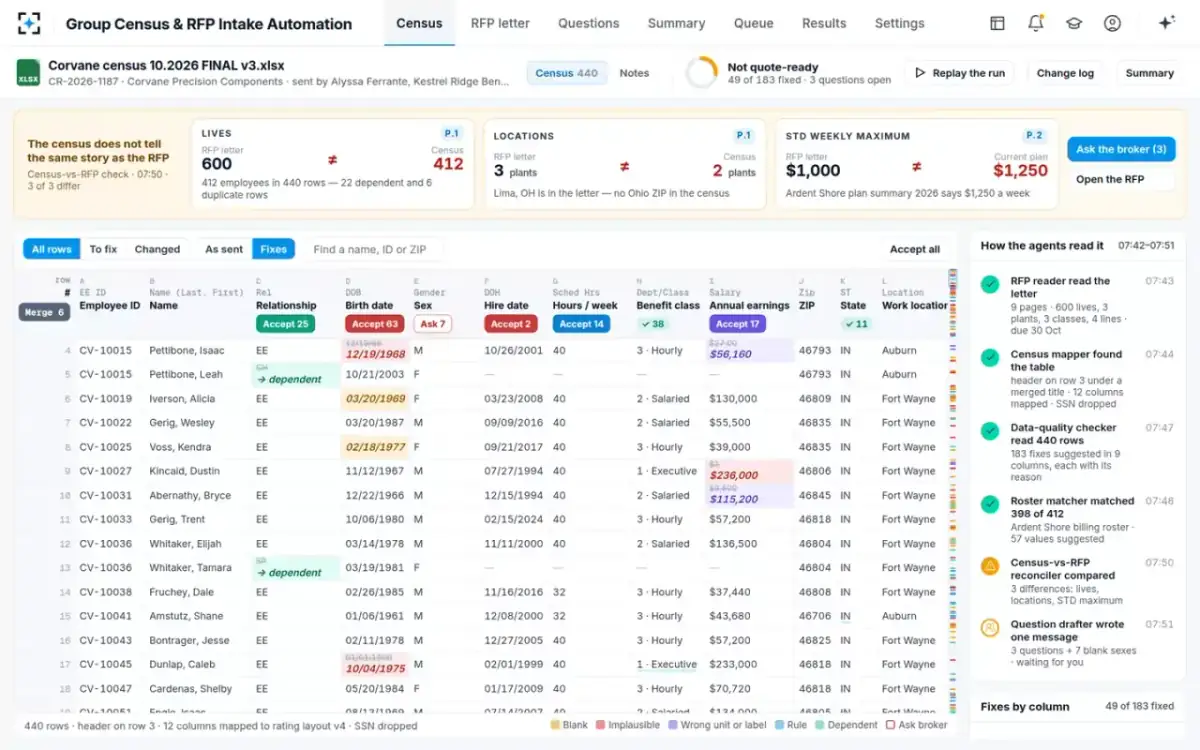
Hourly employees cause the most errors. A payroll export often puts the hourly rate in the salary column, so the template should carry the pay basis next to the amount, and the annual figure should be the rate times scheduled hours times 52. In the sample census, a $27.00 hourly rate typed as annual salary became $56,160 once annualised at 40 hours; seventeen salary cells changed in all. How much a wrong earnings figure moves a premium is priced in how long term disability rates are calculated.
The four columns that cause most questions
As exported from payroll: 12/19/68, or 01/01/1900 where the field was empty.
As the template asks: 12/19/1968: a full date, and a blank left blank with a note, never a placeholder.
As exported from payroll: 27.00 in the salary column, beside salaried employees’ annual figures.
As the template asks: 56,160 annual, with “Hourly 27.00” in the pay basis column.
As exported from payroll: The employer’s department codes, five different labels for three classes.
As the template asks: The letter’s class number, with a legend for any code the employer keeps.
As exported from payroll: Spouses and children on the employee sheet under the employee’s ID.
As the template asks: Employees only; dependents on their own sheet if dependent cover is quoted.
How should employee classes be listed?
By the classes the RFP letter defines, one class per row, with a legend if the employer's own codes are kept alongside. The letter is the specification: if it says Class 1 is officers and executives, Class 2 all other salaried employees and Class 3 all hourly employees, each row should carry 1, 2 or 3. Employers' department and grade codes do not map themselves.
Public RFPs show what happens otherwise. Indiana's 2019 census used codes such as "JUD10K" and "Basic Life TaxSaver" that bidders had to ask about; the answers were a class of senior judges with a $7,500 benefit and a pre-tax deduction status (Indiana RFP 19-112). On Clark County, Washington's 2023 RFP, the census showed 40 employees electing a buy-up their classes were not offered, and the county had to clarify the plan (Clark County RFP 868; quoted in group benefits underwriting). A legend and a class column that matches the letter remove both questions.
Do you need SSN on an employee census?
No. No group life or disability rate depends on a Social Security number, and leaving it out keeps the file out of the most sensitive category of personal data under state insurance data-security law. Use a stable employee ID instead, the same one the current carrier bills on, so that missing values can be matched to the billing roster and questions can name rows. Carriers that use the solution drop SSN columns on arrival in any case. What a census can safely leave out, and why a blinded census still identifies people, is covered in what is a blinded employee census.
Any layout, mapped to the carrier’s rating fields
What is a census for group life insurance?
It is the same census with the life-specific fields in focus: date of birth for the age bands, the benefit formula's input (earnings for a multiple-of-salary benefit, or the class for a flat amount), and current coverage amounts, which let the carrier compare the volume it is quoting with what the employer has today. Age matters twice. Rates are set by age band, and amounts above $50,000 of employer-provided group-term cover are taxed to the employee as wages (IRS Publication 15-B, 2026), valued on the IRS's table in five-year age brackets (26 CFR 1.79-3); the imputed income calculator shows the arithmetic.
Voluntary cover adds two needs. The census should carry each employee's current elected amount, because volume above the guaranteed issue limit needs evidence of insurability: in the sample letter, voluntary term life ran to $500,000 in $10,000 units with $150,000 guaranteed issue. And if spouse cover is quoted, the dependents sheet needs whatever age the contract prices it on. That is a contract term, not a convention: the federal employees' program prices its family option by the employee's age band, not the spouse's (OPM, FEGLI premiums).
Hours matter too, and the number to send is the scheduled one. A group policy's eligibility rule is a plan term, such as the sample letter's "30 hours per week", and it is not the same test as the Affordable Care Act's, under which a full-time employee is one "employed an average of at least 30 hours of service per week" measured over months (26 CFR 54.4980H-1). Send scheduled hours and let the carrier apply the letter's wording.
A census template is not a list of headers. It is a list of sources: for every column, the system it comes from and the check it passed before it left the employer.
Why do carriers reject a census?
Rarely for format; mostly because it does not describe the group in the letter, or leaves a rating factor blank. The common reasons: fewer lives than the letter states, a location or class missing, dependents or retirees mixed in with employees, codes without a legend, blank birth dates or sexes, and earnings on mixed bases. Clark County's 2023 census, for example, listed retirees although "retirees are not eligible for life insurance or LTD", and Providence's 2024 census showed no lives in a class for which a certificate was supplied.
In the solution's fictional sample season, 38% of censuses, 82 of 214, did not match their RFP letter on lives, locations or plan design, and the most common difference was fewer lives than the letter. A carrier using the solution does not reject those files; the agents find the difference on arrival and the underwriter sends one message asking for what is missing, as described in the RFP intake process.
A census the carrier received, read against its letter on arrival
Before you send it: the census checklist
Employers and brokers who run these checks before the census leaves send a file that needs no questions back. For a carrier's sales-support team, the same list is what the first message to a broker should ask about.
Ten checks before an employee census goes to carriers
- One row per eligible employee, dependents on their own sheet
Retirees and terminated employees out unless the plan covers them.
- Lives, locations and classes match the RFP letter
Count them; a whole missing site passes every cell-level check.
- A stable employee ID on every row, and no SSNs
The same ID the current carrier bills on.
- Full dates of birth with four-digit years
No placeholders; blanks explained.
- Sex on every row
A blank comes back from the carrier as a question.
- Earnings annual and on one basis, with the pay basis stated
Hourly annualised at scheduled hours × 52.
- Scheduled hours, not hours worked last month
The letter’s eligibility wording decides who is in.
- Status on the effective date
Who is on leave, disability or otherwise not at work.
- A legend for every code
Classes, statuses, plans, deduction codes.
- The census date stated
The extract date, so later changes can be reconciled.
Questions people ask
What format should an employee census template use?
A single spreadsheet sheet, one header row, one row per employee, with dates as full dates and amounts as numbers. Avoid merged title rows, hidden tabs and separate sheets per location unless the carrier asks; each is a step someone has to undo before rating.
Should part-time employees be on the census?
Include everyone the eligibility wording might reach, with their scheduled hours, and let the carrier apply the letter. In the sample case, 14 employees scheduled 20 to 28 hours a week were on the file and were confirmed with the broker as not eligible under the 30-hour wording.
Should retirees be on the census?
Only if the plan covers them, and then on a separate sheet or with a status code. Clark County's 2023 census included retirees for a plan that does not cover them, and a bidder had to ask.
How many columns does an employee census need?
About twelve for group life and disability: ID, birth date, sex, hire date, hours, status, class, earnings, pay basis, ZIP, state and location, plus current amounts per line where cover exists. More columns rarely help; missing ones cost a round trip to the broker.
How current does the census need to be?
As close to the quote as the payroll cycle allows, with the extract date stated. Indiana's 2019 bidders found the census-based life volume differed from the prior year's exhibit by more than half a billion dollars of cover; the state's explanation was that the census was based on 2019 data and summed only enrolled employees' salaries.