Age banded rates vs composite rates is a choice between two ways of billing the same group premium. With age banded rates, each employee is charged the rate for their age band, usually five years wide, times their coverage. With a composite rate, the carrier works out the total premium the same way and then divides it by the total coverage, so everyone pays one rate. At the start of the rate period both produce the same total; they differ in who pays what and in how a wrong birth date on the census spreads. Botminds' Group Census & RFP Intake Automation checks every birth date on a broker's census against a second source before either rate is built, because both rest on it.
The worked example on this page uses ten employees and the published age-banded rates of the federal government's own group life program, the Federal Employees' Group Life Insurance Option B, at its 2021 employee rates (OPM, FEGLI premiums). The two oldest employees are a fifth of the group and pay two-thirds of its premium.
The oldest fifth of the group pays two-thirds of the premium
Share of the ten employees
- Under 50 · 60%
- 50–59 · 20%
- 60–64 · 20%
Share of the monthly premium
- Under 50 · 11.9%
- 50–59 · 22.1%
- 60–64 · 66%
What are age banded rates?
Age banded rates are a table of rates, one per age band, applied to each employee's coverage. Group life and disability tables usually use five-year bands, and the rate climbs steeply after 50. FEGLI's Option B, the additional life cover federal employees buy for themselves, charges $0.043 a month per $1,000 under 40, $0.130 at 45 to 49, $0.390 at 55 to 59 and $0.867 at 60 to 64. Tennessee's long-term disability plan for its state employees does the same per $100 of covered salary, from $0.06 under 30 to $0.42 at 60 to 64 in 2026 (State of Tennessee).
A public age-banded life table: FEGLI Option B, per $1,000 a month
What is a composite rate in group insurance?
A composite rate is one rate for every member of the group, whatever their age: a single price per $1,000 of life cover or per $100 of covered payroll. The same federal program shows it. FEGLI's Basic insurance costs employees "$.1600 (16 cents)" per $1,000 every two weeks "FOR ALL AGES", while Option B is age banded. Tennessee's employer-paid long-term disability option is a single $0.278 per $100 for all ages beside its age-banded employee-paid options, and the State of Indiana's group life RFP in 2019 showed basic life and AD&D at "$0.113 per $1,000 of salary" bi-weekly for everyone, against supplemental life priced by age band (Indiana RFP 19-112).
The pattern is common: employer-paid basic cover on a composite, employee-paid supplemental cover age banded. A composite is easy to administer and to explain to employees. Age banding is fairer to the young when employees pay, because under a composite they subsidise older colleagues.
How do you calculate a composite rate?
Price each employee on the age-banded table, add up the premium, and divide by the total coverage. The table below does it for ten employees with life cover of two times salary. The total is $404.39 a month on 1,322 thousands of cover, so the composite rate is $404.39 ÷ 1,322 = $0.306 per $1,000 a month.
Ten employees, one census: the banded premium and the composite
| Employee (age) | Cover (2× salary) | Band rate per $1,000 | Banded premium | At the $0.306 composite |
|---|---|---|---|---|
| A (26) | $90,000 | $0.043 | $3.87 | $27.53 |
| B (31) | $104,000 | $0.043 | $4.47 | $31.81 |
| C (37) | $122,000 | $0.043 | $5.25 | $37.32 |
| D (41) | $116,000 | $0.065 | $7.54 | $35.48 |
| E (44) | $150,000 | $0.065 | $9.75 | $45.88 |
| F (48) | $132,000 | $0.130 | $17.16 | $40.38 |
| G (52) | $160,000 | $0.217 | $34.72 | $48.94 |
| H (57) | $140,000 | $0.390 | $54.60 | $42.83 |
| I (61) | $180,000 | $0.867 | $156.06 | $55.06 |
| J (63) | $128,000 | $0.867 | $110.98 | $39.15 |
| Group | $1,322,000 | $404.39 | $404.39 |
In practice carriers compute the composite on the carrier's own manual rates for the group's industry, size and plan design, often with an adjustment for the group's claims experience, and the census supplies the ages and volumes in every band. A composite quoted for a three-year rate guarantee stays fixed for those three years even as the group ages, so the composite also builds in an assumption about how the age mix will move.
Why do life insurance rates go up in five year bands?
Because mortality rises with age, and because two federal rules work in five-year steps. The Age Discrimination in Employment Act lets employers reduce benefits for older workers only as far as cost justifies, and the EEOC's rule says "Cost comparisons and adjustments under section 4(f)(2) may be made on the basis of age brackets of up to 5 years" (29 CFR 1625.10). The IRS values employer-provided group-term life cover above $50,000 with a table "computed on the basis of 5-year age brackets", from $0.05 per $1,000 a month under 25 to $2.06 at 70 and above (26 CFR 1.79-3, Table I). That value is reported as wages: the cost of employer-provided cover above $50,000 goes on the employee's W-2 (IRS Publication 15-B, 2026), which the group term life imputed income calculator works through.
Five-year bands are a compromise between precision and administration. One-year bands would price each birthday; ten-year bands would leave a 54-year-old and a 45-year-old on one rate. The census has to place each person in the right band, which is why a two-digit birth year or a placeholder date is not a formatting nuisance but a pricing error.
Composite and age-banded rates are the same premium cut two ways. The cut decides who pays; the census decides how big the premium is.
Which is cheaper, age banded or composite rates?
At the start of the rate period neither: the group's total premium is the same by construction. What differs is who pays and what happens next. In the example, employee A pays $3.87 a month on banded rates and $27.53 on the composite, while employee I pays $156.06 banded and $55.06 composite. Where employees pay, a composite moves cost from older to younger staff; where the employer pays, the split only matters for budgeting by department.
Over time they diverge. Banded premiums rise as employees cross into older bands and fall as older employees leave; a composite fixed for a guarantee period does neither until renewal. A group that hires young after the quote pays more on a composite than its banded premium would have been, and a group that ages pays less. The carrier prices that expectation into the composite, from the census's age mix.
What happens over a three-year rate guarantee
The group ages, and the two methods treat that differently. Hold the ten employees, their pay and the FEGLI Option B table fixed, and move everyone a year older each year. The banded premium rises from $404.39 a month to $414.14 in the second year, as employee E turns 45 and moves into the next band, and to $447.77 in the third, as F reaches 50 and J reaches 65. By the fourth year it is $544.92, 35% above the first, because three employees cross into higher bands at 40, 55 and 60 at once. A composite of $0.306 guaranteed for three years collects $404.39 every month of those three years.
The same ten employees, one year older each year: banded premium against a fixed composite
Real groups also hire and lose people, which pulls the other way, so a carrier pricing a composite projects the age mix over the guarantee from the census it has. That projection is only as good as the birth dates: a census that places three people in the wrong band today places them wrongly in every projected year. It is also why renewal can surprise an employer that has paid a flat composite: the rise the banded table would have shown gradually arrives at once.
How a census error moves each rate
Take the same ten employees and one keying error: employee I, aged 61, appears on the census with a birth year 30 years too late, so she is priced in the under-35 band. Her banded premium falls from $156.06 to $7.74 a month, and the group total from $404.39 to $256.07. Under age-banded billing, the error sits on one row, where an age check can find it. Under a composite, the same error drops the group rate from $0.306 to $0.194 per $1,000, 37% lower, and every employee's rate is wrong for the whole guarantee.
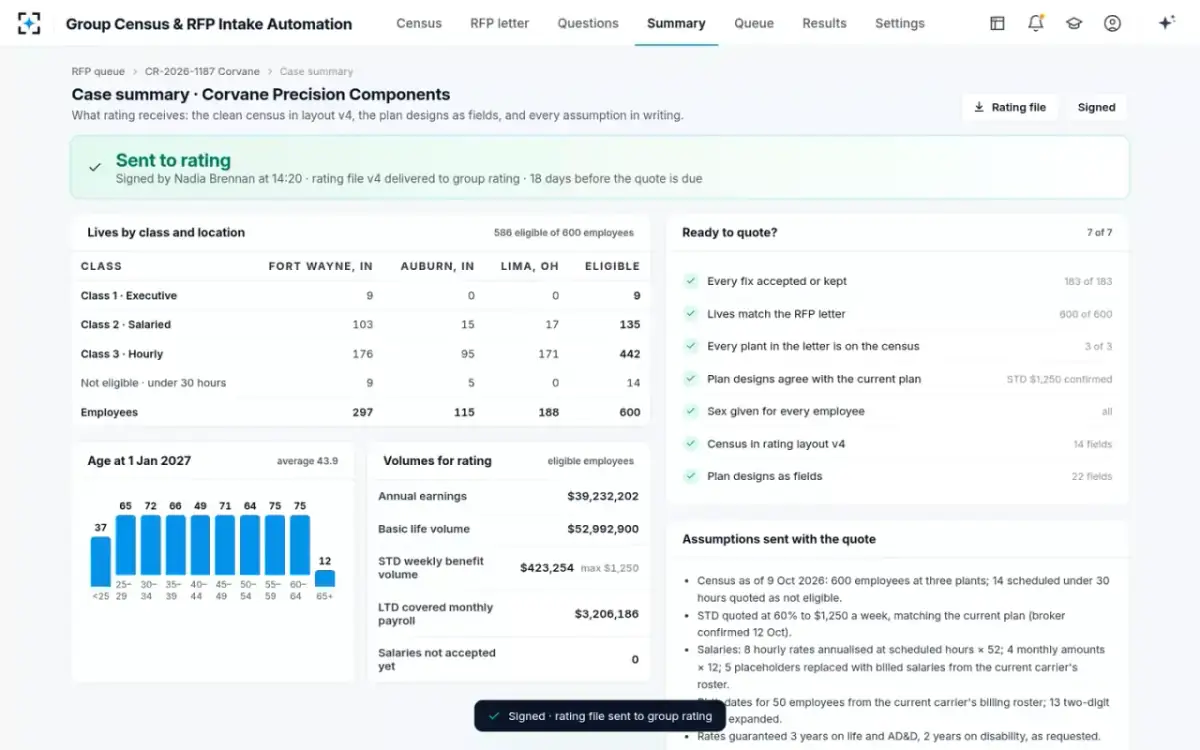
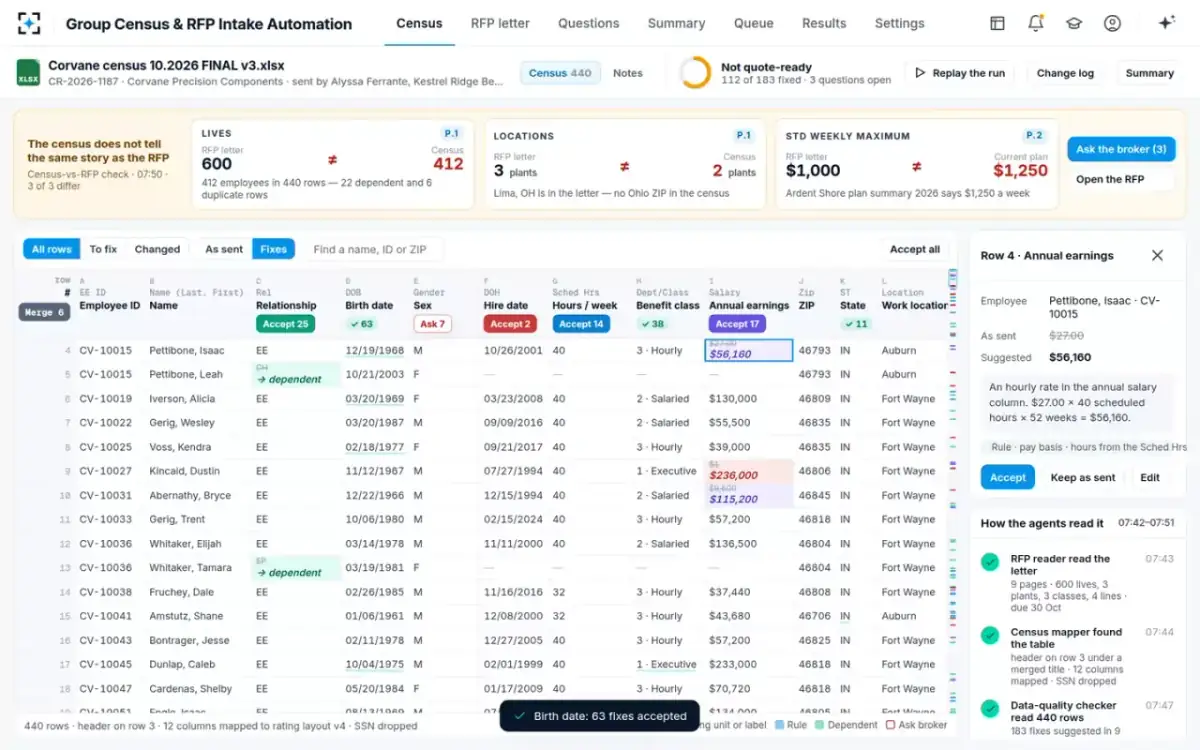
That is why the birth-date column carries the most fixes in census cleaning. In the fictional sample season of Group Census & RFP Intake Automation, birth dates were 24% of all suggested fixes; in the sample case, 63 birth dates were fixed before rating, 50 from the current carrier's billing roster when two of three keys matched and 13 two-digit years expanded. The checks behind those fixes are set out in census data cleaning.
Ages at the effective date, in five-year bands, as rating receives them
What age is used for age banded rates?
It depends on the rule or contract, and the census must carry a full birth date for any of them to work. The federal tax table, the small-group health rules and public employers' contracts each pick a different date.
Four rules for the age that sets the band
| Where | Age used | Source |
|---|---|---|
| IRS Table I, imputed income on group-term life | Attained age on the last day of the employee’s taxable year | 26 CFR 1.79-3(d)(2) |
| ACA small-group health rating | Age at the date of policy issuance or renewal | 45 CFR 147.102(a)(1)(iii) |
| City of Providence life plan, 2024 RFP | Age at 1 July of each year | City of Providence RFP answers |
| The sample case in Group Census & RFP Intake Automation | Age at the effective date, 1 January 2027 | Case summary (fictional) |
The bidders on Providence's 2024 life RFP asked exactly this: "What is the definition of age for the purpose of determining premium age bracket - end of plan year, 1st of each month, etc.?" The answer was "July 1st of each year" (City of Providence). An employee born on 15 July moves bands a year later under that rule than under a 1 January rule.
Are age banded rates legal?
Yes, for group life and disability, and the law cares mainly about benefits rather than rates. The ADEA lets employers reduce older workers' benefits only to the extent cost justifies, measured in brackets of up to five years; its rule gives the example that "higher group term life insurance costs for older workers would justify a corresponding reduction in the amount of group term life insurance coverage for older workers". Age-banded premiums that employees pay for voluntary cover are the cost itself, shown to them.
Small-group health insurance has its own federal rules. Under the Affordable Care Act's rating rule, rates may vary by age by no more than 3:1 for adults, in one-year bands from 21 to 63, and an issuer may offer a group "premiums that are based on average enrollee premium amounts" only if the total equals the per-member total (45 CFR 147.102). That is a composite by another name. How a census field such as actively-at-work status interacts with these rules for life cover is covered in the actively at work clause.
A column of birth dates, accepted with its sources
Questions people ask
How do age banded rates work?
The carrier publishes a rate for each age band, and each employee's premium is that rate times their coverage in thousands of dollars, or per $100 of covered payroll for disability. On FEGLI Option B, $100,000 of cover costs $4.30 a month under 40 and $86.70 at 60 to 64.
What does age banded insurance rates mean?
It means the price depends on which age band the insured person is in, usually five years wide. The rate changes when the person moves into the next band on the date the contract uses to measure age.
How do you convert age banded rates to a composite rate?
Multiply each employee's coverage by their band rate, add the results, and divide by total coverage. In the worked example, $404.39 of monthly premium on $1,322,000 of cover gives $0.306 per $1,000.
Do age banded rates change every year?
The table is usually fixed for the rate guarantee, but each employee's rate changes when they cross into a new band on the contract's age date. A composite stays the same for every employee until renewal.
Are age banded rates used for disability insurance too?
Yes. Long-term disability is often priced per $100 of covered monthly payroll by age band: Tennessee's 2026 state plan charges $0.06 under 30 and $0.42 at 60 to 64 on its 60% / 90-day option, and offers one employer-paid option at a single $0.278 for all ages. The same census errors move both.
Why do younger employees pay more under a composite rate?
Because the composite is an average weighted by coverage. In the example, a 26-year-old with $90,000 of cover pays $27.53 a month on the composite against $3.87 banded; the difference funds older colleagues' higher cost.